If you have ever searched for mathematical shapes and names, you probably wanted one simple thing: a clear list that explains what each shape is called, what it looks like, and how it is different from the shapes around it. This guide gives you exactly that. It organises mathematical shapes and names by dimension and by number of sides, so you can move from the simplest flat shapes to the solid shapes you meet in everyday life, from a dinner plate to a football, from a roofline to a dice cube. Whether you are a student revising for a test, a parent helping with homework, or simply a curious reader who wants to name the shapes in the world with confidence, this guide is written to be read from start to finish or dipped into whenever you need one name.
Shapes are the building blocks of geometry. A shape is a closed form made from lines, curves, or surfaces, and its name usually tells you something useful about it. The word triangle tells you there are three angles. A quadrilateral tells you there are four sides. A pentagon has five sides, a hexagon has six, and so on. Once you learn this naming pattern, a long list of mathematical shapes and names becomes much easier to remember, because the names themselves carry clues. In this guide we will look at flat shapes first, then at solid shapes, then at the special cases and curved forms that often cause confusion, such as the difference between a circle and a sphere, or between a square and a cube.
Before we begin, it helps to know two words that appear throughout this guide. A two-dimensional shape, often written as 2D, is flat: it has length and width but no depth. You can draw it on paper. A three-dimensional shape, or 3D shape, has length, width, and depth. You can hold it in your hand. Many flat shapes have a solid partner. A circle becomes a sphere. A square becomes a cube. A triangle can become a pyramid or a prism. Keeping that pairing in mind makes the whole world of mathematical shapes and names feel organised rather than random.
Mathematical Shapes and Names by Dimension
Sorting mathematical shapes and names by dimension is the fastest way to make sense of them. Flat shapes live on a surface. Solid shapes occupy space. This section explains both groups and shows how they connect, so that when you meet a new shape you can place it in the right family straight away.
Flat shapes you can draw on paper
Flat shapes are the ones most people learn first. A circle is a round shape in which every point on the edge is the same distance from the centre. An oval, or ellipse, is like a stretched circle, longer in one direction than the other. A triangle has three straight sides and three angles. A square has four equal sides and four right angles. A rectangle also has four right angles, but its opposite sides are equal while neighbouring sides may differ in length. A parallelogram has opposite sides parallel and equal, but its angles are not necessarily right angles. A trapezium has at least one pair of parallel sides. A rhombus has four equal sides with opposite sides parallel, like a slanted square. A kite has two pairs of adjacent equal sides. Each of these names describes a precise set of properties, and learning the properties matters more than memorising the list, because properties are what let you tell similar shapes apart.
Polygons deserve special attention because they form such a large family. A polygon is a flat shape made only from straight sides that join up to form a closed loop. Triangles, squares, pentagons, hexagons, heptagons, octagons, nonagons, and decagons are all polygons. The names follow a counting pattern drawn from Greek number words: three, four, five, six, seven, eight, nine, and ten sides. A regular polygon has all sides and all angles equal, while an irregular polygon has sides or angles of different sizes. A shape can therefore be a pentagon, for example, without being a regular pentagon, and recognising that distinction is a useful step in geometry.
Solid shapes you can hold in your hand
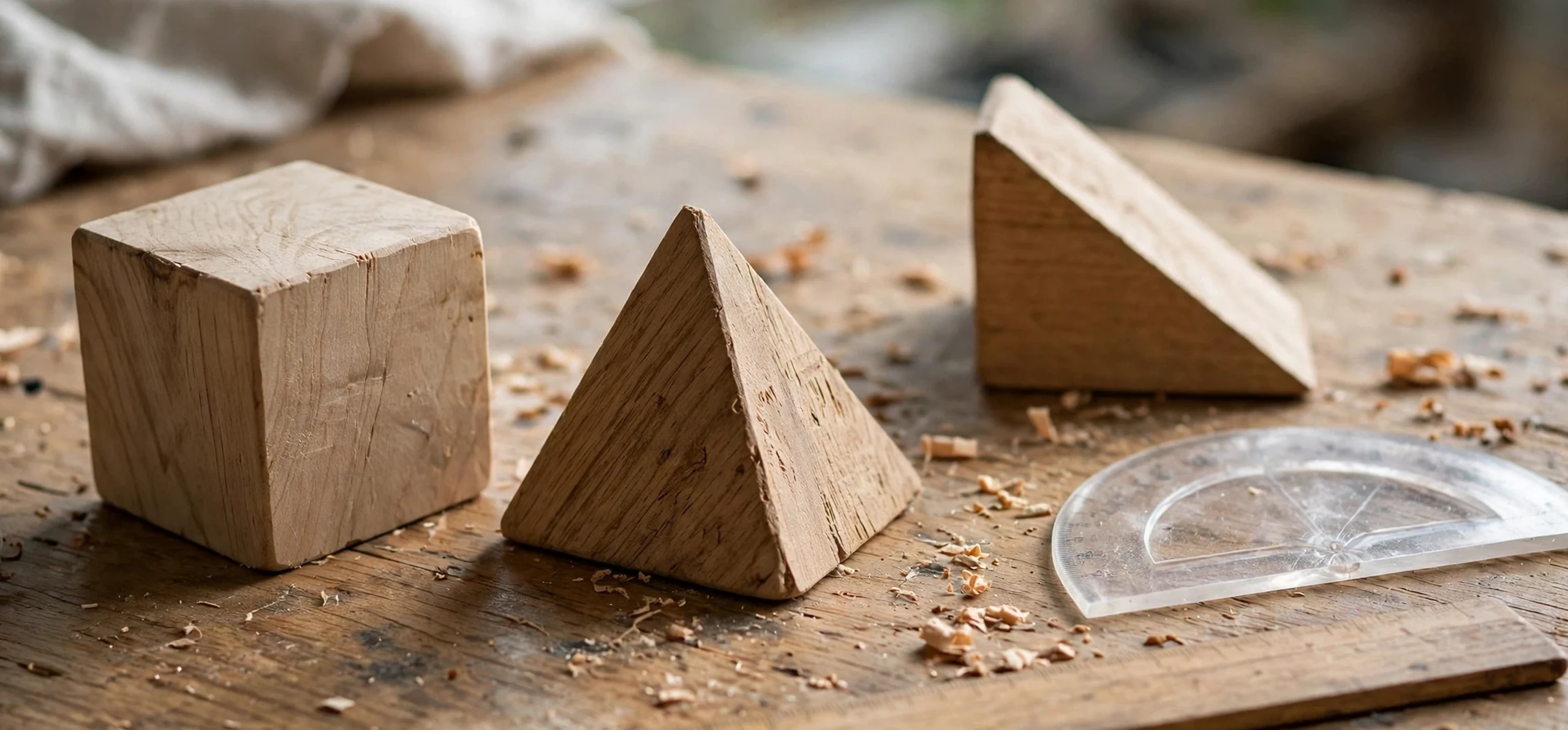
Solid shapes add depth to the flat shapes you already know. A sphere is perfectly round in every direction, like a ball. A cube has six square faces, twelve edges, and eight corners. A cuboid, sometimes called a rectangular prism, has six rectangular faces. A cylinder has two circular ends joined by a curved surface, like a drinks can. A cone has one circular base that tapers to a single point, like an ice cream cone. A pyramid has a polygon base and triangular faces that meet at a point at the top. A triangular prism has two triangular ends joined by three rectangles. A torus, the doughnut shape, is a ring with a hole through the middle. These solid forms appear everywhere in packaging, architecture, sport, and design, which is why their names are worth learning alongside the flat forms.
Faces, edges, and vertices are the three words used to describe solid shapes. A face is a flat or curved surface of the solid. An edge is the line where two faces meet. A vertex is a corner where edges meet. Counting these features is a classic classroom activity, and it is also a practical check: if you are not sure whether a shape is a cube or a cuboid, count and compare the faces. A cube has six identical square faces. A cuboid has rectangular faces, and opposite faces match. That small counting habit turns naming from guesswork into reasoning.
Mathematical Shapes and Names by Number of Sides
Counting sides is the most reliable way to name a polygon, and it is the reason this guide organises mathematical shapes and names by number of sides here. When you can count the sides and check whether they are equal, you can name almost any straight-sided flat shape you meet, even one you have never seen before.
Three sides and four sides
Three-sided shapes are all triangles, but triangles have their own family names. An equilateral triangle has three equal sides and three equal angles. An isosceles triangle has two equal sides and two equal angles. A scalene triangle has no equal sides and no equal angles. A right-angled triangle has one angle of ninety degrees. An acute triangle has all angles smaller than ninety degrees, while an obtuse triangle has one angle larger than ninety degrees. Notice that a triangle can carry two labels at once: it can be both right-angled and isosceles, for example. The labels describe different properties, so they combine rather than compete.
Four-sided shapes are called quadrilaterals, and this family is large. A square is the most regular member, with four equal sides and four right angles. A rectangle keeps the right angles but allows two different side lengths. A rhombus keeps equal sides but allows slanted angles. A parallelogram keeps opposite sides parallel and equal. A trapezium has at least one pair of parallel sides, and a kite has two pairs of adjacent sides equal. Drawing these shapes side by side is the best way to see how they relate. Many textbooks show them as a family tree, with the square sitting at the meeting point of the rectangle family and the rhombus family, because it satisfies both sets of rules at once.
Five sides and beyond
From five sides upward, the naming pattern is wonderfully steady. A pentagon has five sides, a hexagon six, a heptagon seven, an octagon eight, a nonagon nine, and a decagon ten. Beyond ten sides, names such as hendecagon for eleven sides and dodecagon for twelve sides appear, though they are less common in everyday use. A regular pentagon, like the shape of a home plate in baseball or the cross-section of some flowers, has equal sides and equal angles. A regular hexagon appears in honeycomb, in nuts and bolts, and in tiled floors, because hexagons fit together without gaps. A regular octagon is the familiar shape of a stop sign. These real-world examples make the names stick, because each name becomes attached to a picture in your memory.
It is worth pausing on the octagon, because it shows how a shape name travels from the classroom into daily life. Most people recognise a stop sign long before they learn the word octagon, and when the word arrives it simply labels something already familiar. The same is true of the pentagon, which many people know from government buildings, and the hexagon, which many know from board games and nature. Learning mathematical shapes and names is often less about meeting new shapes and more about giving names to shapes you already know.
Curved Shapes and Special Cases
Not every shape is made from straight lines. Circles, ellipses, and semicircles are curved shapes, and they have their own vocabulary. The centre of a circle is the point exactly in the middle. The radius is the distance from the centre to the edge. The diameter is the distance across the circle through the centre, exactly twice the radius. The circumference is the distance around the edge. A semicircle is half a circle, and a sector is a slice of a circle, like a slice of pie. An arc is part of the curved edge. These words are useful far beyond maths lessons: they appear in design, engineering, cooking, sport, and navigation.
Some shapes cause confusion because their names sound alike. A circle is flat; a sphere is solid. A square is flat; a cube is solid. A triangle is flat; a pyramid is solid. A rectangle is flat; a cuboid is solid. When you are unsure, ask yourself whether the shape could be drawn on paper or whether it would need to be built. Another common confusion is between an oval and an ellipse. In everyday speech the two words are often used interchangeably, but in maths an ellipse has a precise definition involving two focal points, while oval is a looser everyday word for an egg-like or stretched round shape. For most general purposes the difference does not matter, but it is good to know that one word is the technical term and the other is the everyday one.
Symmetry and angles help you check a name
Symmetry is a powerful checking tool. A shape has line symmetry if it can be folded along a line so that the two halves match exactly. A square has four lines of symmetry. A rectangle that is not a square has two. An equilateral triangle has three. A circle has infinitely many lines of symmetry, because any line through its centre divides it into matching halves. Rotational symmetry describes how a shape looks the same after being turned by some amount less than a full turn. Counting lines of symmetry is a quick way to test whether your identification of a shape is correct, and it is a favourite activity in school geometry for exactly that reason.
Angles provide another check. The angles inside a triangle always add up to 180 degrees. The angles inside any quadrilateral always add up to 360 degrees. In a regular polygon, dividing 360 degrees by the number of sides tells you the exterior angle at each corner. These rules mean you can often work out a missing angle or confirm a shape name with simple arithmetic, and readers who enjoy number patterns will find that this corner of geometry rewards a little calculation. If you want a gentler refresher on maths vocabulary, you may enjoy our explainers on what mean means in maths and the definition of mean in maths.
A Quick Reference Table of Shapes
The table below gathers the most useful mathematical shapes and names in one place. Use it as a revision sheet, a homework helper, or a quick check when you are naming a shape and want to be sure.
| Shape name | Dimension | Key features | Everyday example |
|---|---|---|---|
| Circle | 2D | All points on the edge are equally distant from the centre | A coin seen face on |
| Triangle | 2D | Three straight sides and three angles | A road warning sign |
| Square | 2D | Four equal sides and four right angles | A chessboard square |
| Rectangle | 2D | Four right angles, opposite sides equal | A book cover |
| Pentagon | 2D | Five straight sides | A home plate marker |
| Hexagon | 2D | Six straight sides | A honeycomb cell |
| Octagon | 2D | Eight straight sides | A stop sign |
| Sphere | 3D | Perfectly round in every direction | A football |
| Cube | 3D | Six square faces | A dice cube |
| Cylinder | 3D | Two circular ends and a curved side | A drinks can |
| Cone | 3D | One circular base tapering to a point | An ice cream cone |
| Pyramid | 3D | A polygon base with triangular faces meeting at a point | A famous ancient tomb shape |
How to Remember Shape Names
Revision guides on mathematical shapes and names work best when they are used actively, so try covering the table above and naming each shape from its description alone. If you can complete a quiz on mathematical shapes and names from clues such as six sides or six square faces, you have moved from recognising shapes to genuinely knowing them.
Memory works best when names are connected to pictures, stories, or patterns. For polygons, learn the counting roots in order: tri for three, quad for four, penta for five, hexa for six, hepta for seven, octa for eight, nona for nine, and deca for ten. Say the sequence aloud a few times and the pattern becomes a chant. For solid shapes, pair each solid with its flat partner: circle with sphere, square with cube, rectangle with cuboid, triangle with pyramid or prism. For curved shapes, practise the circle words as a set: centre, radius, diameter, circumference, arc, sector, semicircle. Small sets are easier to recall than long lists, and each set unlocks a whole family of questions.
Another good habit is naming shapes out loud as you walk around. The window may be a rectangle. The clock face may be a circle. The roof may be a triangular prism. The tin in the cupboard may be a cylinder. This habit turns revision into a game and builds the kind of instant recognition that tests and real life both reward. It also reveals how often shapes combine: a house outline is a square or rectangle topped by a triangle, a pencil is a hexagonal prism with a conical tip, and a tent is a triangular prism with a rectangular floor. Real objects are rarely a single textbook shape, and that is part of the fun.
Common mistakes to avoid
Three mistakes appear again and again. The first is calling every four-sided shape a square. A square is only a square when all four sides are equal and all four angles are right angles. The second is calling every round three-dimensional object a circle. A ball is a sphere; only its flat outline is a circle. The third is confusing a rhombus with a diamond. Diamond is an everyday word for a tilted square shape, but in maths the precise name is usually rhombus, and a rhombus does not need right angles. Avoiding these three mistakes alone will make your use of mathematical shapes and names noticeably more accurate.
Frequently Asked Questions
How many sides does a hexagon have?
A hexagon has six sides. The prefix hexa means six, so the name itself gives the answer. A regular hexagon has six equal sides and six equal angles, and it appears in honeycomb, in tiled patterns, and in the heads of many bolts.
What is the difference between a circle and a sphere?
A circle is a flat, two-dimensional shape, while a sphere is a solid, three-dimensional shape. You can draw a circle on paper, but a sphere, like a ball, has depth and can be held. Every cross-section through the centre of a sphere is a circle.
What makes a shape a polygon?
A polygon is a closed, flat shape made only from straight sides. Triangles, squares, pentagons, and hexagons are polygons. A circle is not a polygon, because its edge is curved rather than made of straight sides.
What is the easiest way to learn mathematical shapes and names?
Learn the counting prefixes for polygons, pair each flat shape with its solid partner, and name shapes in the world around you every day. Short, frequent practice beats one long session, and the table in this guide gives you a ready-made revision sheet to return to.
Conclusion
Learning mathematical shapes and names is really about learning to see the world with a little more precision. Once you know that a triangle has three sides, a quadrilateral four, a pentagon five, and a hexagon six, and once you can pair flat shapes with their solid partners, you can name almost any shape you meet. Keep the table above nearby, practise naming shapes in everyday objects, and return to the counting prefixes whenever a new polygon appears. Geometry becomes much friendlier when its vocabulary feels familiar, and familiarity grows every time you use a name correctly. If this guide helped you, share it with a student, a parent, or a friend who is also learning, and keep exploring the shapes hiding in plain sight all around you.



