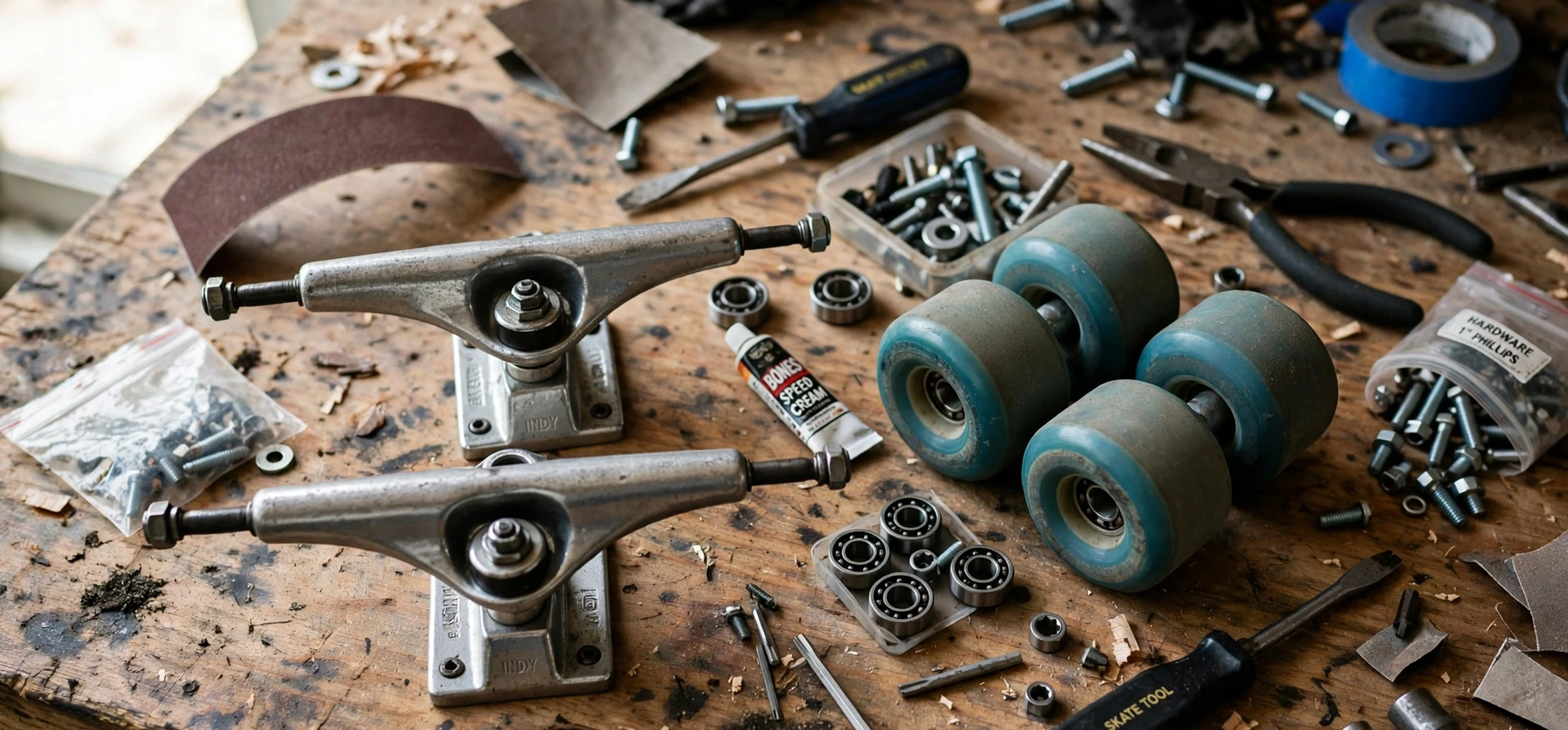
Most guides answer the question of truck sizes skateboard shoppers ask by pointing at a width chart, but your riding style is just as important as your deck width. A street skater who spends sessions on flat ground and ledges needs a different feel from a vert skater dropping into a large ramp, and a cruiser who rolls across town needs something different again. This guide looks at truck sizes skateboard choices through the lens of riding style, so you can choose trucks that suit how you actually skate, not just the number printed on your deck.
Width still matters, and nothing here replaces the basic rule of matching truck width closely to deck width. Style comes in after that baseline, shaping whether you sit at the narrower or wider end of the acceptable range, which truck height you choose, and how you set up your bushings. Think of deck width as the frame and riding style as the fine tuning: the frame keeps you in the right range, while style tells you where inside that range you will feel most at home.
It helps to be honest about where you spend most of your time. Many skaters ride a mix of street and park, and that is fine, but one style usually dominates. If eighty percent of your sessions are street, choose for street. If you split time evenly, choose a versatile all-round setup rather than a specialist one. Specialist trucks shine in their home terrain and can feel awkward elsewhere, while a balanced setup may not be perfect anywhere but will never hold you back badly. Start from your dominant style and adjust from there.
Truck Sizes Skateboard for Street Skating
Street skating rewards responsiveness, light weight, and precision. Sessions are built around flat-ground tricks, ledges, rails, and stairs, where quick turns, fast flicks, and controlled landings matter more than high-speed stability. Street skaters therefore tend to favour trucks at the narrower end of the acceptable range for their deck, paired with low or mid-height trucks and smaller wheels. A slightly narrower truck makes the board feel quicker underfoot, which helps with technical tricks that demand fast foot adjustments.
Street decks are usually in the 7.75 to 8.25 inch range, and trucks matched to those widths keep the setup agile without sacrificing landing stability. Low trucks are popular here because they lower the centre of gravity and make flip tricks feel closer to the ground, while mid-height trucks offer a little more clearance for slightly larger wheels if you also ride rougher street spots. Bushings in the medium range suit most street skaters, with softer bushings for those who like a looser, more surfy turn and harder bushings for those who want a locked-in feel on landings.
One street-specific consideration is grind clearance. Trucks that are too wide leave axle ends exposed, which can catch on rails and copings during grinds, while trucks matched to the deck keep the axle ends tucked near the deck edge. That small detail matters when you are learning fifty-fifties and boardslides, because a catching axle can throw off an otherwise clean trick. If you ride street most of the time, prioritise a close width match and a low-to-mid truck height, and let the board stay quick and predictable.
Truck Sizes Skateboard for Park Skating
Park skating sits between street and transition, mixing bowls, quarter pipes, banks, rails, and flat-ground areas in a single session. Park skaters need versatility above all: enough stability for carving a bowl, enough responsiveness for tricks on flat ground, and enough grind clearance for coping. That usually points to trucks in the middle of the acceptable range for the deck, with mid-height trucks that balance turning response and wheel clearance.
Park decks often run slightly wider than pure street decks, commonly around 8.0 to 8.5 inches, and trucks should follow that width. A mid-height truck is the safe default here because it handles the variety of park terrain without specialising too far in either direction. If your local park is mostly bowls and transition, lean toward the wider and higher end of your range for stability at speed. If it is mostly street-style obstacles, lean narrower and lower, closer to a street setup. The park is where compromise pays off, so avoid extremes unless you know your park demands them.
Bushings deserve attention in park skating because you will ask the trucks to do everything: deep carves in a bowl, quick turns on flat ground, and stable landings from airs. Medium bushings are the usual starting point, and many park skaters experiment with slightly softer bushings to make carving feel smoother. Give any bushing change a few sessions before judging it, because fresh bushings feel stiff until they break in, and a setup that feels wrong on day one may feel perfect by day five.
Truck Sizes Skateboard for Vert and Transition
Vert and transition skating place the highest demands on stability. Riders carry speed into large ramps, carve high on walls, and land airs with significant force, so the setup must feel planted and predictable at speed. Vert skaters therefore favour wider decks, often 8.5 inches and above, with trucks matched to that width at the wider end of the range, and high trucks that provide clearance for larger wheels. The extra width and height add stability exactly when it matters most.
Wheel size plays a bigger role in vert than in street, because larger wheels hold speed better on smooth ramp surfaces and roll over transitions more smoothly. High trucks accommodate those larger wheels without wheel bite, which is when a wheel contacts the deck during a hard turn and stops the board abruptly. Harder bushings are also common in vert setups, because they resist the deep, fast turns of ramp riding and keep the board from feeling loose at speed. The trade-off is reduced agility on flat ground, but vert skaters accept that happily in exchange for confidence on the ramp.
If you are moving from street or park into vert, resist the temptation to keep your old narrow setup and simply ride it faster. A wider deck and matched wider trucks will feel unfamiliar for a session or two, but the added stability quickly becomes reassuring, especially when you start carving higher and landing with more speed. Transition skating rewards setups built for the terrain, and the truck choice is a central part of that build.
Truck Sizes Skateboard for Cruising and Commuting
Cruising and commuting have a different brief entirely: comfort, smooth rolling, and the ability to handle rough pavement, cracks, and small debris without constant attention. Cruisers often ride wider decks with larger, softer wheels, and their trucks should match that width while sitting high enough to clear the wheels. Many cruiser setups use trucks at the wider end of the range, with softer bushings that make turning feel relaxed and flowing rather than sharp.
Because cruising involves long, steady pushes rather than tricks, stability matters more than flick speed. A slightly wider truck than you would choose for street can feel reassuring here, and it pairs naturally with the wider decks cruisers favour. Riser pads, small spacers between truck and deck, are also common on cruisers, because they add wheel clearance and reduce vibration on rough ground. If your commute includes hills, consider harder bushings for downhill stability, since a loose truck at speed can feel unnerving for a newer rider.
Cruisers should also think about weight and maintenance. A setup you push for kilometres every day benefits from durable trucks and regular checks: keep axle nuts snug, check bushings for wear, and replace worn pivot cups before they make the trucks feel sloppy. A comfortable cruiser is one you maintain, not just one you buy, and small upkeep habits keep the ride smooth for months.
Truck Sizes Skateboard by Style at a Glance
| Riding style | Typical deck width | Truck tendency | Height and bushings |
|---|---|---|---|
| Street | 7.75 to 8.25 inches | Narrower end of the matched range | Low to mid height, medium bushings |
| Park | 8.0 to 8.5 inches | Middle of the matched range | Mid height, medium bushings |
| Vert and transition | 8.5 inches and wider | Wider end of the matched range | High trucks, harder bushings |
| Cruising | 8.5 inches and wider | Wider end of the matched range | High trucks, softer bushings |
Use this table as a starting point, not a rulebook. Your height, weight, foot size, and personal taste all shift the ideal setup, and two skaters riding the same style can prefer noticeably different trucks. The table tells you where most riders in each style land; your own sessions tell you where you land. If you are choosing between two setups and cannot decide, borrow a friend’s board for a few minutes where possible, because feel is hard to judge from a chart alone.
Truck Sizes Skateboard for Mixed and Changing Styles
Styles change, and that is normal. A skater who starts on street may discover bowls, and a cruiser may catch the trick bug and move toward park. When your style shifts, revisit your truck choice rather than assuming your old setup still fits. The deck width rule still applies first, but the style tendencies above tell you which end of the range to favour next. Often a simple change of bushings or truck height is enough to adapt a setup, without buying new trucks at all.
Budget also shapes style choices. If you can only afford one setup, choose the versatile middle ground: a mid-width deck, mid-height trucks, and medium bushings, which will handle street, park, and light cruising without excelling at any one of them. That all-round setup is the best teacher, because it lets you discover which style you actually enjoy before you invest in specialist gear. For guidance on getting any new gear fitted comfortably, see this fitting guide, and for a broader view of sporting gear choices, this sports coverage page shows how different disciplines get covered.
Finally, remember that trucks last a long time when they are well matched and maintained. Buying for your real riding style, rather than for the style you wish you rode or the setup a professional rides, gives you a board that feels right from the first push. That feeling is what keeps you skating, session after session, and it is worth more than any single specification on a product page.
Truck Sizes Skateboard Recap: Style First, Chart Second
A good way to summarise this guide is to pair the two ideas it covers. The truck sizes skateboard chart gives you the acceptable width range for your deck, and your riding style tells you where to sit inside it. The truck sizes skateboard choice for a street skater will usually sit narrower and lower, while the truck sizes skateboard choice for a vert skater will usually sit wider and higher, even when both riders start from similar deck widths. Keep a note of the truck sizes skateboard combination that feels best for your dominant style, and revisit it whenever your skating changes, because the truck sizes skateboard setup that suited last year’s sessions may not suit this year’s terrain.
Truck Sizes Skateboard FAQ
Can one truck setup suit every riding style?
A mid-range setup can handle most styles adequately, but specialist styles like vert and cruising benefit from wider, higher trucks, while technical street benefits from narrower, lower trucks.
Should style matter more than deck width?
No. Deck width sets the acceptable range, and style tells you where inside that range to sit. Ignoring deck width entirely will produce a mismatched setup no matter how well it suits your style.
Do bushings change with riding style?
Yes. Softer bushings suit relaxed cruising and carving, medium bushings suit street and park, and harder bushings suit high-speed vert and transition riding.
What if my riding style changes over time?
Revisit your setup when it does. Often a bushing or height change is enough, but a major shift, such as moving to vert, may justify wider trucks matched to a wider deck.
Conclusion
Choosing truck sizes skateboard setups by riding style means starting with a deck-width match and then tuning toward how you skate: narrower and lower for street, balanced in the middle for park, wider and higher for vert, and wide and comfortable for cruising. The chart matters, but the sessions matter more, and the truck sizes skateboard decision you make today can always be revisited as your style evolves. Pick the setup that fits the skating you actually do, give it time to break in, and adjust from feel rather than from fashion, and your trucks will support your progress instead of fighting it.