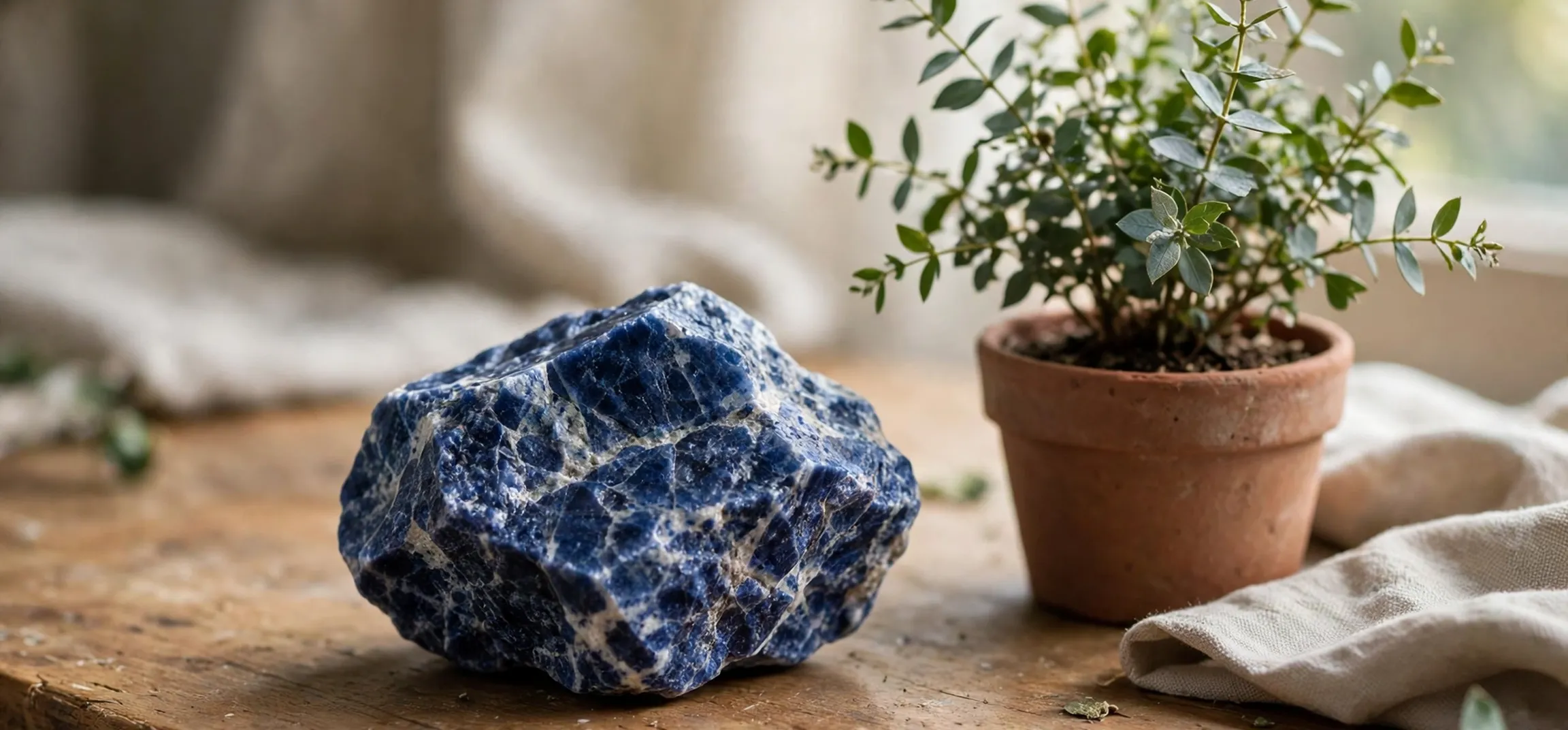
Sodalite meaning has fascinated stone lovers, collectors, and curious readers for generations, because this deep blue mineral seems to carry a whole story in its colour. When people search for sodalite meaning, they are usually asking more than one question at once: what is this stone, where does it come from, what does it symbolise, and how is it used in jewellery and everyday life? This guide answers all of those questions in plain language. You will learn how sodalite forms, how to recognise it, what its blue colour and white veining can tell you, and why it has become one of the most recognisable blue stones in collections around the world. Along the way, we separate well-established facts about the mineral from the symbolic associations that people have attached to it over time, so you can enjoy the lore without confusing it with science. In short, sodalite meaning covers geology, history, symbolism, and everyday use, and this guide treats each part fairly.
What Is Sodalite?
Sodalite is a mineral that belongs to a group of minerals known as feldspathoids, and it is best known for its rich royal blue colour. Its name comes from its sodium content, since the word soda in its name points to sodium, one of the elements in its chemical make-up. The stone is usually found in shades of blue ranging from light denim blue to a deep, almost navy tone, often marked with white streaks or patches of calcite. These white markings are one of the easiest ways to tell sodalite apart from other blue stones, because they create a marbled, cloudy pattern across the surface rather than a single flat colour. Sodalite is also sometimes confused with lapis lazuli, another famous blue stone, but lapis lazuli usually contains golden flecks of pyrite, while sodalite does not. That simple difference helps collectors and jewellers identify each stone with confidence.
The mineral forms in igneous rocks that are low in silica, and it is found in several parts of the world, including Canada, Brazil, Russia, Greenland, and parts of Africa. It is not one of the rarest minerals on Earth, which means it is widely available and affordable compared with precious gemstones. Its hardness sits at around 5.5 to 6 on the Mohs scale, which makes it softer than stones such as quartz or sapphire. Because of this moderate hardness, sodalite is best used in jewellery that does not face heavy daily wear, such as pendants, earrings, and beads, rather than rings that are worn every day. With reasonable care, however, sodalite jewellery can last for many years and keep its deep blue colour. That balance of beauty and affordability is one reason sodalite meaning resonates with so many collectors.
Readers who want the full picture of sodalite meaning should look at both the mineral facts and the cultural stories together, since each side explains something the other cannot.
Sodalite Meaning in History and Culture
The sodalite meaning that people talk about today has roots in both science and storytelling. Sodalite was first described as a mineral in the early nineteenth century, when it was identified in Greenland, and it later became popular in the twentieth century when large deposits were found in Canada. One of the most famous historical connections involves the Canadian deposits in Ontario, where the stone was promoted as a decorative material and even used in interior design. This period helped sodalite move from a little-known mineral specimen to a stone that ordinary people could buy, wear, and display in their homes.
In cultural terms, blue stones have long been linked with the sky, the sea, and the idea of calm and depth. Sodalite, with its deep blue colour and soft white veining, fits naturally into that tradition. Writers and collectors often describe it as a stone of clear thinking and honest expression, and it is frequently associated with communication, learning, and reflection. It is important to be clear about what this means: these associations are symbolic and cultural, not scientific properties of the mineral. They come from the way people have used colour symbolism for centuries, where blue has stood for trust, wisdom, and calm. Understanding sodalite meaning in this way lets you appreciate the tradition while keeping the facts straight.
Sodalite and the Colour Blue
The colour blue plays a central role in how people interpret this stone. Deep blue is often linked with depth and stability, while lighter blue shades suggest openness and clarity. Sodalite shows both qualities at once, since a single piece can contain dark blue areas, lighter blue patches, and white veining. Collectors often say that this mixture is what makes each piece feel unique, because no two stones show exactly the same pattern. When people choose sodalite jewellery, they are often drawn to this natural variation as much as to the colour itself.
Moving from history to symbolism, sodalite meaning takes on a more personal character, as people connect the stone with focus, honesty, and calm reflection.
Sodalite Meaning for Mind and Communication
Another part of sodalite meaning that appears again and again in books about stones is its connection with the mind and with communication. In crystal lore, sodalite is often described as a stone for clear thought, steady focus, and honest conversation. People who follow this tradition sometimes keep a piece of sodalite on a desk while studying, or wear it when they want to feel calm and organised before an important discussion. These practices are personal and symbolic, and they belong to a long tradition of assigning meanings to stones, colours, and natural objects.
It is worth noting that these traditional associations are not medical or scientific claims. Sodalite does not change the way the brain works, and it is not a substitute for study, practice, or professional advice when you need it. What it can do, in a practical sense, is serve as a reminder: many people find that keeping a meaningful object nearby helps them pause, focus, and approach a task with a calmer mindset. If you enjoy sodalite for that reason, that is a perfectly reasonable way to appreciate it, as long as the symbolic meaning is not mistaken for a proven effect.
Sodalite in Study and Creative Spaces
Sodalite is a popular choice for desks, shelves, and creative spaces, partly because its deep blue colour looks striking against wood, metal, and neutral walls. Tumbled stones, small carved shapes, and polished slabs are common forms for display, and they are easy to find from mineral dealers and jewellery suppliers. Some people also use sodalite beads in bracelets and necklaces, where the blue colour pairs well with silver-toned metals. Whether you see it as a decorative stone, a collector’s piece, or a symbol of clear thinking, sodalite fits comfortably into all three roles.
Beyond symbolism, sodalite meaning also has a practical side for buyers, because recognising the real stone is the first step to enjoying it with confidence.
How to Identify Real Sodalite
Learning to identify sodalite is useful if you plan to buy it, because several blue stones can look similar at first glance. The most reliable clues are its colour pattern and its texture. Real sodalite is usually a royal blue with white calcite veining, and the surface has a slightly waxy or glassy shine when polished. It may also contain small patches of a darker blue mineral called sodalite’s close companion, but the overall look remains blue and white rather than blue and gold. If a stone labelled as sodalite contains golden metallic flecks, it is more likely to be lapis lazuli, and if it is a uniform bright blue with no white markings at all, it may be a dyed stone or a different mineral entirely.
Another helpful test is to look at the stone in natural light. Sodalite often shows a range of blue tones within a single piece, from pale blue-grey to deep navy, and the white veining usually appears as soft, cloudy streaks rather than sharp lines. Under a bright lamp, the blue can look slightly darker, while daylight tends to show the full range of tones. Reputable sellers will describe the stone accurately and will usually mention whether it is natural or treated, so buying from a seller who gives clear information is always the safest approach. For a broader look at how meanings are explored for other stones and symbols, see this guide to 888 tattoo meaning, and for a science-based take on a related topic, read about molecule meaning in chemistry.
In jewellery and design, sodalite meaning shows up in the choices makers and wearers make, from protective settings to colour pairings that highlight the blue.
Sodalite Uses in Jewellery and Design
Sodalite is widely used in jewellery, carving, and decorative objects. In jewellery, it appears as cabochons, beads, pendants, and inlay pieces, and its deep blue colour makes it a strong choice for statement pieces. Designers often pair it with white metals, which highlight the blue, or with warm metals, which create a striking contrast. Because sodalite is softer than many gemstones, jewellers usually set it in protective settings, such as bezel settings that surround the stone with metal, rather than exposed prong settings that leave the edges vulnerable to knocks.
Beyond jewellery, sodalite is used for small sculptures, bookends, bowls, and decorative tiles. Large pieces of sodalite have also been used as ornamental stone in buildings, where the blue colour creates a dramatic effect. When caring for sodalite, gentle cleaning is best: warm water, mild soap, and a soft cloth are usually enough, and the stone should be kept away from harsh chemicals and sudden temperature changes. Storing sodalite separately from harder stones also helps prevent scratches, since harder materials can mark its surface over time.
To sum up the factual side of sodalite meaning, the table below gathers the properties that matter most when comparing this stone with others.
Sodalite Properties at a Glance
The table below brings together the key facts about sodalite in one place, so you can compare it quickly with other blue stones you may be considering.
| Property | Detail |
|---|---|
| Colour | Royal blue to light blue, often with white calcite veining |
| Mineral group | Feldspathoid minerals |
| Hardness | 5.5 to 6 on the Mohs scale |
| Main sources | Canada, Brazil, Russia, Greenland, and parts of Africa |
| Common uses | Jewellery, beads, carvings, and decorative objects |
| Lookalike stone | Lapis lazuli, which usually shows golden pyrite flecks |
Many readers arrive with the same questions about sodalite meaning, so the answers below cover the points that come up most often.
Frequently Asked Questions
What does sodalite symbolise?
In crystal lore and colour symbolism, sodalite is most often linked with clear thinking, honest communication, and calm reflection. These are traditional symbolic associations rather than scientifically proven properties, and they reflect the long-standing cultural link between the colour blue and ideas such as wisdom, trust, and depth. That is the heart of sodalite meaning in the symbolic tradition.
Is sodalite the same as lapis lazuli?
No. Although both stones are blue, they are different minerals. Sodalite usually shows white calcite veining, while lapis lazuli typically contains golden flecks of pyrite. They also differ in composition, hardness, and price, so a seller should always identify which stone is being sold. Keeping the two apart is part of understanding sodalite meaning as a distinct stone.
Can sodalite be worn every day?
Sodalite can be worn often, but it is softer than many gemstones, so daily wear in a ring may lead to scratches over time. Pendants, earrings, and bracelets tend to last longer, and protective settings help keep the stone in good condition. Gentle cleaning with warm water and mild soap is usually all that is needed.
Where does sodalite come from?
Sodalite is mined in several countries, with well-known deposits in Canada, Brazil, Russia, and Greenland. Canadian sodalite became especially well known in the twentieth century, when it was used as a decorative stone and promoted to a wider public.
Before wrapping up, it helps to hold both halves of sodalite meaning in mind at once: the geology that explains the stone, and the symbolism that explains its appeal.
Conclusion
Sodalite meaning brings together geology, history, and symbolism in a way that few other blue stones can match. As a mineral, it is a royal blue feldspathoid marked by distinctive white veining, found in several countries and valued for jewellery, carving, and decoration. As a symbol, it is linked with clear thinking, honest communication, and calm reflection, associations that grow out of the long cultural history of the colour blue. By keeping the scientific facts and the symbolic lore side by side, you can appreciate sodalite for what it truly is: a beautiful, accessible blue stone with a story worth knowing. Whether you collect it, wear it, or simply enjoy learning about it, sodalite rewards a closer look, and its deep blue surface will always invite one more glance.