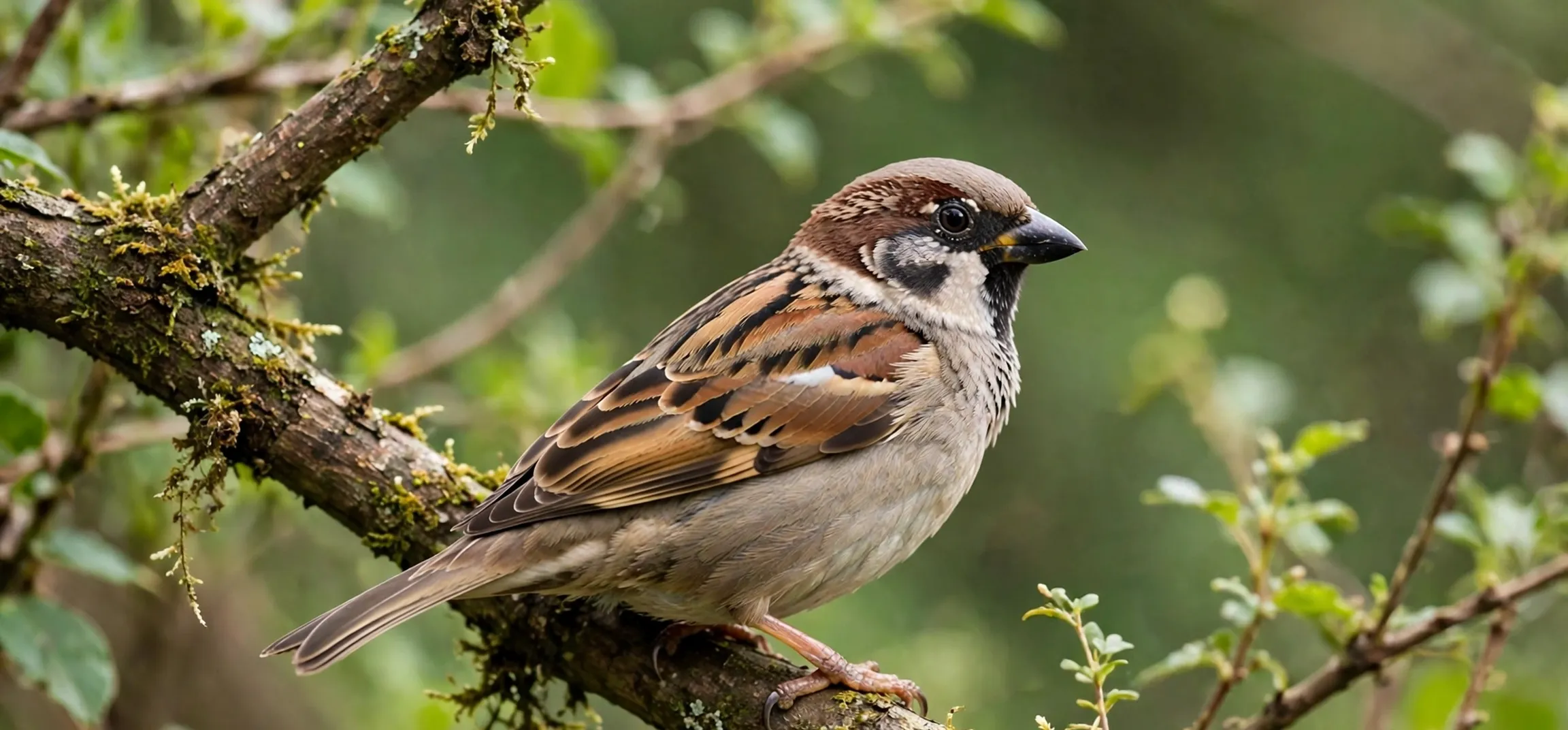
The meaning of the sparrow is far richer than the small brown bird suggests, because sparrows have lived alongside people for thousands of years, nesting in roofs, gathering in market squares, and appearing in proverbs, songs, and sacred stories. To ask about the meaning of the sparrow is therefore to ask about humility, community, resilience, and joy, as well as about freedom and the value of ordinary life. This guide explores the meaning of the sparrow across cultures, literature, spirituality, dreams, tattoos, and everyday symbolism, and it explains why such a common bird carries such an uncommon weight of meaning.
Sparrows are among the most familiar birds in the world. The house sparrow, in particular, thrives in towns and villages, feeding on seeds and crumbs, nesting in eaves and hedges, and gathering in noisy, sociable flocks. That familiarity is central to their symbolism. Unlike eagles, which suggest power and distance, or owls, which suggest mystery and solitude, sparrows suggest closeness, ordinariness, and belonging. They are birds of the street and the garden, not of the remote wilderness, and their meaning grows from that everyday presence. A sparrow in a story is rarely a grand hero; it is a neighbour, a friend, or a small voice that proves unexpectedly important.
Biology reinforces the symbolism. Sparrows are small, but they are hardy, adaptable, and persistent. They survive cold winters, busy cities, and scarce seasons by cooperating, by remembering food sources, and by making homes in unlikely places. Their cheerful chirping, even in winter, has long been read as a sign of hope and good cheer. When people speak of the meaning of the sparrow, they often mean that combination of smallness and toughness: the idea that a modest life, lived with energy and community, is a complete life.
Cultural Symbolism and the meaning of the sparrow
In many European traditions, the sparrow symbolises simplicity, hard work, and domestic happiness. Folk tales present sparrows as clever, talkative birds that outwit larger creatures through persistence rather than strength. In some stories, a sparrow’s chatter warns a household of visitors or danger, linking the bird to vigilance and home protection. In others, sparrows represent the common people, cheerful and resilient, who endure while grander figures fall. That democratic quality, the sparrow as the bird of ordinary folk, runs through proverbs and nursery rhymes across the continent.
In East Asian traditions, sparrows carry related but distinct meanings. In Chinese culture, the sparrow is often associated with joy, liveliness, and the pleasures of everyday life, and sparrow imagery appears in painting, embroidery, and festival decoration. In Japanese tradition, sparrows, known as suzume, are linked to good fortune, loyalty, and the warmth of home, and the famous tale of the tongue-cut sparrow explores gratitude, greed, and kindness. Across these traditions, the sparrow is rarely a solitary symbol of power; it is a social symbol, tied to family, community, and the small delights that make a household feel alive.
Spiritual and Biblical Dimensions of the meaning of the sparrow
Sparrows appear in sacred texts as emblems of divine care for the smallest creatures. In the Christian tradition, sparrows are mentioned as birds of little market value that are nevertheless known and cared for, a passage that has comforted readers for centuries with its message that no life is overlooked. That image has made the sparrow a symbol of trust, providence, and self-worth, especially for people who feel small or unnoticed. The message is not that sparrows are grand, but that their smallness does not make them unimportant.
In broader spiritual and folk belief, sparrows are also read as messengers of hope and renewal. A sparrow visiting a garden is sometimes taken as a sign to pay attention to simple pleasures, to reconnect with friends, or to trust that a difficult period will pass. In dream interpretation, a sparrow often suggests a need for community, a longing for home, or a reminder to protect one’s energy and joy. A flock of sparrows in a dream may suggest social support, while a single sparrow may suggest independence within a community, a small voice worth listening to. These readings are symbolic, not predictive, and they work best as prompts for reflection rather than as forecasts.
Sparrow symbolism at a glance
| Theme | What it suggests | Where it appears |
|---|---|---|
| Humility | Value in an ordinary life | Proverbs and folk tales |
| Community | Friendship and belonging | Flock behaviour and festivals |
| Resilience | Surviving hardship with cheer | Winter imagery and songs |
| Freedom | Joy without grandeur | Poetry and tattoo art |
| Protection | Watchfulness over the home | Folk tales and charms |
Sparrows in Literature, Art, and Music
Poets have long used sparrows to explore tenderness and loss. In ancient Roman poetry, a sparrow is a beloved pet whose death prompts a famous lament, showing how a tiny creature can carry great affection. In English poetry, sparrows appear as emblems of the common and the cherished, often contrasted with grander birds to make a point about love, humility, or the passage of time. In modern songwriting, sparrows continue to suggest freedom, homesickness, and the hope of return, because their migratory and communal habits map neatly onto human feelings about home.
In visual art, sparrows are painted with a softness that suits their scale: small, brown, and lively, often perched on a branch or a windowsill. Tattoo art has adopted the sparrow for similar reasons. A sparrow tattoo often represents freedom, loyalty, love, or a journey safely completed, and sailors historically used sparrow and swallow tattoos to mark voyages and homecomings. The choice of a sparrow over a larger bird is itself meaningful: it says that freedom need not be fierce, and that loyalty need not be loud. For many wearers, the sparrow is a reminder of a person, a place, or a value carried quietly.
What a Sparrow Sighting Means in Everyday Life
For many people, the everyday meaning of the sparrow is simpler than any cultural history: it is a reminder to notice what is near. A sparrow on a garden fence, a sparrow bathing in a puddle, or a sparrow feeding its young in a hedge can prompt a pause in a busy day. Gardeners often welcome sparrows as signs of a healthy, insect-rich environment, and their presence suggests that a garden offers food, water, and shelter. Conservationists note that sparrow numbers have declined in some cities, so a thriving flock can also be a small indicator of urban ecology, and a reason to protect hedges, seeds, and nesting spaces.
In memes and online culture, sparrows appear as cheerful, relatable characters: small, round, and unbothered, often captioned with humour about everyday struggles. That modern use fits the older symbolism well. The sparrow meme works because the bird is recognisable, ordinary, and endearing, and because its small dramas, squabbling over crumbs or puffing up in the cold, mirror human life in miniature. The meaning of the sparrow therefore continues to evolve, but its centre holds: smallness, community, and cheerful persistence.
Frequently Asked Questions
What does a sparrow symbolise most commonly?
Most commonly, a sparrow symbolises humility, community, joy, resilience, and freedom. The exact emphasis varies by culture, but those themes recur across traditions.
Is a sparrow a good luck symbol?
In many traditions, yes. Sparrows are linked to good fortune, home, and protection, although the specific belief varies, and the symbolism is best read as cultural rather than literal.
What does a sparrow tattoo mean?
A sparrow tattoo often means freedom, loyalty, love, or a journey completed, and for sailors it historically marked voyages and a safe return home.
The Meaning of the Sparrow in Modern Life
In modern life, the meaning of the sparrow has found a new home in gardens, classrooms, and social media, where the bird stands for cheerful resilience in ordinary circumstances. Teachers use sparrows to introduce children to nature, because the birds are easy to spot, easy to hear, and easy to love, and their behaviour illustrates cooperation, parenting, and adaptation without needing exotic examples. Gardeners welcome sparrows as lively neighbours, and their chatter has become, for many city dwellers, a small daily reminder that nature persists even in busy streets. The meaning of the sparrow in this everyday setting is refreshingly simple: pay attention, share what you have, and keep going.
Writers and artists continue to return to the sparrow for the same reason. A sparrow can carry a poem about grief without grandeur, a song about home without sentimentality, or a story about courage without heroics. That versatility is the heart of the meaning of the sparrow: the bird is small enough to be humble, social enough to suggest community, and hardy enough to suggest hope. Whether the sparrow appears as a tattoo, a garden visitor, or a character in a tale, it reminds us that significance is not measured by size, and that an ordinary life, lived with warmth and persistence, is a meaningful life indeed.
Conservation adds a further layer to the modern meaning of the sparrow. Where sparrow numbers have fallen, their return to a garden or a street is celebrated as a sign of a healthier environment, with hedges, seeds, and nesting spaces restored. Protecting sparrows therefore means protecting the small habitats that support them, and that practical care echoes the symbolic message: look after the common, the local, and the everyday, because those are the foundations on which larger flourishing depends.
The meaning of the sparrow also rewards a simple practice: notice the birds around you. A morning walk that includes a sparrow chorus is a small reminder of the meaning of the sparrow itself, that ordinary life, shared and persistent, carries its own quiet significance.
Conclusion
The meaning of the sparrow endures because the bird itself endures: small, sociable, adaptable, and close to human life. Across cultures, sparrows speak of humility without self-pity, of community without conformity, and of joy that does not depend on grandeur. Whether encountered in a poem, a garden, a dream, or a tattoo, the sparrow invites us to value ordinary life, to protect our communities, and to keep singing through lean seasons. That is a modest message, and that modesty is precisely the point. For more symbolism guides, see our articles on spiritual number meanings, bird proverb meanings, and tattoo number meanings.