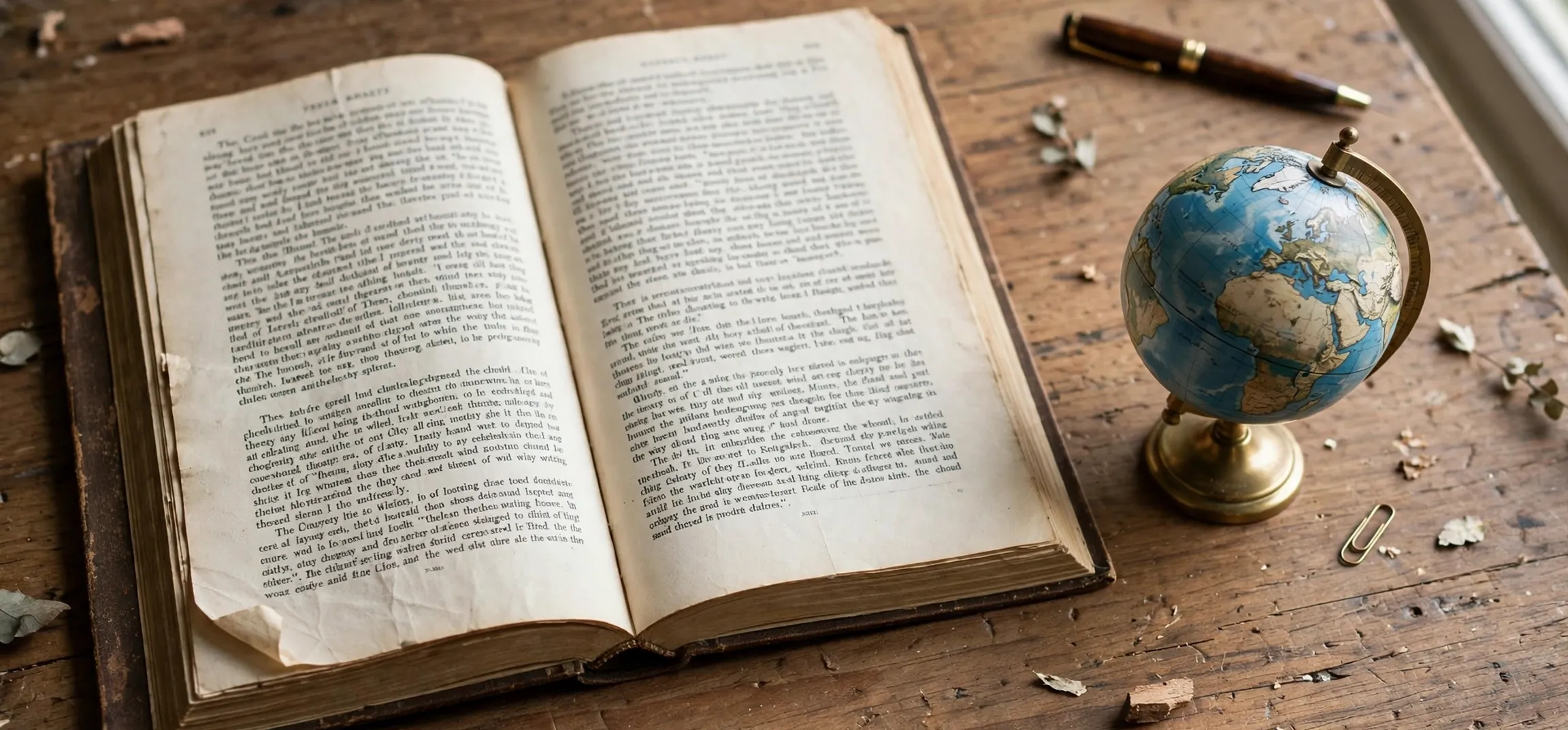
A text-to-world connection happens when something you read reminds you of something happening in the wider world, such as a news event, a historical pattern, a scientific idea, or a social issue you have heard about. It is one of the most powerful reading strategies students and lifelong learners can build, because it turns reading from a private exercise into a conversation with real life. This guide explains what a text-to-world connection is, how to practice it every day, and how a small daily habit can steadily improve comprehension, critical thinking, and curiosity.
Teachers often introduce three kinds of connections: text-to-self, text-to-text, and text-to-world. The first links reading to personal experience. The second links one book or article to another. This third kind of link goes one step further, linking reading to events and ideas beyond your own life. When a novel about a drought reminds you of water shortages discussed in the news, or when a biography of an inventor reminds you of a modern technology debate, you are making exactly this kind of connection. It shows that reading is not isolated from the world; it is one of the best ways to understand it.
What Is a Text-to-World Connection?
At its simplest, a text-to-world connection is a bridge between a text and the world outside it. The text might be a novel, a news article, a poem, a textbook chapter, or even a short story read for pleasure. The world side of the bridge might be a current event, a historical moment, a cultural tradition, a scientific discovery, or a community issue. The connection is useful when it helps you understand either side better: the text illuminates the world, or the world illuminates the text.
Consider a student reading a story about a community rebuilding after a storm. A text-to-world connection might link that fictional story to real recovery efforts the student has seen reported, or to general knowledge about how weather affects coastal towns. The student does not need expert knowledge. General awareness is enough. The point is to notice patterns: people responding to hardship, communities organizing help, or leaders making difficult choices. Those patterns appear in both fiction and real life, and recognizing them deepens understanding of both.
Strong readers make this kind of connection almost automatically, but the skill can absolutely be learned. It begins with a simple habit: while reading, pause occasionally and ask, “Does this remind me of anything happening in the world?” The answer might be immediate, or it might take a moment of reflection. Either way, the question itself trains the brain to look outward, and over time the connections come faster and feel more natural.
Building a Text-to-World Connection Every Day
The daily drop idea is simple: make one connection every day. You do not need a long study session. Choose one thing you read, whether it is a chapter, an article, or a few pages of a novel, and find one link to the wider world. Write it down in a sentence or two. Over weeks and months, that small habit builds a personal library of connections, and it changes how you read. Texts start to feel less like isolated assignments and more like pieces of a larger puzzle.
A practical daily routine might look like this. First, read for ten to twenty minutes without worrying about connections. Second, stop and think about what stood out: a character’s choice, a surprising fact, or a theme that kept repeating. Third, ask what it reminds you of in the world: a news story, a historical event, a place you know, or an issue people debate. Fourth, write one short note explaining the link in your own words. That note is your daily connection, and it is worth far more than a page of copied definitions.
Parents and teachers can support this habit by modeling it. When an adult says, “This article about bees reminded me of the discussion about farming and pollination,” a young reader learns that connections are normal, not a test with one right answer. The best responses to a student’s connection are curiosity and follow-up questions: “Tell me more about that link,” or “How does that change what you think about the story?” Those questions reward thinking rather than correctness, which keeps the habit enjoyable.
Text-to-World Connection Examples Across Subjects
A text-to-world connection works in every subject, not just English class. In science, reading about ecosystems might connect to conservation efforts or climate discussions. In history, a chapter about ancient trade routes might connect to modern supply chains and global shipping. In social studies, a story about voting rights might connect to current conversations about civic participation. The strategy is flexible because the world is the common thread running through all subjects.
Here are some everyday examples that show how natural this thinking can be. A reader finishing a novel about migration might connect it to stories of families moving for work or safety. A reader learning about the water cycle might connect it to local weather or farming seasons. A reader exploring a biography of a scientist might connect it to a recent discovery or a medical advance. None of these connections requires specialist knowledge. They require attention, curiosity, and a willingness to link ideas across boundaries.
| Connection Type | What It Links | Example Prompt |
|---|---|---|
| Text-to-self | The text and your own life | Has anything like this happened to me? |
| Text-to-text | The text and another book or article | Does this remind me of something else I read? |
| Text-to-world | The text and wider events or ideas | What does this remind me of in the world? |
| Text-to-media | The text and a film, song, or report | Have I seen this theme elsewhere? |
Notice how the table separates the connection types without ranking them. All four are valuable, and strong readers use them together. A single reading session might produce a personal memory, a link to another book, and a text-to-world connection all at once. The goal is not to force one type but to notice whichever links appear and to give the world-focused ones special attention, because they build the broad background knowledge that makes future reading easier.
Using a Text-to-World Connection in Class and at Home
In classrooms, this strategy is often practiced through short discussions, sticky notes, or reading journals. A teacher might read a passage aloud and ask students to share one world link they noticed. The variety of answers is the point: one student might connect to a news event, another to a historical parallel, and another to a community issue. Hearing different connections teaches students that the same text can open many doors, and it builds respect for different perspectives and background knowledge.
At home, the strategy fits naturally into everyday reading. While reading a bedtime story, a parent might ask, “Does this remind you of anything real?” While browsing news together, a family might ask, “Have we read a book about something like this?” These small conversations cost nothing and take only a minute, but they train young readers to see reading as connected to life. Over time, children who practice this habit tend to ask better questions, remember more of what they read, and show more interest in news and nonfiction.
For adult learners, the same habit supports professional growth. Reading a management article might connect to a workplace challenge. Reading a history book might connect to a policy debate. Reading a science feature might connect to a health decision. Adults who deliberately practice this habit often find that they retain ideas longer and can explain them more clearly, because the ideas are anchored to real contexts rather than floating as abstract facts.
Readers who want more examples can explore related explainers such as what a text-to-world connection is and text-to-world connection examples. Comparing different explanations helps learners see the strategy from several angles and find the phrasing that clicks for them. It also models the very skill being taught: connecting one text to another, and then to the world.
Common Mistakes When Making a Text-to-World Connection
One common mistake is forcing a connection that is too vague to be useful. Saying “this reminds me of the world” without explaining how is not really a connection. A stronger version names the specific link: “This story about a village sharing water reminds me of reports about communities managing drought.” The difference is detail. A good connection explains the shared pattern, not just a general feeling of similarity.
Another mistake is treating the connection as a final answer instead of a starting point. The best connections raise new questions. If a novel about unfair rules reminds you of a real debate about fairness, the natural next step is to ask how the two situations differ as well as how they are alike. That comparison builds critical thinking, which is the deeper goal of the strategy. Similarities open the door; differences sharpen understanding.
A third pitfall is relying only on recent headlines. News is a great source of connections, but history, science, geography, and culture offer equally rich material. A text-to-world connection that draws on a historical event or a scientific idea can be just as powerful as one drawn from today’s news. Encourage variety: sometimes the world link will be current, sometimes historical, and sometimes a timeless human pattern.
Text-to-World Connection FAQ
How is a text-to-world connection different from text-to-self?
Text-to-self links reading to your personal experience, while a text-to-world connection links reading to events, ideas, or issues in the wider world. Both are useful. Personal links build emotional engagement, while world links build background knowledge and civic awareness. Strong readers use both, often in the same reading session.
Can young children make a text-to-world connection?
Yes. Young children naturally connect stories to the world around them, such as linking a story about sharing to a classroom rule or a story about weather to a rainy day. Adults can nurture this by asking gentle questions and celebrating any thoughtful link, however simple. The skill grows with vocabulary and experience, so early practice pays off for years.
How long should a daily text-to-world connection take?
Just a few minutes. Read normally, pause to notice one link, and write one or two sentences about it. The daily drop approach works precisely because it is small and sustainable. A short daily habit beats an occasional long exercise, and it keeps reading connected to life all year round.
Does a text-to-world connection have to be correct?
It has to be thoughtful, not perfect. A connection is a hypothesis to explore, not a test answer. If a link turns out to be weak, discussing why it does not quite fit is itself valuable learning. Teachers and parents should reward reasoning and curiosity rather than demanding a single approved connection.
Conclusion
A text-to-world connection is a small habit with a large payoff. By pausing each day to link something you read to something happening in the world, you build background knowledge, sharpen critical thinking, and make reading feel relevant. The daily drop approach keeps the practice simple: one text, one link, one short note, every day. Over time, those single connections add up to a richer understanding of both books and the world they reflect. Start today with whatever you are reading right now, and ask the question that opens everything up: what does this remind me of in the world?



