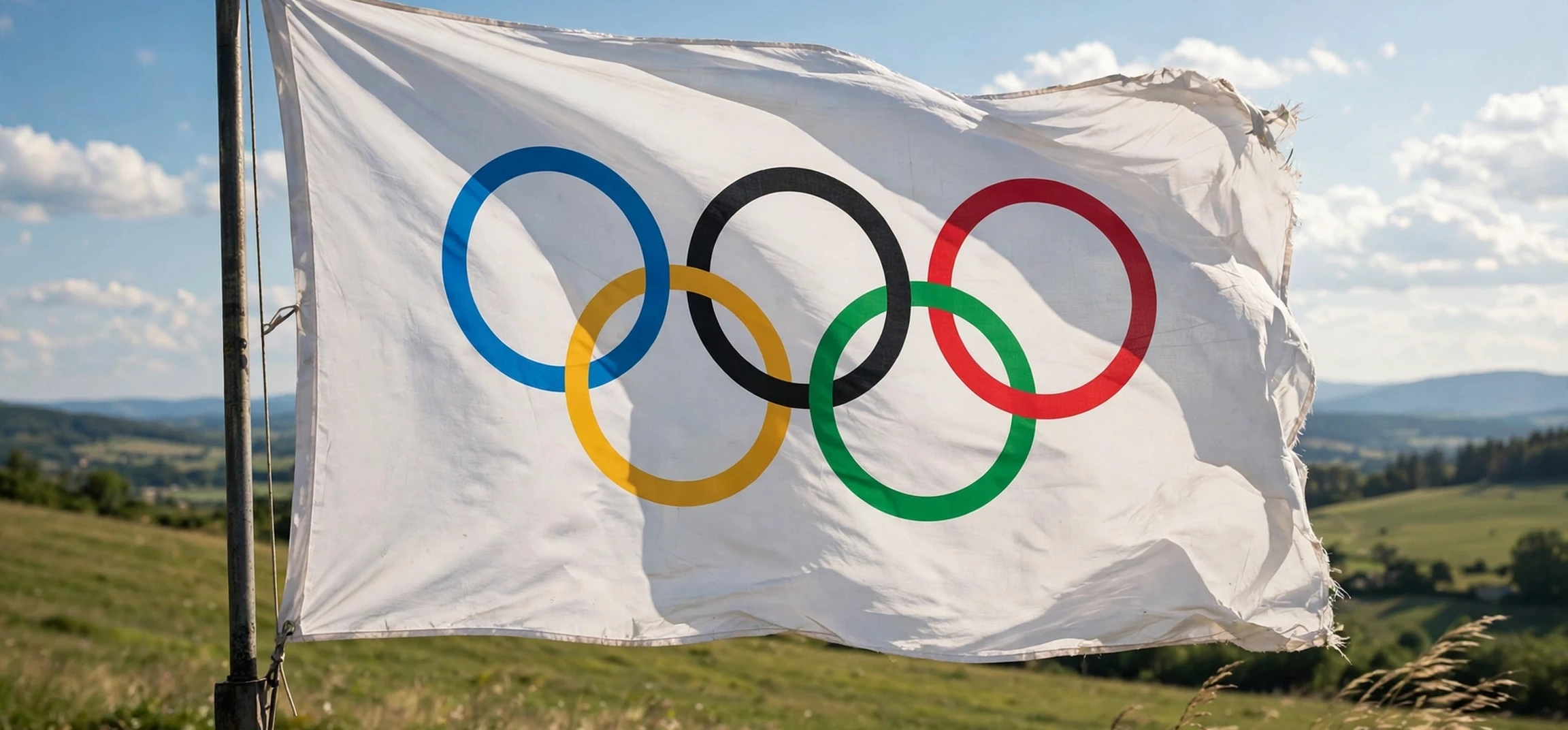
If you have ever watched an Olympic opening ceremony and wondered what do olympic rings symbolize, you are asking about one of the most recognised symbols in the world. Five interlocking rings in blue, yellow, black, green, and red, set on a white background, appear on flags, medals, stadiums, and television graphics at every Olympic Games. This guide explains what do olympic rings symbolize, where the design came from, what each colour does and does not mean, and why the rings have lasted for more than a century as an emblem of international sport. It also clears up the most common misconceptions, so you can explain the symbol confidently in schoolwork, quizzes, and conversation.
The short answer to what do olympic rings symbolize is unity and universality. The five rings represent the inhabited continents of the world coming together through sport, and their interlocking design represents connection, friendship, and peaceful competition between nations. The Olympic movement’s own language describes the rings as expressing the activity of the Olympic movement and the coming together of athletes from all over the world at the Games. That idea, that sport can bring people together across borders, languages, and political differences, is the heart of the symbol, and it has remained constant even as the Games themselves have grown enormously.
What Do Olympic Rings Symbolize? Origins of the Design
To understand what do olympic rings symbolize, it helps to start with their creator. Pierre de Coubertin, the French educator who founded the modern Olympic Games, designed the rings in 1913 and introduced them publicly in 1914. Coubertin wanted an emblem that would be instantly recognisable, easy to reproduce, and meaningful across cultures. He chose five interlocking rings because the number five matched the inhabited continents as understood at the time, and because the interlocking form suggested linkage rather than separation. The design was first used on the Olympic flag, which was flown at the 1920 Games in Antwerp after the First World War delayed its debut.
Coubertin himself explained the colours with a practical observation that is often overlooked. He noted that the six colours in the emblem, the five ring colours plus the white background, appeared in the flags of the nations competing at the time, so that every national flag contained at least one of them. That was a design choice about universality, not a code in which each colour stood for a single continent. Remembering that point prevents the most common error in explanations of what do olympic rings symbolize, which is to assign blue to Europe, yellow to Asia, and so on. The Olympic movement has repeatedly clarified that no ring colour corresponds to a particular continent.
What Do Olympic Rings Symbolize? The Five Continents
The five rings in answer to what do olympic rings symbolize stand for the five inhabited continents: Africa, the Americas, Asia, Europe, and Oceania. The Americas are counted as a single continent in this tradition, which is why there are five rings rather than six or seven. That counting reflects early twentieth-century geographical convention, and it has been retained for continuity even though school geography in different countries sometimes divides the Americas into two continents. For Olympic purposes, the five-ring tradition is fixed, and it appears in the movement’s official descriptions of the symbol.
The interlocking arrangement is just as important as the number. The rings overlap in a specific pattern, with three on top and two below, and each ring links to its neighbours. That interlacing is deliberate: it suggests that the continents are not separate blocks placed side by side, but parts of a connected whole. Athletes, officials, and spectators from different continents meet, compete, and share experiences at the Games, and the rings visualise that meeting. When you see the rings on a flag or a podium, the message is therefore not only “five continents exist”, but “five continents come together”.
What Do Olympic Rings Symbolize? The Colours Explained
Colour is where explanations of what do olympic rings symbolize most often go wrong, so it deserves careful treatment. The rings are blue, yellow, black, green, and red, from left to right, on a white field. Popular articles sometimes claim that blue stands for Europe, yellow for Asia, black for Africa, green for Oceania, and red for the Americas, but that mapping is not official and has no basis in Coubertin’s design. The colours were chosen because, together with white, they covered the colours found in the world’s national flags at the time, making the emblem feel inclusive rather than tied to any single nation.
That distinction matters for quizzes and school projects. If a question asks what do olympic rings symbolize, the safe, accurate answer emphasises the five continents and their union, and treats the colours as a universal palette rather than a continent code. Teachers and examiners who know the symbol well will mark the continent-colour mapping as incorrect, even though it appears widely online. A useful way to remember the correct explanation is to think of the colours as a promise: no matter which flag an athlete competes under, at least one colour of that flag appears in the Olympic emblem, so everyone belongs in the picture.
| Ring colour (left to right) | Position | Common misconception | Accurate explanation |
|---|---|---|---|
| Blue | Top left | Often wrongly assigned to Europe | Part of the universal colour palette |
| Yellow | Top middle | Often wrongly assigned to Asia | Part of the universal colour palette |
| Black | Top right | Often wrongly assigned to Africa | Part of the universal colour palette |
| Green | Bottom left | Often wrongly assigned to Oceania | Part of the universal colour palette |
| Red | Bottom right | Often wrongly assigned to the Americas | Part of the universal colour palette |
What Do Olympic Rings Symbolize? Olympic Values and the Motto
Beyond continents, what do olympic rings symbolize connects to the values of the Olympic movement: excellence, friendship, and respect. Excellence means striving to do one’s best, whether that leads to a medal or simply to a personal best. Friendship means building understanding between people through shared experience, on and off the field of play. Respect covers respect for oneself, for others, for rules, and for the environment. The rings, as a symbol of gathering, give those abstract values a visible form that children and adults can recognise instantly, even without knowing the official terminology.
The Olympic motto, “Faster, Higher, Stronger”, later extended with “Together”, reinforces the same message. Athletic achievement matters, but the added word “Together” makes explicit what the rings have always implied: progress in sport is meaningful because it is shared. That is why the rings appear not only at elite competitions, but in schools, youth programmes, and community events inspired by the Games. They signal participation and connection, not only victory, and they remind viewers that the Games are a meeting place as well as a contest.
Symbols and their colours fascinate readers in many contexts, and the same careful approach applies elsewhere. For national symbols, see our guide to what the colours of the Mexican flag mean and our explanation of what the colours of the Italian flag mean, both of which separate official meanings from popular guesses. For personal symbols, our piece on 888 tattoo meaning shows how a simple design can carry many different interpretations depending on context.
What Do Olympic Rings Symbolize Through History?
The history of the rings adds depth to what do olympic rings symbolize. After their introduction in 1914, the rings became the centrepiece of the Olympic flag, which is raised at the opening ceremony and lowered at the closing ceremony of each Games. The flag’s white background was chosen to suggest peace, a deliberate contrast to the conflicts that interrupted the early modern Games. During the twentieth century, as more nations joined the Olympic movement, the rings came to represent an ever-wider gathering, and their meaning of universality grew stronger rather than weaker.
The rings have also been adapted for different Games while keeping their core design intact. Host cities create their own emblems, which often incorporate the rings alongside local imagery, and the Paralympic Games use a separate symbol, the Agitos, to distinguish their movement. Those adaptations show how durable the original design is: it can sit alongside new artwork without losing its identity, and viewers around the world still recognise it immediately. That instant recognition is rare among international symbols, and it is a testament to Coubertin’s simple, bold design.
What Do Olympic Rings Symbolize? Frequently Asked Questions
What do olympic rings symbolize in one sentence? They symbolize the five inhabited continents coming together in peaceful sporting competition under the Olympic movement.
Does each ring colour stand for a continent? No. The colours were chosen because, with white, they appear in the flags of competing nations. No official mapping links a single colour to a single continent.
Who designed the Olympic rings? Pierre de Coubertin, founder of the modern Olympic Games, designed them in 1913.
Why are there five rings? Because the Olympic tradition counts five inhabited continents: Africa, the Americas, Asia, Europe, and Oceania.
What does the white background mean? The white field of the Olympic flag is associated with peace, reinforcing the idea of nations meeting in friendly competition.
Conclusion: What Do Olympic Rings Symbolize Today?
Today, what do olympic rings symbolize remains what Coubertin intended: a world of separate continents choosing to meet, compete, and understand each other through sport. The five interlocking rings remind viewers that the Games are bigger than any single race, match, or medal, and that their value lies in the gathering itself. The next time you see the rings, look past the familiar colours and notice the interlocking: five parts, joined together, stronger as a whole than they would be apart. That simple image, more than a century old, still captures the Olympic ideal as clearly as any words could.



