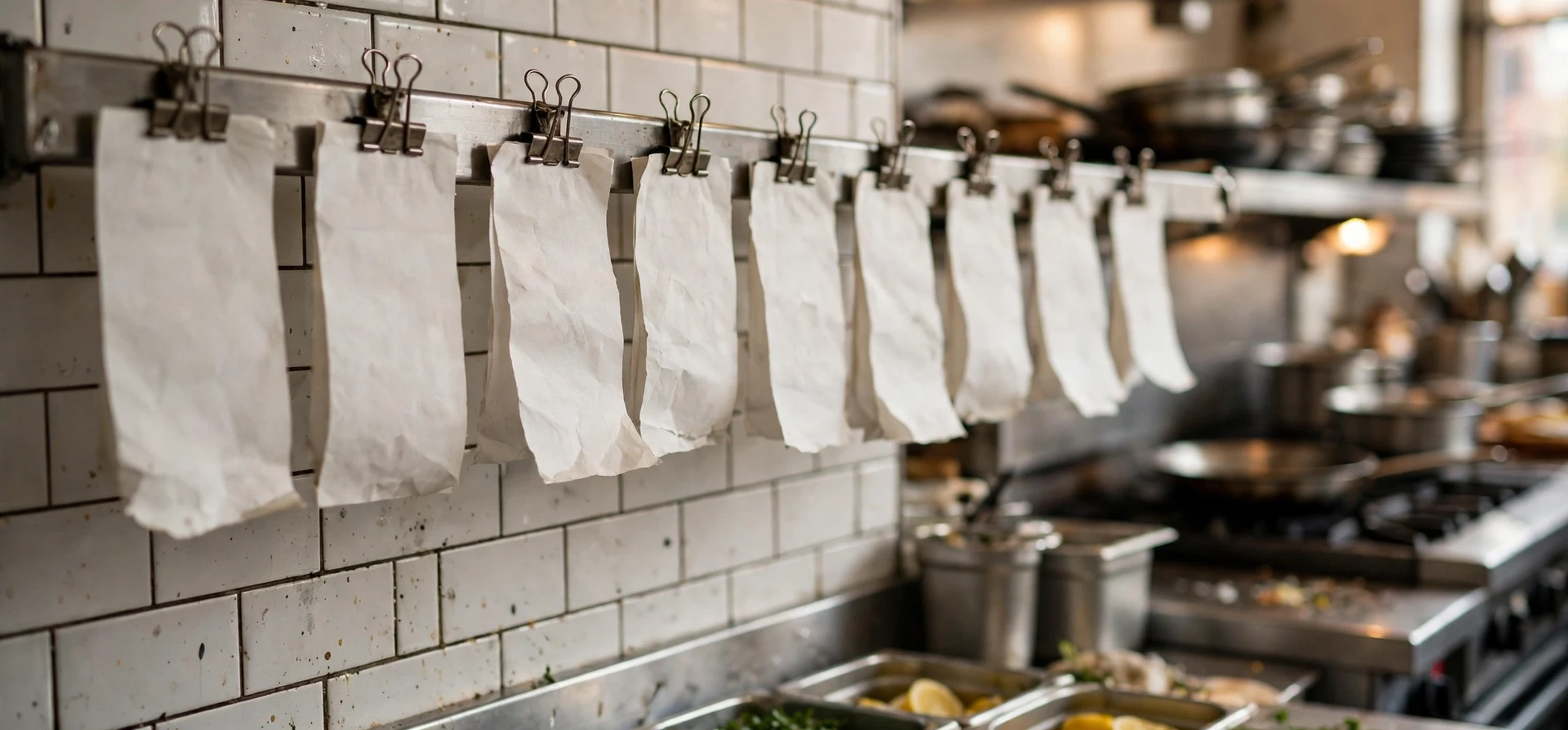
Walk into a professional kitchen during dinner service and you will hear a rhythm of short, sharp calls. Among them, one phrase does more organisational work than almost any other. The all day meaning restaurant teams use in a kitchen is the total count of one dish that is still outstanding — every portion ordered but not yet sent, added together. This article takes a different angle from a basic definition: it looks at how “all day” shapes training, timing, menu planning, and teamwork in a working kitchen, and how home cooks can borrow the idea to run a calmer dinner party.
If you are learning to cook professionally, training new staff, or simply fascinated by how restaurants cope when twenty tables order at once, this guide will show you why a two-word phrase matters so much. It is not jargon for its own sake. It is a counting system, a timing tool, and a shared language that lets a dozen people work as one team under pressure.
All Day Meaning Restaurant Teams Use as a Shared Count
The all day meaning restaurant kitchens depend on is a shared count, and the word “shared” is the key. Every cook on a station needs the same number in mind, or the kitchen will drift out of step. Suppose the grill cook thinks five steaks are owed while the sauce cook thinks three are owed. Two plates will arrive at the pass without sauce, or sauce will be made for plates that do not exist. When the pass calls “five steaks all day” and both cooks echo it, that drift is prevented before it starts.
This shared count, at the heart of the all day meaning restaurant system, also changes how cooks think about their work. Instead of seeing a single ticket as an isolated job, they see a queue with a shape: how many portions, how long each takes, and in what order they should be started. A cook who knows that seven portions of a slow dish are owed will start the earliest ones first and stagger the rest, rather than starting everything at once and overwhelming the stove. A cook who knows only one portion is owed will give it focused attention. In both cases, the all-day number sets the strategy.
The count is dish-specific, which keeps it manageable. A busy pass may carry dozens of tickets, but each station tracks only its own dishes. The fish cook tracks fish all-day counts; the pastry cook tracks dessert all-day counts. The expeditor is the one person who holds the whole picture, matching mains to sides and starters to mains, and using the counts to decide the order in which courses are fired.
All Day Meaning Restaurant Timing and the Pass
Timing is where the all day meaning restaurant count earns its keep. In a restaurant, dishes for a table should arrive together, hot, and correctly plated. That sounds simple until you consider that a table’s order may include a dish that takes four minutes, a dish that takes twelve minutes, and a side that takes six minutes. The cooks cannot all start at the same moment; the four-minute dish must wait while the twelve-minute dish gets going. The expeditor uses all-day counts, along with knowledge of cooking times, to call “fire” at the right moment for each course.
Consider a table of four whose mains include two steaks, one fish dish, and one pasta. The steaks take longest, so they are fired first. The fish follows, and the pasta — which cooks quickly — is fired last, so that everything meets on the pass together. Meanwhile, the all-day counts tell each station how many other tables are also waiting for the same dishes, so no station fires a single table’s dish in isolation and then discovers it must immediately start five more. The system balances the needs of one table against the needs of the whole room.
When service peaks, the expeditor may also use all day meaning restaurant counts to pace the dining room. If the kitchen owes forty mains all day, the front-of-house team may be asked to slow the seating of new tables slightly, or to warn guests that popular dishes will take longer. That conversation, held early, protects both guests and cooks. Without a clear count, pacing becomes guesswork, and guesswork during a rush usually ends in delays and apologies.
Training New Cooks to Think in “All Day”
For a new cook, learning the all day meaning restaurant term is often one of the first lessons in kitchen communication, and it is taught by doing rather than by lecture. A trainer will stand a newcomer beside the pass, read tickets aloud, and ask the newcomer to keep the running count for one dish. At first, the numbers slip: a sent dish is counted twice, or a new order is added to the wrong dish. With practice, the counting becomes automatic, and the newcomer begins to anticipate — noticing, for example, that a rising all-day count for chips means the fryer will need attention soon.
Good trainers also teach the call-back habit from day one. The newcomer repeats the dish and the count loudly and clearly, even if it feels unnatural. That repetition is not about volume for its own sake; it is a check. In a kitchen with extractor fans, clattering pans, and music from the dining room, a number can easily be misheard. A call-back gives the caller a second chance to catch an error before food is wasted or a table is kept waiting.
Trainers also warn against a subtle trap: counting what has already been cooked. A newcomer who has just plated three portions may proudly report a high count that includes those three, inflating the total. The rule is drilled until it is instinctive: all day counts only what is still owed. Sent food is history, however good it looked on the plate.
Simple Drills That Build the Habit
One useful drill is to run a mock service with paper tickets. The trainer reads orders at increasing speed, and the trainee keeps a tally for two or three dishes, updating it as dishes are “sent.” Another drill pairs two trainees: one calls orders, the other calls back, and they swap roles after ten minutes. A third drill introduces a sudden change — a dish runs out mid-service — and the trainee must adjust the count and communicate the change clearly. These exercises feel artificial, but they build the mental muscle that a real rush demands.
How “All Day” Connects to Menu Design and Stock
Menu design and the all day meaning restaurant counts are linked more closely than many diners realise. A menu with many dishes that share a station — for example, six different grill items — will produce high, fast-moving all-day counts on that station during a rush, while other stations sit quiet. A thoughtful menu balances the load, spreading dishes across stations so that no single count becomes unmanageable. Chefs who design menus with service in mind think about this balance, not just about flavour.
Stock control follows the same all day meaning restaurant logic. If a dish regularly reaches an all-day count of twenty on a Friday night, the kitchen knows to prepare enough components for at least that many, plus a margin. If a dish rarely exceeds five all day, preparing twenty portions in advance would waste food. Over weeks, all-day patterns reveal which dishes are true bestsellers, which are steady sellers, and which are occasional treats — information that shapes ordering, preparation, and even whether a dish stays on the menu.
Seasonal changes add another layer. A warming stew that barely registers in summer may dominate all-day counts in winter, while a cold starter may do the reverse. Kitchens that track these patterns informally, through the counts they hear each service, adjust their preparation without needing a spreadsheet. The language of service becomes a form of everyday data.
Variations, Cousins, and Common Confusions
The all day meaning restaurant term is sometimes confused with related terms. “On order” refers to a single new ticket, not the total. “Sold” or “in the window” may refer to dishes already plated or sent. “86” means an item is finished and cannot be ordered. Keeping these distinct matters: a cook who confuses “on order” with “all day” will undercook, while one who confuses “all day” with “sold” will overcook.
Regional and house variations also exist. Some kitchens call the total “all day” only when a new order arrives; others update it after every course is sent. Some use “all day” for food and a different phrase for drinks. A cook moving between kitchens should listen for the first few services and adapt to the house style, rather than assuming every kitchen uses the phrase identically. The underlying idea — a shared outstanding total — stays constant, even if the exact calling rhythm differs.
Home cooks can borrow the all day meaning restaurant idea without the shouting. When cooking for a group, write down how many portions of each dish are still needed, update the list as plates go out, and use it to decide what to start next. A dinner party for twelve feels chaotic when orders are held in memory; it feels manageable when the outstanding count is visible on a notepad by the stove. The professional system scales down surprisingly well.
| Situation | What “all day” tells the team | Action it prompts |
|---|---|---|
| Count rising fast for one dish | Demand is spiking | Prep more components; check stock |
| Count steady but high | A long queue is owed | Stagger starts by cooking time |
| Count falling to zero | The dish is clearing | Reset preparation for the next wave |
| Count exceeds remaining stock | A shortage is coming | Warn front of house; consider 86ing the dish |
What “All Day” Means for Diners
Diners rarely hear the all day meaning restaurant phrase directly, but they feel its effects. A kitchen that counts well serves food hotter, faster, and more accurately, because cooks are not caught by surprise. Tables receive their dishes together, rather than one guest eating while others wait. Popular dishes are less likely to run out without warning, because the kitchen spots a rising count early and tells the dining room in time.
For front-of-house staff, knowing the concept helps with honest communication. Instead of a vague “the kitchen is busy,” a waiter who understands all-day counts can say that a dish is in high demand and will take a little longer, and can suggest a quicker alternative without guessing. Guests generally accept a wait when it is explained early and accurately; they resent a wait that comes as a surprise after twenty silent minutes.
Readers curious about kitchen preparation can explore our guide to slow-cooked dishes and their preparation, which explains why some all-day counts need longer lead times, and our overview of coordination and operations roles, which shows how the expeditor’s job mirrors operations roles in other businesses.
Frequently Asked Questions
How is “all day” different from a single order?
A single order is one ticket. “All day” is the sum of that ticket plus every earlier ticket for the same dish that has not yet been sent.
Can home cooks use “all day”?
Yes. Keep a visible tally of portions still needed for each dish, update it as food is served, and use it to decide cooking order. It prevents both shortages and waste.
What happens when the all-day count exceeds stock?
The kitchen warns front of house and may 86 the dish — remove it from sale — rather than accept orders it cannot fulfil.
How long does it take a new cook to learn this?
The idea takes minutes to understand and a few busy services to make automatic. Calling back and updating counts under pressure is the part that takes practice.
Conclusion
The all day meaning restaurant kitchens use in a working kitchen is far more than a colourful phrase: it is a shared outstanding count that shapes timing, training, menu balance, and stock control. It lets an expeditor fire courses so they arrive together, lets cooks stagger long and short dishes sensibly, lets trainers teach newcomers to think in queues rather than single tickets, and lets front-of-house staff give guests honest timings. Borrowed at home, the same tally turns a chaotic dinner party into a calmer one. Whether shouted across a pass or scribbled on a notepad by the stove, counting what is still owed — and only what is still owed — is one of the simplest disciplines that separates a smooth service from a frantic one.



