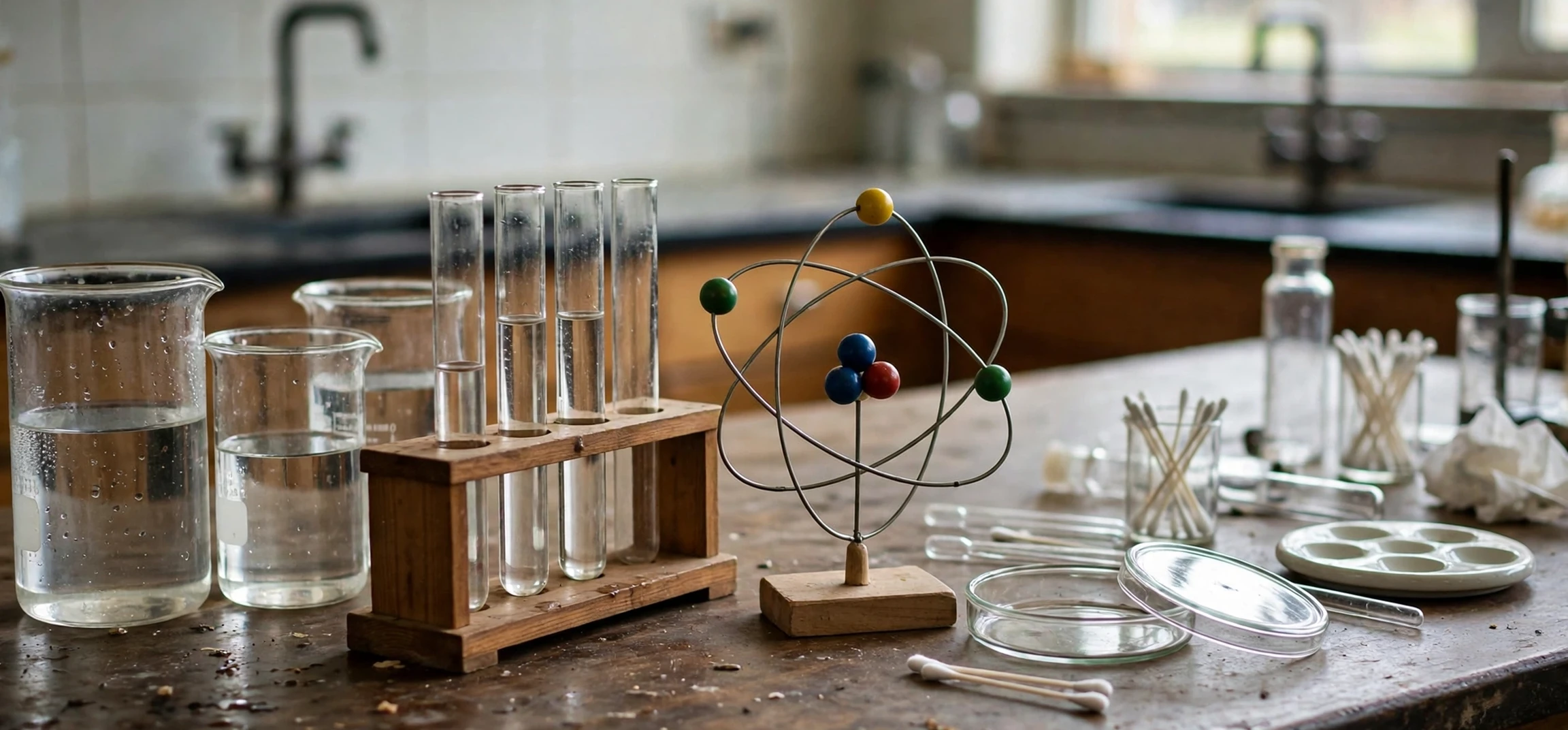
If you searched for ion is what, you are asking one of the most useful questions in basic chemistry: what exactly is an ion, and why does it matter? In short, an ion is an atom, or a group of atoms, that carries an electric charge because it has gained or lost one or more electrons. That single change transforms a neutral particle into a charged one, and charged particles behave very differently from neutral ones. They attract, repel, dissolve, conduct electricity, and take part in chemical reactions in ways that shape everything from table salt to the batteries in everyday devices and the chemistry inside living cells.
This guide explains ions in plain language, without assuming prior chemistry knowledge. It covers how ions form, the difference between positive and negative ions, common examples, and where ions appear in daily life. By the end, you should be able to recognise an ion in a formula, explain why it carries a charge, and understand why chemists treat ions as a separate and important category of particle.
What ‘ion is what’ Means in Science
When someone asks “ion is what”, they are usually looking for a simple definition rather than a technical lecture. The definition is straightforward: an ion is a charged atom or molecule. A normal atom is electrically neutral because it contains equal numbers of positively charged protons and negatively charged electrons. If that balance changes, the atom is no longer neutral. It becomes an ion.
The key point is that the number of protons does not change when an ion forms. Protons sit in the nucleus and identify the element. Sodium, for example, always has eleven protons. What changes is the number of electrons, which sit outside the nucleus and are much easier to gain or lose. Lose an electron and the positive protons outnumber the negative electrons, giving a positive charge. Gain an electron and the negative electrons outnumber the positive protons, giving a negative charge.
Ions can also be made of several atoms joined together. These are called polyatomic ions. A familiar example is the hydroxide ion, made from one oxygen atom and one hydrogen atom together carrying a single negative charge. Another is the ammonium ion, made from one nitrogen atom and four hydrogen atoms together carrying a single positive charge. In both cases, the group behaves as one charged unit in chemical reactions, even though it contains more than one atom.
Scientists write ions using a small raised symbol, called a superscript, after the chemical symbol. A sodium ion is written as Na with a plus sign, a chloride ion as Cl with a minus sign, and a calcium ion as Ca with two plus signs. The number of plus or minus signs tells you how many electrons were lost or gained. A double charge means two electrons were involved, not one.
Why People Search for ‘ion is what’
The phrase “ion is what” is a natural search query, and it usually comes from a student, a curious reader, or someone who has met the word in another context and wants a plain answer. Ions appear in school science, in news stories about batteries, in discussions of water quality, and on product labels for air purifiers and water softeners. Because the word is used in so many places, it is easy to meet it long before anyone explains it properly.
There is also a common source of confusion: the word “ion” sounds like several other words, and it is used as part of longer terms such as “ionisation”, “ionic bond”, and “ion exchange”. Each of those terms builds on the same basic idea, which is a charged particle. Once you understand that core idea, the longer terms become much easier to follow. Ionisation is the process of forming ions. An ionic bond is the attraction between oppositely charged ions. Ion exchange is a process in which one ion is swapped for another, often used in water treatment.
Another reason the question matters is that ions are not an abstract idea confined to textbooks. Your body depends on ions every moment. Nerve signals, muscle contraction, and fluid balance all involve the movement of charged particles such as sodium, potassium, and calcium ions. That does not make ions mysterious. It makes them a good example of how a small change at atomic level can have large effects at human level.
How Ions Form
Ions form when electrons move. Atoms can lose electrons, gain electrons, or share them in ways that leave a charge behind. The most common routes are worth learning separately, because they explain most everyday examples.
First, an atom may lose one or more electrons. Metals are particularly likely to do this. Sodium loses one electron to become a sodium ion with a single positive charge. Magnesium loses two electrons to become a magnesium ion with a double positive charge. Aluminium loses three electrons to become an aluminium ion with a triple positive charge. In each case, losing negatively charged electrons leaves the atom with a net positive charge.
Second, an atom may gain one or more electrons. Non-metals are particularly likely to do this. Chlorine gains one electron to become a chloride ion with a single negative charge. Oxygen gains two electrons to become an oxide ion with a double negative charge. Gaining negatively charged electrons leaves the atom with a net negative charge.
Third, energy can knock electrons off atoms. High-energy radiation, strong electric fields, and very high temperatures can all strip electrons away, leaving positively charged ions behind. This is one reason ions are important in physics and astronomy as well as chemistry. Stars, lightning, and flames all contain ions, because the energy involved is enough to disturb the electron balance of atoms.
Finally, molecules can split into ions when they dissolve. When table salt dissolves in water, it does not simply vanish. It separates into sodium ions and chloride ions, each surrounded by water molecules. This is why salt water conducts electricity while pure water conducts it very poorly. The dissolved ions are free to move, and moving charges carry electric current.
Cations and Anions: Positive and Negative Ions
Chemists use two special names for ions, and learning them saves a great deal of confusion later. A positively charged ion is called a cation. A negatively charged ion is called an anion. A simple way to remember the difference is that a cation is positive, and the letter “t” in cation looks a little like a plus sign. An anion is negative, and its name begins with the same letter as “negative”.
Cations are usually formed from metals, although the ammonium ion is an important exception. Common cations include sodium, potassium, calcium, magnesium, iron, copper, and zinc ions. Many of these play roles in nutrition, industry, and medicine, but the important point for a beginner is simply that they carry a positive charge.
Anions are usually formed from non-metals or from groups of atoms. Common anions include chloride, fluoride, oxide, sulfide, nitrate, sulfate, carbonate, and hydroxide ions. Again, the names matter less at first than the pattern: a negative charge, formed by gaining electrons or by a group of atoms carrying an overall negative charge.
Opposite charges attract. That attraction is the basis of ionic bonding. When sodium ions and chloride ions come together, their opposite charges pull them into a regular, repeating structure called a crystal lattice. That lattice is what we recognise as a grain of salt. The bond is not a shared pair of electrons, as in a covalent bond. It is an electrical attraction between two charged particles.
| Ion type | Charge | How it forms | Examples |
|---|---|---|---|
| Cation | Positive | Loses electrons | Sodium, potassium, calcium, magnesium |
| Anion | Negative | Gains electrons | Chloride, fluoride, oxide, sulfide |
| Polyatomic cation | Positive | Group of atoms with a net positive charge | Ammonium |
| Polyatomic anion | Negative | Group of atoms with a net negative charge | Hydroxide, nitrate, sulfate, carbonate |
Ions in Everyday Life
Ions are far more common in daily life than most people realise. The salt on a dinner table is an ionic compound. The water from a tap contains small amounts of dissolved ions, including calcium and magnesium ions that make water “hard”. A water softener works by exchanging calcium and magnesium ions for sodium ions, which do not form the same chalky deposits.
Batteries are another everyday example. A battery stores chemical energy and releases it as electricity, and that process depends on ions moving inside the battery. In a rechargeable battery, ions move one way during charging and the other way during use. Without mobile ions, the battery could not carry current through its internal chemistry, even though electrons carry current through the external wire.
Inside the human body, ions are essential. Sodium and potassium ions help nerve cells send signals. Calcium ions help muscles contract and help blood clot. Hydrogen ions influence acidity, which is why pH is often described in terms of hydrogen ion concentration. None of this requires memorising every ion. It simply shows that charged particles are part of normal biology, not only of laboratory chemistry.
Ions also appear in the air. Lightning creates ions in the atmosphere. So do flames and some electrical equipment. Products marketed as “ionisers” claim to add ions to the air, and readers who meet such claims should check them against the guidance of a reputable consumer or standards body rather than taking marketing language at face value. The science of ions is solid. The claims made for particular products are a separate question.
For a broader look at how particles join together, see this guide to molecules in chemistry, and for the wider background, this explanation of the meaning of matter in science.
Ions and Ionic Compounds
When cations and anions combine, they form ionic compounds. These compounds have several typical properties, and those properties follow directly from their structure. Because the ions are held together by strong electrical attraction in a lattice, ionic compounds often have high melting points. A great deal of heat is needed to break the lattice apart.
Ionic compounds are usually brittle rather than flexible. If a crystal is struck, layers of ions can shift so that ions of the same charge end up next to each other. Like charges repel, so the crystal cracks rather than bending. This is very different from a metal, which can bend because its structure allows layers to slide without bringing like charges together in the same way.
Many ionic compounds dissolve in water, and when they do, the lattice breaks apart and the ions become free to move. That is why a solution of an ionic compound usually conducts electricity, while the solid compound usually does not. In the solid, the ions are locked in place. In solution, they can move and carry charge.
Not every ionic compound dissolves easily. Some, such as calcium carbonate, dissolve only slightly in water. That low solubility matters in geology, where calcium carbonate forms limestone and chalk, and in everyday life, where it forms limescale in kettles and pipes. Solubility is therefore a property to check for each compound, rather than a rule that applies to every ionic substance.
Common Mistakes About Ions
One common mistake is to think that an ion is a different element from the atom it came from. It is not. A sodium ion is still sodium in the sense that it still has eleven protons. What has changed is its charge and therefore its behaviour. A sodium atom reacts violently with water. A sodium ion dissolved in water is stable and harmless in the small amounts found in food. The charge changes the chemistry completely, even though the element stays the same.
Another mistake is to confuse ions with isotopes. Isotopes differ in the number of neutrons, which are neutral particles in the nucleus. Ions differ in the number of electrons. An atom can be both an isotope and an ion at the same time, but the two ideas describe different changes. Neutrons affect mass. Electrons affect charge.
A third mistake is to assume that every charged particle is an ion. Electrons themselves carry a charge, but they are not ions. Protons carry a charge, but they are not ions either. An ion is specifically an atom or a molecule that carries a charge because its electron count differs from its proton count. Keeping that definition in mind prevents a great deal of confusion.
Finally, many readers assume that ions are always dangerous because they are “charged”. Charge alone does not make something harmful. Many ions are essential nutrients. Others are harmful in large amounts but harmless in small ones. As with most chemistry, the dose, the specific ion, and the context matter far more than the word “charged” on its own.
Frequently Asked Questions About Ions
Is an ion an atom?
An ion is an atom, or a group of atoms, that has gained or lost electrons and therefore carries an electric charge. A neutral atom has equal numbers of protons and electrons. An ion does not.
What is the difference between a cation and an anion?
A cation carries a positive charge because it has lost electrons. An anion carries a negative charge because it has gained electrons, or because a group of atoms carries an overall negative charge.
Can a molecule be an ion?
Yes. A group of atoms that carries an overall charge is called a polyatomic ion. Hydroxide, ammonium, nitrate, and sulfate are common examples.
Why does salt water conduct electricity?
Dissolved salt separates into sodium and chloride ions. Those ions are free to move through the water, and moving charged particles carry electric current. Pure water contains very few ions, so it conducts electricity very poorly.
Are ions found in the human body?
Yes. Sodium, potassium, calcium, and chloride ions all play roles in nerve signalling, muscle contraction, fluid balance, and other normal functions. They are a normal part of body chemistry.
Conclusion
So, ion is what, in the simplest possible terms? An ion is a charged atom or molecule, formed when electrons are gained or lost so that the numbers of protons and electrons no longer balance. Positive ions are cations, negative ions are anions, and groups of atoms can also form polyatomic ions. Those charged particles join into ionic compounds, dissolve in water, carry current in batteries, and keep the chemistry of living things working. Once that core idea is clear, the rest of chemistry becomes much easier to read, because ions appear in almost every chapter that follows.



