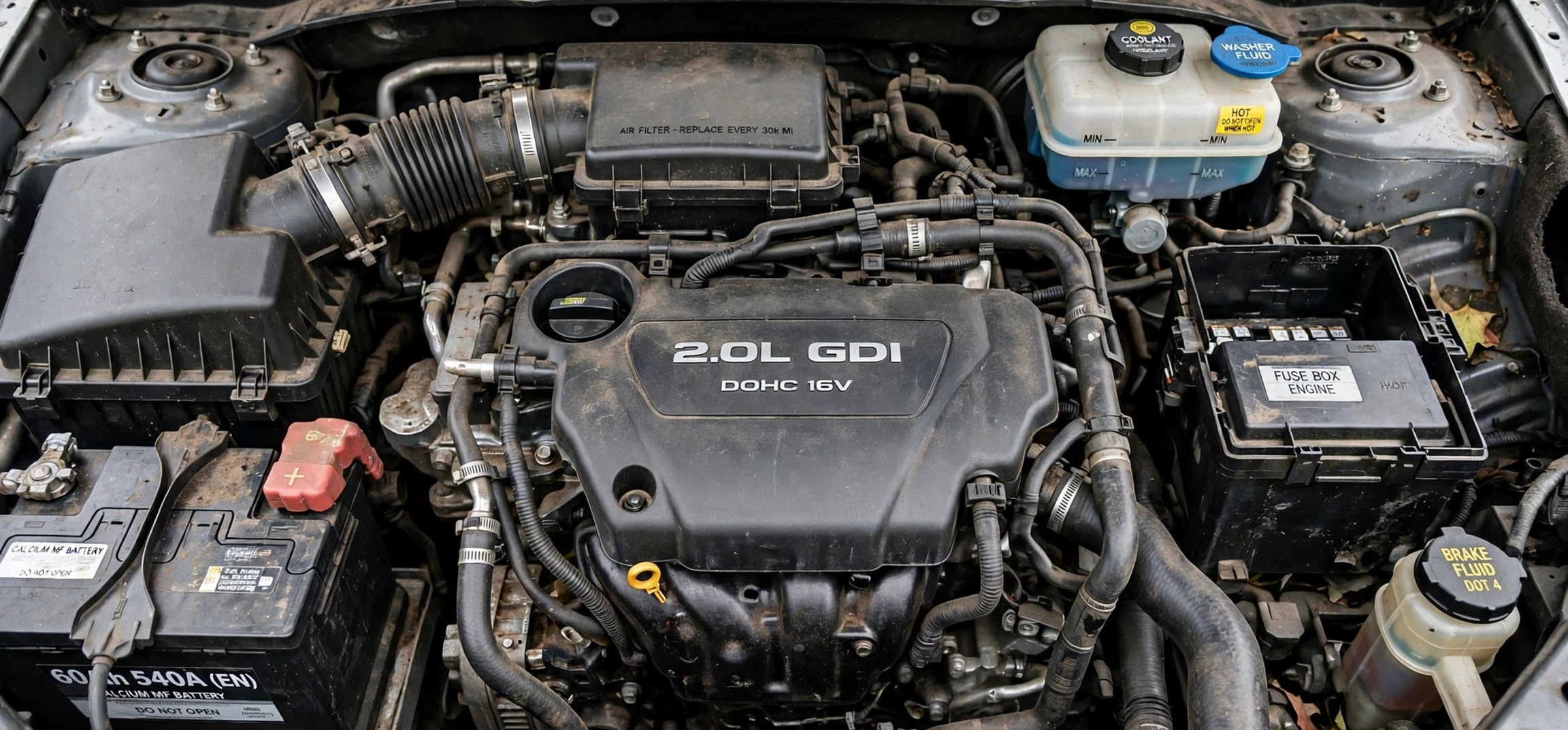
If you searched for “what does the liter of an engine mean”, you are asking about the number, such as 2.0L or 3.5L, that appears in car specifications and badges. That number is the engine’s displacement, measured in litres, and it tells you the total volume swept by all the pistons inside the engine’s cylinders. This guide explains what engine litres mean, how displacement relates to power and fuel use, and why the number matters less than it once did.
What Does the Liter of an Engine Mean? The Measurement
An engine’s displacement is the total volume of air and fuel mixture that its cylinders can draw in during one complete cycle. Each cylinder contributes its own swept volume, calculated from the cylinder’s bore, the diameter, and its stroke, the distance the piston travels. Add up all the cylinders and you get the displacement, usually expressed in litres or cubic centimetres, where 1,000 cubic centimetres equals one litre.
A 2.0-litre four-cylinder engine therefore has four cylinders of roughly 500 cubic centimetres each, while a 3.5-litre V6 has six cylinders of roughly 583 cubic centimetres each. The litre figure is a summary of the engine’s physical size, not a direct measure of its power, though historically the two were closely related.
Do More Litres Mean More Power?
Traditionally, yes, more litres meant more power, because a bigger engine burns more fuel and air per cycle and therefore produces more energy. A large V8 from decades ago typically produced far more power than a small four-cylinder of the same era, and buyers used displacement as a rough proxy for performance. That relationship still holds in broad terms, but modern technology has weakened it considerably.
Turbocharging and supercharging force extra air into the cylinders, letting a small engine produce the power of a much larger one. Direct fuel injection, variable valve timing, and higher compression ratios have added further gains. As a result, a modern turbocharged 2.0-litre engine can outperform an older naturally aspirated 3.5-litre engine, and comparing litre figures across eras, or across turbocharged and non-turbocharged engines, can mislead.
Why Cars Carry Litre Badges
Manufacturers display engine size on badges and in model names because buyers have long used it as shorthand for performance and prestige. A badge reading 3.0 suggests something more potent than a badge reading 1.6, and marketing has reinforced that association for decades. Some manufacturers, however, now use badges that no longer match displacement, instead reflecting a performance tier or an equivalent power level, which has made badges less reliable as a guide.
Electric vehicles have complicated the picture further, since they have no displacement at all. Their badges use numbers that evoke performance tiers rather than litres, and their power is quoted in kilowatts. The litre figure therefore belongs to the combustion era, and its importance is fading as the market electrifies.
Litres, Fuel Economy, and Tax
Larger displacement generally means higher fuel consumption, because more fuel is burned per cycle, though driving style, vehicle weight, and aerodynamics matter as much. That is why smaller engines dominate economy cars and why regulators in some countries tax vehicles partly by engine size. A buyer comparing two similar cars can reasonably expect the smaller-engined one to use less fuel in gentle driving, while the larger-engined one may be more relaxed at motorway speeds because it works less hard.
Running costs also interact with displacement through insurance and tax bands in some markets. Before buying, check the official figures for the specific model rather than relying on the litre number alone, since two engines of the same size can differ greatly in efficiency.
| Engine size | Typical layout | Common use |
|---|---|---|
| 1.0-1.6 litres | 3 or 4 cylinders | City cars, economy models |
| 1.8-2.5 litres | 4 cylinders, often turbocharged | Family cars, crossovers |
| 3.0 litres and above | 6 or 8 cylinders | Performance and large vehicles |
What Does the Liter of an Engine Mean for Buyers?
For buyers, the litre figure is a starting point, not a verdict. Test driving matters more, because it reveals how the engine feels: its responsiveness, noise, and smoothness in real conditions. A small turbocharged engine can feel lively in town but strained when fully loaded, while a larger engine may feel effortless everywhere but cost more to run. Neither is universally better; the right choice depends on how you drive.
Also consider the future. As cities introduce emissions zones and manufacturers shift to hybrid and electric models, a car’s long-term costs and resale value depend on more than its engine size. Hybrid systems, which pair a small combustion engine with electric assistance, are a good example: they often carry a modest litre figure while delivering strong performance and economy.
For more motoring explainers, see our guide to how technical terms are defined and our article on how classifications work.
Frequently Asked Questions
What does 2.0L mean on a car?
It means the engine’s total displacement is 2.0 litres, the combined swept volume of all its cylinders.
Is a bigger litre engine always better?
No. Turbocharging and modern engineering mean smaller engines can outperform larger older ones, and bigger engines usually cost more to run.
Do electric cars have litres?
No. Electric motors have no displacement, so litre figures do not apply; power is measured in kilowatts.
A Brief History of Displacement
Displacement became the standard measure of engine size in the early twentieth century, when carmakers needed a simple way to compare engines and regulators needed a basis for taxation. Early engines were large and inefficient, so displacement correlated strongly with power, and the litre figure became a badge of prestige. The classic American V8s of the 1960s, often displacing five litres or more, embodied that era, when fuel was cheap and efficiency was an afterthought.
The oil crises of the 1970s changed the equation, pushing manufacturers toward smaller, more efficient engines, and the turbocharging revolution of recent decades has completed the shift. Today a 1.5-litre turbocharged engine can deliver the performance once expected of a 2.5-litre unit, and the litre figure survives mainly as tradition. Its history explains why it still appears on badges even as its technical importance fades.
Cylinders, Layouts, and Sound
Displacement alone does not determine an engine’s character; cylinder count and layout matter too. A 2.0-litre four-cylinder feels different from a 2.0-litre six-cylinder, which is smoother but rarer, and both differ from a V8 of any size. Enthusiasts often choose engines by sound and smoothness as much as by power figures, which is why the same displacement can inspire very different reactions in different cars.
Layout also affects packaging. Inline engines are simple and compact, V engines are shorter and suit larger cars, and flat engines lower the centre of gravity. These engineering choices interact with displacement to produce the driving experience, and they explain why two cars with identical litre badges can feel entirely different on the road.
The Future Beyond Litres
As electrification spreads, the litre figure is gradually being replaced by kilowatts, battery capacity in kilowatt-hours, and range figures. Hybrid cars sit in between, quoting both a litre figure for their combustion engine and electrical figures for their motors, which can confuse buyers. The lesson is to focus on outcomes, acceleration, economy, range, and running costs, rather than on any single specification number.
For enthusiasts, the litre era will be remembered fondly, and classic cars will keep their badges as historical markers. For everyday buyers, the transition means learning a new vocabulary, but the underlying questions remain the same: how does it drive, what does it cost to run, and does it suit my needs.
Comparing Specifications Fairly
When comparing cars, the litre figure should sit alongside power, torque, weight, and fuel economy figures, not replace them. Torque, the twisting force that determines how strongly a car pulls, matters as much as power for everyday driving, and it is often available at lower engine speeds in turbocharged or diesel engines. A car with modest power but strong low-speed torque can feel quicker in town than a more powerful car that needs high revs.
Weight is the other great equaliser. A light car with a small engine can outperform a heavy car with a larger one, which is why sports car makers obsess over weight reduction. Reading specifications as a set, rather than fixating on one number, is the habit that leads to good buying decisions.
Ultimately, the litre figure is best treated as background information. It tells you how big an engine is, which is interesting and sometimes useful, but it does not tell you how a car drives, how much it costs to run, or whether it suits your life. Those answers come from specifications read together, reviews, and above all a test drive.
Conclusion
What the liter of an engine means is straightforward: it is the engine’s displacement, the total cylinder volume, expressed in litres. It remains a useful shorthand for engine size, but modern turbocharging, hybrid systems, and electrification mean it no longer tells the whole story. Judge an engine by its real-world performance, efficiency, and suitability for your driving, with the litre figure as one clue among several.