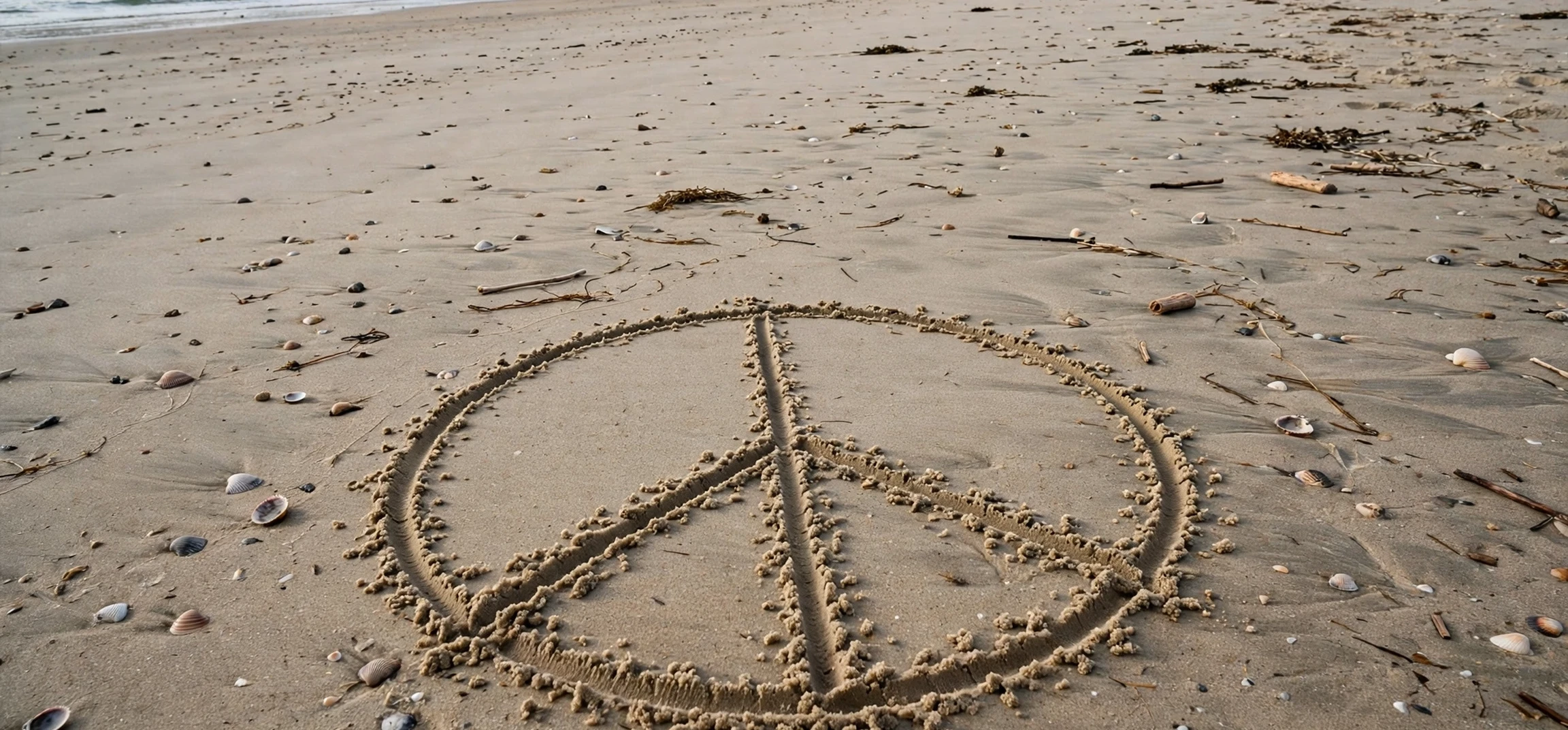
One of the most recognised symbols in the world is a simple circle with lines inside it, yet many people still ask: where did the peace sign originate from? The short answer is that the modern peace symbol was designed in Britain in 1958 for the nuclear disarmament movement, and it later became a wider emblem of peace, protest, and hope. Its story, however, is richer than a single date, and it is the full story behind where did the peace sign originate from. It involves semaphore signals, a designer with a clear purpose, a march that carried the symbol into public life, and decades of reuse by very different groups. This guide explains where the symbol came from, what its lines mean, how its meaning changed, and how to use it respectfully and accurately today.
To understand the symbol, start with its shape. It is a circle with a vertical line running down the centre and two diagonal lines branching downwards from the middle. That design was not chosen at random, which is why asking where did the peace sign originate from leads to a designer, a date, and a purpose rather than to folklore. Its creator combined two semaphore positions: one for the letter N and one for the letter D, standing for nuclear disarmament. In semaphore, a person holds flags in particular positions to signal letters. For N, the flags point downwards and outwards; for D, one flag points up and one points down. Superimposed inside a circle, those positions create the familiar design. The circle itself was understood as a symbol of the earth, or of wholeness, which suited a campaign concerned with the future of humanity.
It is also worth clearing up a common confusion. The peace symbol is not the same as the two-fingered peace gesture, although the two are often used together and both are associated with peace in popular culture. The hand gesture has its own history, including its use as a victory sign in earlier decades. The drawn symbol discussed here has a specific, documented origin in the late 1950s, and that distinction matters when you are writing about history, designing educational material, or explaining the symbol to children. Knowing where did the peace sign originate from helps you avoid turning a precise historical design into a vague decoration.
Where Did the Peace Sign Originate From?
The modern peace sign originated from the work of British designer and artist Gerald Holtom, who created it in 1958 for the Campaign for Nuclear Disarmament in Britain. The campaign was preparing a march from London to Aldermaston, the site associated with atomic weapons research, and it needed a symbol that could be carried on banners and badges. Holtom’s design was first used on that Easter march, and it quickly became recognisable because it was simple, bold, and easy to reproduce by hand. People could draw it, paint it, sew it, and print it without special equipment, which helped it spread beyond the original march.
Holtom later explained his thinking in personal terms as well as in semaphore terms. He described a figure with arms lowered in despair, echoing the pose of a person in distress, placed within a circle. Whether readers emphasise the semaphore explanation, the human-figure explanation, or both, the core point is the same: the symbol was deliberately designed to express opposition to nuclear weapons and a desire for a peaceful future. It was not an ancient symbol rediscovered by accident, and it was not originally a general logo for every kind of peace campaign — a distinction that answers where did the peace sign originate from more accurately than folklore does. Its specific beginning gives it its power, and later uses build on that beginning rather than replacing it.
The march itself matters to the story of where did the peace sign originate from, because it gave the new design its first public audience. A symbol gains meaning when people carry it together, and the Aldermaston march gave the design its first public audience. Marchers, photographers, and journalists spread the image, and the campaign adopted it more widely. From Britain, it travelled to other countries and other movements, partly because the fear of nuclear war was international and partly because the design crossed language barriers. A person did not need to read English to recognise the circle and lines, and that visual simplicity remains one of the reasons the symbol is still in use today, long after the original answer to where did the peace sign originate from was first carried on a march.
Where Did the Peace Sign Originate From in Popular Culture?
By the 1960s, the peace symbol had moved well beyond its original campaign. It became closely associated with opposition to the Vietnam War, with youth culture, and with a broader counterculture that valued non-violence, civil rights, and environmental care. Musicians, artists, and protesters adopted it, and it appeared on clothing, posters, album art, and placards. That wider adoption changed how many people understood the symbol: for some, it still meant nuclear disarmament specifically; for others, it had become a general sign of peace, love, and resistance to war. Both readings have historical roots, but the second is broader than the first, and careful writers answering where did the peace sign originate from should say which meaning they intend.
Popular culture also created misunderstandings. Some later claims linked the symbol to ancient runes, to unrelated religious traditions, or to secret meanings, but the documented 1958 design is the reliable account of its origin. When a symbol becomes famous, people often invent older histories for it, sometimes innocently and sometimes to discredit it. Checking the designer’s own explanation and the campaign’s records is the best way to separate history from folklore about where did the peace sign originate from. Teachers, journalists, and content creators can help readers by naming Holtom, naming 1958, and naming nuclear disarmament, rather than repeating a vague claim that the symbol is simply ancient.
Another cultural change is commercial use. Today the peace symbol appears on fashion, homeware, jewellery, and social media graphics, often with no political message at all. That does not erase its history, but it does mean context matters. A peace symbol on a protest banner and the same symbol on a fashion print are not making the same statement, even though the shape is identical. Readers should therefore pay attention to where a symbol appears, who is using it, and what words surround it. Meaning in real life is rarely carried by a shape alone; it is carried by shape plus context, and the peace symbol is a clear example of that principle.
What the Peace Sign Means Today
Today, the peace sign is most commonly understood as a general emblem of peace and non-violence. It is used in anti-war protests, in educational materials about conflict resolution, in art about hope and reconciliation, and in personal expression by people who value calm, kindness, and cooperation. It is also used in memorial contexts, where it can express grief and a wish that violence will not be repeated. In all of these uses, the symbol draws on its original association with disarmament, even when the immediate issue is different. That continuity is part of why it still feels meaningful rather than merely decorative.
At the same time, the symbol can be interpreted differently in different places and communities. In some contexts, it is seen as a political statement; in others, it is seen as a harmless, even nostalgic, image. Some people associate it strongly with a particular generation or movement, while younger users may encounter it first through fashion or digital stickers. None of these readings is automatically wrong, but they show why a single symbol cannot be reduced to a single dictionary definition. When you use the peace sign, consider your audience and your purpose, and add words where clarity matters. A short caption can prevent a well-meaning design from being misunderstood, especially when readers are still learning where did the peace sign originate from.
There is also a practical point for designers and educators. Because the symbol is simple, it is easy to draw badly or to alter in ways that change its appearance. The vertical line should run through the centre, and the two diagonal lines should branch downwards from the middle, not upwards — the accurate form of the symbol whose origin is explained by where did the peace sign originate from. An upside-down version looks different and has sometimes been given different interpretations, so accuracy matters if you are teaching history or producing educational material. Drawing the symbol carefully is a small act of respect for its origin and for the people who first carried it, and for the history behind where did the peace sign originate from.
Peace Sign Variants and Common Misunderstandings
Several related symbols are often confused with the peace sign, and keeping them apart improves accuracy. The peace gesture made with two fingers is a hand sign, not the drawn circle symbol, and it has its own varied history. The dove, the olive branch, and the rainbow flag are also peace-related emblems, but they come from different traditions and carry different associations. The circle-and-lines design is distinct because it has a named designer, a dated origin, and a specific campaign purpose. Naming those details is the simplest way to avoid confusion in writing and teaching about where did the peace sign originate from.
Another misunderstanding concerns ownership. The peace symbol was not copyrighted as a commercial logo in the usual sense, and it has long been treated as a public emblem available for campaigning and educational use. That openness helped it spread, but it also means anyone can use it for purposes the original campaign might not have endorsed — a point worth noting when explaining where did the peace sign originate from to new readers. Commercial use is therefore not proof of political meaning, and political use is not proof of commercial intent. Readers should judge each use on its own context, rather than assuming every appearance carries the same message.
| Question | Short answer | Detail to remember |
|---|---|---|
| When was it designed? | 1958 | For the British nuclear disarmament campaign |
| Who designed it? | Gerald Holtom | A British designer and artist |
| What do the lines mean? | Semaphore for N and D | Nuclear disarmament, inside a circle |
| Where was it first carried? | The Aldermaston march | From London, at Easter 1958 |
| What does it mean now? | Peace and non-violence, broadly | Meaning depends on context and use |
For readers interested in how symbols and meanings are explained, see our guides to symbol meanings in everyday culture, what flag colours and symbols can communicate, and how number and image meanings are interpreted. Each takes the same approach: start with documented origin, then explain how meaning changes in use.
Using the Peace Sign in Education and Everyday Life
In classrooms, the peace sign offers a useful lesson in visual literacy, and the question where did the peace sign originate from is an ideal starting point for that lesson. Pupils can learn that symbols are designed, not found; that a simple shape can carry a serious message; and that meanings change as symbols travel. A teacher might ask learners to draw the symbol accurately, to explain the semaphore idea, and to discuss how the same image can appear in a protest, a history textbook, and a fashion shop. That discussion encourages critical thinking without requiring any political agreement. It also shows why sources matter: a claim about a symbol should be checked against its history, not accepted because it sounds interesting.
In everyday life, people use the peace sign to express values, to remember history, and to connect with others who share a wish for non-violence. It appears at vigils, in community art, in charity campaigns, and in personal jewellery or tattoos. If you choose to wear or display it, it helps to know its story, so you can answer questions about it honestly. You do not need to agree with every group that has used it, and you do not need to use it only in its original sense, once you understand where did the peace sign originate from. You do, however, benefit from knowing that its origin was specific, serious, and hopeful: a designer trying to give a campaign a clear, humane emblem at a time of real fear about nuclear war.
Finally, it is worth reflecting on why this symbol has lasted while many campaign logos have faded. Its simplicity makes it memorable. Its circle suggests wholeness and care for the world. Its lines tell a coded story for those who know the semaphore explanation, while remaining striking for those who do not. And its history connects personal expression with collective action, because it was made to be carried by ordinary people walking together. Those qualities explain why a question first asked in 1958 — how can we show our desire for peace? — still finds an answer in a circle and three lines.
Answering Where Did the Peace Sign Originate From for Students and Writers
When students and writers ask where did the peace sign originate from, they usually want a clear, citable answer, not a vague claim about ancient history. The clear answer is that where did the peace sign originate from has a documented starting point: Britain in 1958, a designer named Gerald Holtom, and a campaign for nuclear disarmament. Giving those three details — place, person, and purpose — turns a general question into a precise historical statement, and it helps readers check the answer for themselves. If you are writing an essay, a lesson plan, or a news article, lead with that answer, then explain the semaphore design, so readers understand both the date and the design.
It also helps to explain why the question where did the peace sign originate from is asked so often. The symbol is everywhere, from protest banners to fashion, yet its origin is not obvious from its shape alone. A circle with lines inside it does not immediately suggest semaphore, nuclear disarmament, or a 1958 march, so people naturally search for its background. Answering where did the peace sign originate from therefore does more than satisfy curiosity: it reconnects a familiar image with a serious historical moment, and it reminds readers that symbols are made by real people for real reasons. That connection is what makes the history worth teaching, even decades after the original march.
Finally, when you answer where did the peace sign originate from in your own writing, be specific about what changed afterwards. The symbol began as a campaign emblem, became a wider peace emblem in the 1960s, and is now used in many contexts, from memorials to commercial design. Tracing that journey — from a specific origin to a broad modern meaning — gives readers the full picture without overstating or understating the symbol’s history. In short, where did the peace sign originate from is a question with a firm answer and a long afterlife, and both parts deserve a place in any good explanation.
Frequently Asked Questions
Where did the peace sign originate from, exactly?
It originated in Britain in 1958, designed by Gerald Holtom for the Campaign for Nuclear Disarmament. It was first carried on the Aldermaston march at Easter that year.
What do the lines inside the circle represent?
They combine the semaphore signals for N and D, standing for nuclear disarmament. Holtom also described the design as a human figure with lowered arms inside a circle.
Is the peace sign the same as the peace hand gesture?
No. The hand gesture is a separate sign with its own history, although both are associated with peace. The drawn symbol has a specific 1958 origin, while the gesture developed differently.
Is the peace sign an ancient symbol?
No, the modern peace symbol is not ancient. Later folklore sometimes links it to older traditions, but the documented design dates to 1958 and to the nuclear disarmament movement.
Can I use the peace sign in my own artwork?
Yes, it is widely used as a public emblem for peace and education. For historical or educational work, draw it accurately and, where helpful, add a short note about its origin so readers understand its background.
Conclusion
So, where did the peace sign originate from? It came from a deliberate act of design in 1958, when Gerald Holtom combined semaphore for nuclear disarmament with a circle suggesting the world and human wholeness, and gave the British disarmament campaign an emblem it could carry on a march. From that specific beginning, it grew into a broader symbol of peace, protest, hope, and non-violence, travelling across countries, generations, and cultures. Its lasting power lies in that combination of clarity and openness: a shape simple enough for anyone to draw, and a history serious enough to deserve remembering. When you see it next, whether on a banner, in a book, or on a piece of art, you will know not only what it commonly means today, but also where it began and why it still matters.



