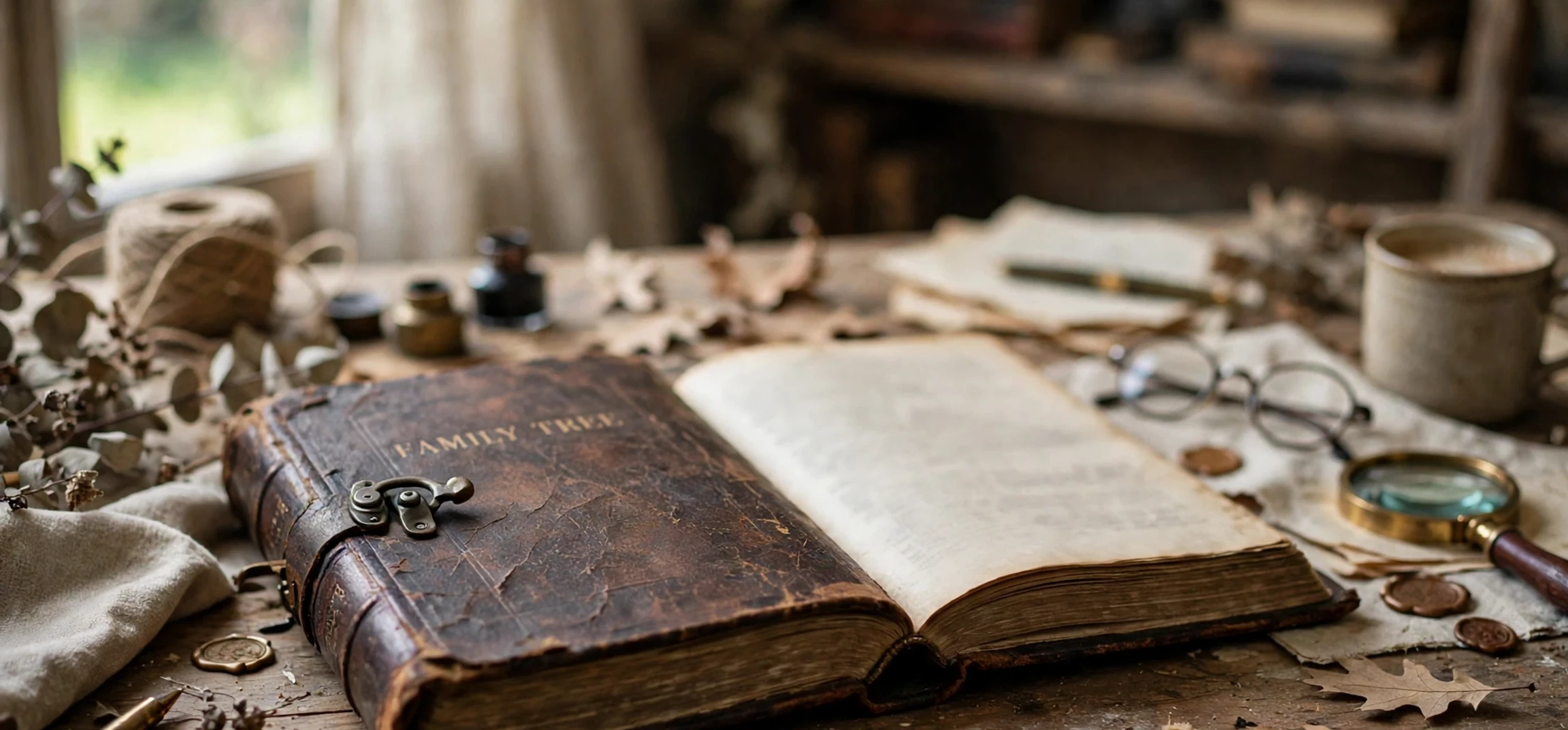
When people ask what do our last names mean, they are usually asking a question that is at once personal and historical: why does my family carry this particular word, where did it come from, and what did it once describe? A surname, also called a last name or family name, is a word passed down through a family that originally identified a person by their parentage, their occupation, the place they lived, or a personal characteristic. Over centuries, those descriptive labels hardened into inherited family names, so that a name which once described a blacksmith, a hill dweller, or the son of a man named John is now carried by people who may have no connection to that trade, that hill, or that ancestor. This guide explains what do our last names mean in general terms, outlines the main types of surname origin, and shows how you can research your own family name through public genealogy resources.
The question matters because surnames are among the oldest pieces of personal history most people possess. Long before identity documents, photographs, or databases, a surname helped a community distinguish one John from another John, one Mary from another Mary. In a village with several men named John, calling one John the smith and another John the son of William was a practical solution, and those descriptions, repeated over generations, became the surnames Smith and Williamson. Understanding that practical origin takes the mystery out of surnames: they were not, for the most part, invented as grand family titles, but grew out of everyday language used by ordinary people to tell each other apart.
What Do Our Last Names Mean? The Main Origins
This section answers what do our last names mean by sorting surnames into patronymic, occupational, locational, and descriptive groups.
To answer what do our last names mean, historians of names usually divide surnames into four broad groups: patronymic, occupational, locational, and descriptive, sometimes called nickname surnames. Most surnames in English, and many in other languages, fall into one of these groups, although some names have more than one possible origin, and some have origins that are still debated. A single surname may have arisen independently in different places for different reasons, so the origin of a name in general is not always the origin of that name in your particular family. That caution is important: a guide can explain the usual origins of a type of name, but only family research can show which origin applies to your own line.
Patronymic surnames are those derived from a father’s given name, and in some traditions from a mother’s name, known as matronymic names. In English, the most familiar patronymic endings are -son, as in Johnson, meaning son of John, Williamson, meaning son of William, and Richardson, meaning son of Richard. The prefix Fitz-, from Norman French, also means son of, as in Fitzgerald, meaning son of Gerald. In Welsh tradition, ap and ab, meaning son of, were contracted into names such as Price, from ap Rhys, and Bowen, from ab Owen. In Scottish and Irish tradition, Mac- and Mc- mean son of, as in MacDonald, meaning son of Donald, while O- means descendant of, as in O’Brien, meaning descendant of Brian. Patronymic names therefore preserve a chain of fathers’ names, frozen at the point when surnames became hereditary.
Occupational Surnames
A surname dictionary is the best first check when you ask what do our last names mean, because it gives the language, region, and type of a name.
Occupational surnames describe what a person did for a living, and they are among the easiest surnames to recognise. Smith, the most common surname in many English-speaking countries, originally meant a worker in metal, whether a blacksmith, a goldsmith, or another kind of smith. Baker, Miller, Taylor, Carpenter, Mason, Fisher, Shepherd, and Cook all describe trades or roles that were essential in a medieval community. Some occupational names are less obvious today because the trade has changed or vanished: a Fletcher made arrows, a Chandler made candles, a Webster was a weaver, and a Baxter was a female baker, using an old feminine ending. If your surname is an occupational word, it is likely, though not certain, that an ancestor practised that trade at the time surnames became fixed.
Occupational names also reveal the structure of medieval society. The most common occupational surnames correspond to the most common and most needed trades: food production, cloth making, building, and metalwork. Rarer trades produced rarer surnames, which is why some occupational names are now extremely uncommon. It is also worth noting that an occupational surname did not necessarily mean that every bearer practised the trade: once surnames became hereditary, children inherited the name regardless of their own occupation, so a modern Smith may have no family connection to metalwork for many generations. The name records an ancestor’s trade, not a destiny.
Locational Surnames
Comparing two or three reputable sources is wise when you ask what do our last names mean, since dictionaries sometimes disagree on rarer names.
Locational surnames identify a person by where they lived or where they came from. Some are derived from a specific place name, such as a village, town, or estate: a person who moved from a village called Preston might be known as Preston in their new home, to distinguish them from locals. Others are derived from a landscape feature: Hill, Wood, Brook, Ford, and Field all describe the kind of place a family lived near. Still others combine a feature with a direction or a description, such as Underhill, meaning someone who lived under or at the foot of a hill, or Atwood, meaning someone who lived at or near a wood. In some languages, locational names use a preposition or prefix, such as the French de, the German von, or the Dutch van, meaning of or from a place.
Locational surnames are particularly useful for family historians, because they can point to a region of origin, even if they cannot pinpoint a single village with certainty. A name derived from a common landscape word, such as Hill, could have arisen independently in many places, so it gives only a general clue. A name derived from an unusual place name is a stronger clue, since fewer places share that name. In either case, locational surnames remind us that medieval people were often identified by movement: a surname was needed most when a person left their home place and needed to be distinguished in a new community, which is why so many locational names describe a place of origin rather than a place of residence.
What Do Our Last Names Mean? Descriptive and Nickname Surnames
Descriptive names show why what do our last names mean is sometimes a puzzle, since a nickname may have been humorous, ironic, or simply lost to time.
The fourth group, descriptive or nickname surnames, describes a personal characteristic, whether physical, temperamental, or habitual. In English, examples include Long, Short, Brown, White, Black, Young, and Old, which may have described height, hair colour, complexion, or relative age. Strong, Swift, and Wise may have described strength, speed, or reputation, though such names should be read with caution: medieval nicknames were often humorous or ironic, so a man called Little might have been tall, and a man called Good might have earned the name for reasons that are now lost. Animal names, such as Fox, Wolf, and Bull, may have described a person’s character, appearance, or even a sign on their house or shop.
Descriptive surnames are the hardest group to interpret with confidence, precisely because a nickname depends on a joke, an incident, or an impression that was never written down. Two families with the same descriptive surname may have acquired it for entirely different reasons. That uncertainty is part of the fascination of surname research: a name like Armstrong might describe a genuinely strong ancestor, or it might have been a family joke, or it might have a completely different origin in another language. Good surname guides therefore present descriptive origins as possibilities, not as certainties, and encourage researchers to look for supporting evidence in family records rather than accepting a single dictionary entry as the final word on their own family.
Surnames in Other Languages and Traditions
Finally, what do our last names mean for your family specifically can only be settled by records, not by a general definition alone.
Although this guide focuses on English surnames, the same four patterns appear in many languages, with different endings and prefixes. In Spanish, patronymic names often end in -ez, as in Fernandez, meaning son of Fernando, and Gonzalez, meaning son of Gonzalo. In Russian and other Slavic languages, -ovich and -evich mean son of, while -ov and -ev can indicate belonging to a family. In Arabic naming, ibn or bin means son of, and al- can indicate origin from a place or tribe. In Chinese, Korean, and Vietnamese traditions, the family name comes first, before the given name, and surnames often derive from ancient place names, states, or occupations, with a relatively small number of very common surnames shared by large populations. In Iceland, patronymic naming remains a living system for many people, with a child’s last name formed from a parent’s first name plus -son or -dottir, rather than being an inherited family name at all.
These differences matter when researching a family name, because the rules for interpreting a surname depend on the language and culture it comes from. Applying English patterns to a non-English name, or vice versa, can produce a false origin. A surname that looks occupational in English may be locational in another language, and a name that looks like a single word may in fact be two words contracted over time. Researchers should therefore start by establishing the language, region, and tradition their family name belongs to, before looking up its meaning in a general dictionary. That first step, identifying the tradition, is often more valuable than any single definition.
How Surnames Became Hereditary
The history of hereditary surnames explains what do our last names mean today, because a description used once became a family name passed down for generations.
Surnames did not become hereditary everywhere at the same time, and the process took centuries. In England, hereditary surnames began to appear among the Norman aristocracy after the Conquest of 1066, spread gradually to landowners and townspeople, and became general among ordinary people by the fourteenth and fifteenth centuries, as population growth, taxation, and record-keeping made it necessary to identify individuals more precisely. In Scotland and Wales, the process followed a different timetable and produced different forms, such as clan names and patronymic contractions. In many other parts of Europe, hereditary surnames became general between the fifteenth and nineteenth centuries, often under pressure from church registers, tax records, or state registration laws.
Once a surname became hereditary, it was passed from father to children as a matter of custom and later of law, with variations for marriage, adoption, and legal name changes. Traditionally in English-speaking countries, a married woman often took her husband’s surname, although that practice has always had exceptions and is now one choice among several, including keeping a birth surname, combining surnames, or creating a new surname. Children traditionally took their father’s surname, but many families now choose either parent’s surname or a combined form. These modern choices mean that a surname today is a less reliable guide to distant ancestry than it once was, but it remains a valuable starting point for research, especially when combined with other records.
Spelling variation is another feature of surname history that researchers must expect. Before spelling was standardised, a surname might be spelled several different ways in different documents, even for the same person, depending on the clerk who wrote it and how the name sounded to them. A name might gain or lose a letter, change a vowel, or acquire a prefix or suffix over time. Immigrants’ names were sometimes altered, deliberately or accidentally, on arrival in a new country, when officials recorded a name as they heard it or translated it into the new language. Genealogists therefore search variant spellings routinely, and a family that cannot find its name under one spelling often finds it under another.
How to Research Your Own Family Name
When you research what do our last names mean for your own family, start at home, then check each generation against public records before drawing conclusions.
Researching your own surname begins at home, with what your family already knows. Talk to older relatives, look at family documents such as birth, marriage, and death certificates, old letters, photographs with captions, and family Bibles or registers where names and dates were recorded. Note variant spellings, places associated with the family, and any stories about where the family came from or what ancestors did. These oral and family sources are not always accurate in every detail, but they provide leads that can be checked against official records, and they often preserve information that no public record contains, such as a nickname, a previous spelling, or a village of origin.
From there, public genealogy resources can take the research further. Census records, civil registration records, parish registers, military records, immigration and passenger lists, and electoral rolls are all public or publicly accessible records in many countries, available through national archives, local record offices, and reputable genealogy websites, many of which offer free access in libraries. Start with the most recent generations and work backwards, one generation at a time, verifying each link with a record rather than jumping to a famous bearer of the same surname. The temptation to connect your family to a well-known person with the same name is strong, but a shared surname alone is not evidence of a relationship, especially for common names.
For the meaning of the name itself, surname dictionaries and academic name studies are the most reliable sources. A good surname dictionary will give the language and region of origin, the likely type, patronymic, occupational, locational, or descriptive, and any variant forms, along with early recorded examples. Compare entries across more than one reputable source, since dictionaries sometimes disagree, and treat a single online meaning, especially one without sources, with caution. If your surname is uncommon, a specialist study of names from its region or language may be more helpful than a general dictionary, and a local historical society or university name-studies department may be able to point you to the right source.
| Surname type | How it originated | English examples |
|---|---|---|
| Patronymic | From a father’s given name | Johnson, Williamson, Fitzgerald, MacDonald |
| Occupational | From a trade or role | Smith, Baker, Miller, Taylor, Fletcher |
| Locational | From a place or landscape feature | Preston, Hill, Wood, Underhill, Atwood |
| Descriptive | From a characteristic or nickname | Long, Brown, Young, Swift, Fox |
Frequently Asked Questions About Last Names
Ultimately, what do our last names mean is a question about ordinary people, their work, their places, and their families, preserved in a single word.
Does my surname tell me exactly what my ancestors did?
Not exactly. It suggests what an ancestor may have done, where they may have lived, or who their father may have been, at the time surnames became hereditary. It is a clue, not a proof, and it should be checked against family records.
Can two families with the same surname be unrelated?
Yes, very often. Common surnames, and many landscape or occupational names, arose independently in different places. A shared surname alone does not prove a family relationship.
Why is my surname spelled differently in old records?
Spelling was not standardised for much of surname history, and clerks recorded names as they heard them. Variant spellings are normal, and genealogists search all variants when tracing a family.
Conclusion
Asking what do our last names mean opens a window onto the everyday language, trades, places, and families of centuries past. Whether your name is patronymic, occupational, locational, or descriptive, it began as a practical description that helped a community tell one person from another, and it has survived as a piece of family history you carry every day. Research it patiently, starting with family sources, checking each generation against public records, and comparing surname dictionaries rather than trusting a single unverified meaning. For related reading, see common English last names, the origin of the last name Khan, and how to make a last name plural.



