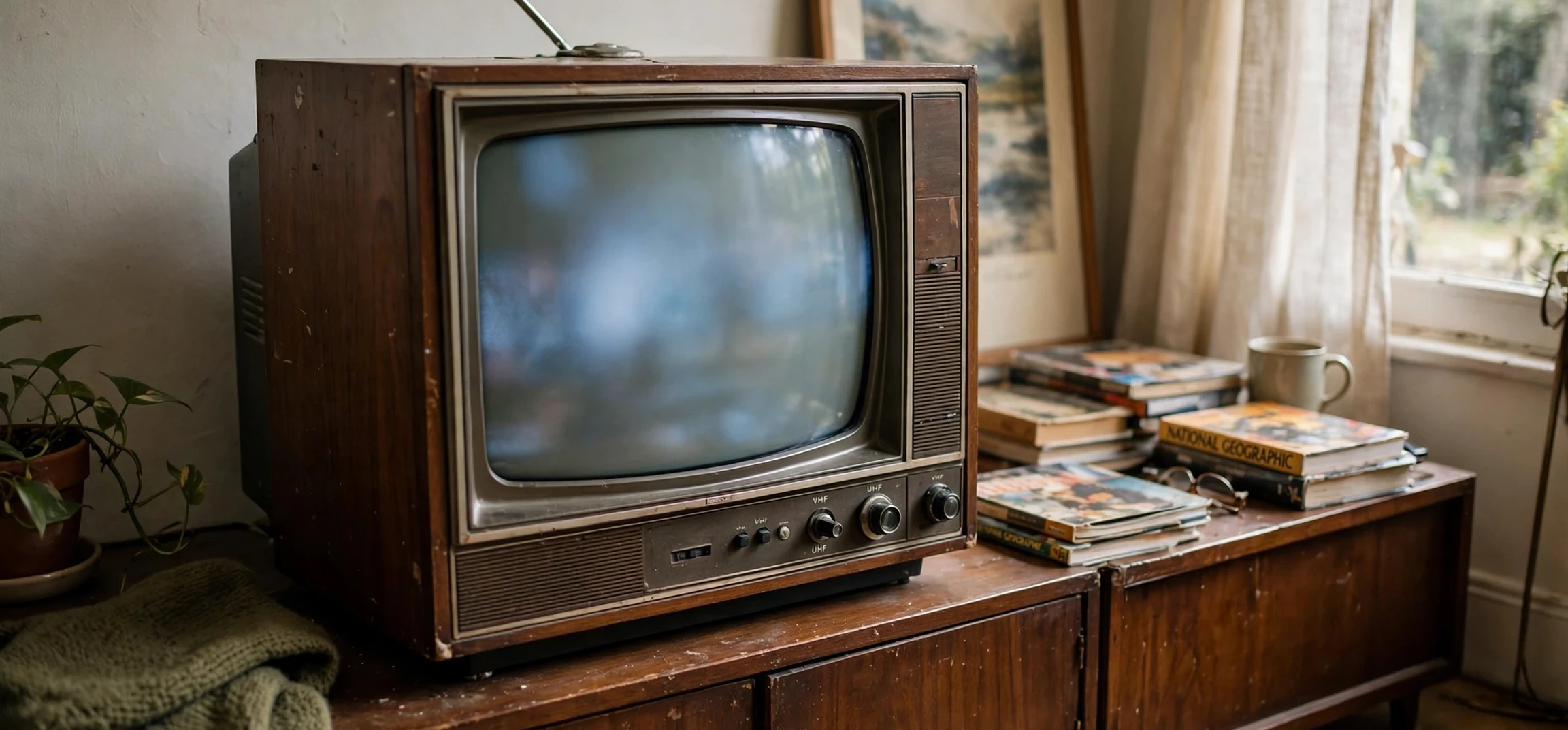
The story of when color tv started in people’s homes is different from the story of its invention, because a working laboratory system and an affordable living-room set are two very different things. The first commercial colour television sets appeared in the mid-1950s, yet for years they remained expensive luxuries that few families owned. This article traces how color tv started as a product: the first sets on sale, what they cost, why early buyers hesitated, and how colour finally became the normal way to watch television.
The distinction matters because it explains the long gap between the first colour broadcasts and the colour living room. Regular colour programmes began in the United States in 1954, but most viewers still watched them in black and white for another decade, simply because colour sets were rare and costly. When color tv started to feel ordinary, it was not because of a single launch but because prices fell, programme hours grew, and manufacturers finally committed to colour as the standard rather than a novelty.
Color TV Started on Shop Shelves in 1954
The first commercial colour television sets reached American shops in 1954, immediately after the NTSC compatible colour standard was approved. RCA, the company behind that standard, led the way with its early colour models, and other manufacturers followed cautiously. These first sets were triumphs of engineering: they decoded a colour signal into red, green, and blue images on a shadow-mask tube, a device far more complex than anything in a black-and-white receiver.
They were also, by modern standards, almost comically impractical. Screens were small, often around fifteen inches measured diagonally, while the cabinets were large, heavy, and expensive. Early colour tubes were difficult to manufacture, and yields were low, which pushed prices up further. A buyer in 1954 was not simply buying a television; they were buying into an unproven format, with only a handful of colour programmes each week to justify the expense.
The Price Problem That Slowed How Color TV Started at Home
Price was the single biggest reason color tv started slowly in homes. An early colour set could cost around one thousand dollars in 1954 money, at a time when a good black-and-white set cost a fraction of that and the average family income was far lower than today. Adjusted for inflation, that first colour set cost roughly what a large premium television costs now, except that it offered only a few hours of colour programming a week.
Manufacturers faced a chicken-and-egg problem. Without many colour viewers, networks had little reason to produce expensive colour programmes. Without many colour programmes, viewers had little reason to buy expensive colour sets. The industry broke this deadlock gradually: networks expanded colour hours, especially for popular entertainment, while set makers improved manufacturing and slowly brought prices down. By the early 1960s, colour sets were still premium products, but they were no longer curiosities, and showrooms increasingly displayed them as the future of television.
What Early Buyers Actually Got
Early buyers got a set that needed careful adjustment. Colour purity, convergence, and tint controls required regular attention, and service technicians sometimes made house calls to keep the picture looking right. The experience was closer to owning an early home computer than a modern television: impressive, occasionally temperamental, and a talking point for visitors. Enthusiasts loved it anyway, because a colour football match or variety show genuinely looked spectacular compared with black and white, even on a small screen.
The Tipping Point: When Color TV Started to Become Normal
The tipping point arrived in the mid-1960s. In the United States, the major networks announced that most of their prime-time schedules would be in colour, which finally gave buyers a full evening of colour viewing rather than a few showcase programmes. Prices continued to fall as production volumes rose, and colour tube manufacturing became more reliable. Sales climbed sharply, and by the end of the decade colour sets were outselling black-and-white sets in the American market.
Britain and much of Europe followed a similar pattern a few years later, with regular colour services launching in 1967 and colour set sales accelerating through the 1970s. The pattern repeated wherever colour arrived: a slow, expensive start, a programming-led tipping point, and then rapid adoption as prices fell and colour became the default. By the late 1970s, a black-and-white set was a budget or second-set choice, not the main family television, and the question of when color tv started in homes had a clear answer: the 1950s for the first buyers, the 1960s for the mass market.
Color TV Started: The Commercial Timeline at a Glance
| Year | Commercial milestone | What it meant for buyers |
|---|---|---|
| 1954 | First NTSC colour sets go on sale in the United States | Colour becomes buyable, but very expensive |
| Late 1950s | More manufacturers offer colour models | Choice grows, prices ease slightly |
| Early 1960s | Colour programming hours expand | More reason to invest in a colour set |
| Mid-1960s | Networks move prime time to colour | The tipping point for mass adoption |
| 1967 | Regular colour services launch in Britain and Europe | Colour goes international at scale |
| 1970s | Colour outsells black and white in major markets | Colour becomes the default television |
The contrast with the invention story is instructive. The first colour demonstrations happened in the 1920s, yet the first commercial colour sets did not arrive until 1954, and mass adoption took another decade beyond that. Invention, product, and mass market are three separate milestones, and confusing them is why published dates for when color tv started vary so widely. For the invention side of the story, see the companion account of the first colour TV invented, and for the medium’s earliest days, the guide to when television was invented.
Color TV Started Around the World in the 1970s and Beyond
While the United States reached its colour tipping point in the mid-1960s, the rest of the world followed on its own schedule, and that staggered rollout is an important part of how color tv started as a global product. Britain launched its regular colour service in 1967, and manufacturers there faced the same early problems American makers had faced a decade earlier: expensive tubes, limited programming, and buyers waiting for prices to fall. As in America, the turning point came when broadcasters committed whole evenings to colour and set prices dropped with rising production volumes.
Through the 1970s, colour spread across Western Europe, Japan, Australia, and parts of Latin America and Asia, each market adopting whichever broadcast standard its regulators had chosen. By the end of that decade, colour was the default in most wealthy countries, while many developing markets made the transition during the 1980s as cheaper imported sets arrived. The global story therefore mirrors the American one at a slower pace: an expensive first generation, a programming-led tipping point, and then rapid, almost total adoption.
That worldwide pattern also explains why colour television feels both old and new. Viewers who grew up in the 1980s or later have never known a black-and-white living room, yet the first colour buyers of 1954 were already grandparents by then. The technology bridged two eras: it began as a luxury for enthusiasts and ended as the unremarkable background of everyday life, which is exactly what happens when a successful invention stops being news and starts being furniture.
What Changed When Color TV Started in the Living Room
Colour changed programme-making as much as viewing. Designers began thinking in colour: costumes, sets, and lighting all had to work on a colour screen, and genres such as nature documentaries, sport, and musical variety gained enormously. Advertisers loved colour too, since products could finally be shown as shoppers would see them in a store. These changes fed back into set sales, because a programme designed for colour looked flat in black and white, giving viewers yet another reason to upgrade.
Colour also changed the television itself as an object. The family set moved from being a piece of furniture that happened to show pictures to a display device judged on picture quality, a shift that foreshadowed every later display revolution, from flat screens to high definition and beyond. The living room had acquired its first colour screen, and although the technology inside that screen would change completely in later decades, the expectation it created, that television should look like the world, never went away.
Frequently Asked Questions About the First Colour TV Sets
In what year was the first colour TV set sold?
The first commercial colour television sets based on the NTSC standard went on sale in the United States in 1954, shortly after the standard was approved in late 1953.
How much did the first colour TV cost?
Early colour sets cost around one thousand dollars in 1954, several times the price of a black-and-white set. That high price is the main reason colour adoption took more than a decade despite regular colour broadcasts.
Why did people keep black-and-white sets for so long?
Colour sets were expensive, colour programming was limited at first, and existing black-and-white sets still showed colour broadcasts in black and white. Many families waited until prices fell and colour schedules filled out before upgrading.
When did colour become the standard television?
Colour overtook black and white in major markets during the late 1960s and 1970s. By the end of the 1970s, the main family television in most homes in the United States and Western Europe was a colour set.
Conclusion: When Color TV Started at Home
When color tv started at home, it started quietly and expensively: a small number of costly sets in 1954, bought by enthusiasts who could accept limited programming and fussy controls. The mass-market story took another decade, driven by falling prices and the networks’ move to full-colour prime-time schedules in the mid-1960s. That two-stage pattern, invention first, affordable product much later, is common to many technologies, but colour television shows it with unusual clarity. The set in the corner of the living room did not become a colour set overnight; it became one household by household, programme by programme, until one day black and white was the exception rather than the rule.



