Many people search for rosetta stone image when they want to understand one of the most famous objects in the history of archaeology, and this article explains the artifact itself in words rather than claiming to display a picture of it. The search term rosetta stone image is used here honestly as a related search phrase: readers often begin with a picture search, then realise they also want to know what the stone is, where it was found, why it mattered, and how it helped scholars read Egyptian hieroglyphs after centuries of mystery. This guide answers those questions. It describes the stone, its three scripts, its discovery, and its decipherment, so that a reader who arrived looking for an image leaves with a clear understanding of the object behind the image.
The Rosetta Stone is a slab of dark stone, inscribed in 196 BC with a decree issued during the reign of the young Egyptian king Ptolemy V. It is not a glamorous treasure in the usual sense: it contains no gold, no jewels, and no portrait of a god. Its value lies in language, which is why a search for rosetta stone image so often turns into a search for the story behind the object. The same decree appears in three scripts, and that repetition gave scholars a bridge between a known language and a writing system that had been unreadable for more than a thousand years. That is why the stone became a symbol of decipherment itself, and why its name is still used for language-learning tools and translation projects today.
Rosetta Stone Image: What the Stone Is
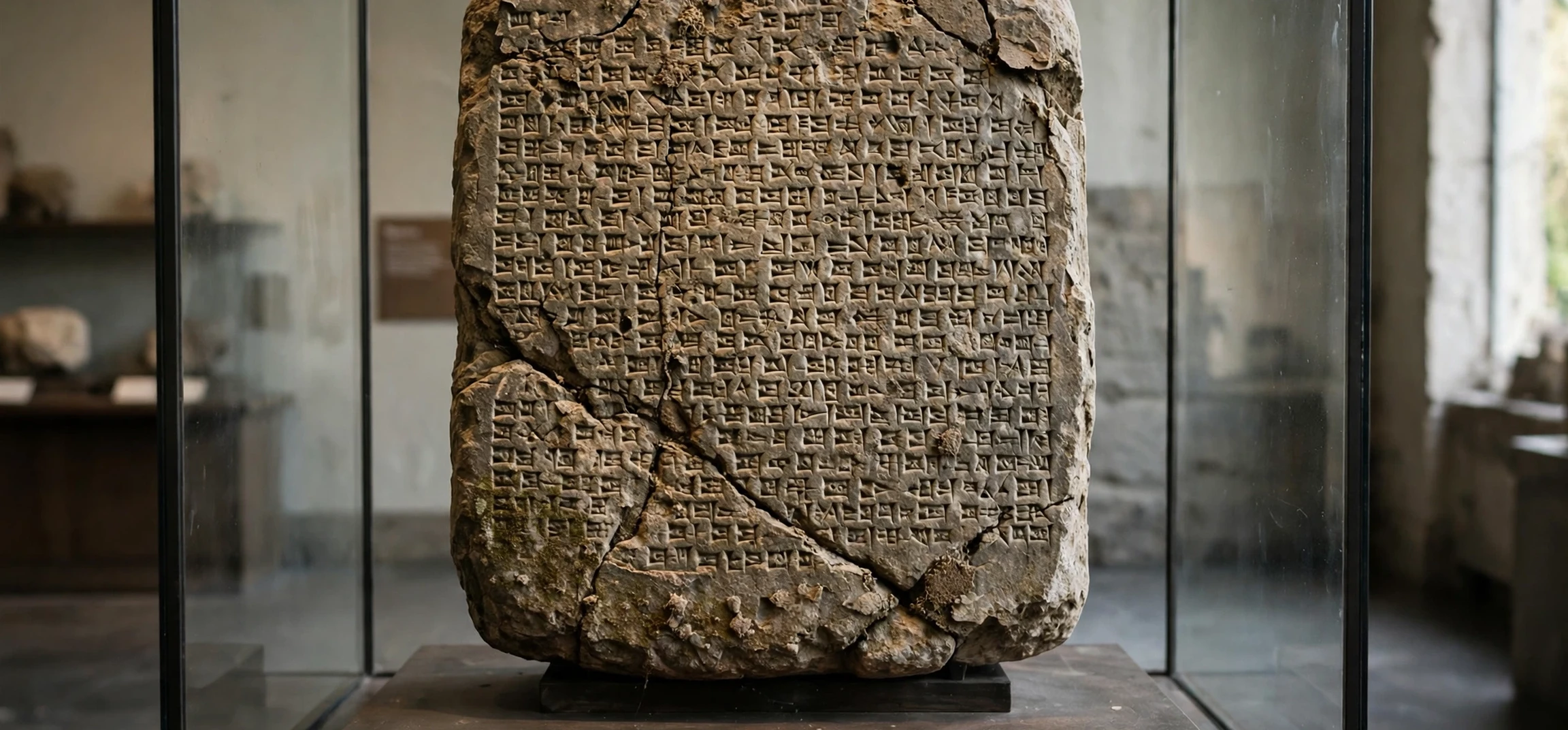
Physically, the stone is a fragment of a larger inscribed slab, made of granodiorite, a dark, speckled igneous rock that is often described simply as black stone in popular accounts. It is roughly 112 centimetres tall, 75 centimetres wide, and 28 centimetres thick, and it weighs about 760 kilograms. The top is broken, so the beginning of the text is missing, but enough survives to make the structure clear. The inscription is arranged in three bands. The top band is in Egyptian hieroglyphs, the formal script used for monuments and religious texts. The middle band is in Demotic, the everyday cursive script of late Egyptian administration. The bottom band is in ancient Greek, the language of the Ptolemaic administration that ruled Egypt at the time.
That threefold structure is the whole secret of the stone, and it is the first thing to understand after a rosetta stone image search. Greek was still understood by scholars in the eighteenth and nineteenth centuries, so the Greek text could be read directly. If the three bands really said the same thing, then the Greek could serve as a key to the Egyptian scripts. The challenge was that the relationship was not a simple word-for-word substitution, and hieroglyphs turned out to be far more complex than early investigators assumed. Still, without the parallel texts, there would have been no reliable starting point, and Egyptian writing might have remained unreadable for much longer.
What the Decree Actually Says
The content of the decree is, by itself, fairly administrative. It records honours granted to Ptolemy V by a council of priests, including tax relief, the release of prisoners, and the establishment of cult honours for the king. It also orders that the decree be inscribed in the three scripts and displayed in temples across Egypt. Modern readers sometimes feel disappointed that such an ordinary document became so famous, but that ordinariness is part of the point. A decree meant for public display had to be readable by different audiences, which is exactly why it was written in more than one script. A royal proclamation, a temple record, and a piece of administrative routine all became, by accident of survival, the key to a lost language.
Rosetta Stone Image: Discovery and Early History
The stone was found in 1799 near the town of Rosetta, now known as Rashid, in the Nile Delta of Egypt, a fact that every rosetta stone image caption should ideally mention. French soldiers working on fortifications during the Egyptian campaign uncovered it while rebuilding an old fort, and officers recognised that the inscription might be important. The find quickly attracted the attention of scholars attached to the expedition, who made copies and began studying the Greek text. The name Rosetta Stone comes from that findspot, not from any person or king named Rosetta, a point that is often misunderstood by new readers.
After the French defeat in Egypt, the stone passed to British hands under the terms of the Treaty of Alexandria in 1801, and it was taken to London. It has been displayed in the British Museum since 1802, where it remains one of the most visited objects in the collection. Its location has been the subject of long-running debate, with Egyptian authorities and many scholars arguing that it should be returned to Egypt, while the museum argues for its role in a global collection. That debate is separate from the linguistic story, but it shapes how visitors and readers encounter the stone today, and it is part of why a search for rosetta stone image often leads to questions about ownership and display as well as about language.
Early study of the stone was slow and competitive, and no single rosetta stone image could show the years of comparison work that followed its discovery. Scholars could read the Greek, and they could see that the Demotic and hieroglyphic bands were related, but they did not yet know how hieroglyphs worked. Some assumed that each hieroglyph stood for a whole idea, which made the script seem almost impossible to decode. Others noticed repeated groups of signs and began to suspect that some signs represented sounds. Progress came in stages, with different scholars contributing pieces: identifying royal names in cartouches, matching Demotic signs to Greek words, and gradually building a picture of how the Egyptian scripts combined sound signs, meaning signs, and determinatives that clarify meaning.
How the Stone Was Deciphered
The breakthrough is most closely associated with the French scholar Jean-François Champollion, who announced his decipherment of hieroglyphs in 1822. Champollion built on the work of others, including Thomas Young in Britain, who had made important progress on Demotic and on the sound values of some hieroglyphs. Champollion’s key insight was that hieroglyphs were not purely pictorial: they included phonetic signs that spelled out sounds, including the sounds of foreign names such as Ptolemy and Cleopatra, which could be identified in cartouches. Once that principle was established, scholars could begin reading other Egyptian texts, opening up temple inscriptions, tomb paintings, papyri, and administrative records that had been silent for centuries.
Decipherment did not happen in a single day, and it did not depend on the Rosetta Stone alone, a point often lost when a rosetta stone image is shared without context. The stone provided the parallel text, but scholars also used other bilingual inscriptions, knowledge of Coptic, the later form of the Egyptian language, and careful comparison of sign groups across many documents. The Rosetta Stone mattered because it was the clearest and most complete example of the principle, and because its Greek text gave a reliable control against which guesses could be tested. Without that control, early theories about hieroglyphs could not have been checked, and the field might have spent decades on elegant but wrong ideas.
The wider effect was enormous. Once hieroglyphs could be read, Egyptology changed from guesswork based on classical authors and visual interpretation into a historical discipline based on Egyptian sources in their own words. Kings lists could be checked, temple rituals could be understood, and everyday documents such as letters, accounts, and legal records could be read. The stone therefore stands at the start of modern Egyptology, not because it is the most beautiful Egyptian object, but because it made the rest of the evidence readable.
Why the Stone Still Matters Today
Today the Rosetta Stone matters for at least three reasons, and each one explains why rosetta stone image remains such a popular search term. First, it remains a teaching object: students of history, linguistics, and archaeology learn from it how parallel texts work and how a writing system can be cracked. Second, it is a reminder that major discoveries are often accidental, and that an ordinary administrative text can become extraordinary through survival and context. Third, it raises questions about museums, colonial history, and cultural heritage that are still debated, and those questions affect how the public understands ancient objects in general. A reader who began with rosetta stone image as a search term will find all three themes connected: the picture, the language, and the museum story.
For anyone studying the stone further, it helps to look beyond the famous image and read a translation of the decree, compare the three scripts side by side in a diagram, and then read a short account of Champollion’s method. That sequence moves from recognition to understanding: first seeing that the bands exist, then seeing that they correspond, then seeing how correspondence becomes reading. It is a satisfying progression, and it explains why the stone still appears in textbooks, documentaries, and museum displays more than two centuries after its discovery.
| Feature | Detail | Why it matters |
|---|---|---|
| Material | Granodiorite slab, about 760 kilograms | Durable stone preserved the inscription |
| Date | 196 BC, reign of Ptolemy V | Places the decree in Ptolemaic Egypt |
| Scripts | Hieroglyphs, Demotic, ancient Greek | Greek provided the key to Egyptian scripts |
| Found | 1799 near Rosetta in the Nile Delta | Findspot gave the stone its modern name |
| Deciphered | Champollion, announced 1822 | Opened Egyptian texts to modern reading |
| Displayed | British Museum, London, since 1802 | Location remains debated today |
Related reading on this site includes Egyptian pharaoh names for the rulers whose world the stone came from, and Night at the Museum guide for a popular-culture take on museum objects. Together they show how ancient history reaches modern audiences through both scholarship and storytelling.
Frequently Asked Questions
Is the Rosetta Stone a picture or a text?
It is a text, inscribed in three scripts, which is the essential correction to a bare rosetta stone image search. People often search for rosetta stone image because they want to see what it looks like, but its importance is linguistic: the same decree in Greek and in Egyptian scripts allowed scholars to decode hieroglyphs.
Where is the Rosetta Stone now?
It is displayed in the British Museum in London, where it has been since 1802. Its future location is debated, with calls for its return to Egypt discussed in public and academic debate.
Who deciphered hieroglyphs?
Jean-François Champollion is credited with the decisive breakthrough, announced in 1822, building on earlier work by Thomas Young and others. The decipherment used the Rosetta Stone together with other inscriptions and knowledge of Coptic.
What does the decree say?
It records honours for Ptolemy V, including tax relief and cult honours, and orders the decree to be displayed in temples in three scripts. The content is administrative, but the three-script format made it uniquely valuable.
Conclusion
The Rosetta Stone endures because it solved a problem that had lasted for more than a thousand years: how to read the writing of ancient Egypt. A search that begins with rosetta stone image ends, on closer inspection, with a story about language, accident, scholarship, and museums. The stone is a fragment of a decree, a product of Ptolemaic administration, and a key that unlocked an entire civilisation’s written record. Understanding those three facts together gives a far richer picture than any single photograph can, and it explains why this dark, broken slab remains one of the most famous objects in the world.