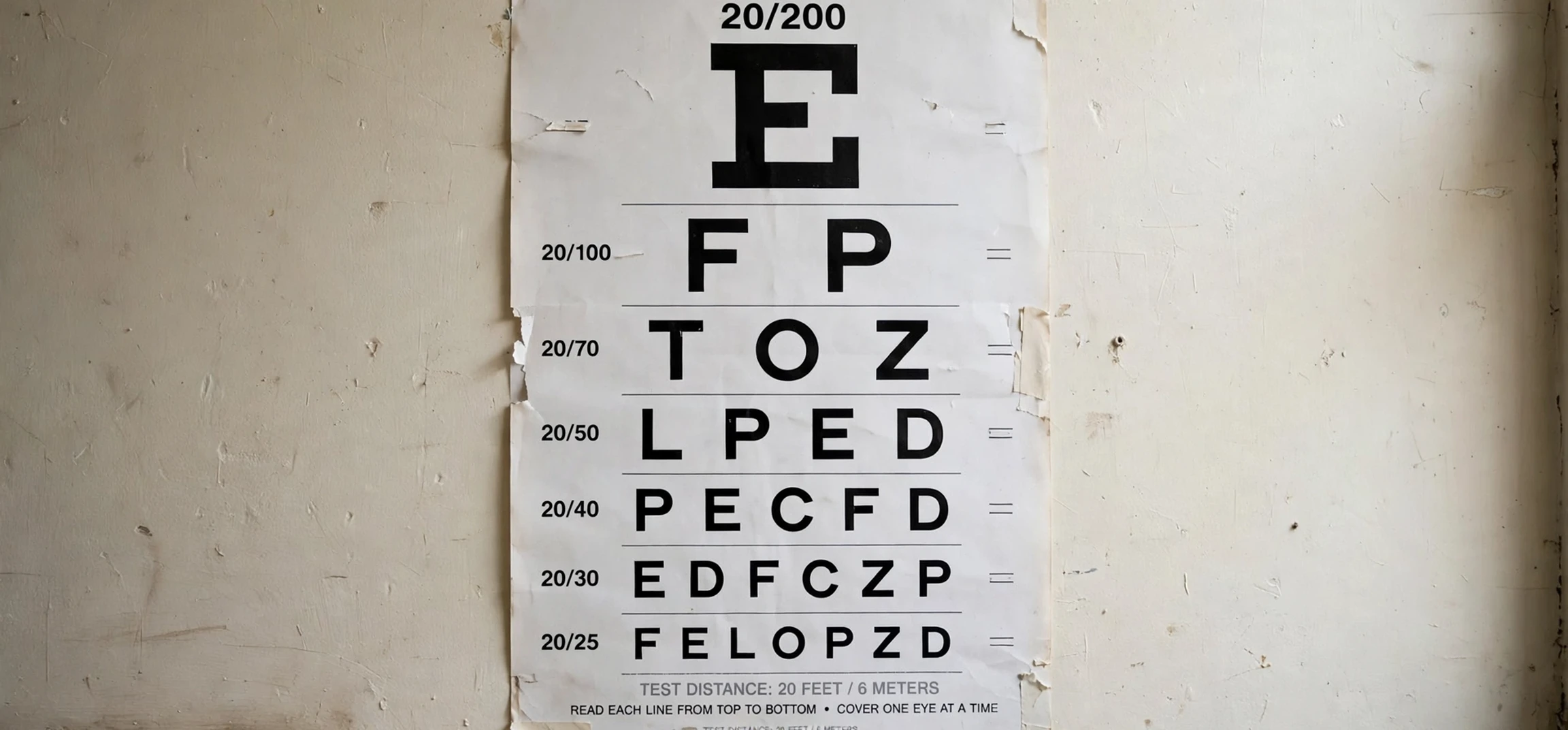
Seeing the notation 20/25 on an eye report can be puzzling if nobody explains it. The question what is 20/25 comes up often, because the numbers look like a score or a fraction, and it is not obvious whether a higher or lower second number is better. In simple terms, 20/25 is a way of describing distance vision: it compares what a person can see at 20 feet with what a person with standard vision can see at the same distance. This article explains that comparison in plain language, as general education only. It is not medical advice, and anyone with concerns about their own vision should speak with a qualified eye care professional, who can assess their individual situation.
The short answer to what is 20/25 is that it means slightly less sharp distance vision than the 20/20 standard, but still close to it. A person with 20/25 vision needs to be 20 feet away from something to see clearly what a person with standard vision can see clearly from 25 feet away. The difference is small, and many people with 20/25 vision go about daily life without noticing any difficulty. The sections below unpack the two numbers, compare 20/25 with neighbouring measurements, and explain why the same result can mean different things in different contexts, from a school screening to a driving licence check.
what is 20/25: Breaking Down the Two Numbers
Understanding what is 20/25 starts with the two numbers and what each one stands for. The first number is the testing distance, measured in feet. In the most common system, the person being tested stands 20 feet from the chart, because at that distance the light entering the eye is close to parallel, which is the standard condition for distance vision testing. The second number is the distance at which a person with standard vision could read the same line of letters. So in 20/25, the first number says “tested at 20 feet”, and the second number says “this line is normally readable at 25 feet”. The person being tested needs to be closer, at 20 feet, to read what standard vision reads at 25 feet.
It helps to think of the second number as a description of the size of the letters. Letters on the 25-foot line are slightly larger than letters on the 20-foot line. A person with 20/25 vision can read the slightly larger letters at 20 feet, but not the slightly smaller letters that a person with 20/20 vision can read at the same distance. The gap between the two lines is one step on a standard chart, which is why 20/25 is described as just one step below 20/20. The measurement is about sharpness of distance vision only. It does not describe colour vision, peripheral vision, night vision, or how the eyes work together, and it says nothing about eye health on its own.
The fraction-like appearance of 20/25 can mislead people into treating it as a percentage or a grade. It is not 25 percent of anything, and it is not a score out of 25. It is a comparison between two distances, and that is all. Someone with 20/25 vision does not see “25 percent worse” than someone with 20/20 vision; they see slightly less sharply at distance, by one chart step. Keeping that comparison in mind makes every other vision notation easier to read, because the same logic applies to 20/30, 20/40, 20/15, and all the rest.
what is 20/25 Compared With 20/20 Vision
The comparison most people want when they ask what is 20/25 is the comparison with 20/20. The figure 20/20 is often called “normal” vision, but a more accurate description is “standard” vision: it is the reference point chosen for the chart, not a perfect score. Many people see better than 20/20, for example 20/15, which means they can read at 20 feet what standard vision reads at 15 feet, using smaller letters. Many others see slightly less sharply, such as 20/25 or 20/30, and still manage everyday tasks comfortably. Vision exists on a scale, and 20/20 is simply the middle reference mark on that scale.
In everyday life, the practical difference between 20/20 and 20/25 is usually modest. Road signs, television subtitles, classroom boards, and faces across a room may appear very slightly less crisp, or may appear exactly the same in good light. Lighting, contrast, tiredness, and whether the person is wearing their usual glasses or contact lenses can all shift a result by a line. That is why a single measurement is a snapshot, not a permanent label. Eye care professionals generally consider a result together with other findings, such as refraction measurements and eye health checks, rather than treating one line on a chart as the whole story.
It is also worth noting that 20/25 is described differently depending on whether it is measured with or without corrective lenses. A result recorded without glasses may improve to 20/20 or better with glasses, and that improved result is often the more relevant one for daily life. Reports therefore commonly note whether a measurement was taken unaided or with correction. When reading an old report, look for that note, because it changes what the numbers mean in practice. A person whose uncorrected vision is 20/25 and whose corrected vision is 20/20 has a very different everyday experience from a person whose best corrected vision is 20/25.
Where 20/25 Sits on the Vision Scale
Placing 20/25 on the full scale answers what is 20/25 more completely than any single definition. At the sharper end sit 20/10 and 20/15, which are better than standard and relatively uncommon. Then comes 20/20, the standard reference. One step below is 20/25, then 20/30, 20/40, and so on, with the second number growing as distance vision becomes less sharp. At the other end of the scale are measurements such as 20/200, which is used in many countries as one of the thresholds in legal definitions of blindness, although those definitions also involve visual field and best corrected vision, and they vary by jurisdiction.
The step sizes on the scale are not equal in everyday terms. The jump from 20/20 to 20/25 is small, while the jump from 20/100 to 20/200 represents a much larger change in functional vision, even though both are single steps in the numbering in some chart designs. Modern charts are designed so that each line differs from the next by a consistent ratio, which makes the scale fairer for comparison, but the lived experience of each step still depends on the task. Reading a distant departure board is affected by small changes in sharpness, while recognising a friend’s face at close range may not be affected at all.
Different countries also use different notations for the same idea. In much of the world, the metric equivalent is written as 6/7.5, because 20 feet is roughly 6 metres and 25 feet is roughly 7.5 metres. The logic is identical: tested at 6 metres, reading a line normally read at 7.5 metres. Decimal notation is another alternative, where 20/20 becomes 1.0 and 20/25 becomes 0.8. All three notations describe the same comparison, and converting between them is a matter of arithmetic, not a change in what was measured.
Vision Notations Compared
| Feet Notation | Metric Notation | Decimal Notation | Plain Meaning |
|---|---|---|---|
| 20/15 | 6/4.5 | 1.33 | Sharper than standard |
| 20/20 | 6/6 | 1.0 | Standard reference vision |
| 20/25 | 6/7.5 | 0.8 | One step below standard |
| 20/30 | 6/9 | 0.67 | Mildly less sharp at distance |
| 20/40 | 6/12 | 0.5 | Common threshold in driving rules |
| 20/200 | 6/60 | 0.1 | Threshold used in some legal definitions |
what is 20/25 in Everyday Life
When people ask what is 20/25, they often really mean “does this matter for my daily life”. For most everyday purposes, 20/25 vision is close to standard, and many people would not notice it without a chart test. Watching television, using a computer, reading a book, and recognising people at ordinary distances are usually unaffected, or affected so slightly that the difference passes unnoticed. Distance tasks in poor light or low contrast, such as reading a dim road sign at night, are where a small reduction in sharpness is most likely to show, because low contrast makes every line on the chart harder to read.
Driving rules illustrate why context matters. Many jurisdictions set a minimum distance vision standard for driving, and the threshold is often around 20/40 with correction, which is less sharp than 20/25. A person with 20/25 vision therefore typically sits comfortably above such a threshold, but the exact rules, and whether they apply to each eye separately or to both eyes together, vary by place and by licence type. This article does not summarise any particular jurisdiction’s rules, because they change and they differ. Anyone who needs to know the rule that applies to them should check the current official guidance for their own licensing authority or ask an eye care professional.
School and workplace screenings add another context. A child or employee who records 20/25 at a screening may simply be referred for a fuller check, or may be recorded as passing, depending on the screening protocol. A screening is a filter, not a diagnosis: its job is to decide who might benefit from a fuller examination, and a borderline result is a common outcome. Parents and workers who receive a screening note mentioning 20/25 often find that a fuller examination either confirms a small refractive difference that glasses can correct, or finds that the screening result was affected by lighting, tiredness, or an unfamiliar chart.
What 20/25 Does Not Tell You
An important part of what is 20/25 is what the measurement leaves out. It does not measure near vision, which is tested separately with a reading card held at close distance. It does not measure colour vision, depth perception, peripheral vision, or how well the eyes move and work as a pair. It does not diagnose any eye condition, and it does not say whether glasses will help, although a refraction test performed alongside it can answer that question. Two people with the same 20/25 result may have quite different underlying reasons for it, and only a fuller examination can distinguish them.
The measurement is also sensitive to test conditions. A chart that is poorly lit, a room that is too bright, a person who is tired or unwell, or a chart the person has already memorised can each shift a result by a line. That variability is normal and is one reason professionals repeat measurements and combine them with other tests. A single 20/25 reading should therefore be read as “about one step below the standard line on this occasion”, not as a precise and permanent fact about a person’s eyes.
Frequently Asked Questions About what is 20/25
Is 20/25 vision good?
Yes, in general terms the answer to what is 20/25 in everyday language is a result close to standard vision, only one chart step below 20/20. Many people with 20/25 vision notice no difficulty in daily life. The meaning of any individual result, however, depends on whether it was measured with or without correction and on other examination findings.
Does 20/25 vision mean glasses are needed?
Not necessarily. Whether glasses help depends on the cause of the result and on the person’s needs, which only a fuller examination can establish. Some people with 20/25 vision use glasses for specific tasks, while others do not use any correction. This article gives general information only and does not recommend for or against glasses for any individual.
Is 20/25 better or worse than 20/20?
It is slightly less sharp than 20/20 at distance. In what is 20/25 terms, the person reads at 20 feet what standard vision reads at 25 feet, using slightly larger letters. A smaller second number means sharper distance vision, so 20/15 is sharper than 20/20, and 20/25 is one step less sharp.
What is 20/25 vision in metric notation?
The metric equivalent is 6/7.5, and the decimal equivalent is 0.8. All three notations describe the same comparison between testing distance and the distance at which standard vision reads the same line.
Can you drive with 20/25 vision?
Driving standards vary by jurisdiction and licence type, and many thresholds sit below 20/25, but this article does not summarise any particular set of rules. Check the current official guidance for your licensing authority, or ask an eye care professional, for the standard that applies to you.
More Questions Behind what is 20/25
People who look up what is 20/25 often have follow-up questions that go beyond the two numbers. One common question is whether the result can change, and the answer is yes: vision changes over time, and a measurement can also shift between visits because of lighting, tiredness, or the correction worn. Another common question is whether both eyes usually match. They often differ by a line, and a difference between the eyes is itself a normal finding that an examination records, not a problem in its own right. Understanding what is 20/25 therefore means accepting a little variation, rather than treating one reading as fixed for life.
Another question behind what is 20/25 is whether children and adults are measured the same way. The notation is the same, but the charts and the approach differ for young children, who may use pictures or symbols instead of letters. The comparison logic does not change: the result still describes the smallest detail recognised at the set distance, compared with the standard line. Adults sometimes worry when a child’s report shows 20/25, but a single line below standard is a common screening outcome, and a fuller examination is the step that puts it in context. Anyone who wants to know what a result means for a particular person, child or adult, will get the clearest answer from an eye care professional who has seen the full examination, not from the notation alone.
Conclusion: Making Sense of what is 20/25
The answer to what is 20/25 is reassuringly simple once the two numbers are separated: tested at 20 feet, reading a line that standard vision reads at 25 feet, one small step below the 20/20 reference. For anyone still asking what is 20/25 after reading a report, that one-line version is the whole definition, and everything else in this guide is context around it. It is a measure of distance sharpness only, it sits close to standard on the vision scale, and it leaves many questions about eye health and correction to a fuller examination. If the notation appears on your own report and you want to know what it means for you personally, an eye care professional can explain it in the context of your full results. For a companion explanation of how the test itself works, see our guide to what 20/30 vision means, and for related everyday meanings, see what it means when your left eye jumps and what a twitchy left eye means.



