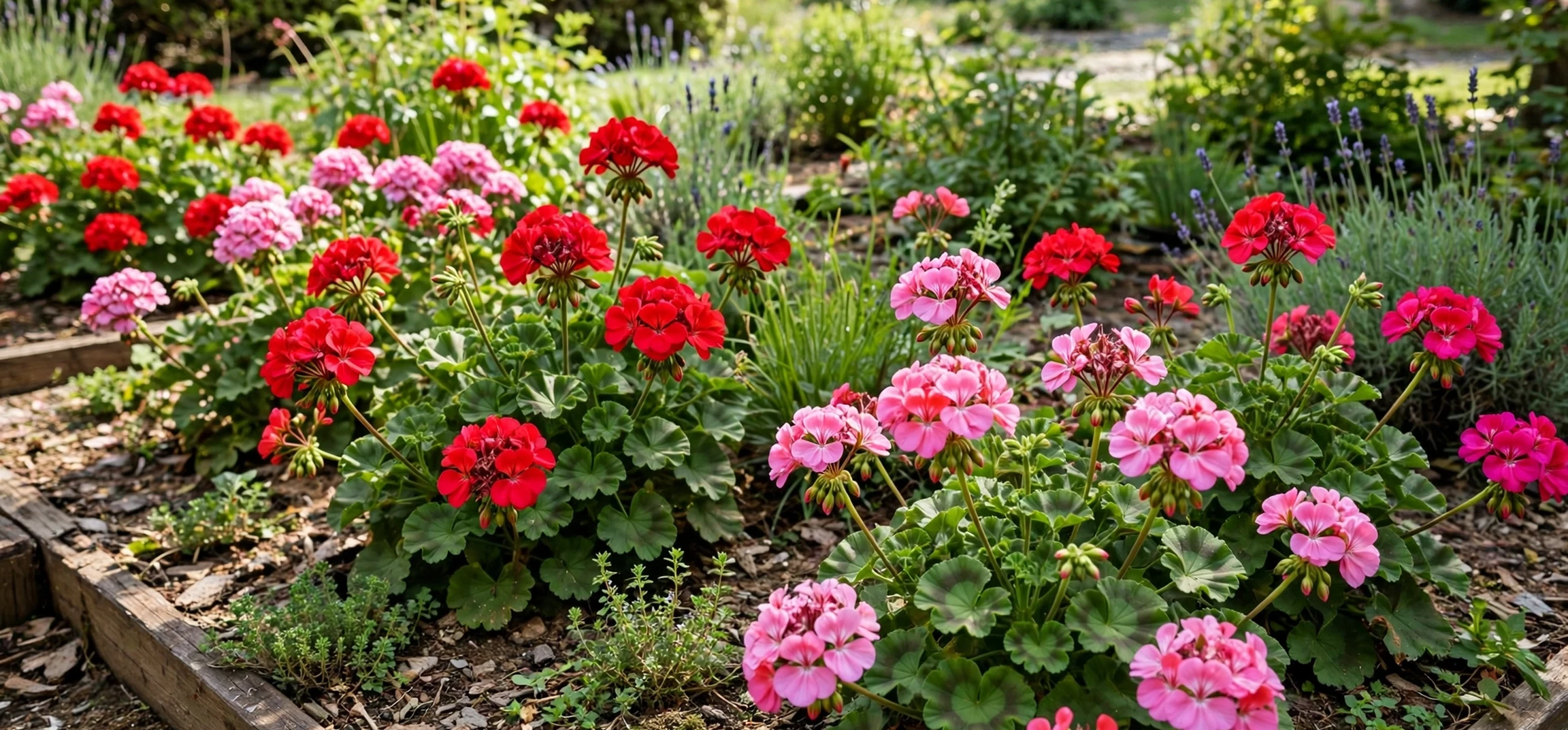
If you searched for “latin name for geranium”, you are asking a question that looks simple but has a slightly surprising answer, because the word geranium is used in everyday gardening language for two different groups of plants. In strict botanical terms, the Latin name for geranium depends on which plant you mean. A true geranium belongs to the genus Geranium, in the plant family Geraniaceae. Many of the bright bedding plants sold in garden centres under the name geranium, however, belong to a related but separate genus, Pelargonium. This guide explains both uses, how Latin plant names work, and how to tell which Latin name applies to the plant in front of you, so that you can buy, plant, and care for it with confidence.
The confusion is understandable, and it is not a modern mistake. Gardeners have called pelargoniums geraniums for centuries, long after botanists separated the two genera. Nurseries, seed packets, and plant labels sometimes keep the familiar common name because customers recognise it, even when the botanical label says something different. Once you know the distinction, the whole subject becomes much clearer. You will be able to read a plant label properly, search for care advice for the right plant, and understand why two plants that are both called geraniums may need quite different treatment in the garden.
What “latin name for geranium” Means
When someone asks for the Latin name for geranium, they usually want the scientific name that botanists use around the world. Scientific names are written in Latin, or in Latinised form, and they follow a two-part system called binomial nomenclature. The first part is the genus name, written with a capital letter. The second part is the species name, written in lower case. Together, the two parts form the species name. For example, Geranium pratense is the scientific name of meadow cranesbill, a hardy perennial wildflower. Geranium sanguineum is bloody cranesbill, another hardy garden plant. Both begin with Geranium because both belong to that genus.
Scientific names matter because common names vary from place to place and from language to language. One plant may have several common names in different regions, and one common name may be applied to several different plants. A scientific name, by contrast, is intended to point to one particular species, wherever in the world it is used. That is why gardeners, botanists, nurseries, and plant societies use Latin names when precision matters, for instance when ordering a specific plant, checking whether it is hardy in a particular climate, or finding out whether it is safe around pets or children. The Latin name is a shared reference point that cuts through local variation.
It is also worth noting that scientific names are normally shown in italics in print, while common names are not. The genus is capitalised and the species is not, even when the species name comes from a person’s name or a place name. A third part is sometimes added for a subspecies, variety, or cultivar. A cultivar name, which identifies a cultivated selection, is written in single quotation marks and is not italicised, as in Geranium ‘Rozanne’, a well-known garden selection. Understanding these conventions helps you read labels and catalogues without confusion.
The “latin name for geranium” for True Geraniums
True geraniums are hardy perennials, often called cranesbills because their seed pods resemble the beak of a crane. They belong to the genus Geranium and the family Geraniaceae. They are generally tough, long-lived garden plants that return year after year, and many are valued for ground cover, for filling gaps in borders, and for flowering over a long season. Their leaves are often deeply lobed or divided, and their flowers have five petals, usually in shades of pink, purple, blue, or white, depending on the species and variety.
Some of the best-known true geranium species include Geranium pratense, meadow cranesbill, a tall plant of meadows and verges with blue-violet flowers; Geranium sanguineum, bloody cranesbill, a lower, spreading plant with magenta flowers; Geranium maculatum, wild geranium or spotted cranesbill, a woodland plant of North America; Geranium robertianum, herb Robert, a small wildflower often found on banks and in woodland edges; and Geranium sylvaticum, wood cranesbill, a plant of damp woodland and meadows. Each of these is a distinct species within the same genus, which is why they share the first part of their name and differ in the second part.
True geraniums are also useful plants for wildlife-friendly gardens. Their open flowers are accessible to pollinating insects, and their foliage provides cover at ground level. Many are tolerant of a range of soils, provided the soil is not waterlogged, and many cope well with partial shade as well as sun. Their exact needs vary by species, so it is always wise to check the requirements of the particular species or cultivar you have, rather than assuming that every plant called a geranium wants the same conditions. If you are planning a planting scheme, our guide to zone planting and seasonal planning offers general advice on matching plants to local conditions.
Geranium or Pelargonium: Why the Names Differ
The other half of the story concerns pelargoniums. Pelargoniums are the tender, brightly coloured plants most people picture when they hear the word geranium in a garden centre: zonal geraniums with rounded leaves and clusters of red, pink, or white flowers; ivy-leaved geraniums for hanging baskets; and scented-leaved types grown for their fragrant foliage. Botanically, these plants belong to the genus Pelargonium, not Geranium, although they are in the same family, Geraniaceae. That family relationship explains why they look somewhat similar, but it does not make them the same genus.
The historical reason for the mix-up is straightforward. Early botanists originally grouped both kinds of plant together under Geranium. Later, as botanical knowledge grew, the group was split, and the tender South African plants were placed in their own genus, Pelargonium. The common name geranium, however, stayed in everyday use for both groups. Gardeners continued to say geranium when they meant pelargonium, and the habit has never fully disappeared. As a result, a label that says geranium in large letters may carry the botanical name Pelargonium zonale or a pelargonium hybrid in smaller print, and that smaller print is the name that matters for precise identification.
There are practical differences that make the distinction worth learning. True geraniums are generally hardy and perennial in temperate climates, surviving winter outdoors in the ground. Pelargoniums are generally tender and are often treated as annuals in colder climates, or brought indoors over winter, because frost damages them. Their watering, feeding, and overwintering needs differ as well. If you search for care advice using only the common name, you may find guidance for the wrong plant. Searching by the Latin name, whether Geranium or Pelargonium, avoids that problem and leads you to advice suited to the plant you actually own.
A simple visual clue can help, although it is not a substitute for reading the label. True geranium flowers usually have five petals of similar size and shape, giving a fairly symmetrical flower. Pelargonium flowers usually have petals of different sizes, with the upper petals often larger or marked differently from the lower ones, giving a less symmetrical appearance. Leaf shape also differs: pelargonium leaves are often rounded or kidney-shaped, sometimes with a darker zone or ring, while true geranium leaves are usually more deeply cut or lobed. These are useful hints, but the botanical name on the label remains the reliable guide.
How Latin Plant Names Work
Binomial nomenclature was formalised by the Swedish botanist Carl Linnaeus in the eighteenth century, and it remains the foundation of plant naming today. Every plant species has a unique two-part name, and that name is recognised internationally. The system is governed by a code of rules, the International Code of Nomenclature for algae, fungi, and plants, which sets out how names are published, how priority is decided when more than one name has been used, and how names change when scientific understanding improves. Occasionally a species is moved to a different genus as new evidence emerges, and its name changes accordingly, which is why older books sometimes show a different Latin name from newer ones.
The genus name often describes a feature of the plant, honours a person, or comes from an older Greek or Latin word. Geranium itself comes from the Greek word for crane, referring to the shape of the seed pod. Pelargonium comes from the Greek word for stork, again referring to the seed pod shape, which is said to resemble a stork’s bill. Species names may describe colour, habitat, leaf shape, place of origin, or the person who first described the plant. Pratense means of the meadow, sanguineum means blood-red, and sylvaticum means of the woodland. Learning a few of these descriptive words makes Latin names feel less intimidating and often tells you something useful about the plant.
For gardeners, the most important habit is to note the full botanical name when you buy a plant, including any cultivar name, and to keep the label. That record lets you replace the same plant later, look up its mature size and hardiness, and avoid buying a different plant with a similar common name by mistake. Photographing the label is a simple way to keep the information, especially if the physical label fades or is lost. When you share plants with friends or neighbours, passing on the botanical name as well as the common name is a kindness, because it saves the recipient from the same confusion.
| Common name | Genus | Example Latin name | General character |
|---|---|---|---|
| Meadow cranesbill | Geranium | Geranium pratense | Hardy perennial, blue-violet flowers |
| Bloody cranesbill | Geranium | Geranium sanguineum | Hardy perennial, spreading habit, magenta flowers |
| Wild geranium | Geranium | Geranium maculatum | Woodland perennial, pink to lilac flowers |
| Herb Robert | Geranium | Geranium robertianum | Small wildflower of banks and woodland edges |
| Zonal geranium | Pelargonium | Pelargonium zonale and hybrids | Tender bedding plant, rounded leaves, bright flower clusters |
| Ivy-leaved geranium | Pelargonium | Pelargonium peltatum and hybrids | Tender trailing plant for baskets and containers |
Choosing the Right Plant by Its Latin Name
When you are choosing a plant, start with the label, not the display sign. The display sign may say geranium in large, friendly letters, while the label gives the botanical name. If the label says Geranium, you are looking at a hardy cranesbill. If it says Pelargonium, you are looking at a tender bedding or container plant. That single distinction shapes the most important care decisions: where to plant it, whether it will survive winter outdoors in your climate, and how much protection it needs. If you are unsure about local hardiness, a local nursery or plant society can advise based on your area and on the specific species, since hardiness varies even within a genus.
Consider also the plant’s mature size and habit, which are best checked by species and cultivar rather than by common name alone. Some true geraniums form neat mounds, while others spread widely and are better suited to ground cover. Some pelargoniums stay compact in a pot, while others trail vigorously from a basket. The Latin name, together with the cultivar name, is the key to finding reliable descriptions of size, spread, flowering season, and preferred soil and light. Without it, two plants that look alike in a small pot may behave very differently once established in the garden.
Care for true geraniums is generally straightforward. They usually prefer soil that drains freely, with sun or partial shade, and many benefit from being cut back after the first flush of flowers, which can encourage fresh foliage and sometimes a second flowering. Pelargoniums generally prefer a sunny, sheltered spot, free-draining compost in containers, and watering that allows the compost to dry somewhat between waterings, since constantly wet compost can cause problems. In colder climates, pelargoniums need frost protection or indoor overwintering. These are general patterns, not rules for every species, so always check the needs of your particular plant. For a broader look at how scientific names are used for other plants, see our articles on the scientific name of Virginia creeper and the scientific name of the coconut tree.
Frequently Asked Questions
What is the Latin name for geranium?
For a true geranium, the Latin name begins with the genus Geranium, followed by the species name, for example Geranium pratense. For the bedding plants commonly called geraniums, the Latin name begins with Pelargonium, for example Pelargonium zonale and its hybrids.
Are geraniums and pelargoniums the same plant?
No. They are related plants in the same family, Geraniaceae, but they belong to different genera. True geraniums are generally hardy perennials, while pelargoniums are generally tender plants grown as bedding or container plants in colder climates.
Why do garden centres still call pelargoniums geraniums?
The common name predates the botanical split between the two genera, and it has remained in everyday gardening language. The botanical name on the label is the precise identification, even when the display name uses the familiar common name.
Should scientific names be written in italics?
Yes, in print the genus and species names are normally italicised, with the genus capitalised and the species in lower case. Cultivar names are written in single quotation marks and are not italicised.
Can the Latin name of a plant change?
Yes, occasionally. As botanical research improves, a species may be moved to a different genus or its classification may be revised, and its scientific name changes accordingly. Older books may therefore show an earlier name for the same plant.
Conclusion
The Latin name for geranium is not a single answer, but a pair of answers that reflect a long and interesting history. True geraniums carry the genus name Geranium, with species such as Geranium pratense and Geranium sanguineum among the best known. The familiar bedding plants sold as geraniums carry the genus name Pelargonium, with Pelargonium zonale and its hybrids among the most common. Knowing which genus your plant belongs to is the key to identifying it correctly, finding the right care advice, and avoiding confusion in the garden centre. Next time you buy a plant labelled geranium, take a moment to read the smaller print on the label. That Latin name tells you exactly which plant you are taking home, and it is the most reliable guide to how it will grow.