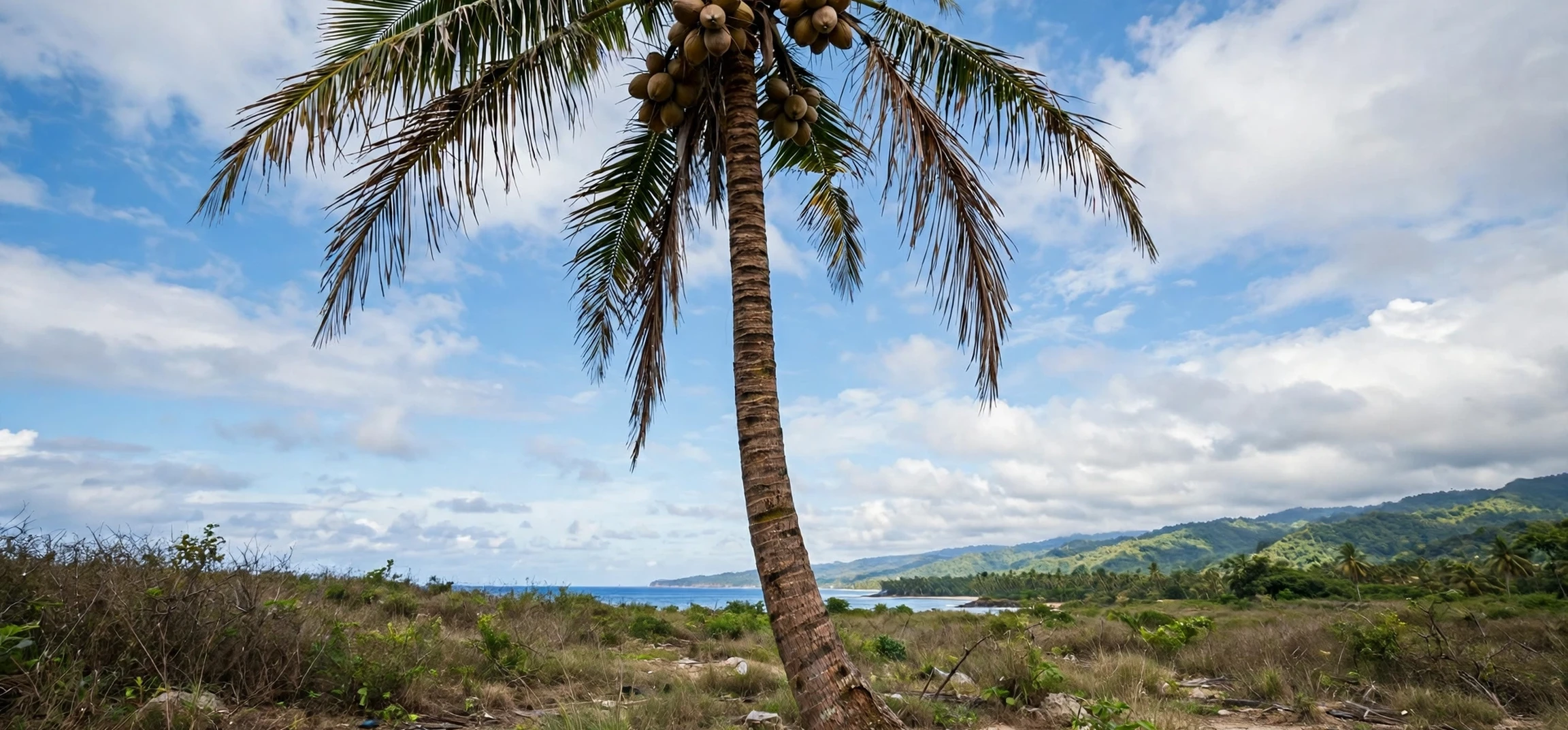
So, what is the classification of a coconut? In botanical terms, the coconut palm is classified as Cocos nucifera, a flowering plant in the palm family, Arecaceae. It sits within the order Arecales and the class of monocotyledons, which means it shares more in common with grasses, orchids and lilies than it does with broad-leaved trees such as oaks or maples. This single scientific name covers the familiar tall palms of tropical beaches as well as the shorter dwarf varieties grown in gardens and plantations around the world.
Classification matters because it tells us how a plant is related to other plants, how it grows, and how it reproduces. A coconut is not a true nut in the strict botanical sense, even though we call it one in everyday language. It is a drupe: a fleshy fruit with a hard, stony layer surrounding a single seed. Understanding that distinction clears up a surprising amount of confusion about coconuts, from food labelling to allergy advice and gardening guides.
What Is the Classification of a Coconut in Full?
The full taxonomic hierarchy for the coconut palm runs from the broadest group to the most specific. At the top sits the kingdom Plantae, which includes all land plants. Below that comes the division of flowering plants, then the class of monocots, then the order Arecales, the family Arecaceae, the genus Cocos, and finally the species Cocos nucifera. The genus name Cocos comes from the Portuguese word coco, meaning a grinning face, a reference to the three dark marks on the shell that resemble eyes and a mouth. The species name nucifera means nut-bearing.
One point that often surprises readers is that Cocos is a genus with only one living species. The coconut palm has no close sister species still in existence, although the fossil record shows related palms from millions of years ago. That uniqueness is part of why the coconut is so recognisable and why it has been carried by ocean currents, traders and settlers to tropical coastlines across Asia, Africa, the Pacific and the Americas.
| Taxonomic rank | Coconut classification | What it means in plain language |
|---|---|---|
| Kingdom | Plantae | All plants, as opposed to animals or fungi |
| Clade | Angiosperms | Flowering plants that produce seeds enclosed in fruit |
| Clade | Monocots | Seedlings with a single seed leaf; parallel-veined leaves |
| Order | Arecales | The order containing palms and their close relatives |
| Family | Arecaceae | The palm family, with over 2,500 species |
| Genus | Cocos | A genus containing only the coconut palm today |
| Species | Cocos nucifera | The coconut palm itself |
What Is the Classification of a Coconut and Why It Is a Monocot?
Being a monocot shapes almost everything about how a coconut palm grows. Monocots have a single cotyledon, or seed leaf, when they sprout. Their leaves tend to have parallel veins rather than the branching network seen in most broad-leaved plants, and their flower parts usually appear in multiples of three. If you look closely at a coconut palm frond, you can see that parallel structure in the leaflets running either side of the central rib.
Monocots also lack the secondary thickening that lets many trees add a new ring of wood each year. A coconut palm does not grow wider in the way an oak does. Instead, its trunk reaches its full diameter relatively early and then grows taller, adding new fronds at the crown while older ones fall away. This is why the trunk of an old palm is often marked with ring-like leaf scars, and why a palm cannot simply be pruned back and expected to branch the way a hardwood tree might. Damage to the growing tip, the single apical bud at the top, can kill the palm outright.
The palm family itself is enormous and varied. It includes date palms, oil palms, rattans and fan palms, and its members grow in deserts, rainforests and coastal regions alike. The coconut belongs to a subgroup of palms adapted to seashores. Its fruit is built for ocean travel: a thick, fibrous husk that cushions the seed and helps it float, and a waterproof shell that protects it during weeks or even months at sea. That natural design explains how coconuts reached remote islands long before people began planting them deliberately.
Is a Coconut a Nut, a Fruit or a Seed?
The honest answer is that it is all three, depending on which definition you use. Botanically, the whole coconut as it falls from the palm is a fruit, and more precisely a drupe. The outer skin, the fibrous husk and the hard shell correspond to the layers of a drupe, comparable to the flesh and stone of a peach or a cherry, except that in a coconut the middle layer is dry and fibrous rather than juicy. Inside the shell sits the seed, and the white flesh and liquid we eat and drink are parts of that seed and its nourishment store.
In the kitchen and in food labelling, however, coconut is often treated as a tree nut. That matters for people with allergies, because regulations in many countries require coconut to be labelled as a tree nut even though botanists classify it differently. If you have a nut allergy, the botanical debate is beside the point: always follow the advice of your clinician and read labels carefully. The difference between a culinary label and a scientific classification is a good reminder that the same word can mean different things in different contexts.
There is a related confusion about the word nut itself. True nuts, in the botanical sense, are dry fruits with a single seed and a hard shell that does not split open, such as acorns and hazelnuts. Many foods we call nuts, including almonds, walnuts and cashews, are actually seeds from drupes, just like coconut. So the coconut is in distinguished company, and its classification as a drupe is entirely normal within the plant world.
Tall, Dwarf and Hybrid Coconut Varieties
Within the single species Cocos nucifera, growers recognise a wide range of varieties and cultivars. The two broad groups are tall varieties and dwarf varieties. Tall palms, sometimes called typica types, can reach 20 to 30 metres, live for 60 to 80 years, and begin bearing fruit after six to ten years. They are typically cross-pollinated, which gives their seedlings a good deal of genetic variety, and they are the classic palms of tropical beaches and large plantations.
Dwarf varieties, by contrast, stay much shorter, often under 10 metres, and start fruiting earlier, sometimes within three to four years. They are usually self-pollinating, so their offspring resemble the parent more closely. Dwarfs are popular in home gardens because harvesting is easier and safer, and because their colourful fruits, which may be green, yellow, orange or red, look attractive. Popular dwarf types include the Malayan dwarf and its hybrids, which were developed partly for resistance to a serious palm disease known as lethal yellowing.
Hybrids combine the strengths of both groups. Crossing a dwarf with a tall variety can produce a palm that fruits early, yields heavily and tolerates disease better than either parent. Hybrid coconuts now dominate many commercial plantings, particularly in South and South-East Asia. For the home grower, the choice between tall, dwarf and hybrid comes down to space, patience and purpose: tall palms for a traditional landscape and a long productive life, dwarfs for a manageable garden tree, and hybrids for the best balance of yield and resilience.
How the Coconut Palm Grows and Reproduces
A coconut palm begins life as a single seed, the nut itself, which germinates over several weeks or months. The sprout pushes through one of the three germination pores on the shell, the softest of which is sometimes called the eye. The young palm puts down roots and sends up a shoot that unfurls into fronds. For the first few years it grows as a rosette of leaves close to the ground before the trunk begins to rise.
Flowering starts once the palm matures. Coconut palms produce large, branching flower clusters called inflorescences, tucked among the frond bases at the crown. Each cluster carries both male and female flowers, although the timing of their opening varies, which encourages cross-pollination in tall varieties. Insects and wind both play a role in moving pollen, and successful pollination leads to bunches of developing fruit that take around a year to ripen fully.
A mature, healthy palm in a good climate can produce 50 to 100 nuts a year, with fruit available in most months rather than in a single season. That steady production is one reason the coconut has been called a tree of life in many tropical cultures: it provides food, drink, oil, fibre, timber, thatch and fuel from a single plant, year after year, with relatively little input once established.
Where Coconuts Grow and Why Climate Matters
Coconut palms thrive in warm, humid, tropical climates, generally between about 25 degrees north and south of the equator. They need plenty of sunshine, rainfall of at least 1,500 millimetres a year or reliable irrigation, and well-drained soil. They tolerate salty coastal soils and sea spray better than most crops, which is why they line beaches, but they cannot survive frost. Even a brief freeze can damage the growing tip and kill the palm.
That climate sensitivity explains the geography of coconut production. The largest producers include Indonesia, the Philippines, India, Sri Lanka, Brazil and Vietnam, all with extensive tropical coastlines. Outside the tropics, coconut palms grow only as ornamental plants in heated glasshouses or very sheltered, frost-free spots, and they rarely fruit. If you live in a temperate climate and want to grow one indoors, a dwarf variety in a large pot, kept warm and bright, is the realistic option, and fruiting should be treated as a bonus rather than an expectation.
Climate change is also reshaping coconut growing. Rising sea levels threaten low-lying plantations, stronger storms snap tall palms, and changing rainfall patterns increase drought stress in some regions. Breeders are working on varieties that tolerate drier conditions and resist diseases spread by insects, but the long life of a palm means that planting decisions made today will play out over decades, so growers watch climate trends closely.
Uses of Every Part of the Coconut
Few crops are as fully used as the coconut. The liquid inside a young nut, coconut water, is a refreshing drink rich in potassium. The white flesh, or kernel, is eaten fresh, dried as copra, grated into curries and baking, or pressed for coconut oil and coconut milk. Mature flesh is high in saturated fat and energy, so it is best enjoyed as part of a varied diet rather than in unlimited quantities.
Beyond food, the husk yields coir fibre, used for ropes, mats, brushes, mattresses and growing media for plants. The shell becomes charcoal, cups, buttons and craft items. Palm fronds are woven into thatch, baskets and mats, and the trunk provides timber for building in many island communities. Even the sap of the flower cluster can be tapped to make palm sugar, vinegar or a fermented drink. Little goes to waste, which is one reason the palm remains central to livelihoods across the tropics.
In recent years, coconut products have also found new markets in cosmetics, health foods and sustainable materials. Coconut oil appears in soaps, skin care and hair care, while coir is marketed as a peat-free alternative for gardeners. As with any fashionable ingredient, it is worth looking past the marketing: coconut products can be useful and enjoyable, but they are not miracle cures, and traditional uses remain the best guide to their real value.
Common Questions About Coconut Classification
One frequent question is whether the coconut palm is a tree at all. Strictly speaking, palms are not trees in the same sense as oaks or pines, because they lack true wood and secondary growth. In everyday language, though, everyone calls them trees, and there is nothing wrong with that. The distinction only matters in botany lessons and in understanding why palms cannot be pruned or grafted like hardwood trees.
Another common query concerns the scientific name itself. You may see the coconut written as Cocos nucifera L., where the L. stands for Carl Linnaeus, the botanist who formalised the modern system of naming species in the eighteenth century. The italics are a convention: genus and species names are italicised in print, while the authority abbreviation is not. Getting the capitalisation right also matters, with the genus capitalised and the species name in lower case.
People also ask how the coconut relates to other familiar palms. Date palms belong to a different genus, Phoenix, while oil palms belong to Elaeis. They share the palm family, Arecaceae, so they are cousins rather than siblings. If you enjoy plant names, you may like reading about another plant with a distinctive scientific name in our guide to the Virginia creeper scientific name, or our piece on a tree named after Lady Jane Grey.
Frequently asked questions
What family is the coconut in? The coconut palm belongs to the family Arecaceae, the palm family, within the order Arecales.
Is a coconut a monocot or a dicot? It is a monocot, with a single seed leaf, parallel leaf veins and flower parts in multiples of three.
Why is coconut labelled as a tree nut if it is a drupe? Food labelling rules treat coconut as a tree nut for allergy purposes, even though botanists classify the fruit as a drupe. Always follow allergy advice rather than the botanical definition.
How many species are in the genus Cocos? Only one living species, Cocos nucifera, although extinct relatives are known from fossils.
Conclusion
The classification of a coconut is a neat illustration of how scientific naming works. One plant, one scientific name, Cocos nucifera, and a hierarchy that places it among the flowering monocots in the palm family. Around that simple framework sits a wealth of practical detail: the drupe structure that explains its husk and shell, the monocot growth habit that explains its unbranching trunk, and the varieties that let growers choose between tall, dwarf and hybrid palms. Whether you came to this guide out of curiosity, for a school assignment, or because you are thinking of growing one, that classification is the key that unlocks the rest of the coconut’s story.



