If you have ever wondered about the meaning of Canaan in Bible passages, you are asking about one of the oldest and most layered place names in the biblical world. In the Hebrew Bible, Canaan is first of all a land: the territory promised to Abraham and his descendants, lying between the Mediterranean Sea and the Jordan Valley. It is also a people, a family line, and a powerful symbol of both promise and conflict. This guide explains the meaning of Canaan in Bible texts in plain, neutral language, looking at its origins, its geography, the people who lived there, and the way later writers and musicians have reused the name.
The name itself is ancient. In biblical Hebrew it appears as Kenaan, and scholars generally connect it with a root suggesting low land, in contrast to the higher country inland. That fits the geography well, because much of ancient Canaan lay along the coastal plain and the low valleys of the Levant. Other ancient languages of the region used similar forms of the name, which tells us that Canaan was not invented by biblical writers: it was a real regional name, already in use long before the biblical narratives were written down. Understanding that background helps modern readers see why the name carries so much weight.
The Meaning of Canaan in Bible Texts: Land, Promise and Identity
The most important strand in the meaning of Canaan in Bible literature is the idea of a promised land. In the book of Genesis, God promises Abraham a land for his descendants, and that land is identified with Canaan. The promise is repeated to Isaac and Jacob, and it becomes the goal of the Exodus story: the Israelites leave Egypt in order to enter the land of Canaan. For readers of these texts, then, Canaan is not simply a dot on a map. It is the destination of a long journey and the place where a community hopes to settle, farm, build towns, and live under its own laws.
At the same time, the biblical writers describe Canaan as already inhabited. The land is full of towns, kings, traders, and farmers. This creates the central tension of the conquest narratives in Joshua and Judges: a promised land that is also somebody else’s home. Modern readers approach this tension in different ways. Historians note that the archaeological picture is more complicated than a single swift conquest, with evidence of gradual settlement, local continuity, and cultural mixing. Literary readers note that the stories use Canaan to explore themes of belonging, loyalty, and the danger of adopting the practices of neighbouring peoples. Either way, the name stands for a place where identity is tested.
There is also a personal name behind the place name. Genesis traces Canaan back to a figure called Canaan, son of Ham and grandson of Noah. In the story, Noah curses Canaan after an incident involving Ham, and that curse is later used within the narrative to explain the subordination of Canaan’s descendants. Scholars and commentators have discussed this passage at length, and many modern readers find it troubling, not least because it was misused in later centuries to justify slavery and colonialism. A responsible modern reading separates the ancient story from those later misuses and treats the passage as part of an ancient family history rather than as a licence for any modern claim.
Where Was Canaan? Geography, Borders and Neighbours
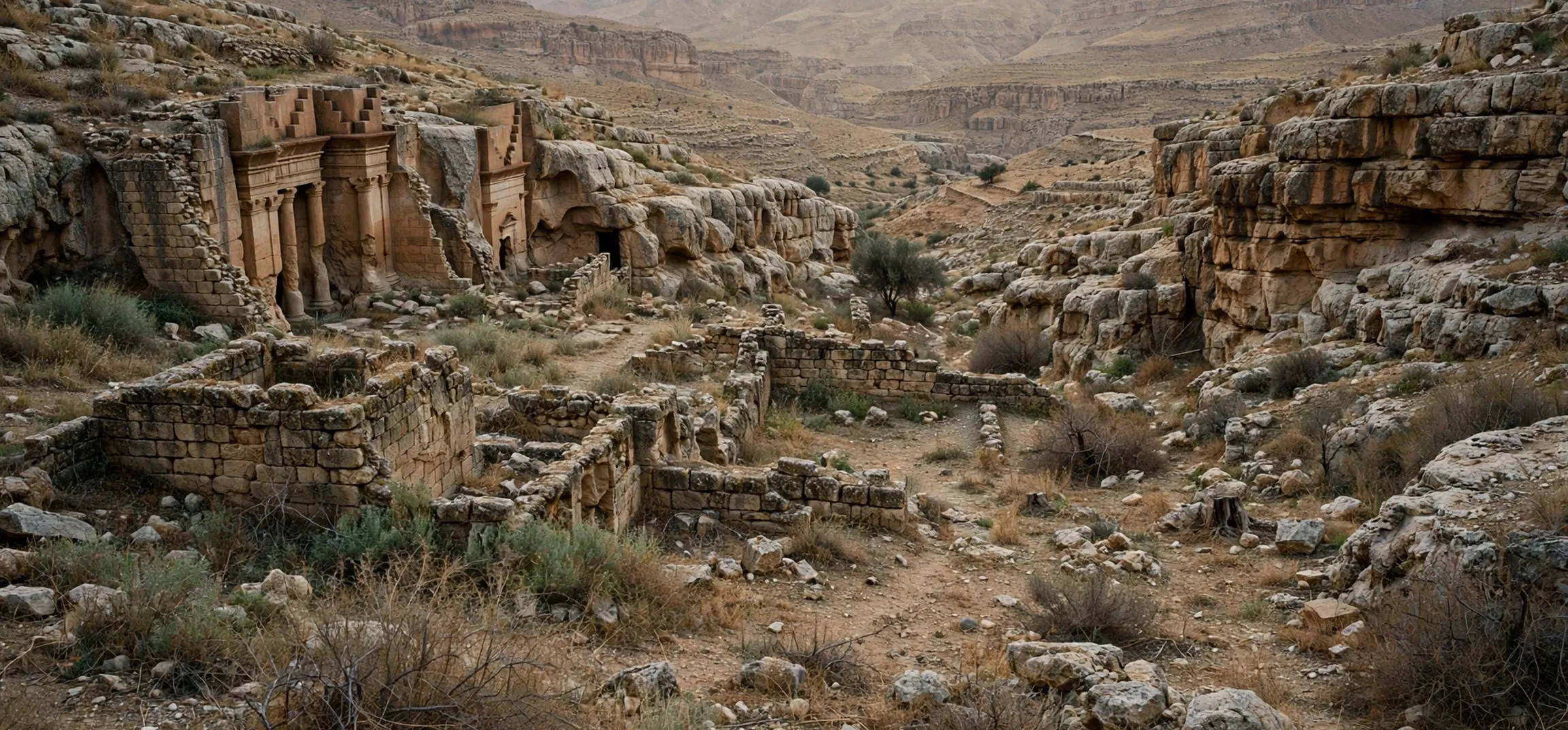
Geographically, ancient Canaan covered roughly the area of modern Israel and Palestine, Lebanon, and parts of Syria and Jordan. Its western edge was the Mediterranean coast, its eastern edge ran towards the Jordan River and the desert beyond, its northern reach extended towards the mountains of Lebanon, and its southern edge faded into the Negev and towards Egypt. Within that frame lay fertile coastal plains, hill country suitable for olives and vines, and busy trade routes linking Egypt with Mesopotamia. Control of those routes made Canaan valuable to every great power of the ancient Near East.
The land was never a single kingdom. Instead, it was a patchwork of city-states such as Jericho, Hazor, Megiddo, and Jerusalem, each with its own ruler, walls, and gods. Egyptian records from the second millennium BCE mention Canaan as a region under Egyptian influence, and letters found at Amarna in Egypt show Canaanite rulers writing to the pharaoh about local rivalries and requests for help. This picture of a divided, contested region matches the biblical description of many small kings, and it helps explain why the name Canaan survived as a regional label even when no single Canaanite state existed.
Climate and farming shaped life in Canaan in practical ways. Rain fell mainly in winter, so farmers depended on seasonal rains for wheat, barley, grapes, and olives. Terraces cut into hillsides held thin soil in place, cisterns stored water through the dry summer, and threshing floors on windy hilltops separated grain from chaff. When biblical texts praise Canaan as a land flowing with milk and honey, they are using the language of farming abundance: milk from flocks and honey from bees or from date syrup. The image is poetic, but it is rooted in a real agricultural economy.
The Canaanites: People, Language and Culture
The Canaanites were the peoples who lived in this region during the Bronze Age and early Iron Age. They spoke Semitic languages closely related to Hebrew, and their best-known written language, Ugaritic, was recorded at the coastal city of Ugarit in tablets that have given scholars a detailed picture of Canaanite myth and poetry. Canaanite religion centred on gods such as El, the father figure, and Baal, the storm god who brought rain. Biblical writers often present worship of Baal as a rival loyalty, which is why the name Baal appears so often in warnings against following local religious practices.
Canaanite culture was far from primitive. Its craftspeople produced fine purple dye from sea snails, a trade so famous that the Greeks later called the coastal traders Phoenicians, from their word for purple. Its merchants sailed across the Mediterranean, its scribes developed early alphabetic writing, and its cities built impressive fortifications. When the biblical texts describe Canaanite cities as large and walled, they are describing a genuinely urban civilisation. Later Israelite culture absorbed a great deal from its Canaanite neighbours, from language and farming methods to building styles and musical instruments.
Over time, the distinct Canaanite identity faded into the wider mix of peoples in the region. Some Canaanite cities were absorbed into the kingdoms of Israel and Judah, others came under Assyrian, Babylonian, and Persian rule, and the coastal Phoenician cities continued as trading powers in their own right. By the later biblical period, Canaan had become more of a historical and literary name than a political reality. That shift matters for readers today: when later biblical books mention Canaan, they are often looking back to an earlier age rather than describing the politics of their own day.
What the Meaning of Canaan in Bible Stories Still Symbolises Today
Beyond history and geography, the meaning of Canaan in Bible interpretation has grown into a symbol. In Jewish tradition, the land remains bound up with covenant, return, and hope. In Christian preaching and hymnody, Canaan has often stood for heaven, or for the rest that follows a long struggle: crossing the Jordan into Canaan becomes an image of reaching a goal after hardship. African American spirituals famously used Canaan in the same way, singing of a promised land beyond present suffering. These symbolic uses show how a place name can carry emotional weight long after its original political meaning has faded.
That symbolic life also explains why the name turns up in music and popular culture, including soundtrack and album titles. Writers and composers borrow Canaan because it instantly suggests a journey, a homecoming, or a longed-for place. If you arrived at this guide because a soundtrack listing or a song title caught your eye, the connection is usually thematic rather than historical: the artist is reaching for the same image of a promised land that biblical readers have used for centuries. No single soundtrack owns the name, and the meaning travels with the story being told, not with any one recording.
For modern readers who simply want a clear answer, the summary is straightforward. Canaan in the Bible is a land, a people, and a promise. As a land, it is the eastern Mediterranean region promised to Abraham’s descendants. As a people, the Canaanites were its Bronze Age inhabitants, with their own languages, cities, and gods. As a symbol, it stands for arrival, belonging, and hope after wandering. Keeping those three layers apart makes the biblical passages much easier to follow, and it prevents the common mistake of treating every mention of Canaan as if it meant exactly the same thing.
Canaan at a Glance
| Aspect | What it means |
|---|---|
| Basic sense | An ancient land in the eastern Mediterranean, and the people who lived there |
| Location | Coastal plains and hill country roughly matching modern Israel, Palestine, Lebanon, and parts of Syria and Jordan |
| Key biblical role | The land promised to Abraham and sought by the Israelites after the Exodus |
| Language link | The name is traditionally connected with low land, matching its coastal geography |
| People | The Canaanites, Semitic-speaking city dwellers with a rich trading and religious culture |
| Later use | A symbol of homecoming, rest, and a hoped-for future in hymns, sermons, and songs |
Frequently Asked Questions
Is Canaan a real place?
Yes, in historical terms. Canaan was a real region of the ancient Near East, known from Egyptian records, the Amarna letters, and archaeology as well as from biblical texts. Its borders shifted over time, which is why modern maps of ancient Canaan differ slightly from one another.
Does Canaan mean the same thing in every biblical book?
Not exactly. In Genesis it is mainly a promised land and a family line. In Joshua and Judges it is contested territory. In later books and in poetry it often works as a backward-looking symbol of an earlier age or of a hoped-for future.
Why do songs and soundtracks use the name Canaan?
Because the name carries an instant story: a long journey towards a promised home. Composers and lyricists borrow that association, just as preachers and poets have done for centuries, without necessarily making a historical claim about the ancient region.
How should modern readers handle the difficult passages about Canaan?
Read them in context, notice the ancient setting, and be aware of how some passages were misused in later history. Many modern study guides and commentaries discuss these passages openly, and they are a good next step for readers who want more detail.
Questions Readers Ask About the Meaning of Canaan in Bible Passages
Many readers arrive at this topic with a single question: what is the meaning of Canaan in Bible passages, in one clear sentence? The shortest honest answer is that the meaning of Canaan in Bible texts combines land, people, and promise, and no one-word definition captures all three. When someone asks about the meaning of Canaan in Bible study notes, they usually want to know whether a passage is talking about geography, about the Canaanite peoples, or about the symbolic promise, and the context of the passage normally makes that clear. Checking whether the verse mentions borders, kings, or journeys is a quick way to tell which layer is in play.
Another common question concerns pronunciation and spelling. The meaning of Canaan in Bible reading is unaffected by whether you say KAY-nan or kuh-NAY-un, and older spellings such as Chanaan appear in some translations without changing the sense. Readers also ask whether the meaning of Canaan in Bible maps matches the modern Middle East, and the answer is approximate rather than exact: the ancient region overlaps several modern countries, and its borders shifted over the centuries. Finally, readers often wonder why the meaning of Canaan in Bible hymns sounds so hopeful when some of the historical passages are so harsh. The answer lies in the symbolic layer: later writers took the image of arrival after wandering and used it to express hope, which is why the meaning of Canaan in Bible-inspired song feels very different from the meaning of Canaan in Bible conquest narratives.
One final clarification helps readers who keep returning to the same question. The meaning of Canaan in Bible study is not a single dictionary entry but a small cluster of related senses, and the meaning of Canaan in Bible passages becomes clear once you identify which sense a verse is using. If the verse describes a journey or a border, the meaning of Canaan in Bible geography is in view. If it names peoples or kings, the cultural sense applies. Keeping that habit will make the meaning of Canaan in Bible reading far less confusing.
Conclusion
The meaning of Canaan in Bible texts rewards a patient reading. It begins as a name for low coastal land, grows into the promise at the heart of the patriarchal and Exodus stories, and ends as a symbol of homecoming that still appears in worship, literature, and music today. If you keep the three layers in mind, land, people, and promise, the passages that mention Canaan become clearer, and the name’s long afterlife in culture becomes easier to understand. For further biblical name and symbol explainers, see our guide to biblical meanings, our look at Christian symbolism, and our overview of apocalyptic names.