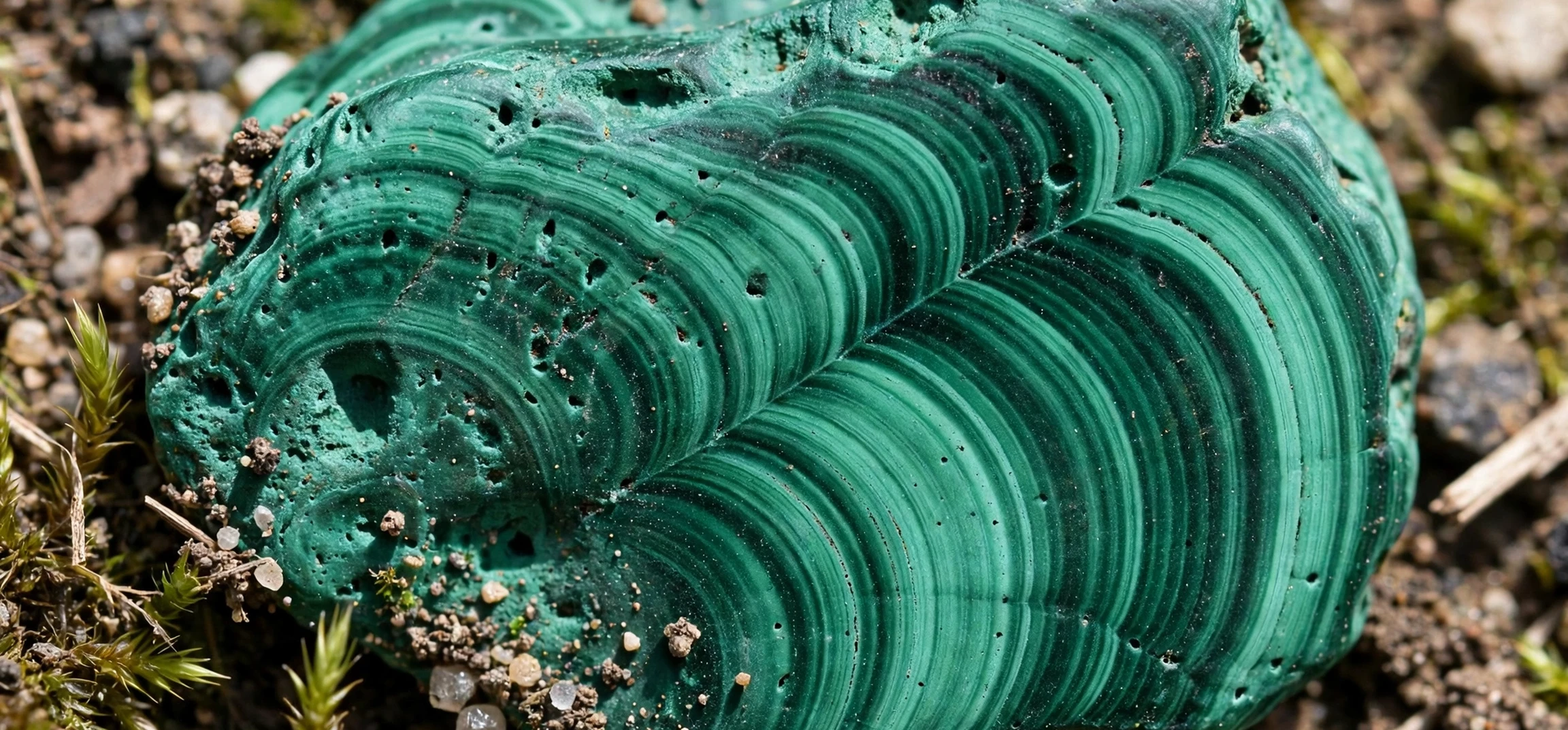
If you are looking for the meaning malachite stone carries, you have chosen a stone with one of the most recognisable appearances in the mineral world. Malachite is a vivid green mineral, banded in swirling patterns of light and dark, that has been carved, polished, worn, and traded for thousands of years. Its colour alone explains much of its appeal, but its history, from ancient Egyptian mines to Renaissance palaces and modern jewellery workshops, gives it a depth that goes far beyond decoration. This guide explains what malachite is, where it comes from, what it has symbolised across cultures, and how to look after it.
Geologically, malachite is a copper carbonate mineral that forms in the oxidised zones of copper deposits, often alongside azurite, its deep blue counterpart. Water rich in copper and carbonate slowly deposits the mineral in cracks, cavities, and veins, building up the layered, botryoidal, or stalactitic shapes that collectors prize. When cut and polished, those layers reveal concentric bands and flowing patterns that make every piece unique. No two polished malachite stones look exactly alike, which is part of why the stone remains so popular with jewellers and collectors today. In this period, the meaning malachite stone carried was inseparable from its striking green colour.
The name itself comes from the Greek word for mallow, a green plant, a reference to the stone’s distinctive colour. That green ranges from pale, almost mint tones to deep, nearly black-green shades, and the contrast between bands is often dramatic. Because malachite is relatively soft, it is usually cut into cabochons, beads, inlays, and decorative objects rather than faceted like a diamond. It takes a high polish, but it also scratches and chips more easily than harder gemstones, a practical point that matters if you plan to wear it regularly. Collectors today still value the meaning malachite stone holds as a symbol of growth and renewal.
The meaning malachite stone Has Carried Through History
The meaning malachite stone held in the ancient world was closely tied to protection and transformation. In ancient Egypt, malachite was ground into pigment for eye paint and wall decoration, carved into amulets, and placed in tombs. Green was associated with fertility, rebirth, and the lush growth that followed the Nile flood, so a green stone naturally carried hopeful associations. Egyptian artisans valued malachite both as a material and as a colour, and its use in sacred and everyday objects shows how deeply it was woven into daily life. Museums and workshops alike keep the meaning malachite stone alive through display and craft.
In the classical world, malachite continued to be used for ornament, jewellery, and pigment, and in later centuries it became a favourite material for grand decorative schemes. Perhaps the most famous example is in Russia, where vast deposits in the Ural Mountains supplied the malachite used to decorate rooms in St Petersburg palaces. Columns, vases, tabletops, and entire wall panels were veneered with carefully matched malachite, creating interiors of extraordinary richness. Those rooms remain a powerful reminder that malachite was once a symbol of wealth and imperial taste as much as of personal adornment. That history helps explain why the meaning malachite stone attracts interest far beyond jewellery circles.
Across many cultures, green stones have been linked with nature, growth, and renewal, and malachite is no exception. Traditional associations include protection during travel, encouragement of change, and support for emotional balance. It is important to present these associations honestly: they are cultural and spiritual beliefs, not scientifically established effects. Malachite does not treat illness, replace medical care, or guarantee any outcome, and anyone with a health concern should speak to a qualified clinician rather than relying on a stone. What malachite can reliably offer is beauty, craftsmanship, and a tangible connection to a long human history of valuing green. For buyers, the meaning malachite stone offers is best understood alongside its geology, not apart from it.
meaning malachite stone: Symbolism and Modern Associations
In modern crystal and jewellery traditions, the meaning malachite stone is most often described in terms of transformation and protection. Its banded patterns are read as a visual metaphor for growth: layers building slowly over time, like experience accumulating through life. Its green colour reinforces associations with the natural world, with spring, and with new beginnings. People who choose malachite often say they are drawn to its energy of change, whether they are starting a new chapter, leaving an old habit behind, or simply marking a moment of personal growth.
Malachite is also frequently associated with the heart in symbolic systems that link colours and stones to parts of the body or to emotional life. Again, this is a symbolic language, not a medical claim. The value of such symbolism is personal: a piece of jewellery can serve as a reminder of an intention, a gift can mark a relationship, and a collected specimen can represent a love of geology and natural beauty. If you buy malachite for any of these reasons, you are participating in a tradition that stretches back millennia, and that continuity is meaningful in itself. Teachers and guides often introduce the meaning malachite stone through its banded patterns, which tell a story of slow formation.
Another modern association is creativity. Because malachite is so visually distinctive, artists, designers, and makers are drawn to it as a material. Its patterns inspire textiles, wallpapers, and interior design, and its colour has become shorthand for bold, natural luxury. Whether you encounter it as a ring, a carved box, a polished slice, or a print inspired by its bands, malachite communicates confidence and a connection to the earth. That broad cultural presence helps explain why interest in its meaning remains strong today. Gift buyers who understand the meaning malachite stone can choose a form that suits daily wear.
Where Malachite Is Found
Malachite occurs wherever copper deposits have been exposed to water and air over long periods. Historically important sources include Egypt, the Ural Mountains of Russia, and the Democratic Republic of Congo, which remains a major producer. It is also found in Australia, the United States, Mexico, Namibia, and several other countries. Deposits vary in quality: the finest material shows sharp, contrasting bands and a smooth, even polish, while lower-grade material may be dull, fractured, or unevenly coloured. In modern collections, the meaning malachite stone represents is frequently linked with change and new beginnings.
For collectors, provenance matters. Russian malachite from historic mines is prized for its deep colour and fine banding, while Congolese material is known for bold, dramatic patterns. Australian malachite, sometimes found alongside azurite in striking green-and-blue combinations, is also highly regarded. When buying a specimen, ask about its origin and whether it has been treated, dyed, or reconstructed. Natural malachite should show organic, flowing bands; unnaturally uniform colour or a plastic-like surface can indicate imitation or heavy treatment.
Malachite and Azurite
Malachite and azurite are closely related minerals that often occur together, and the combination is sometimes called azurmalachite. Azurite is blue, malachite is green, and a single specimen can display both colours in swirling contrast. Over very long periods, azurite can gradually alter into malachite, which is one reason the two are so often found side by side. Collectors value these mixed specimens for their dramatic colour contrast, and jewellers sometimes use them for statement pieces where the natural pattern is the main attraction. That layered symbolism is why the meaning malachite stone remains popular as a gift for marking a transition.
Choosing, Wearing, and Caring for Malachite
If you are buying malachite jewellery, start by considering how you will wear it. Because malachite rates only about 3.5 to 4 on the Mohs hardness scale, it is softer than quartz, topaz, and many everyday gemstones. Rings and bracelets, which take knocks during daily wear, are more vulnerable than pendants and earrings. A protective setting, such as a bezel that surrounds the stone, can help, and removing malachite jewellery before gardening, cleaning, swimming, or exercising will extend its life considerably.
Care is straightforward but important. Clean malachite with a soft, damp cloth and mild soap, then dry it gently. Avoid ultrasonic cleaners, steam cleaners, and harsh chemicals, and never expose malachite to acids, including vinegar or lemon-based cleaners, which can damage its surface. Store it separately from harder stones so it does not get scratched, ideally in a soft pouch or a lined compartment. With sensible care, a well-made malachite piece can last for many years and develop a character that reflects its owner. When choosing a piece, remember that the meaning malachite stone carries is personal, while its care needs are practical.
When judging quality, look for strong colour contrast, smooth banding, and a good polish without pits or dull patches. Small natural imperfections are normal and, in moderation, confirm that a piece is genuine. Be wary of pieces that look too perfect, feel unusually light, or show a repeating printed pattern, all of which can suggest imitation. Buying from a reputable seller who can explain the stone’s origin and any treatments is the simplest way to avoid disappointment. Across centuries, the meaning malachite stone has shifted from protection to personal growth, while its colour stayed constant.
| Property | Detail | Practical Implication |
|---|---|---|
| Colour | Vivid green with light and dark bands | Every piece has a unique pattern |
| Hardness | About 3.5 to 4 on the Mohs scale | Handle gently; avoid knocks and scratches |
| Common forms | Cabochons, beads, carvings, inlays | Suits pendants, earrings, and decorative objects |
| Cleaning | Soft damp cloth, mild soap, dry gently | Avoid acids, ultrasonic and steam cleaning |
| Companion mineral | Often found with blue azurite | Mixed specimens show green and blue together |
Frequently Asked Questions
What is the main meaning of malachite?
Traditionally, malachite is associated with protection, transformation, growth, and renewal. These are cultural and symbolic associations rather than proven effects, and they reflect the stone’s green colour, its layered formation, and its long history of use. Dealers who explain the meaning malachite stone clearly also tend to explain treatments and origins honestly.
How can I tell real malachite from fake?
Real malachite shows organic, flowing bands that vary across the stone, feels cool and relatively dense, and has a smooth polish with minor natural imperfections. Printed or perfectly uniform patterns, a plastic feel, or an unusually low weight can indicate imitation.
Can malachite go in water?
Brief contact with clean water during gentle cleaning is generally fine, but prolonged soaking, hot water, and exposure to chemicals should be avoided. Always dry the stone afterwards and store it separately from harder jewellery. For a balanced view, the meaning malachite stone should be enjoyed as culture and craft, not as a substitute for professional advice.
Is malachite a good gift?
Yes, it is a thoughtful gift for someone marking a new chapter, celebrating a love of nature or geology, or simply appreciating bold, distinctive jewellery. Choose a form that suits the recipient’s lifestyle, favouring pendants or earrings for everyday wear.
Conclusion
The meaning malachite stone carries is layered, much like the stone itself. Geologically, it is a copper mineral formed slowly in the earth. Historically, it is a pigment, an amulet, a palace decoration, and a jeweller’s favourite. Symbolically, it stands for protection, transformation, and growth, associations that have endured for thousands of years. Whether you are drawn to malachite as a collector, a jewellery lover, or simply someone curious about a beautiful green stone, its appeal is easy to understand. Treat it with care, buy it from a reputable source, and enjoy a material that has fascinated people since the ancient world. For more guides to names, symbols, and their histories, see our explainer on the meaning of bildungsroman and our guide to the meaning of cherub. In short, the meaning malachite stone has endured because its beauty, history, and symbolism reinforce one another.