If you searched for the chemical name for CaCO3, the short answer is calcium carbonate. The chemical name for CaCO3 is the systematic name for a common compound made of calcium, carbon, and oxygen, and it is one of the most widespread substances in nature and in everyday life. You may know it better by the names of the materials it forms, such as limestone, chalk, and marble, or by its uses in classrooms, kitchens, gardens, and building sites. This guide explains the name, the formula, the structure, and the many forms of the compound, in plain language, for general education. It describes chemistry concepts only, and it is not a guide to handling chemicals, preparing mixtures, or using any product for a particular purpose.
Formulas such as CaCO3 can look cryptic at first, but each part carries a simple meaning. The letters are symbols for chemical elements, and the small numbers show how many atoms of each element appear in one formula unit. Once you can read that pattern, many other formulas become easier to understand as well. Calcium carbonate is a good example to learn from, because it is familiar, its structure is straightforward, and its behaviour in nature connects chemistry to geology, biology, and everyday materials in a way that is easy to picture. That follows directly from the chemical name for CaCO3.
Chemical Name for CaCO3 in Plain Language
The chemical name for CaCO3 is calcium carbonate. The name is built from its two main parts. Calcium is the metal element represented by Ca, and carbonate is the name for the group made of one carbon atom and three oxygen atoms, represented by CO3. Put together, calcium carbonate describes a compound in which calcium ions combine with carbonate ions. That naming pattern is common in chemistry: the first part names the positively charged component, and the second part names the negatively charged group, with a suffix that hints at the composition of that group.
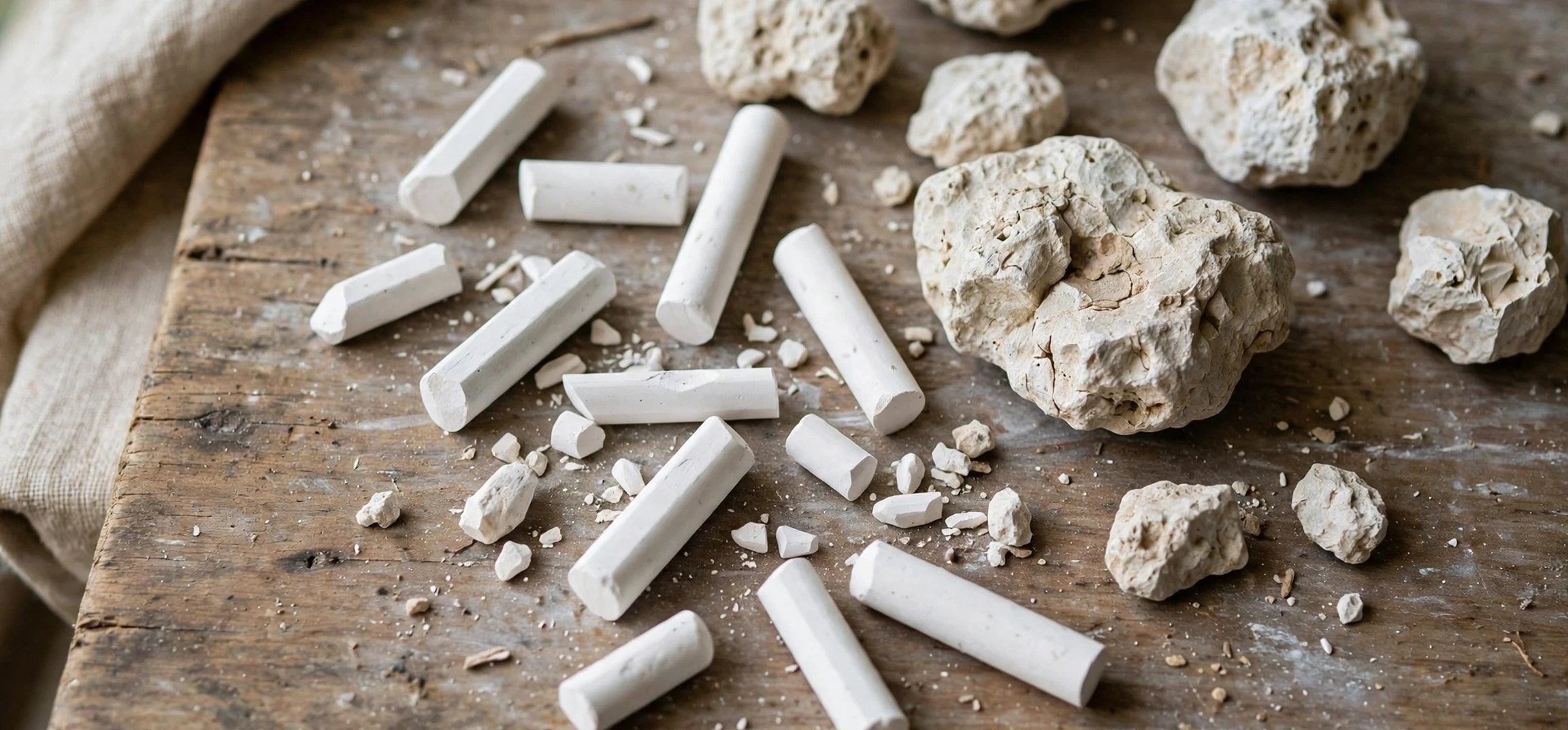
It helps to distinguish the chemical name from the many common names for materials that contain the compound. Limestone is a rock that is mainly calcium carbonate, but it is not a pure chemical name, because natural limestone also contains other minerals and impurities. Chalk is a soft, fine-grained form of limestone, often used for writing or drawing, and it too is mainly calcium carbonate rather than a pure sample. Marble is a metamorphic rock formed when limestone is changed by heat and pressure, and it is also largely calcium carbonate. Travertine, another decorative stone, is formed by mineral deposits and is again mainly calcium carbonate. In each case, the chemical name for CaCO3 stays the same, while the material name describes the natural form, texture, or history of the rock.
Calcium carbonate also appears under other everyday labels. In some contexts it is called precipitated calcium carbonate when it has been produced by a chemical process rather than mined, or ground calcium carbonate when it has been obtained by grinding natural rock. Those labels describe how the material was made or processed, not a different compound. Food, medicine, and industrial labels may also list it by its chemical name, by an additive code in some regions, or by a product name, but the underlying compound remains calcium carbonate. Checking the ingredient or composition label is the reliable way to confirm what a particular product contains. Students first meeting the chemical name for CaCO3 often start with this example.
Reading the formula CaCO3
The formula CaCO3 contains three element symbols. Ca stands for calcium, C stands for carbon, and O stands for oxygen. The small 3 after the O means that there are three oxygen atoms for every one carbon atom in the carbonate group, and the absence of a number after Ca and C means there is one atom of each of those elements in the formula unit. So one formula unit of calcium carbonate contains one calcium atom, one carbon atom, and three oxygen atoms, arranged as a calcium part and a carbonate part. That simple counting rule applies to many chemical formulas, and it is a useful skill for reading labels, textbooks, and science articles. The chemical name for CaCO3 stays the same across these different materials.
The carbonate group itself deserves a closer look. Carbonate is a polyatomic ion, which means it is a group of atoms that behaves as a single charged unit in chemical reactions. The carbon atom sits in the centre, bonded to three oxygen atoms arranged around it. The group as a whole carries a negative charge, which balances the positive charge of the calcium ion, so the compound as a whole is electrically neutral. That balance of charges is why the formula has one calcium part for every one carbonate part, rather than two of one and one of the other. Remembering the chemical name for CaCO3 makes the formula easier to read.
Chemical Name for CaCO3 and Its Structure
The chemical name for CaCO3 points to a compound that forms crystals, and the same compound can form more than one crystal structure. The two most common forms are calcite and aragonite. Calcite is the more stable form at ordinary temperatures and pressures, and it is the form found in most limestone, chalk, and marble. Aragonite is less stable under ordinary conditions and can change into calcite over time, but it is common in seashells, pearls, and some marine deposits, where living organisms build it into their shells and skeletons. The difference between calcite and aragonite is not in the chemical composition, which is calcium carbonate in both cases, but in how the calcium and carbonate units are arranged in the crystal.
That idea, that the same compound can have different crystal arrangements, is called polymorphism in chemistry and mineralogy. It is a reminder that a chemical name tells you what a substance is made of, but not always exactly how its particles are arranged. Arrangement matters, because it affects hardness, shape, and how the material breaks or reacts. Calcite crystals, for example, are famous for splitting along smooth planes, a property called cleavage, which gives calcite fragments their characteristic rhombohedral shape. Aragonite often forms needle-like crystals, which is one reason shells built from it can have such varied textures. This distinction is clearer once you know the chemical name for CaCO3.
Calcium carbonate is an ionic compound, which means its structure is held together by the attraction between positively charged calcium ions and negatively charged carbonate ions, arranged in a repeating three-dimensional pattern. That pattern explains why calcium carbonate is a solid at room temperature, why it has a relatively high melting point in the sense that it decomposes before melting in ordinary conditions, and why it does not dissolve easily in pure water. Solubility is an important property, and it connects calcium carbonate to water chemistry, geology, and even household topics such as scale formation, which are described later in this guide. The chemical name for CaCO3 is the anchor for everything in this section.
How calcium carbonate forms in nature
Calcium carbonate forms in nature through several routes. In the sea, marine organisms such as corals, molluscs, and some plankton take calcium and carbonate from seawater and build shells and skeletons from calcium carbonate. When those organisms die, their remains can accumulate on the sea floor and, over long periods, become compacted into limestone or chalk. On land, calcium carbonate can precipitate from water that carries dissolved calcium and carbonate, forming deposits in caves as stalactites and stalagmites, or forming travertine near springs. It can also form when water evaporates and leaves mineral deposits behind. That follows directly from the chemical name for CaCO3.
The carbon cycle connects those processes to the wider environment. Carbon dioxide from the air dissolves in water and can form carbonate, which then combines with calcium to form calcium carbonate. When calcium carbonate dissolves again, for example in slightly acidic water, carbon dioxide can be released back into the water or air. That cycle, running over geological timescales, helps regulate carbon in the oceans and in rocks, and it is one reason calcium carbonate is so important in earth science, even though it is also an everyday material. Students first meeting the chemical name for CaCO3 often start with this example.
Where Calcium Carbonate Appears in Everyday Life
Calcium carbonate appears in more places than most people realise. In building and construction, limestone and marble have been used for centuries as stone for walls, floors, monuments, and sculptures, valued for their appearance and workability. Crushed limestone is used as aggregate in roads and concrete, and calcium carbonate in powdered form is used as a filler in products such as paper, paint, plastics, and rubber, where it adds bulk, improves brightness, or changes texture. Those industrial uses rely on the compound being abundant, inexpensive to obtain, and chemically stable in many settings. The chemical name for CaCO3 stays the same across these different materials.
In the home and garden, calcium carbonate appears in chalk for blackboards, in some cleaning and polishing products, and in garden lime, which is used to adjust soil acidity in gardening practice. In food and health contexts, calcium carbonate is sometimes listed as an ingredient or additive, and it is a common source of calcium in some supplements and antacid products. This guide does not recommend any product or use, and anyone considering a supplement or medicine should follow product labelling and professional guidance, but recognising the name on a label is a useful piece of general knowledge. The same compound, in different grades and purities, can serve very different purposes, so the grade and the product instructions matter far more than the name alone. Remembering the chemical name for CaCO3 makes the formula easier to read.
In nature, calcium carbonate is the main component of eggshells, seashells, snail shells, and coral skeletons. It gives those structures strength while remaining light enough for the organism to carry or build. Pearl formation also involves calcium carbonate, laid down in layers around an irritant inside a mollusc shell. Those biological examples show why the compound is so widespread: living things have used it for hundreds of millions of years to build protective and supportive structures from materials available in their environment. This distinction is clearer once you know the chemical name for CaCO3.
Properties, Reactions, and Tests
Calcium carbonate is a white solid in its pure form, odourless, and only slightly soluble in pure water. It dissolves more readily in water that contains dissolved carbon dioxide or that is slightly acidic, because the carbonate group reacts with acids. The best-known reaction is with an acid, which produces a calcium salt, water, and carbon dioxide gas. That fizzing release of gas is the basis of the classic school test for carbonate: adding a dilute acid to a sample produces bubbles, and the gas can be identified by further tests in a classroom setting. This guide describes that reaction for education only, and any practical work with acids belongs in a supervised laboratory with proper safety rules. The chemical name for CaCO3 is the anchor for everything in this section.
| Property or feature | Calcium carbonate |
|---|---|
| Chemical name | Calcium carbonate |
| Formula | CaCO3 |
| Elements present | Calcium, carbon, oxygen |
| Common natural forms | Limestone, chalk, marble, travertine |
| Common crystal forms | Calcite, aragonite |
| Appearance in pure form | White solid |
| Solubility in pure water | Low |
| Reaction with acid | Produces a salt, water, and carbon dioxide gas |
When heated strongly, calcium carbonate decomposes into calcium oxide and carbon dioxide. Calcium oxide, commonly called quicklime, is itself an important industrial material, and it reacts with water to form calcium hydroxide, known as slaked lime. That sequence of reactions has been used for thousands of years in making lime mortar, plaster, and cement, and it remains central to the cement industry today. The fact that one simple compound sits at the start of such a long chain of useful materials is part of why calcium carbonate appears so often in chemistry textbooks.
Another everyday consequence of calcium carbonate chemistry is limescale. Hard water contains dissolved calcium and related minerals, and when that water is heated or evaporates, calcium carbonate can deposit as a white crust inside kettles, pipes, and appliances. That crust is not a sign of a different compound, but of calcium carbonate coming out of solution when conditions change. Understanding that connection can make household advice about hard water easier to follow, because the white deposit, the hardness of the water, and the chemistry of calcium carbonate are all part of the same story.
Calcium carbonate and other carbonates
Calcium carbonate belongs to a family of compounds called carbonates, which all contain the carbonate group. Sodium carbonate, often called washing soda, and sodium bicarbonate, often called baking soda, are other familiar members of that family, but they contain different metals and have different properties and uses. Potassium carbonate and magnesium carbonate are further examples. What they share is the CO3 group, and what distinguishes them is the metal or other component paired with it. Learning to spot that pattern can help you read other chemical names with more confidence, because many names follow the same metal-plus-group logic.
For readers interested in how chemistry words are used more broadly, this site also explains malleable meaning in chemistry and molecule meaning in chemistry. Those explainers cover other core vocabulary that appears alongside compound names in school and general science reading.
Chemical Name for CaCO3: Frequently Asked Questions
What is the chemical name for CaCO3?
The chemical name for CaCO3 is calcium carbonate. It is made of calcium, carbon, and oxygen, with one calcium atom, one carbon atom, and three oxygen atoms in each formula unit.
Is limestone the same as calcium carbonate?
Not exactly. Limestone is a rock that is mainly calcium carbonate, but it also contains other minerals and impurities. Calcium carbonate is the pure compound, while limestone is the natural material that contains it in large proportion.
What is the difference between calcite and aragonite?
Both are forms of calcium carbonate, but they have different crystal arrangements. Calcite is the more stable form at ordinary conditions and is found in most limestone and marble. Aragonite is common in shells and pearls and can change into calcite over time.
Why does calcium carbonate fizz with acid?
When calcium carbonate reacts with an acid, it produces a calcium salt, water, and carbon dioxide gas. The bubbles you see are that carbon dioxide escaping, which is why the reaction is used as a simple test for carbonate in educational settings.
Is calcium carbonate natural or man-made?
Both. It occurs abundantly in nature as limestone, chalk, marble, shells, and coral, and it is also produced industrially by grinding natural rock or by chemical precipitation, depending on the purity and particle size needed for a particular use.
Conclusion
The chemical name for CaCO3 is calcium carbonate, a compound of calcium, carbon, and oxygen that appears as limestone, chalk, marble, shells, and many everyday materials. Knowing that one name unlocks a wider story: how to read a chemical formula, how the same compound can form different crystals, how it cycles through oceans and rocks, and why it reacts with acids and forms limescale. Whether you meet it in a classroom, on a product label, in a garden, or in a museum, recognising calcium carbonate for what it is makes the world a little more legible. This chemical name for CaCO3 guide has aimed to give that recognition in plain language, with the compound itself, rather than any single product or use, at the centre.