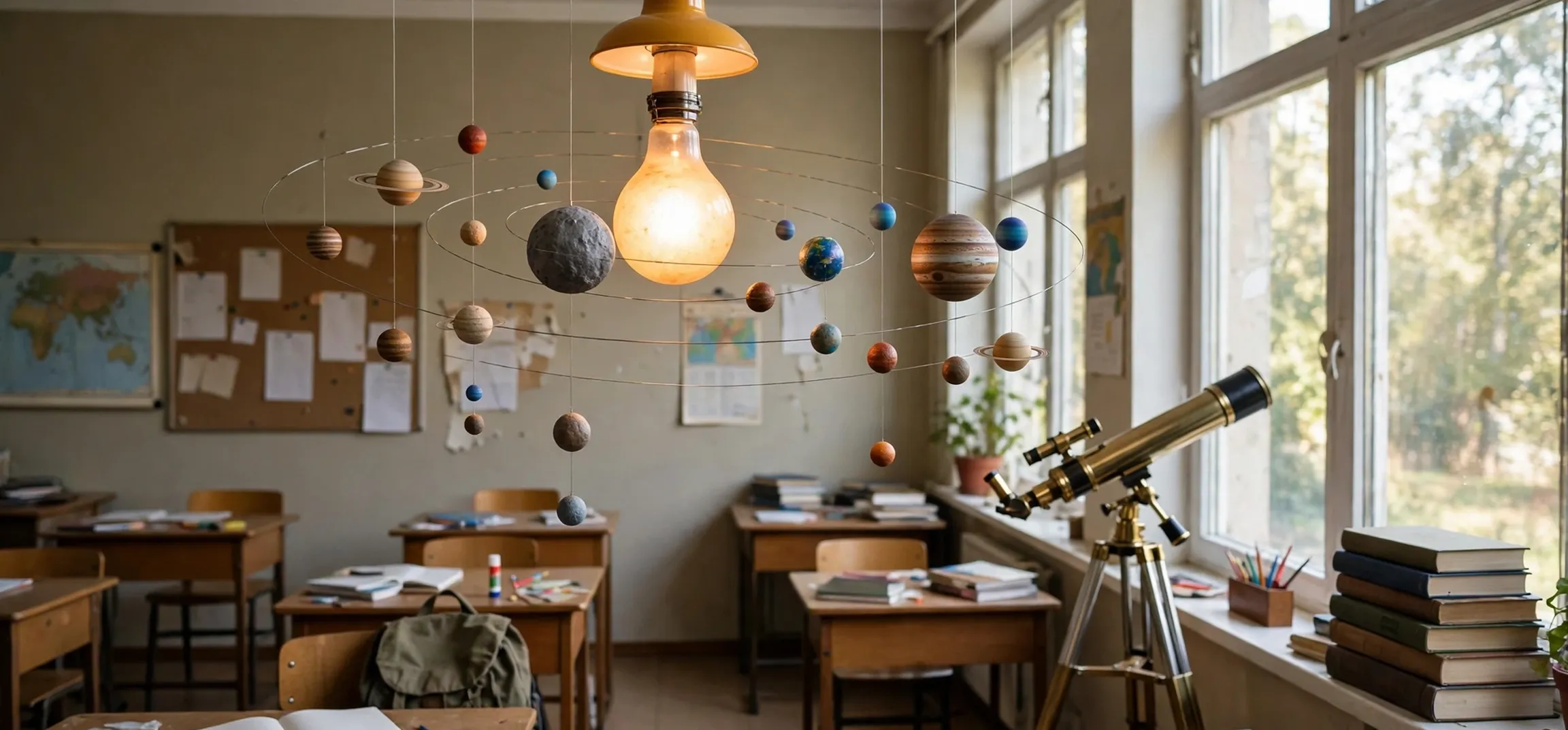
Learning the planet solar system names is usually a person’s first piece of real astronomy, and it has been taught to children the same way for generations: eight names, in order from the Sun, with a silly sentence to hold them in place. The eight planet solar system names are Mercury, Venus, Earth, Mars, Jupiter, Saturn, Uranus and Neptune. This guide lists the planet solar system names in order, explains where each name comes from, adds the facts that make each planet distinct, and answers the Pluto question that always follows.
Eight is the modern count. Anyone taught before 2006 learned nine names, and the story of the missing ninth is part of the story of the list itself.
The planet solar system names in order from the Sun
Here are the planet solar system names in their order outward from the Sun, with the memory sentence generations of schoolchildren have used: “My Very Excellent Mother Just Served Us Noodles” gives Mercury, Venus, Earth, Mars, Jupiter, Saturn, Uranus, Neptune. The first four are small, rocky worlds; the last four are giants of gas and ice. The table below adds the detail that turns a list of planet solar system names into actual knowledge.
| Position | Planet | Type | One fact to remember it by |
|---|---|---|---|
| 1 | Mercury | Rocky | Smallest planet and fastest around the Sun |
| 2 | Venus | Rocky | Hottest planet, wrapped in thick acid cloud |
| 3 | Earth | Rocky | The only world known to hold life and liquid-water oceans |
| 4 | Mars | Rocky | The red planet, rusted with iron oxide dust |
| 5 | Jupiter | Gas giant | Largest planet, with a storm bigger than Earth |
| 6 | Saturn | Gas giant | Famous for its bright rings of ice and rock |
| 7 | Uranus | Ice giant | Rotates on its side like a rolling barrel |
| 8 | Neptune | Ice giant | Dark, cold and home to the fastest winds |
Notice the pattern in the sizes: the inner planets are small and dense, the outer planets are enormous and light, and the dividing line between them, the asteroid belt between Mars and Jupiter, is why the planet solar system names fall so naturally into two teams of four.
Where the planet solar system names come from
Almost all the planet solar system names come from Roman mythology, inherited through the Greek gods before them. Mercury, swift messenger of the gods, fits the fastest planet. Venus, goddess of love and beauty, suits the brightest jewel in the sky. Mars, god of war, matches the blood-red world. Jupiter, king of the gods, is the giant. Saturn, his father and god of time and agriculture, moves slowly and stately. The pattern held even for planets discovered with telescopes: Uranus was named for the Greek god of the sky, father of Saturn, and Neptune for the Roman god of the sea, a nod to its deep blue colour.
Earth is the exception, and the lovely oddity in the planet solar system names: its name simply means the ground, from old Germanic and English words for soil and earth. Every other planet is named for a god; ours is named for the dirt under our feet. Different cultures named the visible planets differently, of course, but the Roman set became the international standard used by astronomers everywhere, which is why one shared list of planet solar system names works in classrooms on every continent.
Two families: rocky planets and giant planets
Learning the planet solar system names is easier with the family structure in mind. The rocky, or terrestrial, planets, Mercury, Venus, Earth and Mars, are small worlds of rock and metal with solid surfaces you could, in principle, stand on. They formed close to the young Sun, where heat drove off most gas and left dense material behind. Venus and Earth are near-twins in size, Mars is about half Earth’s width, and Mercury is barely larger than our Moon.
The giants are another order of thing. Jupiter and Saturn are mostly hydrogen and helium, gas giants so large that every other planet could fit inside Jupiter with room to spare. Uranus and Neptune, the ice giants, hold more water, ammonia and methane in slushy layers and wear the deep blues those chemicals give them. Holding the two families apart, four small rocky worlds, then four vast cold giants, is the standard way teachers anchor the planet solar system names in something more meaningful than a chant.
The Pluto question: why the list has eight names, not nine
No list of planet solar system names escapes the question, so here is the honest answer. Pluto was discovered in 1930 and counted as the ninth planet for 76 years. In 2006 the International Astronomical Union set a formal definition of a planet: a world must orbit the Sun, be round under its own gravity, and have cleared its orbit of similar-sized debris. Pluto passes the first two tests and fails the third, because it shares its region with many similar icy bodies in the Kuiper Belt. It was therefore reclassified as a dwarf planet, alongside Ceres, Eris, Haumea and Makemake.
The change still stirs feeling, and teachers often note that Pluto was not demoted so much as correctly filed, in a category that turned out to be crowded and fascinating. For learners, the practical result is the list this article opened with: eight planet solar system names, and a beloved dwarf planet whose story makes the whole subject more memorable.
Seeing the planets, and remembering the order for good
One reason the names stick in the memory is that five of the eight can be seen with the naked eye, and have been watched since long before telescopes. Venus blazes as the morning or evening star, too bright to miss. Jupiter shines as a steady, brilliant point that outclasses the stars around it. Mars is unmistakable once you know its rusty colour, Saturn glows a calm yellow-white, and Mercury hugs the horizon at dawn or dusk and is the connoisseur’s prize precisely because it is easy to overlook. Uranus sits at the very edge of naked-eye visibility on the darkest nights, and Neptune, found in 1846, was located by mathematics before any telescope confirmed it, predicted from irregularities in the orbit of Uranus.
For learners who keep scrambling the middle of the order, the families do the heavy lifting: rock, rock, rock, rock, giant, giant, ice, ice, with the asteroid belt as the full stop between Mars and Jupiter. Another reliable anchor is brightness and behaviour rather than sequence: the list from the Sun outward is also, roughly, a journey from the fastest world to the slowest, Mercury completing its year in about eighty-eight Earth days while Neptune takes about one hundred and sixty-five Earth years. Attach one vivid fact to each name, the storm on Jupiter, the sideways spin of Uranus, the rings of Saturn, and the order stops being a list to recite and becomes a route you can travel in your head, which is how astronomers themselves hold it.
The names in other cultures and languages
The Roman set is the international standard, but it is not the only inheritance. Chinese, Japanese and Korean traditions name the visible planets after the five elements: Venus is the metal star, Jupiter the wood star, Mars the fire star, Saturn the earth star and Mercury the water star, a system as logical as the mythological one and far older in continuous use. Indian astronomy has its own Sanskrit names woven into astrology. Noting these alternatives matters for more than politeness: it shows that naming the planets was something every stargazing culture did, because the wandering stars demanded names, and the modern shared list is simply the one that international science happened to standardise.
Frequently asked questions
What are the planet solar system names in order? Mercury, Venus, Earth, Mars, Jupiter, Saturn, Uranus and Neptune. The memory sentence “My Very Excellent Mother Just Served Us Noodles” keeps the planet solar system names in sequence.
How many planets are there? Eight, under the definition adopted in 2006. Pluto and several similar worlds are classed as dwarf planets, a separate category, which is why the official planet solar system names stop at Neptune.
Which is the largest and smallest planet? Jupiter is the largest, more massive than all the other planets combined. Mercury is the smallest of the eight, only slightly larger than Earth’s Moon.
Why do the planet solar system names come from Roman gods? Because the visible planets were named in the ancient world and the Roman names, themselves adapted from Greek gods, became the convention astronomers standardised. Earth is the one exception, named simply for the ground.
Conclusion
The planet solar system names are eight words that organise the entire neighbourhood: Mercury, Venus, Earth, Mars, Jupiter, Saturn, Uranus and Neptune. Learn them with their order, their two families and their mythological stories, add Pluto’s tale for flavour, and you hold the framework on which all other astronomy hangs.
To dig into individual names, our story of how the planet Earth got its name explores the great exception, and our guide to how Jupiter got its name looks at the king of the planets in detail.