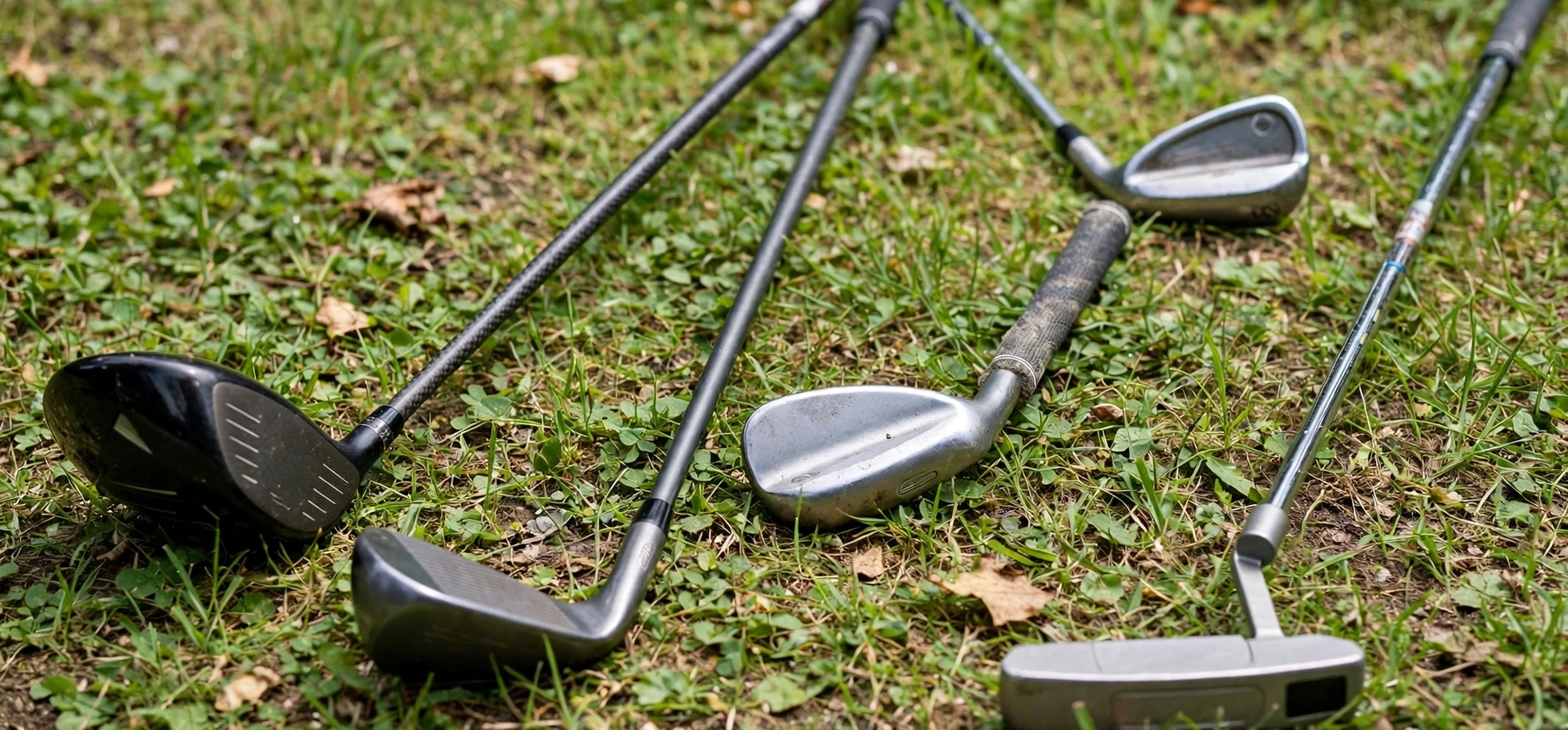
If you are wondering what your old golf clubs are worth, a used club value guide built around the factors that actually drive second-hand prices will serve you better than any single number. This used club value guide takes a different angle from published price lists: instead of starting with a table, it starts with the club in your hands and walks through every factor — age, brand, condition, shaft, completeness, and demand — that determines whether it sells for a tidy sum or barely covers postage.
There is no fixed price for a used golf club. Two identical models can sell for very different amounts depending on condition and timing, and a club that was expensive when new is not automatically valuable second-hand. Understanding the factors gives you control: you can decide whether to sell, trade in, keep, or donate, and you can price with confidence.
Used Club Value Guide: Age and Model Cycle
Age is the single biggest driver of used club value. Golf manufacturers release new models every year or two, and each release pushes previous models down the value ladder. A driver from the current or previous product cycle holds value far better than one from five cycles ago, even if the older club still performs well. This is not a judgement on quality — it is simply how the second-hand market works.
There are exceptions. Some models become classics: irons praised for feel, putters with a cult following, or limited editions. These can hold or even increase in value among collectors. But for ordinary mass-market clubs, expect steady depreciation. If your clubs are more than a decade old and from a mid-range brand, their realistic value is modest, and selling them as a set for a beginner is often the best outcome.
Used Club Value Guide: Condition in Detail
Condition deserves a closer look, because it is where sellers most often misjudge. Buyers examine the clubface, the sole, the crown of a driver, the grooves of irons, and the grip. Here is what they look for:
- Clubface wear: Groove wear on irons and wedges reduces spin and value. A face that looks polished smooth has seen heavy use.
- Sky marks and scratches: Marks on a driver’s crown are cosmetic but very visible, and they lower value.
- Shaft condition: Dents, bends, or rust on steel shafts, and cracks or peeling on graphite shafts, are serious defects.
- Grip condition: Worn, shiny, or torn grips suggest heavy use and an extra cost for the buyer.
- Originality: Non-original shafts, replaced ferrules, or refinished heads can reduce value unless the change is an upgrade a buyer wants.
Photographing these details honestly is not just ethical — it is practical. A buyer who knows exactly what they are getting is far less likely to return the club, and honest listings often sell faster than optimistic ones.
Used Club Value Guide: Brand, Shaft, and Completeness
Brand matters, but not in the way many sellers assume. The most valuable second-hand clubs are not necessarily the most expensive when new; they are the models that golfers actively seek out. A popular mid-priced iron set can outsell a premium set that few golfers wanted. Reputation, reviews, and tour usage all feed demand.
Shafts matter more than many sellers realise. A stock shaft in regular flex suits the widest audience, while an unusual flex or an expensive aftermarket shaft narrows the buyer pool — even though the shaft itself may be valuable. Completeness matters too: a full set of irons (typically 4-iron through pitching wedge, sometimes with gap wedge) sells far better than a partial set, and a driver with its original headcover and adjustment tool is more attractive than one without.
| Factor | Raises value | Lowers value |
|---|---|---|
| Age | Current or recent model | Many generations old |
| Condition | Light wear, clean grooves | Heavy wear, damage, worn grips |
| Brand and model | Popular, well-reviewed model | Obscure or unpopular model |
| Shaft | Desirable, undamaged shaft | Damaged or unusual shaft |
| Completeness | Full set, headcovers included | Partial set, missing covers |
| Timing | Spring, start of season | Deep winter |
Your Options: Sell, Trade, Keep, or Donate
Selling is not the only option. Trade-in programmes offer speed and simplicity: you hand over your clubs and receive credit toward new equipment. The payment is usually lower than a private sale, but there is no listing, packing, or haggling. Private sales earn more but take effort. Keeping older clubs as spares, practice sets, or a beginner set for a friend is often the most satisfying choice for low-value clubs. Donating to junior golf programmes or community schemes gives old clubs a second life and may be the best outcome for clubs with little market value.
Whatever you choose, set expectations honestly. Add up the realistic value of your clubs before deciding: a bag of decade-old mid-range clubs may be worth less than the cost of posting them individually, in which case selling as a single lot, or donating, makes more sense.
Frequently Asked Questions
What is the best time of year to sell golf clubs?
Spring, when golfers are preparing for the season, is generally the strongest period. Listings in midwinter tend to attract fewer buyers.
Are individual clubs or sets easier to sell?
Complete sets sell more easily than individual irons. Drivers, putters, and wedges, however, sell well individually because golfers often buy them one at a time.
Do I need the original receipt or box?
No, but original headcovers, adjustment tools, and any documentation help a listing look trustworthy and complete.
Used Club Value Guide: Selling a Beginner Set
Beginner sets occupy a special corner of the used club value guide world. A complete starter set — driver, fairway wood, hybrid, irons, wedge, putter, and bag — is worth more as a package than as individual clubs, because its buyer is usually a new golfer who wants everything at once. Selling the set whole saves you the effort of many small listings, and it gives the buyer a ready-to-play package, which is exactly what beginners want.
Price a beginner set by its overall condition and brand rather than by adding up individual club values. A well-known brand in good condition commands a better price than an obscure brand, even if the clubs are similar in quality, because beginners buy brands they recognise. Include the bag and any accessories: a complete package feels like better value and photographs well as a single listing.
Be realistic about older beginner sets. Technology has improved significantly, and a set from fifteen years ago competes with cheap new starter sets that come with warranties. If your set is very old, its realistic value may be modest, and donating it to a junior programme or community scheme may be more rewarding than a small sale.
Used Club Value Guide: Wedges and Putters in Particular
Wedges and putters deserve special attention because their value behaves differently from other clubs. Wedges wear out: their grooves lose sharpness with use, and a worn wedge spins the ball less effectively. Buyers know this, so a wedge with visibly worn grooves sells for much less than a similar wedge in good condition. If you regroove or refurbish a wedge, say so honestly, since some buyers prefer original condition.
Putters are the opposite: they wear slowly, and classic putter designs hold value well, sometimes for decades. A well-known putter model in good condition can sell for a substantial fraction of its original price, and limited editions can exceed it. Putter buyers also care about length, grip, and headcover, so include all three in your listing. A putter without its headcover loses appeal disproportionately, because collectors and enthusiasts value completeness.
For both categories, condition photographs matter more than usual: groove close-ups for wedges, and face, sole, and grip shots for putters. A buyer who can see the wear clearly will pay a fair price with confidence.
Used Club Value Guide: Negotiating With Confidence
Negotiation is a normal part of used club sales, and preparation makes it painless. Set your asking price slightly above your minimum acceptable price, so you have room to move without dropping below what you will accept. Decide that minimum in advance, based on your research, and stick to it: accepting a low offer out of impatience usually leads to regret.
When a buyer offers less, respond with evidence rather than emotion. Point to comparable sold prices, your club’s condition, and any extras included. A calm, factual reply — “Similar clubs in this condition have sold recently for around this level, and mine includes the headcover” — is far more persuasive than defensiveness. If the offer is genuinely too low, decline politely and leave the door open: many buyers return with a better offer after checking other listings.
Finally, be wary of deals that seem too good to be true, whether you are buying or selling. Unusually low prices can signal counterfeit clubs, damaged goods, or scams, particularly for premium brands. Buy from reputable sellers, use secure payment methods, and trust your judgement: if a deal feels wrong, walk away.
Conclusion
This used club value guide shows that value is not a single number from a table — it is the sum of age, condition, brand, shaft, completeness, and timing. Assess your clubs honestly against each factor, price realistically, and choose the selling route that fits your effort and expectations. For more practical guides, see our buying and selling explainers and general definitions, plus our name guides.



