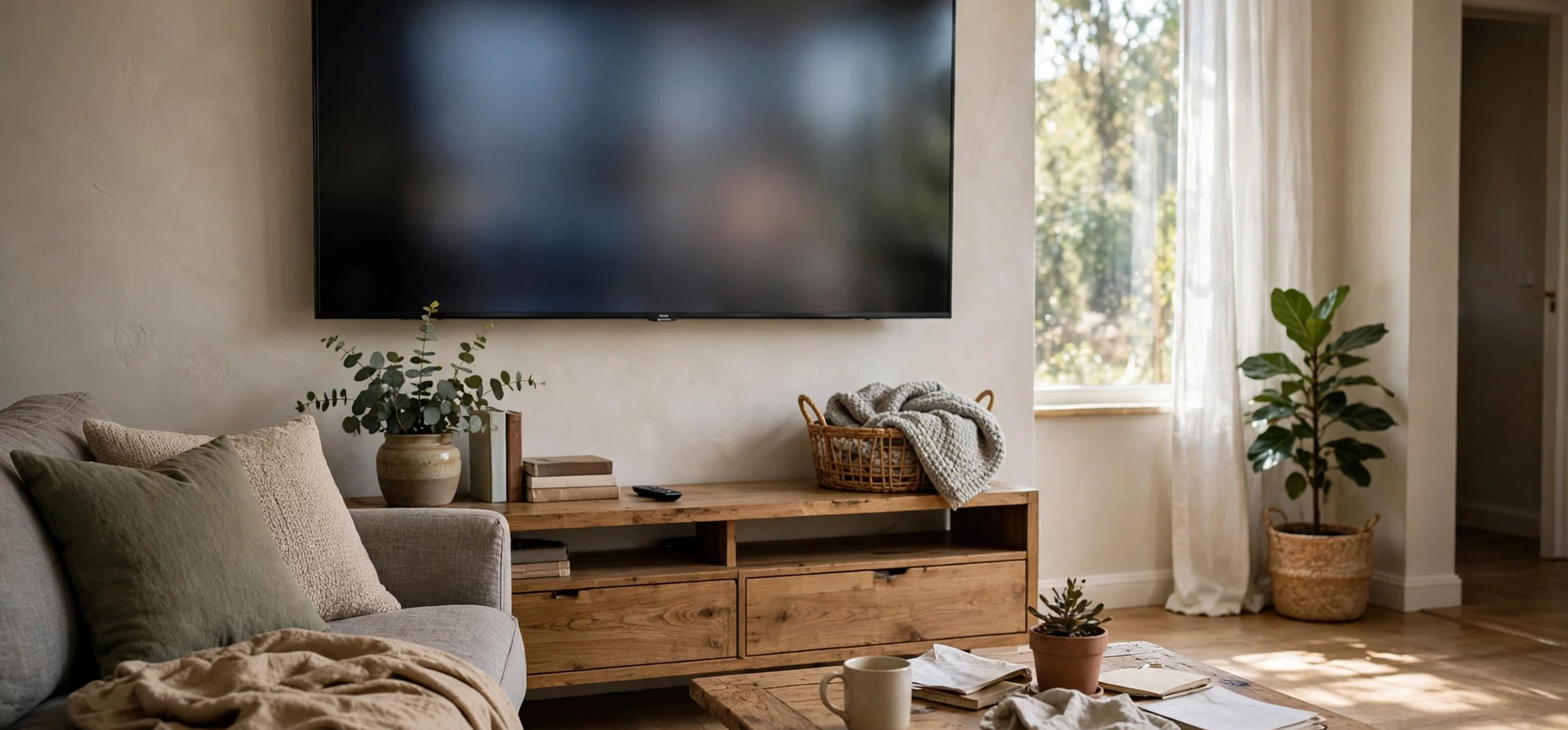
If you searched for “what are the different tv sizes” because you want a screen that fits your room rather than a list of numbers, this guide takes a different route. Instead of starting with a catalogue of models, it starts with your sofa, your wall, and the distance between them. That distance, more than any other single factor, decides whether a screen feels immersive, comfortable, or simply too big. Two homes can buy the same screen and have completely different experiences, because one viewer sits two metres away and the other sits four metres away. Matching size to room is therefore the most practical way to use the answer to what are the different tv sizes.
This article explains viewing distance in plain language, shows how room size, seating layout, and viewing angle change the ideal choice, and gives you simple measurements you can take at home before you decide. It also covers mounting height, wide seating arrangements, small rooms with awkward shapes, and the common traps that make a well-chosen screen feel wrong once it is installed. By the end, you will not just know what are the different tv sizes in theory. You will know which size range fits your room in practice, and why.
What Are the Different TV Sizes by Viewing Distance?
The most useful way to think about what are the different tv sizes is to pair each size with a comfortable viewing-distance range. The ranges below are guidelines for everyday viewing, based on a relaxed field of view where you can see the whole picture without turning your head. People who love a cinema-like feel may prefer the larger end of each range, while people who prefer a calmer picture may prefer the smaller end. Neither preference is wrong. The ranges simply give you a sensible starting point.
| Screen size | Comfortable viewing distance (approx.) | Typical room |
|---|---|---|
| 32 inches | 1.0 to 1.6 metres | Small bedroom or study |
| 43 inches | 1.3 to 2.1 metres | Bedroom or small flat |
| 50 inches | 1.5 to 2.5 metres | Average living room |
| 55 inches | 1.7 to 2.7 metres | Main living room |
| 65 inches | 2.0 to 3.2 metres | Larger living room |
| 75 inches | 2.3 to 3.7 metres | Spacious living room |
| 85 inches | 2.6 to 4.2 metres | Large room or viewing room |
Notice how the ranges overlap. A viewer sitting 2.4 metres from the screen could comfortably choose a 50-inch, 55-inch, or 65-inch screen, depending on taste. That overlap is good news, because it means you do not need to hit one exact number. It also means that room shape and personal preference have room to influence the decision. If your seating distance falls in the overlap between two sizes, choose the smaller size if you sit close to the edge of the range, watch mostly news and talk shows, or dislike a very immersive picture. Choose the larger size if you watch a lot of films, sit at the far edge of the range, or share the screen with several viewers.
Distance also affects how much detail you can comfortably see. Sit too far from a small screen and fine detail, subtitles, and on-screen text become harder to follow. Sit too close to a very large screen and you may notice individual picture elements, or feel that you are scanning the picture rather than watching it as a whole. The sweet spot is the distance where the picture fills a good part of your view without forcing your eyes to work hard. That sweet spot shifts with screen size, which is why size and distance must be chosen together.
What Are the Different TV Sizes for Each Room Type?
Bedrooms usually call for the smaller end of the scale, because the bed is often closer to the wall than a sofa is in a living room, and because the viewer is often lying down at a lower eye height. A 32-inch or 43-inch screen suits many bedrooms, while a 50-inch screen suits a larger bedroom with a longer wall-to-bed distance. In a bedroom, also think about glare from a window opposite the screen, and about whether the screen will be watched mainly in the evening, when a slightly smaller, less bright-feeling picture can be more relaxing.
Living rooms are more varied, because they range from compact flats to open-plan spaces. In a compact living room, a 43-inch or 50-inch screen often gives the best balance. In an average living room, 55 inches is a very common and safe choice. In a larger living room with a sofa three metres or more from the wall, 65 inches or 75 inches starts to feel natural rather than oversized. Open-plan rooms add another factor: the screen may be viewed from a dining area or kitchen as well as from the sofa, so the furthest regular viewing position, not just the sofa, should be part of your thinking.
Dedicated viewing rooms, games rooms, and large family rooms are where the largest screens earn their place. With seating three metres or more away, an 85-inch screen can fill the view in a way that feels cinematic without being overwhelming. Even here, though, the room must support the screen. You need a wide, clear wall, a suitable mount or stand, and seating arranged so that everyone has a reasonably straight view. A very large screen in a room with seating squeezed to the sides will not give the experience its size promises.
Measuring Viewing Distance at Home
Measuring is simple and takes two minutes. Sit in your usual seat, in your usual posture, and measure from your eyes to the wall or stand where the screen will sit. Do this for the main seat first, then for any other seats that will be used regularly. If those distances differ a lot, plan around the main seat but check that the furthest seat can still read subtitles comfortably. Tape a rectangle on the wall in the size you are considering, using the approximate width and height for that screen size, and sit with it for an evening. That low-cost test often settles a decision faster than any chart.
Viewing Angle and Seating Layout
When you study what are the different tv sizes by distance alone, remember distance is only half the story. Angle matters too. A viewer sitting directly in front of the screen sees the picture at its best. A viewer sitting well to the side sees it at an angle, which can reduce contrast and colour accuracy, especially on some screen types. In a room with a wide sofa or an L-shaped arrangement, the side seats deserve attention. A slightly larger screen can help side viewers follow detail, but it cannot fix a seat that is almost beside the screen. In that case, moving the screen, angling it on a swivel mount, or rearranging seating will help more than increasing size.
For group viewing, think about the worst seat, not the best one. If the furthest side seat is four metres away and at a sharp angle, that seat will set a practical limit on how enjoyable the setup is for everyone. Sometimes the answer is a modest screen centred on the group, rather than a huge screen centred on the wall. Sometimes it is a different wall altogether. Walking the room and sitting in each seat, even briefly, gives you information no specification sheet can provide.
When you study what are the different tv sizes by room layout, mounting height is the other half of comfortable viewing. The centre of the screen should sit close to the seated eye level of the main viewers, so the neck stays relaxed. Mounting a screen high above a fireplace looks tidy in photographs, but it can cause neck strain over a long film. If a high position is unavoidable, a tilting mount can help, but it is not a complete substitute for a sensible height. Measure seated eye height in your room, not from a generic diagram, because sofa heights and floor levels vary.
Small, Awkward, and Shared Rooms
For readers asking what are the different tv sizes for a flat, small rooms reward restraint. A screen that leaves breathing room on the wall, with space for a shelf or a picture beside it, usually feels better than a screen that fills the wall edge to edge. In a small room, also consider the stand or mount depth. A screen on a deep stand in a narrow room eats into walking space, while a wall mount can free up floor space and make the room feel larger. Either way, the screen size should leave the room usable for everything else it needs to do.
Awkward rooms, such as rooms with a chimney breast, a sloping ceiling, or a large window on the viewing wall, need a different approach. The available wall width may limit the screen more than the viewing distance does. Measure the usable width, allowing for curtains, radiators, and door swings, and let that measurement cap your choice. A screen that fits the wall cleanly, with a small margin on each side, will look and feel better than a larger screen squeezed into a gap.
Shared rooms, such as a living room that is also a playroom or a workspace, benefit from flexibility. A screen on a swivel mount, or a stand that can be moved slightly, lets different activities share the same space without compromise. In these rooms, a mid-size screen is often the best compromise, because it serves group viewing without dominating the room when it is switched off. Think about the room with the screen off, as well as on, because that is how you will live with it most of the day.
Frequently Asked Questions About Room Size and TV Size
What are the different tv sizes if I sit two metres away?
If you sit about two metres away, the practical answer to what are the different tv sizes is 43 inches, 50 inches, or 55 inches. A 43-inch screen will feel calm and easy, a 50-inch screen is a balanced middle choice, and a 55-inch screen will feel more immersive. Try the tape outline test at two metres before you decide, because personal taste matters as much as the chart.
What are the different tv sizes if I sit three metres away?
At three metres, the useful answer to what are the different tv sizes moves up to 55 inches, 65 inches, and 75 inches. A 55-inch screen can still work at three metres, but many viewers find 65 inches more comfortable for subtitles and detail at that distance. A 75-inch screen suits viewers who want a strongly immersive picture and who have a wide enough wall.
What are the different tv sizes, and how do I know if one is too big?
Whatever answer you choose for what are the different tv sizes, a screen is probably too big if you have to move your head to follow action, if you notice eye strain during a normal programme, or if the screen leaves almost no wall space around it. Those signs matter more than any single chart figure, because they describe your actual experience in your actual room.
What are the different tv sizes for a very small room?
For a very small room, the sensible answer to what are the different tv sizes is 32 inches or 43 inches. A smaller screen keeps the room balanced, leaves wall and floor space free, and still gives a clear picture from a close seat. In a very small room, a wall mount often helps even more than a size change, because it frees up furniture space.
For wider context on television viewing, see this guide to when television was invented and this TV guide overview. They are helpful background reading once you have matched a screen size to your room, because they remind you that the screen is only part of a long history of home viewing.
Conclusion: Match the Screen to the Room, Not the Room to the Screen
The room-first approach to what are the different tv sizes, and to what are the different tv sizes for your seating distance, leads to a simple conclusion. Measure your seating distance, check your wall width and viewing angle, test the outline with tape, and choose the size that feels comfortable from your real seats. That method avoids both common regrets: a screen that overwhelms a small room, and a screen that looks lost across a large room. It also keeps the focus where it belongs, on comfortable, enjoyable viewing over months and years, not on a single impressive number.
When you ask what are the different tv sizes in future, and what are the different tv sizes that suit a shared room,, you will have a better question to ask alongside it: what size fits this room, from these seats, at this distance? Answer that second question first, and the first question answers itself. Your room, your seats, and your viewing habits are the real specification sheet, and they are already in your home, waiting to be measured.