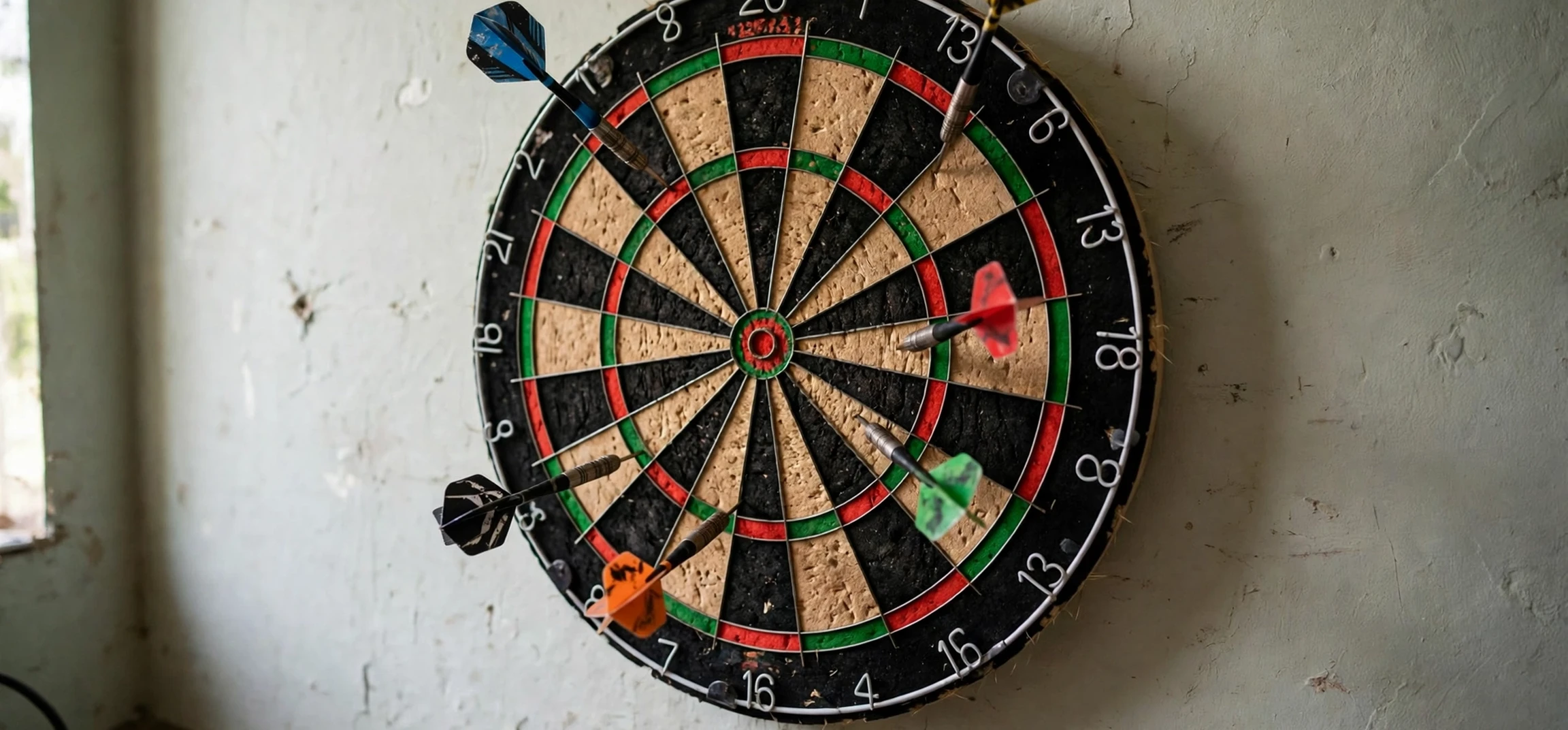
When people ask about darts meaning, they usually mean one of two things: the popular pub and professional game played with small pointed missiles thrown at a circular board, or the word itself, which can describe a sudden quick movement, a pointed projectile, and several related ideas. Both uses are connected, because the game takes its name from the small darts that players throw. This guide covers darts meaning in full, from the rules, scoring, and history of the game to the everyday and figurative uses of the word dart, so you can understand the term whether you meet it in a sports broadcast, a novel, a conversation, or a quiz.
Darts is one of those games that looks simple from the outside and turns out to be surprisingly deep once you start playing. The board hangs on a wall, the player stands behind a line, and the aim is to hit specific numbered sections. Yet behind that simplicity sit strategy, arithmetic, steady nerves, and years of practice. Professional players make it look effortless, hitting tiny targets again and again under bright lights and loud crowds. Beginners, by contrast, quickly learn that throwing a dart accurately is a skill of balance, release, and repetition. That mix of accessibility and depth is a large part of why darts has lasted for centuries and grown into a global televised sport.
Darts Meaning: The Game Explained
In its most common modern sense, darts meaning refers to a game in which players throw three small darts per turn at a dartboard divided into numbered segments. The standard board has twenty numbered sections arranged around a central bullseye. Each section is divided into single, double, and treble areas. The outer ring doubles the value of the segment, while the narrower inner ring trebles it. The centre contains the outer bull, worth a smaller score, and the inner bull, worth the highest single-dart score on a standard board. Players take turns, add up their scores, and work toward a target total, depending on the game being played.
The best known version is 501. Each player starts on 501 points and subtracts the score of every dart thrown. The winner is the first player to reach exactly zero, usually finishing on a double. That finishing rule adds drama, because a player who overshoots or leaves an awkward remainder must adjust the plan. Other popular games include 301, which starts from a lower total and plays faster, and Cricket, in which players aim to close numbers by hitting them three times while also scoring points. Around the world, local variants and casual house rules add further variety, but the core skill remains the same: throw accurately, manage the arithmetic, and keep calm under pressure.
The Board, the Darts, and the Throwing Line
A standard dart has four main parts: the point, the barrel, the shaft, and the flight. The point is the sharp tip that sticks into the board. The barrel is the metal body the player grips, and its weight, shape, and texture vary widely between players. The shaft connects the barrel to the flight, and the flight is the fin-like tail that stabilises the dart in the air. Players often experiment with different combinations until they find a setup that feels balanced and flies consistently. Even small changes in weight or flight shape can affect how a dart lands, which is why serious players treat equipment choice as part of the game.
The throwing line, often called the oche, marks the minimum distance from the board. Players must stand behind it when throwing, though they may lean forward over it as long as their feet stay behind the line. The board itself is hung so that the centre bullseye sits at a standard height above the floor. In casual home games, people sometimes bend these measurements, but in organised play the distances and heights are fixed so that results are comparable. A well-lit board, a firm mounting, and a clear throwing area also matter, because shadows, wobble, and distractions can all change a result.
Darts Meaning and Scoring Basics
Scoring in darts rewards both accuracy and planning. A single segment gives its face value, a double gives twice that value, and a treble gives three times that value. The treble twenty is therefore the most valuable regular target, and skilled players aim for it repeatedly to reduce a large total quickly. The bullseye offers a different kind of reward. The inner bull is the highest single score, but it is a very small target, so players usually chase it only when the remaining total calls for it, often at the end of a leg when a finish requires it.
Finishing a game of 501 is where strategy becomes most visible. Because the final dart must usually land in a double, players plan their last few throws in advance. A player left on a convenient even number can aim for a familiar double. A player left on an odd number must first adjust to an even number before attempting the finish. Commentators often talk about checkouts, which are combinations of two or three darts that finish a leg from a given total. Learning common checkouts is one of the fastest ways for a beginner to improve, because it turns the end of a leg from guesswork into a repeatable plan.
Beginners should also learn the language of the game. A leg is a single game from the starting total to zero. A set is a group of legs, and a match is a group of sets or legs, depending on the format. A bust occurs when a player scores more than the remaining total, or leaves a total that cannot be finished with a double, which usually ends the turn without counting the excess. A maximum, often called a perfect round in 501, comes from three treble twenties. Knowing these terms makes televised matches far easier to follow and helps new players talk about the game with confidence.
A Short History of Darts
The history of darts is often traced to archery and to soldiers and workers throwing short arrows or spears at targets for practice and amusement. Over time, the long bow gave way to smaller hand-thrown missiles, and the target became a circular board rather than a tree trunk or a barrel bottom. Pub culture played a major role in spreading the game, because a dartboard took little space, cost little to maintain, and gave regular customers a friendly competition. Local leagues grew, rules became more standard, and regional styles slowly merged into the game recognised today.
By the twentieth century, darts had moved from a casual pastime to an organised sport with leagues, tournaments, and governing bodies. Television brought the game to a much larger audience, and the atmosphere of major events, with music, costumes, chanting crowds, and dramatic finishes, helped it stand out from quieter precision sports. The professional game now features players from many countries, large prize funds, and a calendar of major tournaments. At the same time, the pub and home game remains strong, because anyone with a board and a set of darts can play without expensive equipment or a large playing area.
Why Darts Stays Popular
Darts stays popular because it combines low barriers to entry with a high skill ceiling. A beginner can learn the basic rules in minutes and enjoy a game on the first evening. A dedicated player can spend years refining a throw, learning checkouts, and studying opponents. The game is also social. It is played face to face, in short turns, with time to talk between throws. That rhythm suits pubs, clubs, family rooms, and community centres, where the game is as much about company as competition.
The mental side of darts is equally important. Players must subtract quickly, plan finishes, and manage pressure. A player who is ahead can lose focus and miss, while a player who is behind can stay calm and recover. This psychological drama is one reason televised matches feel tense even to viewers who have never thrown a dart. The camera can show the board, the remaining score, and the expression on a player’s face at the same moment, so the audience understands exactly what is at stake with each throw.
The Word Dart Beyond the Game
Outside the game, dart is both a noun and a verb, and its meanings all share the idea of something small, sharp, and fast. As a noun, a dart can be a small pointed missile, a sudden quick movement, or a short tapered fold in clothing that shapes fabric to the body. As a verb, to dart means to move suddenly and quickly in a particular direction, often with a sense of lightness or urgency. A bird might dart across a garden, a child might dart between parked cars in a story, or a glance might dart toward a door.
Figurative uses build on the same image. A darting look is quick and restless. A dart of pain is sharp and sudden. A verbal dart is a pointed remark aimed at someone, much like a small missile aimed at a target. Writers use the word because it packs movement, sharpness, and brevity into a single syllable. When you read that someone darted into a room, you do not need a long description. The word itself tells you the movement was fast, sudden, and purposeful.
There is also a plural use worth noting. In everyday speech, darts almost always means the game, while a single dart usually means one projectile or one quick movement. Context resolves any doubt. If someone says they are going to play darts, they mean the board game. If someone says they felt a dart of fear, they mean a sudden sharp feeling. If a tailor mentions darts, they mean the small folds that shape a garment. The shared thread across all these senses is speed, sharpness, and precision.
| Use of Dart or Darts | Meaning | Example in Context |
|---|---|---|
| Darts, the game | Throwing small missiles at a numbered board | Friends meet each week to play darts at the local club |
| A dart, noun | A small pointed projectile | Each player throws three darts per turn |
| To dart, verb | To move suddenly and quickly | The cat darted under the fence when the gate opened |
| Darts, in sewing | Tapered folds that shape fabric | The dressmaker adjusted the darts for a better fit |
| A dart, figurative | A sharp, sudden remark or feeling | Her comment felt like a dart aimed at his confidence |
Beginner Tips for Playing Darts Well
New players should start with stance and grip rather than power. Stand comfortably, keep your weight balanced, and hold the dart in a way that feels steady and repeatable. Aim with a smooth motion, follow through toward the target, and avoid snatching the dart or rushing the throw. Practise the same routine before every throw, because consistency matters more than occasional brilliance. Many coaches advise beginners to practise singles first, then doubles, and only later to chase trebles, because reliable accuracy builds the confidence needed for harder targets.
Arithmetic practice helps just as much as throwing practice. Learn to subtract common scores quickly, and learn a few simple finishes for totals you meet often. Play short games with friends rather than long sessions alone, because match pressure teaches you to throw well when the result matters. Keep track of your averages and your finishing success over time, not just your best single round, because steady improvement is a better sign of progress than one lucky visit to the treble twenty.
For related guides on this site, see our article on what the word diction means, our guide to mean definition in mathematics, and our overview of the guess the picture game.
Frequently Asked Questions About Darts Meaning
What is darts in simple terms?
Darts is a game in which players throw small pointed darts at a circular numbered board, scoring points for the segments they hit and usually trying to reduce a starting total to exactly zero.
What is the highest score with one dart?
On a standard board, the highest score with a single dart is the inner bull, followed closely by the treble twenty. The exact values depend on the board layout, but the inner bull is treated as the top single-dart target.
What does it mean to dart somewhere?
To dart somewhere means to move suddenly and quickly in that direction, often with a sense of urgency or lightness, as in a person darting across a room or an animal darting into cover.
Is darts hard for beginners?
Darts is easy to start and hard to master. Beginners can enjoy a game immediately, but accurate throwing, scoring strategy, and finishing under pressure take regular practice.
Conclusion: Darts Meaning in One Clear Picture
Darts meaning covers both a beloved game and a vivid everyday word. As a game, it is a test of accuracy, arithmetic, strategy, and nerve, played on a numbered board with small pointed darts. As a word, dart captures anything small, sharp, and fast, from a quick movement to a pointed remark. The connection between the two is easy to see: the game borrows its name from the swift little missiles at its centre. Whether you want to play your first leg, follow a professional match, or simply use the word correctly in writing, that picture will serve you well. Start with the basics, practise steadily, learn the common finishes, and enjoy a game that has entertained players for generations without losing its simple appeal.



