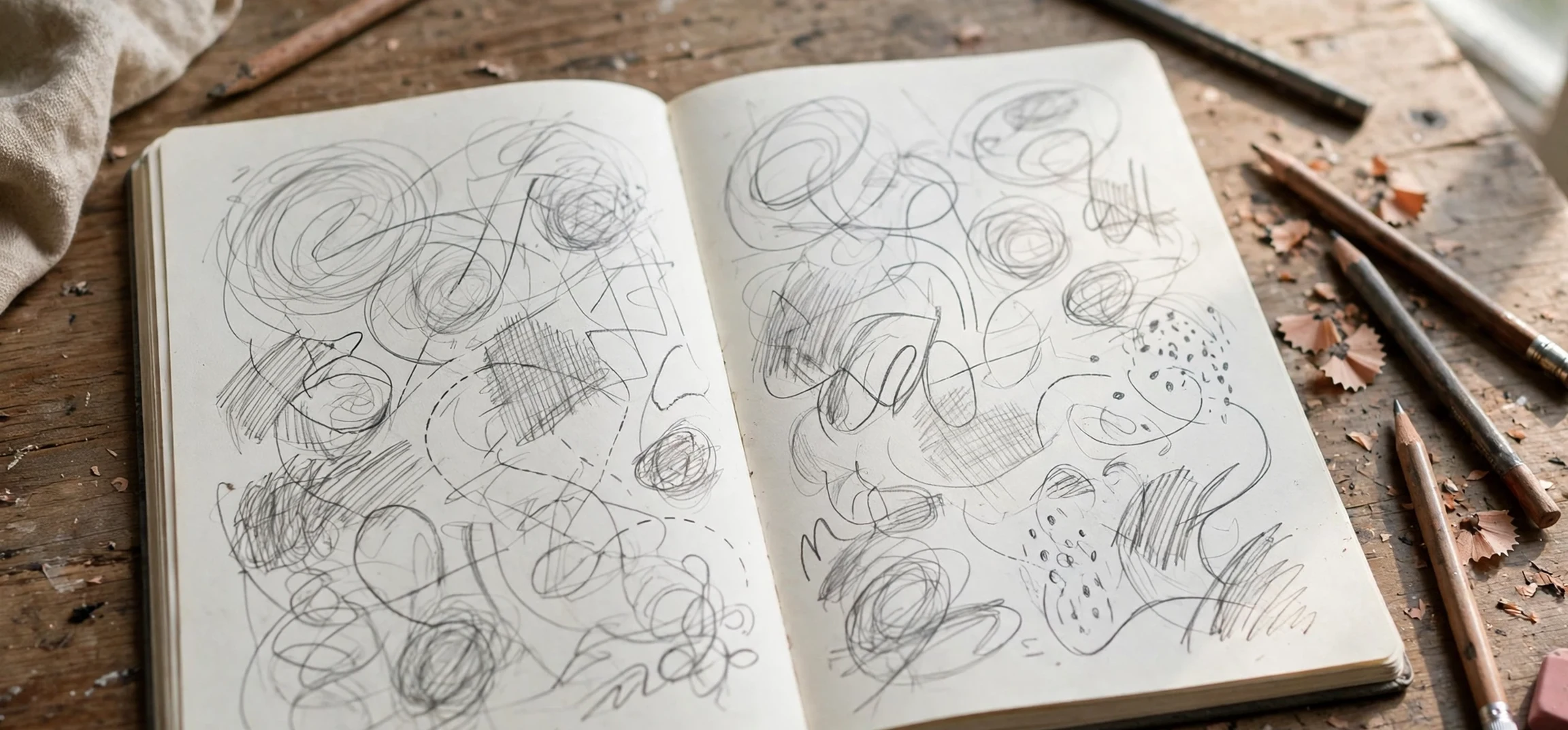
You have probably done it yourself: a margin filled with spirals during a long meeting, a corner of a notebook covered in stars, cubes, and arrows while you were on the phone. That habit has a name, and the question of what is the meaning of doodling turns out to be more interesting than it first looks. Doodling means drawing aimlessly, without a plan or a finished picture in mind, letting the hand wander while the mind is busy with something else. It is drawing for its own sake, and it has a long history, a real psychology behind it, and a set of practical uses that go far beyond killing time.
Doodling is one of the most universal human habits. Children do it, adults do it, and people have done it for centuries, from the margins of medieval manuscripts to the notebooks of modern office workers. It shows up wherever people are asked to sit still and listen: classrooms, conference rooms, lecture halls, and phone calls. Far from being a sign of inattention, research suggests it may actually help attention, and that tension between the stereotype and the science is what makes doodling worth a closer look.
What Is the Meaning of Doodling? A Clear Definition
At its simplest, what is the meaning of doodling? Doodling is the act of making spontaneous, unstructured marks on paper, usually while the attention is focused elsewhere. The marks can be shapes, patterns, faces, letters, or abstract squiggles, and they are rarely planned in advance. A doodle is not a sketch for a painting, not a diagram for a project, and not a finished work of art. It is what the hand does when it is left to itself.
The word itself has an interesting history. “Doodle” originally referred to a fool or a simpleton in the seventeenth century, and it later picked up the sense of wasting time or trifling. The modern meaning, aimless drawing, grew out of that sense of idle activity, and it was popularized in the twentieth century when the word began appearing in descriptions of the scribbles people made during meetings and phone calls. The history matters because it explains the lingering stigma: doodling has been associated with idleness for centuries, even though the habit itself is often anything but idle.
Today, the common answer to what is the meaning of doodling has softened. Doodling is widely understood as a casual, low-pressure form of drawing, and many artists, teachers, and psychologists treat it as a legitimate creative activity in its own right. The key elements are spontaneity, a lack of pressure to produce something good, and the fact that the drawing happens alongside another activity, like listening, thinking, or talking.
What Is the Meaning of Doodling for the Brain?
One of the most cited findings about doodling comes from a well-known study in which participants who doodled while listening to a dull recorded message remembered significantly more of what they heard than participants who simply listened. The explanation offered by researchers is that doodling occupies just enough of the mind to prevent daydreaming, without competing with the main task of listening. It keeps the brain in a state of light engagement, which turns out to be better for focus than total stillness.
This fits with what many people report from experience. Doodlers often say they listen better when their hands are busy, and that stopping the doodling makes their minds wander more, not less. The hand provides a low-level anchor, a small task that keeps the rest of the mind from drifting into unrelated thoughts. It is the same principle behind fidget tools and knitting during lectures: a minor motor activity can support, rather than sabotage, attention.
Doodling also plays a role in processing emotion and stress. Repetitive patterns, spirals, and shading can be calming, in the same way that other repetitive hand activities are calming. Many people doodle when they are anxious, bored, or thinking through a problem, and the act of making marks can help them stay with a difficult feeling or idea instead of avoiding it. That is part of why structured doodling practices, sometimes called Zentangle-style drawing, have become popular as relaxation activities: they take the spontaneous habit and give it just enough structure to feel meditative.
Common Types of Doodles and What They Tend to Show
Although doodles are spontaneous, they tend to fall into recognizable families, and each family has its own flavor. Geometric doodles are made of grids, cubes, triangles, and repeating patterns, and they often appear when someone is thinking in a structured or analytical way. Nature doodles include flowers, leaves, stars, suns, and waves, and they are among the most common of all, probably because they are easy to draw and pleasant to look at.
Faces and figures are another major family. Some people doodle eyes, profiles, or full cartoon characters, often in the margins of their notes. Arrows, boxes, and underlines are a more practical family: they grow out of note-taking itself, as the hand emphasizes, connects, or circles ideas on the page. And then there are word doodles, where people write a word over and over, decorate letters, or turn handwriting into a pattern.
It is tempting to read deep meaning into every doodle, and popular books have claimed that particular shapes reveal particular personality traits. Treat those claims with caution: there is no reliable science that says drawing stars means one thing and drawing boxes means another. What doodles reliably show is simpler and more useful: that the hand was busy, the mind was engaged at some level, and the person was processing something, whether it was the meeting, a worry, or an idea that had not yet found words.
Doodling vs. Drawing, Sketching, and Zentangle
To fully answer what is the meaning of doodling, it helps to separate doodling from its close cousins, because the differences explain why doodling feels so freeing. Drawing, in the usual sense, is intentional: you sit down to draw something, you look at a subject or imagine one, and you work toward a result. Sketching is similar but quicker and more provisional, a rough version of a drawing made to capture an idea or a scene. Doodling is different from both, because it has no goal at all. You are not trying to draw something; you are simply drawing.
Zentangle is a structured method that grew out of doodling. It uses small tiles, deliberate patterns, and a set of steps, and it is often taught as a relaxation practice. It keeps the low-pressure spirit of doodling but adds just enough structure to make it feel like a finished activity. If you enjoy doodling and want to do more of it on purpose, Zentangle-style pattern drawing is a natural next step, and it is widely taught in books and classes.
Another cousin is the visual note, sometimes called sketchnoting, where people combine words and simple drawings to record a talk or a meeting. Sketchnoting borrows the spontaneity of doodling but puts it to work: the drawings are meant to help memory and understanding. Many people discover sketchnoting precisely because they already doodle during meetings, and it gives their habit a purpose without taking away its pleasure.
Doodling Styles at a Glance
The table below summarizes the main doodling styles, what they look like, and when people tend to make them. Use it to recognize your own habits, or to try a style you have not explored yet.
| Style | What it looks like | When it usually appears |
|---|---|---|
| Geometric patterns | Grids, cubes, spirals, repeating shapes | Meetings, lectures, problem-solving |
| Nature motifs | Flowers, stars, suns, waves, leaves | Phone calls, daydreaming, relaxed moments |
| Faces and figures | Eyes, profiles, cartoon characters | Long talks, boredom, creative thinking |
| Arrows and boxes | Underlines, circles, connectors, flow shapes | Note-taking, planning, studying |
| Word art | Repeated words, decorated letters, banners | Brainstorming, journaling, message drafting |
| Abstract squiggles | Loops, zigzags, shading, free marks | Stress, waiting, thinking through feelings |
Practical Benefits of Doodling
Beyond the attention research, doodling offers several practical benefits that make it worth protecting rather than suppressing. First, it gives the hands something to do during long periods of sitting, which many people find physically comfortable. Second, it can serve as a thinking tool: many people find that an idea arrives while they are doodling, because the low-level activity frees the mind to make connections it would not make under direct pressure.
Third, doodling lowers the barrier to creativity. A blank page can be intimidating, but a page with a few spirals on it is already started, and that makes it easier to keep going, whether the next step is a drawing, a plan, or a piece of writing. Teachers sometimes use this deliberately, asking students to doodle for a minute before a creative task, precisely because it breaks the fear of the blank page.
Fourth, doodling is genuinely enjoyable, and enjoyment matters. In a work culture that treats every minute as productive or wasted, a small, pleasurable, harmless habit is a form of self-care. There is no equipment to buy, no skill threshold to cross, and no audience to impress. A pen and a margin are enough, and that accessibility is part of why the habit has survived for centuries.
Should You Doodle at Work?
The honest answer is that it depends on the workplace, but the evidence is on the doodler’s side. If doodling helps you listen, say so plainly if anyone asks, and keep your doodles discreet: a notebook margin rather than a shared document. Many managers now understand that a doodling employee is often a listening employee, and the stigma is fading. If you want to explore more visual habits, the cartoon photographer nostalgia guide and the cartoon dogs characters guide are fun next reads, and the cartoon characters with big chins list shows how simple shapes become memorable characters.
Frequently Asked Questions
What is the meaning of doodling in simple words?
Doodling means drawing aimlessly, without a plan, usually while you are doing something else like listening, talking on the phone, or thinking. The drawings are spontaneous and unfinished by design.
Is doodling good or bad for focus?
Research suggests doodling can help focus during dull listening tasks, because it keeps the mind lightly engaged and reduces daydreaming. It is not a distraction in the usual sense, though it can become one if the drawing itself becomes the main activity.
Do doodles reveal personality?
Popular books make big claims about this, but there is no reliable science linking particular doodle shapes to particular personality traits. Doodles reliably show that the hand was busy and the mind was processing something, which is interesting enough without over-reading them.
How can I start doodling?
Keep a pen and paper near you during calls and meetings, and let your hand move without judging the result. Start with simple patterns like spirals, grids, or stars, and build from there. There is no wrong way to doodle.
Why People Ask What Is the Meaning of Doodling
People ask what is the meaning of doodling for a simple reason: everyone does it, but almost no one is taught what it is. A student wonders whether the spirals in a notebook margin count as art, a manager wonders whether a doodling employee is paying attention, and a curious reader wonders what is the meaning of doodling beyond idle scribbling. The question what is the meaning of doodling keeps appearing because the habit sits between art and habit, between focus and distraction.
Guides that explain what is the meaning of doodling help because they replace the old stigma with evidence. Once you know what is the meaning of doodling in practice, a low-pressure, spontaneous form of drawing that supports attention, the habit stops feeling like a guilty secret. Readers who searched what is the meaning of doodling often end up doodling more, not less, and that is a good outcome: the next time your pen wanders, you will know exactly what is the meaning of doodling, and why it is worth keeping.
Conclusion
So, what is the meaning of doodling? It is aimless drawing with a purpose you might not notice: a habit that helps attention, eases stress, supports thinking, and keeps creativity within reach. The next time your pen starts wandering during a long call, let it. You are not wasting time; you are doing what human hands have done for centuries, and doing it well.