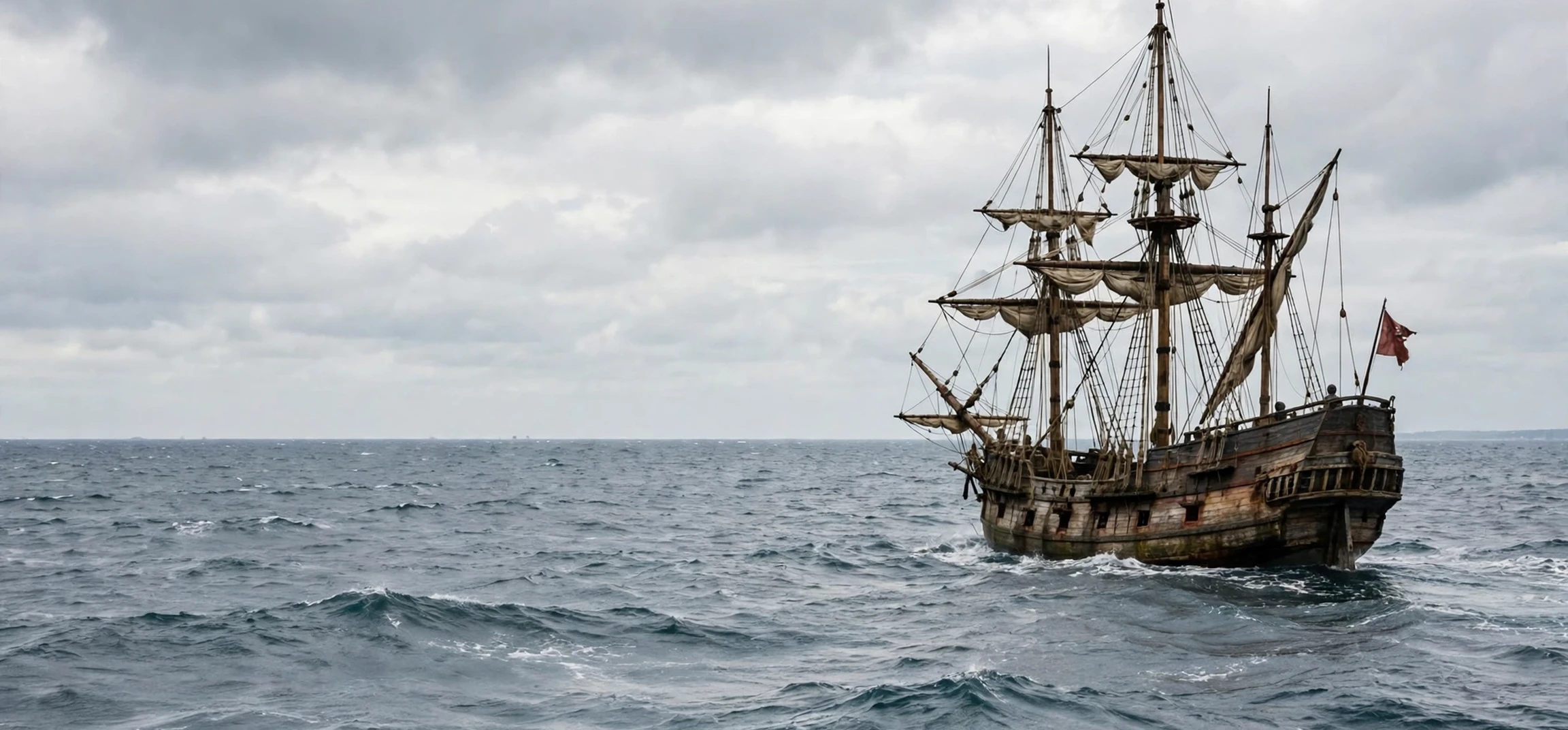
The names of real life pirate ships carry a strange power. Even centuries after the golden age of piracy, names such as Queen Anne’s Revenge, Royal Fortune, and Whydah Gally still sound like stories in themselves, and they invite readers to ask which vessels were real, which captains sailed them, and how much of their fame comes from history and how much comes from legend. The honest answer is a mixture. Some pirate ships are well documented in court records, naval reports, merchant logs, and contemporary newspapers. Others are known only through a handful of mentions, and a few famous names have grown larger in retelling than the surviving evidence can fully support. This guide separates the well-established ships from the more uncertain ones, explains how pirate ships got their names, and shows why those names still matter to maritime history.
Piracy was not a single profession with a single kind of ship. Pirates captured merchant vessels, refitted them for speed and firepower, and often renamed them to suit a new captain, a new crew, or a new purpose. A captured ship might keep its merchant name, take a threatening new name, or receive a name that signalled loyalty, revenge, ambition, or humour. Some names were chosen to frighten victims into surrender without a fight, which was often the pirate preference, since a battle risked damage, injury, and loss of valuable cargo. Other names reflected politics, religion, or personal history. Understanding that variety helps explain why pirate ship names range from the grand and royal to the dark and playful, and why the same captain might sail under several names during a short career.
It also helps to understand the limits of the record. Pirates did not keep neat company archives. Many records survive because a pirate was captured and tried, because a victim reported an attack, or because a colonial governor wrote to London about a threat to trade. Those sources are valuable, but they are incomplete and sometimes biased. A governor might exaggerate a threat to request more naval ships. A captured pirate might minimise his role. A newspaper might repeat a dramatic name without checking it. Historians therefore weigh each ship name against multiple sources where possible, and they treat a single dramatic mention with caution. That careful approach does not make the history less interesting. It makes the confirmed stories more trustworthy.
How names of real life pirate ships Were Chosen
When we look at the names of real life pirate ships, several patterns appear again and again. Royal and fortune names were common, because they suggested power and success. Revenge names were common, because many pirates framed their careers as payback against merchants, navies, or former employers. Religious and moral names appeared too, sometimes sincerely and sometimes ironically, as when a ruthless crew sailed under a pious-sounding title. Animal names, place names, and personal names also appear, often because a captain named a ship after a home town, a patron, a partner, or a previous vessel. In short, pirate ship names worked like branding long before modern branding existed. They told victims, allies, and rivals something about the crew before a single cannon was fired.
Renaming was also practical. A captured merchant ship might already be well known to traders and naval patrols. Giving it a new name, repainting it, and changing its rig could make it harder to recognise, at least for a time. Pirates also changed names after a major refit, after a change of captain, or after a ship was taken from another pirate crew. That is why the same physical vessel can appear in records under two or more names, and why historians sometimes debate whether two mentions describe one ship or two. The famous case of Blackbeard’s flagship is a good example. It began life as a French merchant vessel, was captured, refitted, and renamed, and its later fame rests on a short but intense period of activity before it ran aground.
Ship type mattered as much as name. Most successful pirate vessels were not huge warships. They were sloops, brigantines, schooners, and refitted merchant ships chosen for speed, shallow draught, and manoeuvrability. A fast ship could chase a merchant vessel, escape a naval patrol, and enter shallow coastal waters where a larger warship could not follow. A pirate captain therefore prized a vessel that could be handled by a relatively small crew, carry enough cannon for intimidation, and still hold captured cargo. The name on the stern was important, but the hull, sails, and crew mattered more in a chase. Many of the most famous pirate names belong to vessels that were, by naval standards, modest ships made formidable by daring crews.
Queen Anne’s Revenge and Blackbeard
Queen Anne’s Revenge is probably the most famous pirate ship name in the world, and it belonged to Edward Teach, better known as Blackbeard. Teach captured a French merchant vessel named La Concorde in 1717, refitted it with additional cannon, and renamed it Queen Anne’s Revenge. The name may have referred to Queen Anne of England, who had died a few years earlier, and to the political sympathies of former privateers who felt abandoned after wartime employment ended. Whatever the exact intention, the name sounded both royal and threatening, and it suited a captain who cultivated a fearsome image with slow-burning fuses in his beard and a reputation for theatrical intimidation.
Teach used Queen Anne’s Revenge during a period of intense activity in the Caribbean and along the North American coast, including the blockade of Charleston. The blockade is one of the best-documented episodes of his career, because it affected a major port and generated official correspondence. In 1718, the ship ran aground near Beaufort Inlet in present-day North Carolina and was abandoned. A wreck discovered off that coast in the late twentieth century has been studied extensively, and many researchers identify it as Queen Anne’s Revenge, based on its location, cannon, artefacts, and dating. The identification is widely accepted, though, as with many wrecks, researchers continue to test the evidence. For readers interested in Blackbeard’s vessel in more detail, see this guide to Blackbeard ship name history and naming.
Blackbeard himself died later in 1718, in a battle with naval forces off Ocracoke Island. His short pirate career, lasting roughly two years, shows how quickly a name can become legend. Teach was not the longest-serving pirate, nor the most successful in terms of captured wealth, but his image, his flagship name, and his dramatic death made him the archetype of the pirate captain in later literature and film. Queen Anne’s Revenge therefore carries two histories at once: the documented history of a captured merchant ship refitted for piracy, and the cultural history of a name that came to stand for piracy itself.
Royal Fortune and Bartholomew Roberts
If Blackbeard is the most famous pirate, Bartholomew Roberts, often called Black Bart, was among the most successful. Roberts captured hundreds of vessels during a career lasting from 1719 to 1722, and he sailed a series of ships, several of which he named Royal Fortune. The repeated use of the same name can confuse readers, because records mention more than one Royal Fortune under Roberts. The best-known was a captured French warship refitted for piracy, which served as his flagship during his later career. Roberts was known for discipline, organisation, and bold attacks, including captures off West Africa and in the Caribbean.
Roberts died in battle in 1722, when his ship was engaged by a British naval vessel off the African coast. His death marked a turning point in the suppression of Atlantic piracy, as naval patrols, colonial cooperation, and changing trade conditions made large-scale piracy harder to sustain. The name Royal Fortune, like Queen Anne’s Revenge, combined royal suggestion with the promise of wealth, and it fitted a captain who presented himself as a successful and orderly commander rather than a chaotic outlaw. Roberts also left a set of pirate articles, or rules, that governed his crew, which helps explain why his ships could operate effectively over long voyages.
Other Roberts vessels included the Fortune, the Good Fortune, and earlier captured ships that he renamed or used briefly. This pattern of renaming and reusing names was normal, and it reminds readers that a pirate fleet was often a changing collection of captured vessels rather than a permanent navy. A captain might start with a sloop, capture a larger merchant ship, transfer his crew and cannon, rename the prize, and abandon the old vessel. The name therefore followed the captain and the crew as much as it followed the hull, and a famous name could survive the loss of the original ship.
Whydah Gally, Adventure Galley, and Other Famous Vessels
Whydah Gally, often written as Whydah, was the flagship of Samuel Bellamy, known as Black Sam Bellamy, who operated off the North American coast in 1717. The vessel began as a slave-trading ship, was captured by Bellamy, and was refitted for piracy. It wrecked in a storm off Cape Cod in April 1717, with the loss of most of its crew, including Bellamy. The wreck was discovered in the twentieth century and has yielded a large collection of artefacts, which have helped historians understand pirate life, cargo, weaponry, and daily routines. Whydah Gally is therefore important not only for its name, but for the archaeological evidence it provides about a pirate ship in the early eighteenth century.
Adventure Galley belonged to William Kidd, whose career sits on the boundary between privateering and piracy. Kidd was commissioned as a privateer, authorised to attack enemy shipping, but he was later tried and executed for piracy and murder. Adventure Galley was built for speed and fitted with both sails and oars, allowing it to pursue vessels in calm conditions. Its story illustrates how thin the line could be between legal privateering and piracy, especially when commissions were vague, crews were unpaid, and captains made desperate decisions far from oversight. Kidd’s name and ship became legendary, partly because of buried-treasure stories that grew up after his death, even though the documented treasure was far less romantic than the legend.
Other well-documented pirate vessels include the Ranger, sailed by Charles Vane, the Revenge, associated with Stede Bonnet and later with Blackbeard, and the Fancy, sailed by Henry Every. Every, also known as Henry Avery, captured a rich Mughal vessel in 1695, in one of the most lucrative pirate captures on record, and then largely vanished from history. The Fancy was a fast vessel well suited to long ocean voyages, and Every’s success inspired both admiration and alarm in England and India. The Ranger, by contrast, is associated with a shorter and more confrontational career, ending in capture and execution. Together, these ships show the range of pirate activity, from Indian Ocean raiding to Caribbean and North American coastal attacks.
Pirate Ships in the Indian Ocean
Indian Ocean piracy in the late seventeenth century involved different routes, targets, and risks from Caribbean piracy. Pirates based in Madagascar, the Red Sea, and Indian ports attacked richly laden vessels travelling between India, the Middle East, and Europe. Ships such as the Fancy and the vessels of Thomas Tew operated in this world, where a single capture could yield enormous wealth, but where disease, distance, and monsoon seasons made voyages dangerous. The names of these ships are less familiar to many readers than Caribbean names, yet they belong to an important chapter of pirate history that connected Europe, Africa, and Asia through trade and raiding.
Pirate Ships in the Caribbean and Atlantic
Caribbean and Atlantic piracy, at its peak between about 1716 and 1726, involved many small, fast vessels operating near busy trade routes, colonial ports, and shallow island waters. Captains such as Teach, Roberts, Bellamy, Vane, and Bonnet moved between the Bahamas, the Carolinas, the Caribbean islands, and West Africa, following trade winds and merchant traffic. Their ships were often captured sloops and brigantines, refitted with extra cannon and larger crews. The names from this period dominate popular culture, because they appear in trial records, newspaper reports, and later adventure literature, and because the geography is familiar to readers in Britain, North America, and the Caribbean today.
| Ship name | Captain | Period and notes |
|---|---|---|
| Queen Anne’s Revenge | Edward Teach, Blackbeard | 1717 to 1718, captured French merchant vessel, ran aground off North Carolina |
| Royal Fortune | Bartholomew Roberts | 1719 to 1722, name used for several Roberts flagships |
| Whydah Gally | Samuel Bellamy | 1717, wrecked in a storm off Cape Cod, wreck studied by archaeologists |
| Adventure Galley | William Kidd | Late 1690s, privateer vessel later linked to piracy trial |
| Fancy | Henry Every | 1690s, Indian Ocean raiding, famous rich capture in 1695 |
| Ranger | Charles Vane | 1717 to 1718, Caribbean sloop, captain later executed |
| Revenge | Stede Bonnet | 1717 to 1718, Bonnet’s vessel, later operated with Blackbeard |
The table gives a quick reference, but it should not be read as a complete list. Dozens of pirate vessels appear in records under names that are less famous, and many more were never recorded by name at all. A merchant ship captured and used for a few weeks might appear in a single report, or might be described only by its type and its captain. Historians therefore treat famous-ship lists as starting points, not as full fleets. The ships in the table are those for which the evidence is strongest and the stories are most fully documented.
names of real life pirate ships in Popular Culture
Popular culture has amplified some pirate ship names and invented others, which can make it hard to tell history from fiction. The Black Pearl, the Jolly Roger as a ship name, and many other familiar titles belong to fiction, not to documented pirate history, even though they borrow from real pirate imagery. The Jolly Roger itself was a real pirate flag, a black flag with a skull and crossbones or related design, but it was a flag type, not a single ship. Similarly, many fictional pirate ships borrow real names, or combine elements of real ships, to sound authentic. Readers who enjoy pirate films and books should therefore treat a dramatic ship name as a clue to check, not as proof of history.
At the same time, popular culture has preserved interest in real ships that might otherwise be forgotten. Museums, wreck exhibitions, documentaries, and historical novels have brought Queen Anne’s Revenge, Whydah Gally, and Royal Fortune to wide audiences. That interest supports archaeological research, maritime museums, and local history in coastal communities where pirate history is part of the heritage. The best popular accounts are those that distinguish clearly between documented fact, reasonable inference, and dramatic invention, and that point readers toward trial records, naval reports, and archaeological findings for further reading.
Place names also keep pirate ship history alive. Coastal towns, inlets, and museums in North Carolina, Massachusetts, the Bahamas, and other locations tell the stories of ships that wrecked, were captured, or were based nearby. Visiting those places, or reading their museum guides, can give a sense of scale that a name alone cannot convey. A pirate sloop was not a huge galleon, and a pirate crew was often smaller than a naval crew. Seeing a reconstructed vessel, a cannon, or a recovered artefact helps readers understand why speed, surprise, and intimidation mattered more than sheer size.
How Historians Verify a Pirate Ship Name
Historians verify a pirate ship name by looking for independent confirmation. A name mentioned in a trial transcript, a merchant report, and a naval letter is stronger than a name mentioned only in a later retelling. A wreck identified by location, construction, cannon markings, and artefacts is stronger than a wreck identified by location alone. A ship name that appears consistently over several months, with the same captain and similar movements, is stronger than a single dramatic mention. When sources disagree, historians note the disagreement rather than choosing the most exciting version. That method may seem cautious, but it is what allows readers to trust the core stories of Teach, Roberts, Bellamy, Kidd, and Every.
Readers can apply a simpler version of the same test. Ask whether a ship name appears in more than one reliable history book, whether a museum or university source supports it, and whether the story includes dates, places, and named witnesses. Be cautious with claims that a ship carried an enormous treasure with no surviving record, that a captain operated for decades without capture, or that a ship name appears only on fan sites and social media. Those claims may still be interesting, but they should not be treated as established history without stronger evidence. For a related example of how a vessel can be renamed after a rescue, see this account of a ship renamed after rescue, which shows how ship names can change for honour, memory, and practical reasons.
Frequently Asked Questions
What was the most famous real pirate ship?
Queen Anne’s Revenge, Blackbeard’s flagship, is usually considered the most famous, because of Blackbeard’s image, the Charleston blockade, and the studied wreck off North Carolina. Royal Fortune under Bartholomew Roberts and Whydah Gally under Samuel Bellamy are also among the most documented and most studied.
Did pirates name their own ships?
Often, yes. Pirates commonly renamed captured merchant vessels to suit a new captain, to frighten victims, to honour a cause, or to make recognition harder. Some vessels kept their merchant names, and some names followed a captain from one vessel to another, which is why the same name can appear for different hulls.
Were pirate ships large warships?
Most were not. Successful pirate vessels were usually fast sloops, brigantines, schooners, or refitted merchant ships chosen for speed and shallow-water manoeuvrability. A larger naval warship would have needed a much larger crew and would have been harder to maintain without a home port.
Are there real pirate ship wrecks to visit?
Some wrecks, including material linked to Queen Anne’s Revenge and Whydah Gally, have been studied and displayed in museums. Wreck sites themselves are often protected, and visitors should rely on museum exhibitions and guided heritage sites rather than attempting to visit a wreck directly.
Conclusion
The names of real life pirate ships endure because they combine adventure, history, and human ambition in a few memorable words. Queen Anne’s Revenge, Royal Fortune, Whydah Gally, Adventure Galley, Fancy, Ranger, and Revenge each tell a different part of the pirate story, from Caribbean blockades to Indian Ocean captures, from privateering trials to storm wrecks. Some details remain uncertain, and some legends have grown beyond the evidence, but the core history is rich enough without exaggeration. By checking names against trial records, naval reports, and archaeology, readers can enjoy the romance of pirate history while keeping the real ships, captains, and voyages clearly in view.



