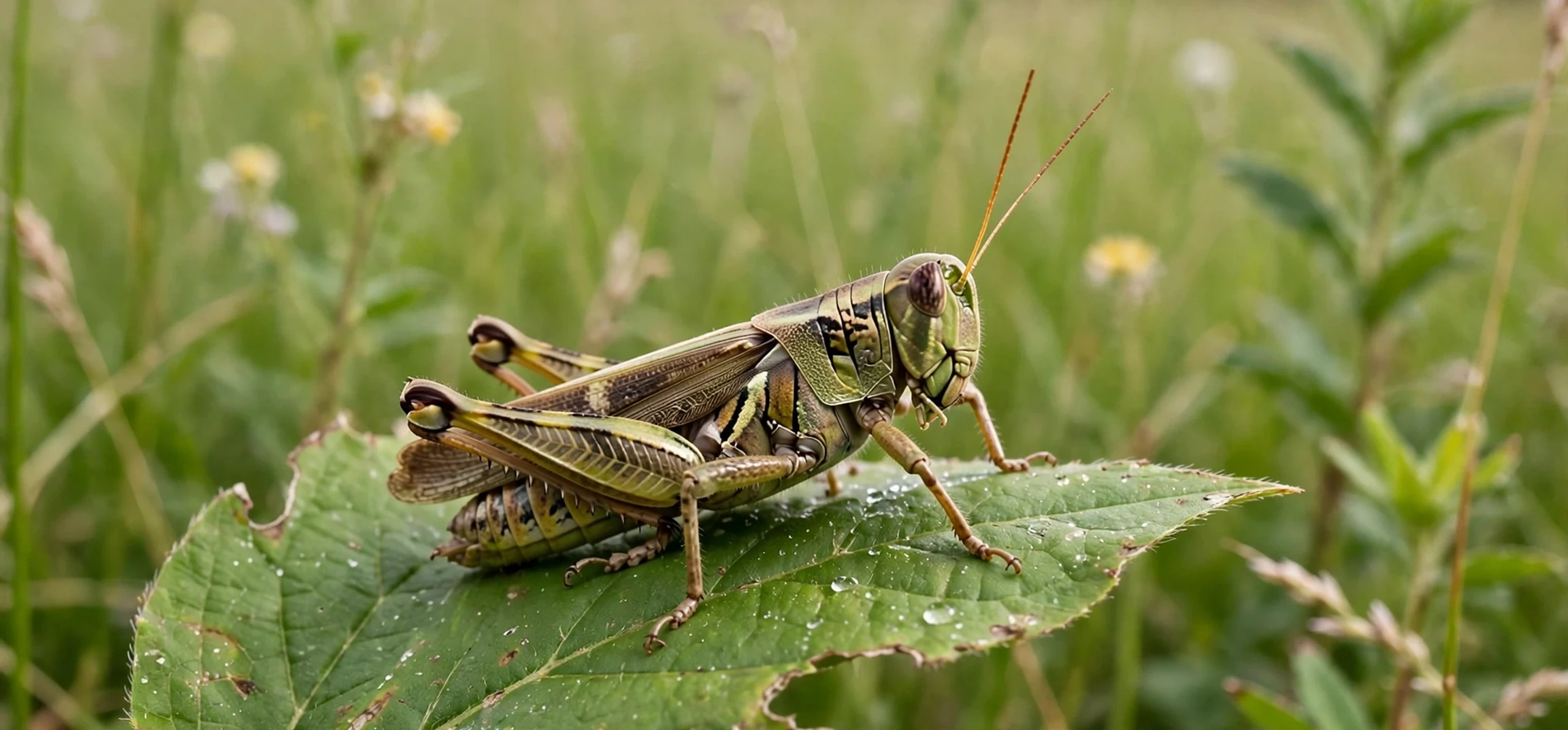
When a grasshopper lands nearby or crosses your path, many people pause and wonder whether the moment carries a deeper message. The spiritual meaning of grasshoppers is not a single fixed fact, but a collection of beliefs, stories, and traditions that have grown up around this small, leaping insect in many cultures. Some people see a grasshopper as a sign of good luck, others as a reminder to be patient, and still others as a symbol of change, freedom, or taking a leap of faith. In this guide, we look at those interpretations honestly, as cultural and spiritual beliefs rather than proven facts, and explore why this insect has captured human imagination for so long.
Grasshoppers are found on almost every continent, and their most striking feature is obvious: they jump. A grasshopper can leap many times its own body length, moving forward in a single bound rather than crawling step by step. That simple physical fact has shaped much of the symbolism attached to them. In stories and spiritual traditions, the leap often stands for courage, progress, and the willingness to move into something new. At the same time, grasshoppers are quiet, watchful creatures for much of the day, and that stillness has led other traditions to link them with patience, listening, and timing.
It is worth stating clearly at the start that spiritual meanings are a matter of belief and personal interpretation. No scientific study proves that seeing a grasshopper predicts the future or guarantees good fortune. What we can do is describe what different communities have believed, why those beliefs make sense in context, and how modern readers often use them as prompts for reflection. If a grasshopper sighting encourages you to think about a decision, a change, or a goal, that reflection itself can be valuable, whether or not you treat the sighting as a sign.
What Grasshoppers Symbolise in General
In general symbolism, grasshoppers are most often linked with good luck, abundance, and forward movement. In parts of China, grasshoppers have long been associated with prosperity and good fortune, and images of grasshoppers appear in art and decoration as hopeful emblems. In some European folk traditions, a grasshopper in or near the home was welcomed as a cheerful visitor, while in other stories the insect served as a reminder not to waste the good seasons of life. The famous fable of the grasshopper and the ant, told in many versions, uses the insect very differently, as a warning about preparation, which shows how one animal can carry opposite meanings depending on the story being told.
Another common theme is intuition and sensitivity. Grasshoppers sense vibrations through their legs and respond quickly to movement around them. Spiritual writers often turn that sensitivity into a metaphor: pay attention to small signals, trust your instincts, and notice what is happening around you before you act. Similarly, the grasshopper’s green colour connects it in many modern interpretations with nature, growth, and renewal, especially in spring and summer when grasshoppers are most visible in fields and gardens.
spiritual meaning of grasshoppers in Folk Traditions
Across folk traditions, the spiritual meaning of grasshoppers in a general sense often centres on leaps and timing. Native American traditions, which vary greatly from nation to nation, have included grasshopper stories in which the insect represents resourcefulness and the ability to make the most of what is available. Because grasshoppers appear in large numbers in some seasons and are scarce in others, they have also been linked with cycles, harvests, and the natural rhythm of plenty and scarcity. Readers should remember that no single summary can speak for all Indigenous traditions, and specific teachings belong to particular communities.
In Chinese culture, the grasshopper has historically been kept as a pet and admired for its song, and it became a symbol of good luck and longevity in some contexts. In ancient Greek culture, grasshoppers and cicadas were admired for their music and were sometimes linked with poetry and the arts. These examples show a pattern: cultures tend to project onto the grasshopper the qualities they notice most, whether that is music, jumping, abundance, or patience. The insect itself does not change, but the human story around it does.
For readers exploring other symbolic meanings, our guide to number and symbol meanings shows how the same kind of cultural layering shapes many everyday symbols, and a related look at ancient symbol meanings explains how one image can carry several traditions at once.
Grasshoppers in Dreams and Everyday Encounters
Dream interpretation is another area where grasshoppers appear frequently. In popular dream guides, a grasshopper in a dream is often read as a prompt to take a chance, to move forward, or to stop holding yourself back. A dream of many grasshoppers might be read as feeling overwhelmed by small worries, while a single calm grasshopper might be read as a quiet encouragement. Again, these are interpretive traditions, not medical or scientific claims. Dreams are shaped by memory, mood, and daily experience, and a dream about a grasshopper may simply reflect something you saw or thought about during the day.
Everyday encounters invite a similar kind of reflection. People often report noticing a grasshopper at a moment of decision, such as before a job change, a move, or a difficult conversation. It is natural for the human mind to look for patterns and meaning in timing, and that tendency itself is well documented in psychology. Whether you treat the encounter as a sign, a coincidence, or simply a pleasant moment in nature, the useful question is often the same: what were you already thinking about, and what would a brave, well-timed step look like?
Questions Worth Asking Yourself
Instead of searching for one correct meaning, many reflective readers ask a few practical questions. What change have you been postponing? What small step could you take this week rather than waiting for a perfect moment? Are you listening carefully to people around you, or rushing past useful signals? These questions turn a fleeting sighting into a moment of honest self-checking, which is arguably the most helpful use of any symbol.
Colour, Place, and Season: Do Details Change the Meaning?
In popular symbolism, details such as colour and setting are often said to change the message. A green grasshopper is commonly linked with growth, health, and new beginnings, matching the colour of leaves and fields. A brown grasshopper may be linked with grounding, practicality, and staying close to what is real and steady. A grasshopper seen indoors is sometimes read as a message brought close to home, while one seen in an open field may be read as freedom and wide horizons. None of these readings is universal, and different guides disagree, which is itself a useful reminder to treat them as inspiration rather than rules.
Season matters too. Grasshoppers are most active in warm months, so summer sightings are common and ordinary. A grasshopper appearing out of season, or in an unexpected place, tends to attract more attention precisely because it is unusual. That surprise factor often explains why an encounter feels significant. Noticing something uncommon naturally makes us pause, and the pause gives meaning room to grow, even when the event has a simple natural explanation.
Patience and Leaps: Two Sides of the Same Symbol
One of the most interesting features of grasshopper symbolism is that it holds two apparently opposite ideas at once: patience and bold leaping. A grasshopper sits still for long periods, camouflaged among leaves, waiting for the right moment. Then, in an instant, it jumps. Spiritual writers often use this combination as a model for good decision-making: wait, watch, and gather information, then act decisively when the moment is right. That balance appeals to people who feel torn between rushing ahead and holding back.
This dual message also appears in ideas about timing. A grasshopper does not jump constantly; it jumps when it needs to move, escape, or reach something new. In reflective readings, that becomes a reminder that progress does not have to be continuous to be real. Periods of stillness can be part of progress, provided they are followed by action. For students, job seekers, and anyone working toward a long goal, that framing can be encouraging without promising any particular outcome.
spiritual meaning of grasshoppers and Personal Reflection
For many modern readers, the value of grasshopper symbolism lies less in prediction and more in personal reflection. Journaling about an encounter, for example, can help clarify what you hope for and what you fear. You might write down where you saw the grasshopper, what you were thinking about at the time, and what step you would take if you felt a little braver. Over time, such notes can reveal patterns in your own thinking that are far more informative than any single symbol.
It is also helpful to separate comforting beliefs from decisions that need evidence. A grasshopper sighting can inspire you to apply for a job, start a project, or have an honest conversation, but the outcome will still depend on preparation, effort, and circumstances. Treating symbolism as encouragement is very different from treating it as a guarantee. Keeping that distinction clear protects you from disappointment and from making risky choices based on a sign alone.
| Theme | Common Interpretation | How Readers Use It |
|---|---|---|
| Leaping forward | Courage, progress, new opportunities | A prompt to take a planned step |
| Good luck | Prosperity and fortunate timing | Hopeful encouragement, not a promise |
| Patience | Waiting for the right moment | A reminder to observe before acting |
| Freedom | Breaking free from limits | Reflection on habits and choices |
| Sensitivity | Noticing small signals | Paying closer attention to surroundings |
| Abundance | Plenty, harvest, natural cycles | Gratitude for what is already present |
Frequently Asked Questions
Is a grasshopper a sign of good luck?
In many folk traditions, yes, grasshoppers are associated with good luck and prosperity, but this is a cultural belief, not a proven fact. Different traditions disagree, and the meaning often depends on context and personal interpretation.
What does it mean if a grasshopper comes into your house?
Popular readings often treat an indoor grasshopper as a message close to home, such as a coming change or a reminder to pay attention to family life. In practical terms, grasshoppers sometimes enter through open doors or windows, especially in warm weather, so the event also has a simple natural explanation.
What does a grasshopper in a dream mean?
Dream guides commonly read grasshoppers as prompts to move forward or take a chance. Dreams are personal, however, and a dream image may simply reflect recent experiences, so it is best treated as a starting point for reflection rather than a fixed prediction.
Is a grasshopper ever a bad omen?
Some traditions link large swarms with crop damage and hardship, which comes from real agricultural history. A single grasshopper, by contrast, is rarely treated as a bad omen in popular symbolism, and most modern readings are positive or neutral.
Conclusion
The spiritual meaning of grasshoppers, as understood across cultures, is rich precisely because it is not one thing. It blends luck, patience, courage, freedom, and sensitivity into a small insect that leaps when the moment comes. By treating these meanings as beliefs and traditions to learn from, rather than facts to obey, you can enjoy the symbolism while keeping your decisions grounded in evidence and effort. The next time a grasshopper crosses your path, you might simply pause, notice what you were thinking about, and ask yourself what brave, well-timed step is waiting for you. That pause, more than any single interpretation, is where the real value lies.