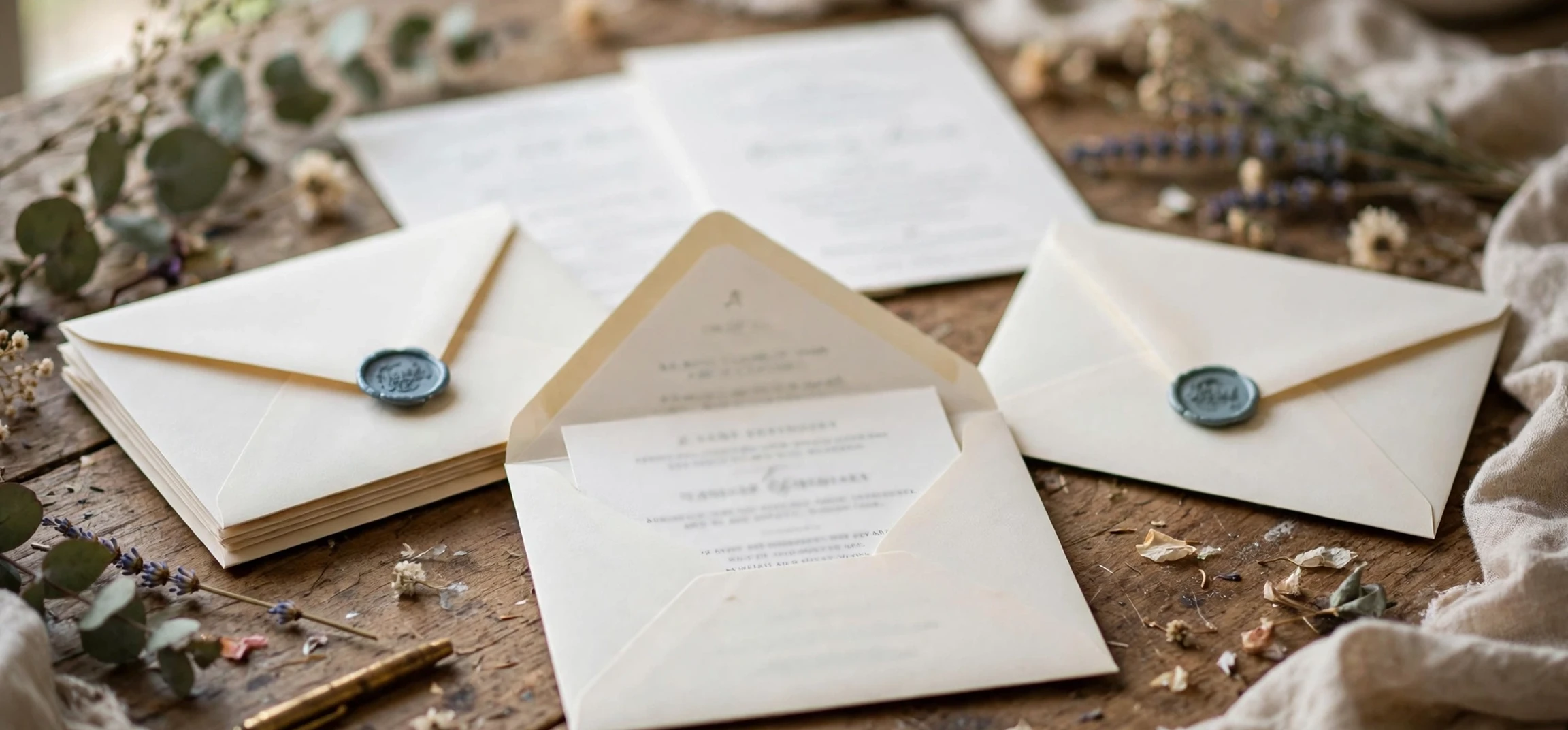
Learning the art of addressing formal wedding invitations can feel surprisingly stressful, even for couples who have planned every other detail with ease. The envelope is the first thing a guest sees, and its wording sets the tone for the whole celebration. Get it right, and guests feel honoured, included, and clear about who is invited. Get it wrong, and a guest may wonder whether a partner is included, whether children are welcome, or whether a title has been overlooked. This guide explains addressing formal wedding invitations step by step, using placeholder formats only, so you can adapt the patterns to your own guest list with confidence.
Formal addressing follows a few steady principles: use full names rather than nicknames, give titles their proper place, name every adult who is invited, and keep the outer and inner envelopes working together. The rules below cover married couples, unmarried couples, single guests, guests with a plus one, families with children, and guests with professional, military, or religious titles. They are general etiquette guidance for a traditional formal style. If your celebration is casual, modern, or culturally specific, you can soften these forms, but understanding the formal baseline helps you make those choices deliberately rather than by accident.
Addressing Formal Wedding Invitations: The Basics
The first principle of addressing formal wedding invitations is clarity. Every envelope should answer three questions at a glance: who is invited, in what order should their names appear, and what title, if any, belongs before each name. Traditional formal style spells out words rather than abbreviating them, so Street is written in full, as are Avenue, Doctor, and similar titles on the outer envelope where space allows. Numbers in a street address are usually written as figures, while the house name or apartment details follow the usual postal format for your country. Check your local postal guidance for the exact layout, and keep the etiquette wording separate from the postal mechanics.
The second principle is respect for titles and relationships. In formal addressing, a married couple who share a surname are traditionally addressed together, with titles preceding the shared name. An unmarried couple, or a couple who keep different surnames, are addressed with each full name listed, usually in alphabetical order by surname or with the person you know best first, depending on the etiquette guide you follow. Consistency matters more than any single rule: pick one approach for similar cases on your list and apply it evenly, so no guest feels singled out by an inconsistent form.
The third principle is the distinction between the outer and inner envelopes. Traditionally, formal invitations use two envelopes. The outer envelope carries the full postal address and the formal names, and it is the one the post office sees. The inner envelope carries only the names of the people invited, without an address, and it is the one guests open first. The inner envelope is where you clarify plus ones and children: if a child name appears on the inner envelope, that child is invited; if it does not, the invitation is for the adults named only. Many modern couples use a single envelope, in which case the outer envelope must do both jobs, so be extra clear about who is included.
Outer Versus Inner Envelope
Think of the outer envelope as the formal, public face and the inner envelope as the private, precise invitation. A typical outer envelope for a married couple might read, in placeholder form: Mr. and Mrs. [Surname], followed by the street line, then the city, state, and postal code line. The inner envelope for the same couple would simply read Mr. and Mrs. [Surname], with no address. For a single guest with a plus one, the outer envelope names the guest, while the inner envelope adds the words and Guest, or names the partner if the partner name is known. That small difference prevents a great deal of confusion.
If you are using one envelope only, adapt by making the addressee line complete. For example, address the envelope to both partners by name, or to a single guest and Guest where a plus one is intended. Do not rely on guests to guess from the invitation wording inside, because many guests read the envelope first and form their understanding there. Clear addressing formal wedding invitations practice means the envelope and the invitation card agree with each other, every time.
Addressing Formal Wedding Invitations for Married Couples
Married couples are the most common case, and the traditional formal forms are well established. When a couple shares a surname, the classic outer form is Mr. and Mrs. [Surname]. This form assumes the traditional convention in which both partners share one surname and the husband title comes first. Many couples today prefer a more egalitarian form, and modern formal etiquette accepts Mr. [First Name] and Mrs. [First Name] [Surname], or Mrs. [First Name] and Mr. [First Name] [Surname], with both first names spelled out. Either is correct in a modern formal context, provided you use the names the couple themselves use.
When spouses keep different surnames, list both full names. A common formal pattern is Mr. [First Name] [Surname A] and Mrs. [First Name] [Surname B], joined by and, in alphabetical order by surname. If one partner uses a professional title, that title normally takes precedence in the listing, as explained in the titles section below. The key point for addressing formal wedding invitations in this case is never to merge two different surnames into one, and never to drop a surname to save space. Each person invited deserves their own full name on the envelope.
Same-sex married couples follow the same logic, with both full names listed. Traditional etiquette guides suggest alphabetical order by surname, or the order that reflects the couple own preference if you know it. A typical placeholder form is Mr. [First Name] [Surname] and Mr. [First Name] [Surname], or Mrs. [First Name] [Surname] and Mrs. [First Name] [Surname]. If you are unsure about a couple preference, alphabetical order is a neutral and respectful default, and asking a close friend or family member is always better than guessing.
Addressing Formal Wedding Invitations for Single Guests and Plus Ones
Single guests are addressed by their title and full name, for example Ms. [First Name] [Surname], Mr. [First Name] [Surname], or Mx. [First Name] [Surname] where Mx. is the guest preferred title. Ms. is the standard formal title for a woman when marital status is unknown or irrelevant, while Mrs. is reserved for a married woman who uses that title, and Miss is traditionally used for an unmarried woman or a young girl. When in doubt, Ms. is the safest formal choice for an adult woman, and it is widely accepted in modern etiquette.
A plus one is handled differently depending on whether you know the partner name. If you know it, name the partner on the inner envelope and, in a single-envelope system, on the outer envelope as well, as a second invited person. If you do not know it, the inner envelope reads, for example, Ms. [First Name] [Surname] and Guest. The words and Guest signal clearly that the guest may bring one companion, without requiring you to invent a name. Do not write plus one on a formal envelope, because that phrase is casual; and Guest is the formal equivalent.
Be careful with the invitation card itself. If the reply card offers a line for the number of guests attending, a plus one guest should be able to write in two. If the reply card is pre-filled with a single name, a plus one guest may assume they must come alone. Addressing formal wedding invitations well therefore includes checking that the reply mechanism matches the envelope: the number of people named on the envelope should match the number the reply card allows.
Unmarried Couples Living Together
Unmarried couples who live together are addressed with both full names, whether or not they share an address. The outer envelope carries the shared postal address, while the addressee line lists both people. A typical placeholder form is Ms. [First Name] [Surname A] and Mr. [First Name] [Surname B], in alphabetical order by surname. Do not use and Family on the outer envelope for an unmarried couple unless you intend to invite the whole household, because and Family implies children and other household members are also invited.
For unmarried couples who live apart, send separate invitations to separate addresses, even if you are inviting both to the same wedding. Each person receives their own invitation, which respects their separate households and avoids the awkwardness of one partner invitation arriving at the other partner home. This rule applies equally to engaged couples who have not yet moved in together, and to long-term couples who simply keep separate homes.
Addressing Formal Wedding Invitations for Families and Children
Families require the most care, because the envelope must make clear exactly which children, if any, are invited. The traditional formal approach is to name adult guests on the outer envelope, and to name children on the inner envelope only. For example, the outer envelope might read Mr. and Mrs. [Surname], while the inner envelope reads Mr. and Mrs. [Surname], followed by the children first names in age order. Children over a certain age, often eighteen, traditionally receive their own separate invitation, even if they live at the same address.
If children are not invited, do not list them anywhere on the envelope or the invitation, and do not add a note saying children not invited on the envelope itself. That message, if needed at all, belongs on a separate details card or on the wedding website, phrased warmly and positively. The envelope simply names the adults invited, and the absence of children names is the signal. Many couples worry that guests will be offended, but clear, consistent addressing is kinder than ambiguity, because it lets guests plan childcare without having to ask.
When a family includes children with different surnames, list each child by their own full first name on the inner envelope, or by first name and surname where confusion is possible. A placeholder inner form might read: Mr. and Mrs. [Surname], [Child First Name], [Child First Name]. Keep the order by age, oldest first, which is the traditional formal order for children. For a single-envelope system, you may need to list children on the outer envelope as well, in which case keep the same age order and full clarity.
| Guest situation | Outer envelope (placeholder) | Inner envelope (placeholder) |
|---|---|---|
| Married couple, shared surname | Mr. and Mrs. [Surname] | Mr. and Mrs. [Surname] |
| Married couple, different surnames | Mr. [First Name] [Surname A] and Mrs. [First Name] [Surname B] | Mr. [Surname A] and Mrs. [Surname B] |
| Single guest, no plus one | Ms. [First Name] [Surname] | Ms. [First Name] [Surname] |
| Single guest, plus one | Ms. [First Name] [Surname] | Ms. [First Name] [Surname] and Guest |
| Family with young children invited | Mr. and Mrs. [Surname] | Mr. and Mrs. [Surname], [Child], [Child] |
| Unmarried couple together | Ms. [First Name] [Surname A] and Mr. [First Name] [Surname B] | Ms. [Surname A] and Mr. [Surname B] |
Titles, Professions, and Special Cases
Professional titles add a layer of formality that guests notice and appreciate when done correctly. A doctor is addressed as Dr. [First Name] [Surname], with Dr. spelled out as Doctor on a very formal outer envelope where space allows. When both partners are doctors, the form is Drs. [Surname] for a shared surname, or Dr. [First Name] [Surname A] and Dr. [First Name] [Surname B] for different surnames. When only one partner is a doctor, the doctor title normally comes first, regardless of gender, as in Dr. [First Name] [Surname] and Mr. [First Name] [Surname].
Military titles follow rank, with the rank preceding the full name, as in Captain [First Name] [Surname] or Major [First Name] [Surname]. Religious titles follow the tradition of the faith concerned: Reverend, Rabbi, Father, and similar titles precede the name in the form that person uses. Judges are addressed as The Honorable [First Name] [Surname], often with Judge as a courtesy in conversation but with the formal honorific on the envelope. If you are unsure about a title, it is perfectly polite to ask the guest, or to check how they sign their own correspondence, and to copy that form.
Widowed and divorced guests deserve particular sensitivity. A widowed woman who uses her married name is traditionally addressed as Mrs. [First Name] [Surname of late husband], or, in modern practice, as Mrs. [Her First Name] [Surname] if that is the name she uses. A divorced woman is generally addressed as Ms. [First Name] [Surname], using her current surname, unless she prefers Mrs. with her former married surname. The safest guide is always the name the person uses today, not a historical form imposed by an old etiquette book. Addressing formal wedding invitations with that principle keeps tradition and kindness in balance.
For help with related addressing tasks, you may find the guide on how to address an envelope with a PO Box useful for postal layout, and the guide on how to address an email to multiple recipients useful if you are sending digital save-the-dates alongside paper invitations.
Common Mistakes to Avoid
The most common mistake is abbreviating names or titles on a formal envelope to save space. Nicknames, initials, and shortened street words all undermine the formal tone, even if the invitation inside is beautiful. Take the time to spell out full first names, full titles, and full street words. If an envelope genuinely cannot fit a long name, use a larger envelope rather than shrinking the name, because the envelope is part of the invitation experience.
Another frequent mistake is using and Family loosely. And Family is a broad invitation: it invites everyone living in the household, including children and other relatives. If you write and Family when you mean only a couple, you may receive replies for extra guests you did not intend to host, and you will face an awkward correction. Reserve and Family for cases where you truly mean the whole household, and name individuals in every other case.
A third mistake is inconsistent plus-one handling. If some single guests receive and Guest and others do not, guests will compare notes and wonder why. Decide your plus-one policy early, apply it by category, such as all guests in long-term relationships, or all members of the wedding party, and let the envelopes reflect that policy exactly. Consistency protects you from accusations of favouritism and makes the guest list easier to manage.
Finally, proofread every envelope twice, ideally with a second person checking names against your guest list. Spelling a surname wrong, swapping first names, or using an outdated title are errors that guests remember, even when they forgive them. A slow, careful proofread is the cheapest insurance for a formal invitation suite, and it is worth more than any decorative detail.
Addressing Formal Wedding Invitations: A Quick Recap
The core of addressing formal wedding invitations is simple: spell out full names, honour titles, and name every person invited. Good addressing formal wedding invitations practice means a guest never has to guess whether a partner or a child is included, because the envelope answers that question clearly.
A second recap point is that addressing formal wedding invitations works best when the outer envelope, the inner envelope, and the reply card all agree. If the envelope names two people, the reply card should allow two replies, and if addressing formal wedding invitations for a family includes children on the inner envelope, that listing should match the invitation wording inside.
A third point is consistency. When addressing formal wedding invitations for a whole guest list, apply the same rules to similar cases, whether they involve married couples, single guests, or families. Consistent addressing formal wedding invitations practice prevents confusion, avoids the appearance of favouritism, and makes proofreading far easier.
Finally, remember that addressing formal wedding invitations is hospitality in written form. A carefully addressed envelope tells each guest that their presence matters, and that careful addressing formal wedding invitations effort is noticed long before the celebration begins.
Frequently Asked Questions
Do I need two envelopes for a formal wedding invitation?
No, two envelopes are traditional but not required. A single envelope works well if the addressee line names every invited person clearly, including plus ones and children where applicable.
How do I address a guest whose partner name I do not know?
Use and Guest on the inner envelope, as in Ms. [First Name] [Surname] and Guest. That signals a plus one without inventing a name.
Should children names go on the outer envelope?
Traditionally, no. Children are named on the inner envelope only, while the outer envelope names the adults. In a single-envelope system, list children on that envelope so the invitation is clear.
What title should I use if I am unsure?
Ms. is the safest formal default for an adult woman, Mr. for an adult man, and Mx. where that is the guest preferred title. When possible, check how the guest styles their own name.
Can I use first names only for close friends?
In a strictly formal style, no. Use title and full name on the envelope, even for close friends, and save first-name informality for a handwritten note inside.
Addressing Formal Wedding Invitations: Takeaways
First, addressing formal wedding invitations starts with full names and correct titles, not with decoration. Careful addressing formal wedding invitations work shows respect before a guest reads a single word of the invitation card itself.
Second, addressing formal wedding invitations succeeds when envelopes and reply cards agree. If your addressing formal wedding invitations list includes a plus one, make sure the reply mechanism allows that guest to confirm for two.
Third, proofread as a final step in addressing formal wedding invitations, with a second person checking surnames and titles. That last check in addressing formal wedding invitations preparation catches the small errors guests remember most.
Conclusion
Addressing formal wedding invitations is, at its heart, an exercise in clarity and respect. Use full names, honour titles, name every invited adult, clarify plus ones with and Guest, and use the inner envelope to settle questions about children. Follow the placeholder patterns in this guide, adapt them to the names and preferences of your own guests, and proofread before posting. Done well, your envelopes will do more than deliver an invitation: they will tell each guest, before they even open the card, that they are truly wanted at your celebration.
For a final check, read each envelope aloud as if you were greeting the guest at the door. If the wording sounds warm, complete, and unambiguous, it is ready to post. If it sounds clipped, vague, or incomplete, adjust it now, while correction is still easy. That simple test captures the whole spirit of addressing formal wedding invitations: formality in service of hospitality, not formality for its own sake. For more on family wording, see the guide to family-oriented meaning.