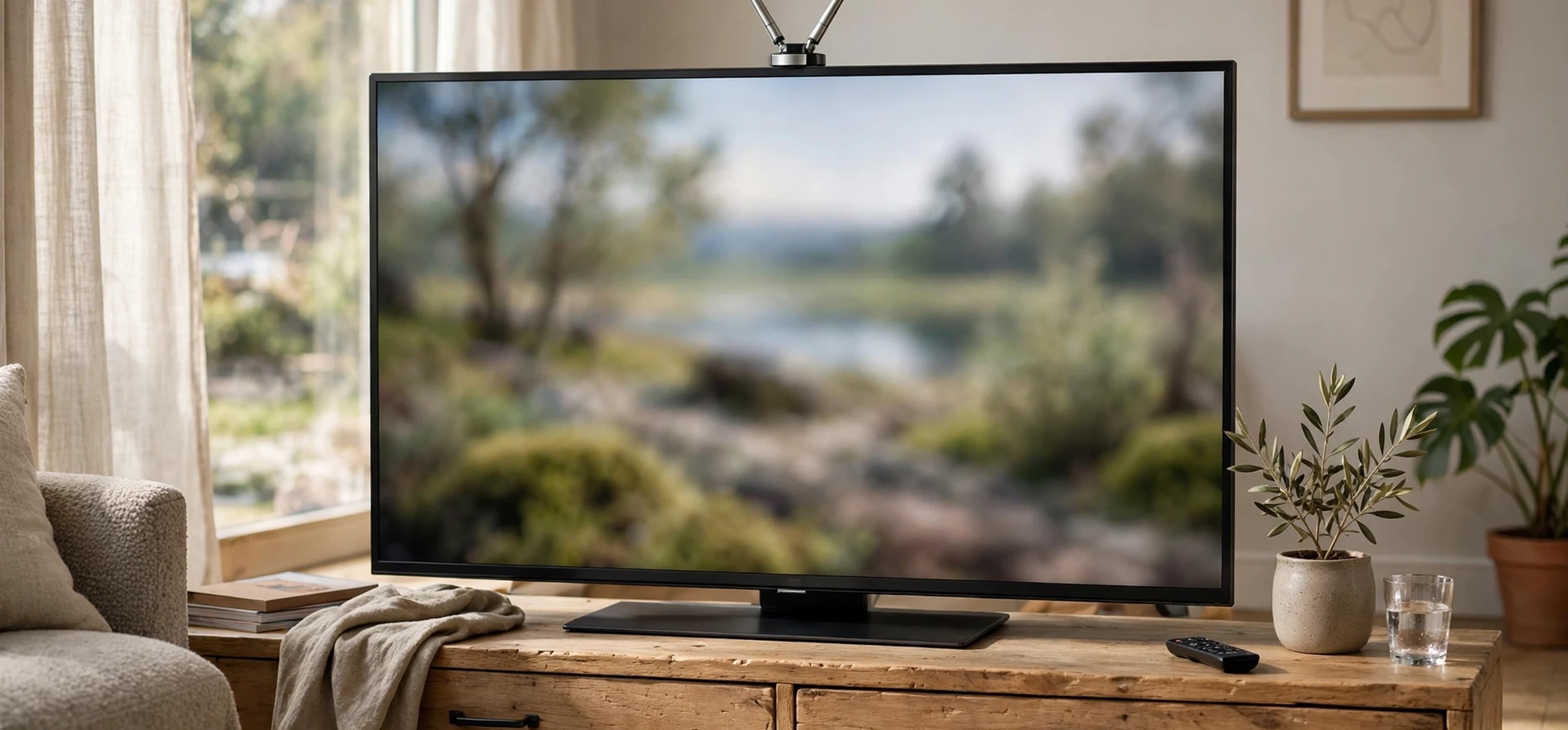
If you searched for “tv antenna review”, you are probably trying to work out whether an indoor television antenna is worth buying, which type suits your home, and what to look for before you choose one. This guide reviews the indoor TV antenna category as a whole, rather than recommending a single model, and it explains how indoor antennas work, what affects reception, and how to compare models fairly. It does not state prices as current facts and it does not link to any shop, because prices and availability change frequently and should always be checked at the time of purchase from the retailer you choose.
An indoor TV antenna is designed to receive free-to-air terrestrial television broadcasts, the signals transmitted from local broadcast towers to homes in the surrounding area. Unlike a satellite dish or a cable connection, an indoor antenna does not require a subscription, and it does not need to be mounted on a roof or an external wall. That simplicity is its main appeal, but it also defines its limits: reception depends on your distance from the transmitter, on obstacles between you and the transmitter, and on the design and placement of the antenna itself. Understanding those factors before you buy will save you from disappointment and from unnecessary returns.
What a “tv antenna review” Should Cover
A useful tv antenna review should start with the basics of how the product works, rather than with a list of features. Terrestrial broadcasts are transmitted on specific frequency bands, and an antenna must be able to receive the bands used in your area. In many regions, that includes both VHF and UHF bands, although the balance between them varies by country and by transmitter. A good indoor antenna will be designed to receive both bands, and its specifications should state that clearly. If a product only covers one band, it may miss some channels, even if it performs well on the channels it does receive.
The second basic question is range, which is often stated in product descriptions as a distance, such as a number of miles or kilometres from the transmitter. Those figures should be treated as estimates under ideal conditions, not as guarantees. A clear line of sight to a nearby transmitter, a high placement in the home, and a lack of interference will all help an antenna reach its stated range, while hills, tall buildings, thick walls, and distance will all reduce it. A review that treats a stated range as a promise, without discussing those conditions, is not giving you the full picture, and you should be cautious about any claim that sounds too good to be true.
Indoor Versus Outdoor Antennas
Indoor antennas are convenient, discreet, and easy to install, and they are often the right choice for people who live relatively close to a transmitter, who rent their home and cannot install an external antenna, or who want a simple solution for a second television. Outdoor antennas, by contrast, are larger, are mounted higher, and generally receive a stronger, cleaner signal, because they are less affected by walls and by interference inside the home. If you live a long way from a transmitter, or if indoor reception is poor despite trying different placements, an outdoor antenna, or professional advice about one, may be a better option than buying another indoor model.
Key Features in a “tv antenna review”
When comparing indoor antennas, several features deserve attention. The first is the design: flat panel antennas that can be placed on a wall or a window are popular because they are discreet, while traditional rabbit-ear antennas with extendable rods can be adjusted more precisely for VHF reception. Amplified antennas include a powered signal booster, which can help in some situations, particularly where the signal is weak or where a long cable is used, but amplification can also amplify interference and cause overload where the signal is already strong. Some amplified models therefore include an adjustable gain control, which is a useful feature if you are unsure about signal strength in your area.
Cable length and connection type are practical details that are easy to overlook. A longer cable gives you more flexibility in placement, which matters because moving an antenna by even a short distance, or from one side of a room to another, can make a noticeable difference to reception. Check that the connector matches your television or set-top box, and that the cable is long enough to reach from your preferred placement to the television without stretching or trailing across a walkway. Build quality also matters: a well-made antenna with a stable base or a reliable wall-mounting option will stay in position, while a flimsy model that keeps falling over will frustrate you and will not maintain a consistent signal.
Placement and Rescanning
Placement is often more important than the specific model you choose. Start by placing the antenna as high as possible, near a window facing the direction of the local transmitter, if you know it, and away from large metal objects, thick walls, and electronic devices that may cause interference. Then run a channel scan on your television, note which channels are received clearly, and try a different placement if the results are poor. Rescan after each move, because the television needs to search again to find channels at the new signal strength. This trial-and-error process takes a little patience, but it is the most reliable way to find the best position in your home, and it costs nothing.
Interference and Signal Quality
Several sources of interference can affect indoor reception, including household electronics, LED lighting, and nearby mobile signals, although modern televisions and antennas are designed to filter much of this out. If reception is intermittent, try switching off nearby devices one at a time to see if the problem improves, and try moving the antenna away from the television itself, because the television can be a source of interference. Signal quality matters more than signal strength alone: a strong but noisy signal can produce a worse picture than a weaker but cleaner signal, which is why a channel scan that reports quality, where available, is more useful than a simple strength meter.
| Antenna type | Best suited to | Points to watch |
|---|---|---|
| Flat panel, unamplified | Homes close to a transmitter | Limited range; placement is critical |
| Flat panel, amplified | Moderate distance or long cable runs | Amplification can overload a strong signal |
| Rabbit-ear, adjustable | Areas where VHF matters | Bulkier; rods need careful adjustment |
| Window-mounted panel | Flats with a clear window view | Direction matters; may need repositioning |
For background on television history, see our guides to when television was invented, when the television was made, and the first television ever made. Those guides explain how broadcast television developed, which helps to explain why terrestrial signals remain a useful free option alongside streaming services today.
Who Should Buy an Indoor Antenna
An indoor antenna is a good fit for viewers who want free-to-air channels without a subscription, who live within a reasonable distance of a transmitter, and who are willing to spend a little time on placement and rescanning. It is particularly useful as a secondary source of television, for example in a bedroom or a kitchen, or as a backup when a streaming service is unavailable. It is less suitable for homes a long way from any transmitter, for homes shielded by hills or tall buildings, or for viewers who want a large number of specialist channels that are only available through cable, satellite, or streaming. In those cases, an outdoor antenna or a different service may be more appropriate, and it is better to recognise that early than to buy several indoor models in succession.
Before you buy, check which free channels are available in your area from the local broadcast authority or from a reputable coverage guide, and note whether those channels include the ones you actually watch. There is little point in buying an antenna for channels you will not use, and there is equally little point in expecting it to receive channels that are not broadcast terrestrially in your region. Set realistic expectations, compare models on design, band coverage, amplification, and cable length rather than on headline range claims alone, and keep the packaging until you have tested the antenna in your home, so that you can return it if reception proves unsatisfactory despite trying different placements.
Frequently Asked Questions
Do I need an indoor antenna if I already stream?
Not necessarily, but an indoor antenna can complement streaming by providing live free-to-air channels, including local news and live events, without a subscription and without using internet bandwidth. Many viewers use both, choosing streaming for on-demand content and an antenna for live broadcast television.
Is an amplified antenna always better?
No. Amplification helps where the signal is weak or where a long cable is involved, but it can overload a strong signal and amplify interference. If you live close to a transmitter, an unamplified model may give a cleaner result, and an amplified model with adjustable gain offers the most flexibility if you are unsure.
Why are some channels missing after a scan?
Missing channels usually mean that the signal for those channels is too weak at the antenna’s current position, or that those channels use a band the antenna does not cover well. Try moving the antenna, preferably higher and nearer a window, and rescan. If the problem persists, check local coverage information to confirm that those channels are broadcast in your area.
Conclusion
An indoor TV antenna remains a simple, subscription-free way to receive free-to-air television, provided that expectations are realistic and that placement is given proper attention. Choose a model that covers the bands used in your area, consider whether amplification will help or hinder in your location, check cable length and connection type, and test different placements with a fresh channel scan each time. Judged on those practical criteria, rather than on headline range claims, an indoor antenna can be a reliable and cost-effective addition to a modern home, sitting happily alongside streaming services as a source of live, local, and free television.



