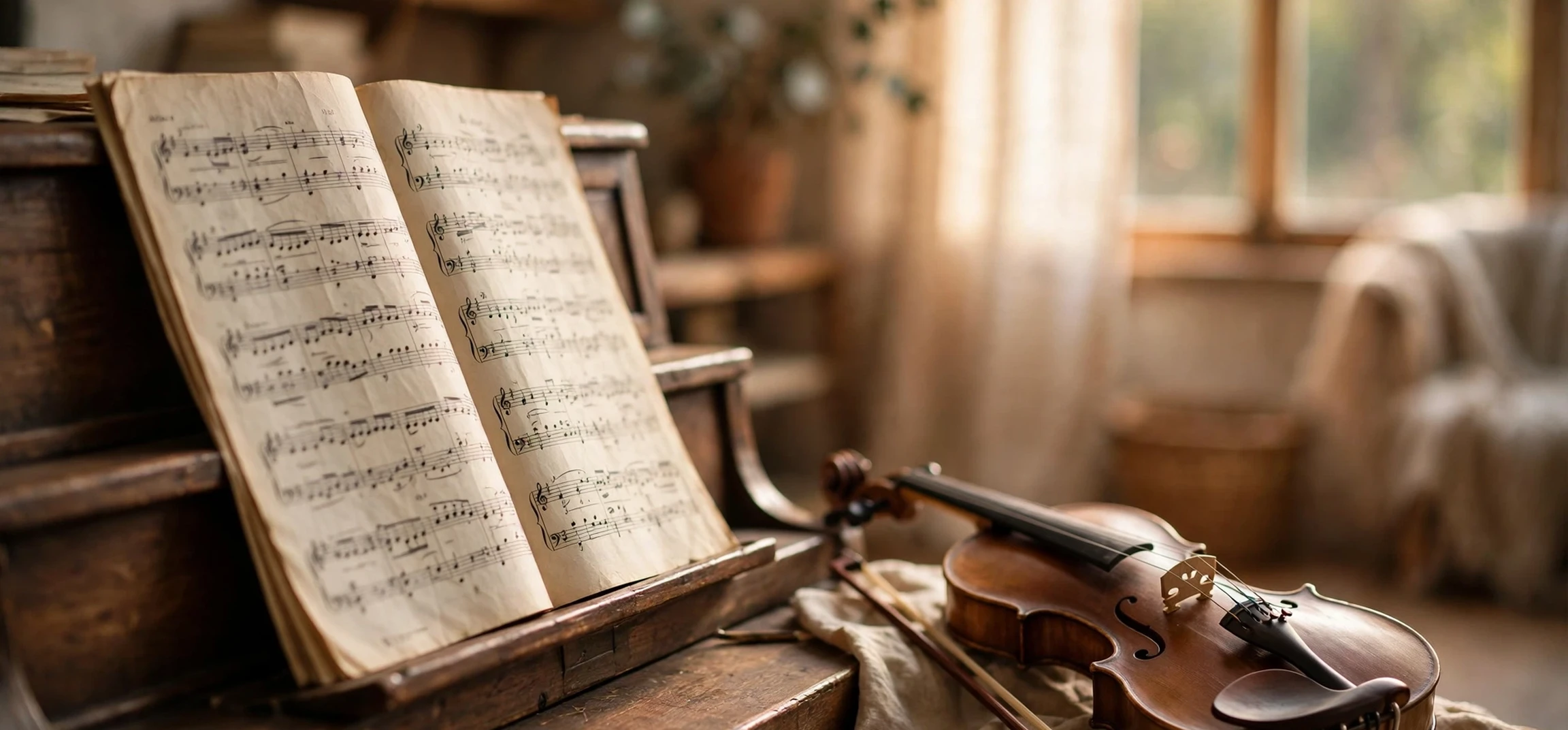
If you have ever opened a piece of sheet music and felt lost among dots, lines, and unfamiliar symbols, you are asking exactly the right question when you search for music notations and meanings. Musical notation is a written language: a system of signs that tells a musician what notes to play, how long to hold them, how loudly to play them, and how the music should feel. Like any language, it looks forbidding at first, but its basic grammar is surprisingly small, and once you understand the staff, the notes, the rhythms, and the most common expression marks, a page of sheet music starts to make sense. This guide explains that system from the ground up, in plain terms, for readers who are learning an instrument, singing in a choir, or simply curious about how music is written down.
It helps to start with why notation exists at all. Before notation, music was passed on by ear, from teacher to pupil, and a tune could change every time it was taught. Notation fixed music in a form that could travel across countries and centuries, so that a piece written hundreds of years ago can still be played today, in essentially the form its composer intended. That is a remarkable achievement, and it is why the system has lasted: it is precise enough for a symphony orchestra, yet simple enough for a beginner’s first tune. The symbols you meet first are the ones that carry the most information, and this guide takes them in the order a new reader needs them.
Music Notations and Meanings: The Staff and the Clefs
The foundation of Western musical notation is the staff, a set of five horizontal lines, with four spaces between them, on which notes are placed. Each line and each space represents a different pitch, meaning a different musical note, with higher positions on the staff meaning higher pitches and lower positions meaning lower pitches. Notes can also sit above or below the staff, on short extra lines called ledger lines, which extend the range in either direction. Reading the staff is therefore a matter of learning which position means which note, and that skill comes with practice, like learning to read words.
At the start of every staff sits a clef, a symbol that tells you which notes the lines and spaces represent. The two clefs you will meet most often are the treble clef and the bass clef. The treble clef, also called the G clef because it curls around the line that represents the note G, is used for higher-pitched instruments and voices, such as the violin, the flute, and the upper range of the piano. The bass clef, also called the F clef because its two dots straddle the line that represents the note F, is used for lower-pitched instruments and voices, such as the cello, the bassoon, and the lower range of the piano. Piano music uses both clefs at once, in a grand staff, with the treble staff for the right hand and the bass staff for the left hand.
Two other marks appear at the start of a staff, and both are essential. The key signature, a group of sharps or flats placed just after the clef, tells you which notes are raised or lowered throughout the piece, and therefore which key the music is in. A sharp raises a note by a semitone, and a flat lowers it by a semitone. The time signature, written as two numbers stacked like a fraction, tells you how the beats are organised: the top number tells you how many beats are in each bar, and the bottom number tells you which note value gets one beat. A time signature of 4/4, the most common of all, means four beats per bar, with the crotchet, or quarter note, getting one beat. A time signature of 3/4 means three beats per bar, which gives music a waltz-like feel.
Music Notations and Meanings: Notes, Rests and Rhythm
Notes are the symbols that represent musical sounds, and each note shape tells you both a pitch, from its position on the staff, and a duration, from its shape. The longest note in common use is the semibreve, or whole note, an open oval with no stem, which lasts for four beats in 4/4 time. A minim, or half note, is an open oval with a stem, lasting two beats. A crotchet, or quarter note, is a filled oval with a stem, lasting one beat. Quavers, or eighth notes, are filled ovals with a stem and one flag or beam, lasting half a beat each, so two quavers fit into one beat. Semiquavers, or sixteenth notes, have two flags or beams and last a quarter of a beat each.
The two naming systems, British and American, describe the same symbols, and it is worth knowing both, because books and teachers use them interchangeably. British names describe the note’s fraction of a whole bar in 4/4 time: semibreve for a whole bar, minim for half a bar, crotchet for a quarter, quaver for an eighth, semiquaver for a sixteenth. American names describe the same fractions more directly: whole note, half note, quarter note, eighth note, sixteenth note. Neither system is more correct; they are two vocabularies for one system, and a reader who knows both will never be confused by a book that uses the other.
Rests are the symbols for silence, and they follow the same durations as notes: a semibreve rest, a minim rest, a crotchet rest, and so on. Silence is not an absence of music; it is part of the music, shaping its rhythm and its phrasing just as surely as sound does. A rest at the right moment can make a phrase breathe, create suspense, or mark the boundary between two ideas. Dots and ties modify durations further. A dot after a note increases its length by half, so a dotted crotchet lasts one and a half beats. A tie is a curved line joining two notes of the same pitch, which combines their durations into one longer sound, while a slur, which looks similar but joins notes of different pitches, means to play them smoothly and connectedly.
Dynamics, Tempo and Expression Marks
Notes and rhythms tell you what to play and when, but dynamics and expression marks tell you how to play it, and they are what turn correct notes into musical performance. Dynamics are markings for loudness, and they use Italian terms and abbreviations that have been standard for centuries. The most common are pianissimo (pp), very quiet; piano (p), quiet; mezzo-piano (mp), moderately quiet; mezzo-forte (mf), moderately loud; forte (f), loud; and fortissimo (ff), very loud. A crescendo, shown by a widening hairpin symbol or the abbreviation “cresc.”, means to grow gradually louder, while a diminuendo or decrescendo, shown by a narrowing hairpin or “dim.”, means to grow gradually quieter.
Tempo markings tell you the speed of the music, and they too are usually Italian. Largo means very slow and broad, adagio means slow and stately, andante means at a walking pace, moderato means at a moderate speed, allegro means fast and lively, and presto means very fast. A metronome mark, such as a crotchet equals 120, gives an exact speed in beats per minute, and it is the most precise way to indicate tempo. Changes of tempo are marked with terms such as accelerando, meaning to speed up gradually, and ritardando, often shortened to “rit.”, meaning to slow down gradually. A return to the original speed is marked “a tempo”.
Articulation marks describe how individual notes are attacked and released. A staccato dot above or below a note means to play it short and detached, with a clear gap before the next note. An accent mark, a wedge or a chevron shape, means to emphasise that note more strongly than its neighbours. A tenuto line means to hold the note for its full value, with a slight weight. A fermata, a dot under a curved line like an eye, placed over a note or a rest, means to hold it for longer than its written value, at the performer’s judgement. These small marks carry a great deal of expressive information, and two performances of the same notes can sound very different depending on how the articulation is handled.
Other Symbols Every Reader Meets
Beyond the basics, a reader will soon meet repeat signs, which tell you to play a section again. A repeat is shown by a double bar line with two dots, and the music between two such signs is played twice, unless a different instruction is given. First and second time endings, marked with brackets labelled “1.” and “2.”, tell you to play one ending on the first pass and a different ending on the second pass. Directions such as “D.C. al Fine”, short for “da capo al fine”, mean to go back to the beginning and play until the word “Fine”, meaning the end, while “D.S. al Fine”, short for “dal segno al fine”, means to go back to a sign, marked with a stylised S symbol, and play until “Fine”. These directions save space on the page, and they are a normal part of reading music fluently.
Ornaments are decorative symbols that add flourishes to a note. A trill, marked “tr” with a wavy line, means to alternate rapidly between the written note and the note above it. A mordent, a short zigzag symbol, means a quick alternation with a neighbouring note, once or twice, before returning to the main note. A grace note, a small note printed before a main note, is played quickly and does not count towards the bar’s beat total. Ornaments were especially important in music of the Baroque period, and their exact performance can vary by style and period, so a teacher or a good edition’s notes are the best guide to their interpretation.
Finally, there are the symbols that shape phrasing and structure. A phrase mark, a long curved line over a group of notes, indicates a musical sentence, a complete thought that should be shaped as a unit, with a slight rise and fall. A breath mark, a small comma-like symbol, tells a singer or a wind player where to breathe, and it also marks a natural break in the phrase. A double bar line marks the end of a section, and a final double bar line, with a thicker second line, marks the end of the piece. Learning to notice these structural marks is what separates a reader who plays the right notes from a reader who understands the music’s shape.
| Symbol or term | Meaning |
|---|---|
| Treble clef | High pitches; curls around the G line |
| Bass clef | Low pitches; dots straddle the F line |
| Sharp | Raise the note by a semitone |
| Flat | Lower the note by a semitone |
| 4/4 time signature | Four crotchet beats per bar |
| Crotchet / quarter note | One beat in 4/4 time |
| Forte (f) | Loud |
| Piano (p) | Quiet |
| Allegro | Fast and lively |
| Staccato dot | Play the note short and detached |
| Fermata | Hold the note longer than written |
Frequently Asked Questions
How long does it take to learn to read music?
The basics, including the staff, the common note values, and the most frequent dynamics, can be learned in a few weeks of regular practice. Fluency, meaning reading at speed without stopping to work out each note, takes longer, typically months of steady practice, and it improves fastest when combined with playing or singing.
Are British and American note names different?
Yes, but they describe the same symbols. A crotchet is a quarter note, a quaver is an eighth note, and a semibreve is a whole note. Knowing both vocabularies prevents confusion when you switch books or teachers.
Do I need to learn Italian to read music?
No. You need to learn a small set of Italian terms for speed, loudness, and expression, but that vocabulary is limited, it is used internationally, and it is quickly learned in context.
What is the best way to practise reading notation?
Read a little every day, starting with simple pieces, and say or clap the rhythms before playing them. Singing the note names, or solfa syllables if your teacher uses them, helps connect the written symbol to the sound.
Conclusion
Music notations and meanings can seem like a secret code, but the code is open to anyone willing to learn its alphabet. The staff and clefs tell you the pitches, the note shapes and rests tell you the rhythm, the key and time signatures set the framework, and the dynamics, tempo, and expression marks tell you how the music should feel. Each symbol has a job, and none of them is arbitrary: the system grew over centuries because musicians needed a reliable way to preserve and share music. Start with the basics, practise a little every day, and the page that looks like a forest of dots today will soon read like a language you understand. For more on musical terms and their meanings, see our guides to rubato in music and to subito in music.



