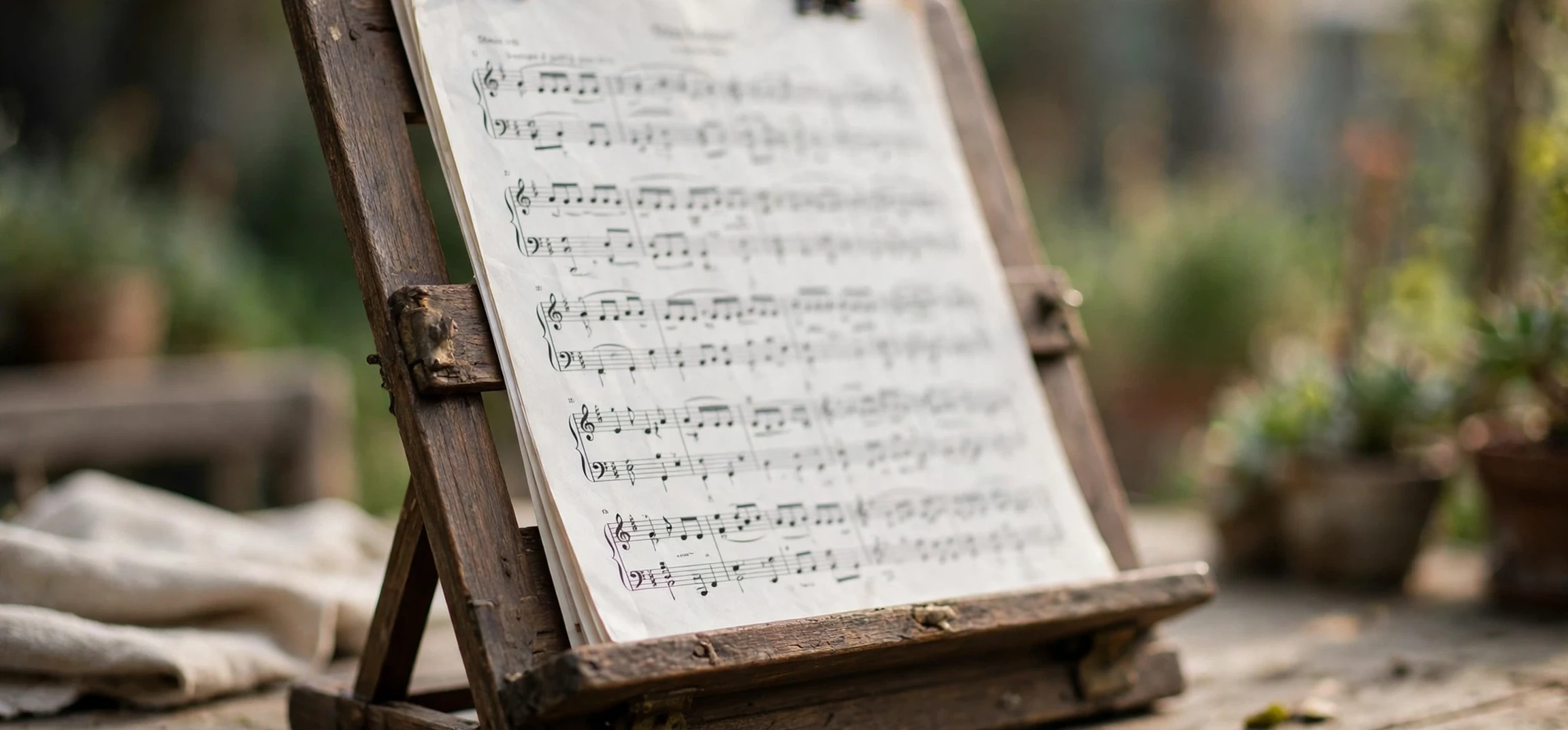
Learning note names treble clef readers need is one of the first steps in reading music, and it is also one of the most rewarding. The treble clef, also called the G clef, is the symbol at the start of a staff that tells you which lines and spaces represent which pitches. Once you know the notes on the five lines and the four spaces, you can begin to read melodies for the right hand of the piano, for violin, flute, trumpet, voice parts that sing high, and many other instruments. This guide explains the lines, the spaces, the notes above and below the staff, sharps and flats, and simple ways to practise. It assumes no prior music knowledge, and it builds step by step so that each new idea rests on the one before it.
First, picture the staff. A staff is a set of five horizontal lines, with four spaces between them. Notes are written on the lines, in the spaces, or on short extra lines called ledger lines above or below the staff. The treble clef curls around the second line from the bottom, which is the line for the note G. That is why it is called the G clef: its shape marks the G line. From that anchor point, every other line and space can be worked out by moving up or down the musical alphabet, which runs A, B, C, D, E, F, G, and then repeats. The musical alphabet has only seven letters, so after G comes A again, but at a higher pitch.
note names treble clef: the five lines
The five lines of the treble staff, from bottom to top, are E, G, B, D, and F. Many learners remember them with the phrase Every Good Boy Does Fine, where the first letter of each word gives the line note in order. Another common phrase is Every Good Boy Deserves Fudge. The exact phrase does not matter, as long as it sticks in your memory and you can recall it quickly. What matters is the order: bottom line E, second line G, middle line B, fourth line D, top line F. If you can say that sequence forward and backward, you have a solid anchor for reading any note that sits on a line.
It helps to practise the lines in both directions. Reading bottom to top, you go E, G, B, D, F, stepping up by skipping one letter each time, because notes on lines are always a third apart. Reading top to bottom, you go F, D, B, G, E, stepping down in the same way. That skipping pattern is not a coincidence. It reflects how the staff works: moving from one line to the next line always skips one note name, while moving from a line to the space just above it moves to the very next note name. Once you see that pattern, the staff stops looking like a set of random positions and starts looking like a ladder where each step has a predictable name.
Beginners often confuse the bottom line E with the top space E, or the middle line B with a nearby space note. The way to avoid that confusion is to always ask two questions: is the note on a line or in a space, and which line or space is it counting from the bottom? Counting from the bottom is essential, because counting from the top reverses the order and leads to errors. A simple habit helps: place a finger on the bottom line, say E, and count upward until you reach the note. After a few weeks of practice, you will no longer need to count every time, but the habit is a reliable fallback whenever you meet an unfamiliar note.
note names treble clef: the four spaces
The four spaces of the treble staff, from bottom to top, spell the word FACE. Bottom space F, second space A, third space C, top space E. That spelling is a gift for learners, because it is easy to remember and it gives the spaces in the correct order without any extra phrase. If you know FACE, you know the spaces. Combined with the lines EGBDF, you now know every note that sits inside the staff itself. Together, the lines and spaces give you nine notes from bottom line E up to top line F, covering more than an octave of pitches in the middle of the treble range.
Notice how lines and spaces alternate. Starting at the bottom line E, the next position up is the bottom space F, then the second line G, then the second space A, and so on. The full sequence from bottom to top is E, F, G, A, B, C, D, E, F. That is simply the musical alphabet, repeated, with each step moving to the next letter. The staff is therefore not a code to memorise note by note in isolation, but a visual representation of the alphabet itself. If you forget a line note, you can work it out from a neighbouring space note, and vice versa. That cross-checking skill is what turns slow counting into fluent reading over time.
Practice with the spaces should follow the same pattern as practice with the lines. Say FACE forward, then backward as E, C, A, F. Then mix lines and spaces: pick a random line or space, name it, and check yourself. Flashcards, whether physical cards or a simple app, work well for this stage, because they force quick recall rather than slow counting. The goal is not to memorise a list for a test, but to build the kind of instant recognition that lets you focus on rhythm, phrasing, and musical expression instead of decoding each note. That fluency takes time, and it is normal for it to develop unevenly, with some notes becoming instant while others still need counting.
Ledger lines, notes above and below, and range
Music does not stop at the top line F or the bottom line E. Notes higher than the staff are written on or between short ledger lines above the staff, and notes lower than the staff are written on or between ledger lines below it. Ledger lines are short horizontal lines that extend the staff for a single note. To read them, continue the alphabet pattern beyond the staff. Above the top line F, the next space is G, the next ledger line is A, the next space is B, and the next ledger line is C. That high C is a well-known landmark, often called high C, and it is a useful reference point for violinists, singers, and other treble readers.
Below the staff, the pattern continues downward. Below the bottom line E, the next space is D, the next ledger line is C, which is the famous middle C, then the space below that is B, and the ledger line below that is A. Middle C is a crucial landmark because it sits between the treble and bass staffs on the piano, and it is where many beginners start. If you can find middle C quickly, you can work out nearby low notes by counting down or up from it, just as you can work out high notes by counting from the top line F. Ledger lines can look intimidating at first, because they add extra lines to the page, but the logic is exactly the same as inside the staff: each step up or down moves one letter in the alphabet.
It is worth learning a few landmark notes well, rather than trying to memorise every ledger line note at once. Middle C below the staff, the bottom line E, the middle line B, the top line F, and high C above the staff give you five anchors spread across the range. Any other note can be found by counting from the nearest anchor. Over time, as you play more music, the notes between anchors will become familiar through repetition, and you will need the anchors less often. That is how reading develops: from counting, to anchoring, to instant recognition, in a gradual and uneven process that is different for every learner.
Sharps, flats, and naturals in treble clef
So far, this guide has covered natural notes, which are the white keys on a piano. Music also uses sharps, flats, and naturals, which alter a note by a semitone, the smallest step in Western music. A sharp sign, which looks like a hash symbol, raises a note by one semitone. A flat sign, which looks like a lowercase b, lowers a note by one semitone. A natural sign cancels a previous sharp or flat in the same bar. These signs can appear in two places: in the key signature at the start of each staff, where they apply to every occurrence of that note throughout the piece unless cancelled, and as accidentals in front of an individual note, where they apply only to that note and to later notes of the same pitch in the same bar.
The note name does not change its position on the staff when it is sharpened or flattened. F sharp sits on the same line or space as F natural, but it sounds one semitone higher. That can confuse beginners, who expect a different position to mean a different letter name. The rule to remember is that the letter name comes from the staff position, and the sharp or flat tells you how to adjust the pitch. So a note on the top line is always some kind of F, whether it is F natural, F sharp, or in rare cases F flat. The same logic applies to every position. Learning to separate letter name from accidental is a key step in reading fluently.
Key signatures deserve special attention, because they are easy to overlook. A key signature with one sharp, for example, means every F in the piece is F sharp unless a natural sign cancels it. A key signature with one flat means every B is B flat. Beginners who ignore the key signature will play wrong notes even while naming the staff positions correctly. The habit to build is to glance at the key signature before playing the first note of any piece, and to remind yourself which notes it affects. With practice, common key signatures become familiar, and the reminder becomes automatic.
Practice routines that build note reading
Effective practice for note names treble clef readers need is short, frequent, and varied. Ten minutes a day of focused note naming will usually beat an hour once a week, because recognition is a memory skill that benefits from repetition spaced over time. A good routine might start with two minutes saying lines and spaces aloud, then five minutes naming notes in a simple piece or flashcard set, then three minutes playing or singing those notes slowly. The playing stage matters, because it connects the visual symbol to a sound and a physical action, which strengthens memory far more than silent naming alone.
Another useful routine is to learn notes in the context of simple melodies, rather than only in isolation. A melody you already know by ear, such as a folk tune or a simple scale, gives you a check on your reading: if the note you named sounds wrong against the tune you expect, you know to recheck. That feedback loop is powerful, and it keeps practice musical rather than mechanical. Singing note names aloud while playing, sometimes called solfa or letter singing, is another technique that links the name, the sound, and the hand movement together. It can feel slow at first, but it builds a deeper connection than silent reading alone.
Common pitfalls include rushing, guessing, and practising only the notes you already know. Rushing leads to errors that then need unlearning, so slow and accurate practice is better than fast and approximate practice at this stage. Guessing without checking reinforces wrong associations, so it is better to count from an anchor than to guess. Practising only easy notes leaves gaps that appear later in real music, so it is worth deliberately including ledger line notes and less familiar positions in every session. A patient, systematic approach will feel slower in the first weeks, but it produces far more reliable reading in the months that follow.
| Position | Note | Memory aid |
|---|---|---|
| Bottom line | E | Every (first word) |
| Second line | G | Good |
| Middle line | B | Boy |
| Fourth line | D | Does |
| Top line | F | Fine |
| Spaces bottom to top | F, A, C, E | Spells FACE |
| Below staff ledger line | Middle C | Key landmark note |
| Above staff second ledger line | High C | Key landmark note |
Related music reading on this site includes explanations of musical terms: rubato meaning in music and subito meaning in music. For a different kind of music listening, see this theme music compilation: Dallas TV show theme music compilation.
Frequently asked questions about note names treble clef
Why is treble clef also called G clef?
The treble clef curls around the second line from the bottom, which is G, and its shape is a stylised letter G. The name therefore tells you which line the clef marks, and from that line all other notes can be worked out.
What is the fastest way to learn the lines and spaces?
Learn EGBDF for the lines and FACE for the spaces, practise them forward and backward, and then practise naming notes in real music for a few minutes each day. Short daily practice usually beats long occasional sessions.
Do I need to learn ledger lines straight away?
Not all at once. Start with middle C below the staff and high C above it as landmarks, and learn other ledger notes as they appear in pieces you play. The counting pattern is the same as inside the staff.
How do sharps and flats affect note names?
They do not change the letter name, which comes from the staff position. They raise or lower the pitch by a semitone. So a note on the top line is always an F of some kind, whether natural, sharp, or flat.
Is treble clef only for piano right hand?
No. Treble clef is used by many instruments and voices, including violin, flute, trumpet, clarinet, guitar in written form, and higher singing voices. Piano right hand is simply one common example.
Conclusion
Note names treble clef readers need come down to a small set of patterns: lines EGBDF, spaces FACE, the alphabet ladder that connects them, ledger lines that extend the same ladder, and sharps and flats that adjust pitch without changing letter names. Those patterns, practised a little each day and checked against landmark notes such as middle C and high C, will carry you from slow counting to fluent reading. The process takes patience, and it is normal for some notes to become instant while others still need a moment of counting. Keep practising in real music, keep checking the key signature, and keep singing or playing the notes as you name them. Over time, the staff will stop looking like a puzzle and start looking like what it is: a clear map of the music you want to play.



