The peruvian flag symbols tell a story of independence, geography, and national identity that goes far beyond three vertical stripes. At first glance, the flag of Peru looks simple: red, white, and red, with a coat of arms at its centre in the state version. Look closer, however, and each element carries meaning. The peruvian flag symbols include colours that recall sacrifice and peace, and emblems that represent the country’s natural wealth, its animal life, and its history. This guide explains those symbols in plain language, traces how the flag developed, and clears up the confusion between the national flag used by citizens and the state flag used by government institutions.
Peru is a country of striking contrasts: Pacific coastline, Andean mountains, and Amazon rainforest, with ancient civilisations, colonial history, and a modern republic layered on top of one another. Its flag reflects that layered history. It was first adopted in the early 1820s during the struggle for independence from Spain, and it has been modified several times since, while keeping its essential red and white identity. Understanding the peruvian flag symbols, and studying peruvian flag symbols in detail, therefore means understanding both what the flag looks like today and why each part was chosen in the first place.
Peruvian Flag Symbols: The Basic Design
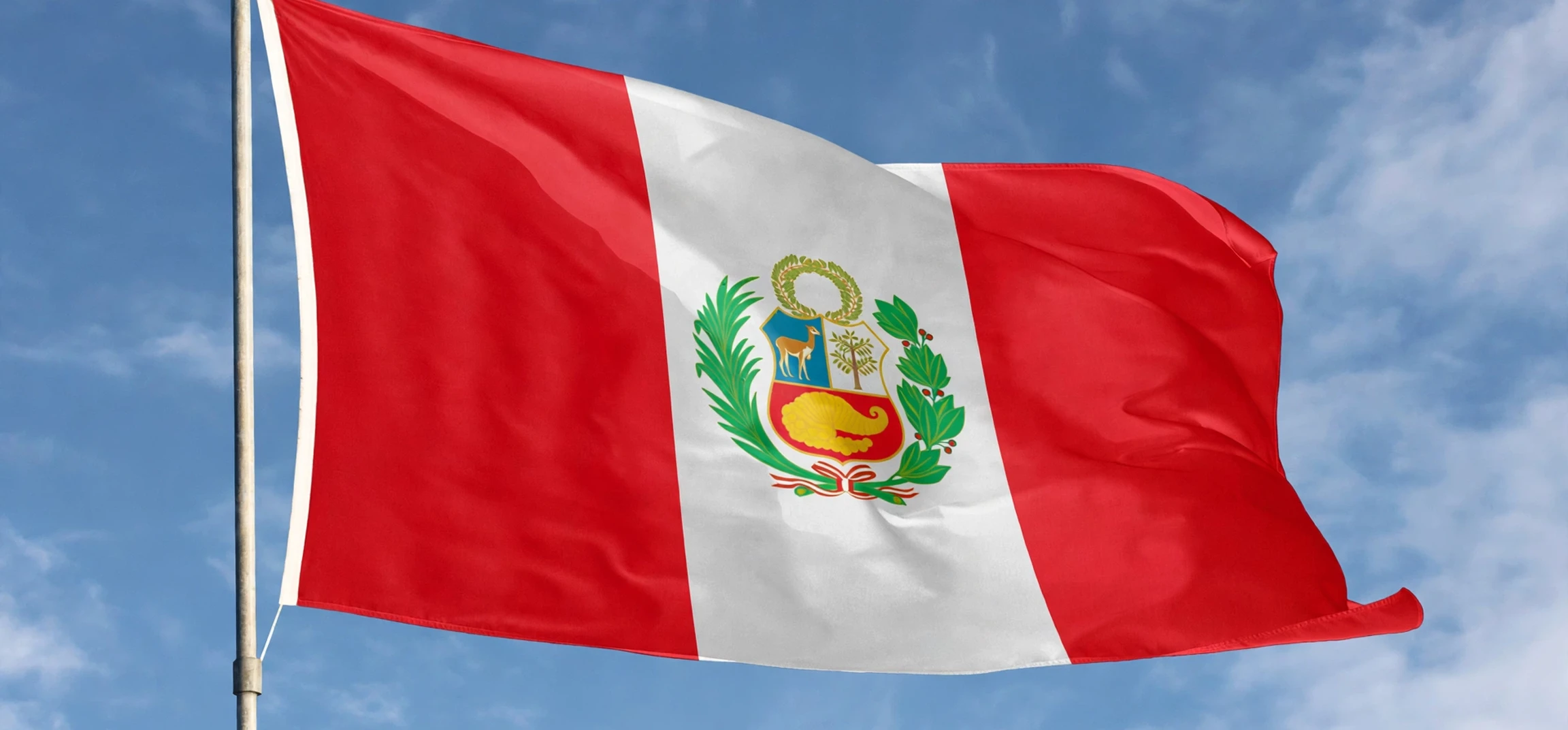
The basic design of the Peruvian flag is a vertical triband: a red band on the hoist side, a white band in the middle, and a red band on the fly side. The proportions are two units high to three units wide, a common ratio for national flags. The civil flag, used by ordinary citizens, shows only those three stripes with no emblem. The state flag, used by government bodies, adds the national coat of arms in the centre of the white band. That distinction is important, because many images online show the version with the coat of arms, while the plain version is equally official for civilian use.
The colours themselves carry traditional interpretations. Red is commonly understood to represent the blood shed by those who fought for independence, as well as courage and sacrifice. White is commonly understood to represent peace, purity, and justice. These interpretations are traditional rather than legally codified in every detail, and historians note that colour symbolism often develops over time. Nevertheless, the red and white pairing has remained constant since independence, and it is instantly recognisable as Peruvian, whether seen at a football match, a national holiday, or an embassy abroad.
Peruvian Flag Symbols in the Coat of Arms
The most detailed peruvian flag symbols appear in the coat of arms at the centre of the state flag. The shield is divided into three sections. The upper left section shows a vicuna, a graceful South American camelid related to llamas and alpacas, standing against a blue background. The vicuna represents Peru’s animal kingdom and its natural fauna, and it also recalls the value of vicuna wool, one of the finest natural fibres in the world. The upper right section shows a cinchona tree, also known as the quina tree, against a white background. The cinchona tree represents Peru’s plant kingdom, and it is historically significant because its bark was a source of quinine, used in the treatment of malaria.
The lower section of the shield shows a cornucopia, or horn of plenty, spilling gold coins against a red background. This represents Peru’s mineral wealth and abundance. Peru has long been known for mining, including gold, silver, copper, and other resources, and the cornucopia symbolises prosperity drawn from the land. Above the shield sits a civic crown, a wreath of oak or laurel, and the shield is flanked by branches and flags in fuller versions of the emblem. Each element was chosen to summarise a different source of national richness: animals, plants, and minerals. Together, they present Peru as a country blessed with diverse natural resources.
The vicuna, the cinchona, and the cornucopia
It is worth pausing on each emblem, because each tells a broader story. The vicuna lives at high altitudes in the Andes and was once hunted almost to extinction for its wool. Today it is protected, and its image on the flag serves as a reminder of conservation as well as national pride. The cinchona tree connects Peru to global medical history, because quinine derived from its bark saved countless lives before modern antimalarial drugs existed. The cornucopia connects Peru to its mining heritage, from pre-Columbian goldwork to modern copper production. None of these symbols is decorative filler. Each was selected to represent a real aspect of Peruvian life and economy.
State flag versus civil flag
Many visitors are confused when they see two versions of the Peruvian flag. The rule is simple: the plain red-white-red flag is the civil flag, suitable for general public use. The version with the coat of arms is the state flag, used by government institutions, the military, and official ceremonies. Both use the same colours and proportions. The presence or absence of the coat of arms does not make one version incorrect. It reflects the context in which the flag is flown. Flag etiquette in Peru, as in many countries, treats the flag with respect, and it is flown prominently on national holidays, especially around Independence Day in late July.
History of the Peruvian Flag
The history of the Peruvian flag begins in 1820, when General Jose de San Martin, leading the independence movement, is said to have designed an early version after being inspired by flocks of flamingos with red wings and white chests along the coast. That story is traditional and widely repeated, although historians debate its details. What is certain is that the first Peruvian flag was adopted in October 1820 and featured different arrangements of red and white, including diagonal divisions in some early designs. Over the following years, the design was simplified to the vertical triband familiar today.
Later changes refined the coat of arms and standardised the colours and proportions. In the nineteenth century, Peru experimented with different emblems and arrangements, reflecting political changes and the search for a stable national identity. By the twentieth century, the vertical red-white-red design with the coat of arms on the state flag had become settled. The flag’s endurance is notable: while governments changed, the core identity of red and white remained, giving Peruvians a continuous symbol across generations. That continuity is part of why the flag commands such respect in public life.
| Symbol | Where it appears | Traditional meaning |
|---|---|---|
| Red bands | Left and right stripes | Sacrifice, courage, and the struggle for independence |
| White band | Centre stripe | Peace, purity, and justice |
| Vicuna | Upper left of shield | Animal kingdom and Andean fauna |
| Cinchona tree | Upper right of shield | Plant kingdom and medicinal heritage |
| Cornucopia | Lower section of shield | Mineral wealth and abundance |
| Civic crown | Above the shield | Republic and civic honour |
The Flag in Peruvian Daily Life and Culture
In Peru, the flag is more than a government symbol. It appears at schools, where children learn its history and participate in flag ceremonies. It appears at sporting events, where supporters wave it with pride. It appears during Fiestas Patrias, the national holidays on 28 and 29 July that commemorate independence, when houses and public buildings are decorated in red and white. It also appears in Peruvian communities abroad, where it serves as a visible link to home for people living far from Peru. In all these contexts, the peruvian flag symbols function as a shared language: even without words, red and white signal Peruvian identity.
The flag also appears in art, textiles, and crafts, where its colours are woven into clothing, souvenirs, and public murals. Peruvian artisans have long used red and white in traditional designs, and the flag’s colours blend naturally with indigenous textile traditions. That cultural presence helps explain why the flag feels personal rather than merely official. For many Peruvians, it is associated with family celebrations, school memories, and national sporting moments, not only with state ceremonies.
For visitors, understanding the flag adds depth to a trip. When you see the state flag at a government building, you can now read its coat of arms and understand what each emblem represents. When you see the civil flag at a home or shop, you can recognise it as the everyday expression of the same identity. That knowledge turns a simple visual encounter into a connection with Peruvian history, geography, and values. It also helps avoid a common mistake: assuming that a flag without a coat of arms is incomplete or unofficial, when in fact it is the standard civil version.
Reading Peruvian Flag Symbols in Everyday Encounters
Once you can read peruvian flag symbols, you will notice them everywhere in Peruvian life, from school ceremonies to football scarves. The peruvian flag symbols work as a quick visual summary: red for sacrifice, white for peace, and a shield that celebrates animals, plants, and minerals. Learning peruvian flag symbols also helps travellers distinguish the civil flag from the state flag, so a plain flag no longer looks unfinished. Teachers often use peruvian flag symbols as a starting point for lessons on independence, geography, and natural resources, because each emblem opens a different topic. A lesson on the vicuna leads to the Andes, a lesson on the cinchona leads to medicine, and a lesson on the cornucopia leads to mining and trade. In that way, peruvian flag symbols are not only a subject for flag enthusiasts; they are a doorway into Peruvian history itself, and recognising peruvian flag symbols enriches every encounter with the flag.
Frequently Asked Questions About the Peruvian Flag
What do the colours of the Peruvian flag mean?
Red traditionally represents sacrifice and courage in the independence struggle, while white traditionally represents peace and justice. These are traditional interpretations that have developed alongside the flag’s history.
Why do some Peruvian flags have a coat of arms and others do not?
The plain version is the civil flag for general public use. The version with the coat of arms is the state flag for government and official use. Both are official in their respective contexts.
What animals and plants appear on the coat of arms?
The coat of arms shows a vicuna, representing fauna, and a cinchona tree, representing flora, above a cornucopia representing mineral wealth.
When was the Peruvian flag first adopted?
An early Peruvian flag was adopted in 1820 during the independence movement, and the design was simplified to the current vertical triband in the years that followed.
Conclusion
The peruvian flag symbols combine simplicity and depth. Three stripes convey sacrifice and peace at a glance, while the coat of arms adds a detailed portrait of a country rich in animals, plants, and minerals. From its independence-era origins to its role in modern celebrations, the flag has remained a constant symbol of Peruvian identity. Whether you encounter the plain civil flag or the state flag with its shield, you are looking at the same story: a nation that honours its past, values its natural heritage, and expresses its pride in red and white. If you enjoy exploring the meanings behind symbols, you may also like guides to the meaning of the number 888 in tattoos and the meaning of the ankh symbol. Each shows how a simple design can carry centuries of history, just as the peruvian flag symbols do.