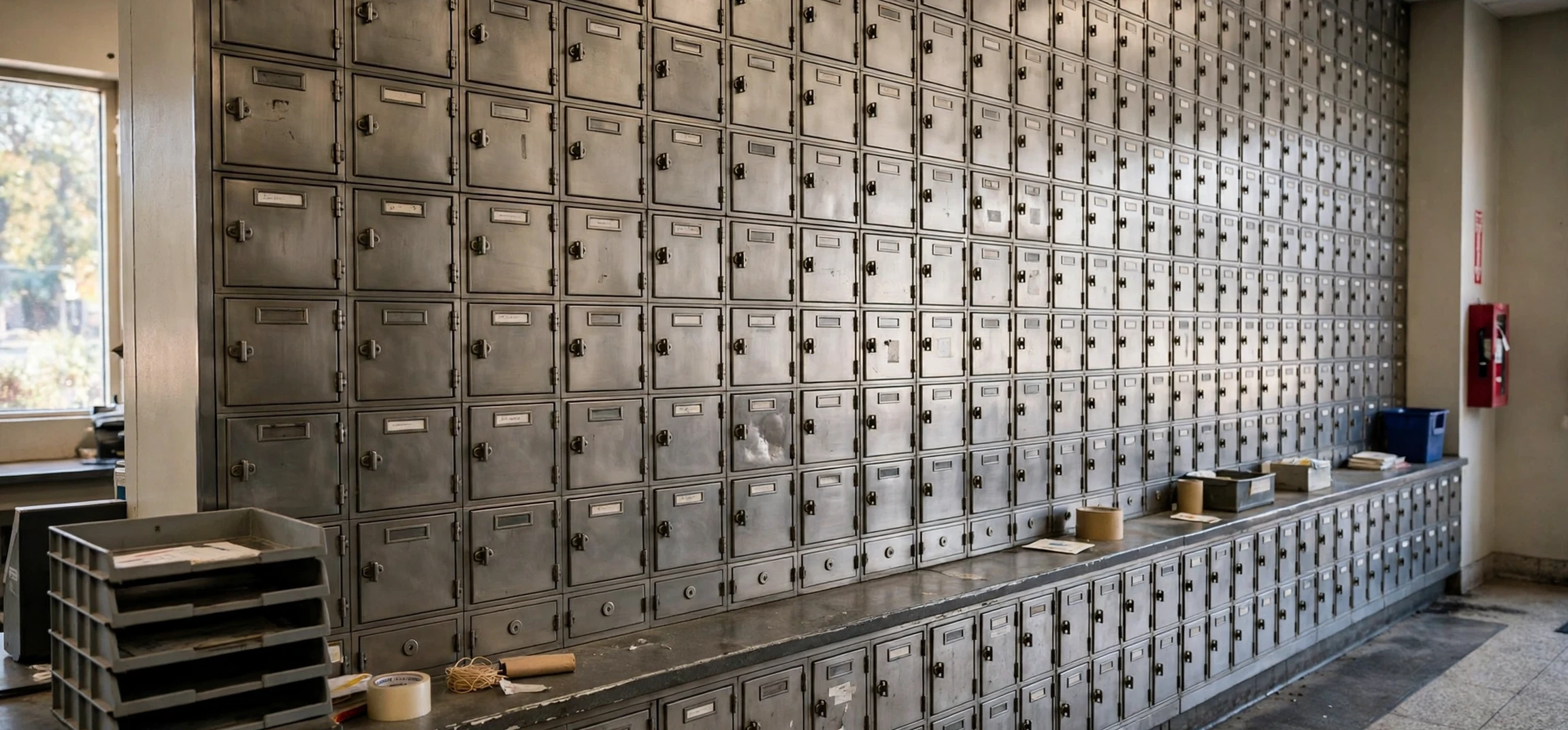
What is a post office box address? In simple terms, it is a mailing address that points to a locked box inside a post office rather than to a building on a street. Mail sent to a post office box address is held securely at the post office until the box holder collects it, which makes it a popular choice for people who move often, run a small business from home, or want to keep their home address private. This guide explains how a post office box address works, how it differs from a street address, when each one is the better choice, and what to know before renting a box.
The idea is older than most people realize. Postal boxes have existed for well over a century as a way to give people a stable mailing point even when their physical location changes. That stability is still the main selling point today: your street address can change when you move house or office, but your box number stays the same as long as you keep the rental active.
What Is a Post Office Box Address?
A post office box address, usually shortened to PO Box address, has a standard shape: the words PO Box followed by a number, then the name of the post office location, usually a city and state or region, plus a postal code. Mail addressed in that format is sorted to the box, not delivered to a door. The box holder opens the box with a key or combination and collects whatever has arrived.
The key feature is separation between mailing and physical location. A street address says where a building stands and where a courier can knock on the door. A PO Box address says where mail is held for collection. That difference explains almost every practical difference between the two, from which carriers can deliver to them to what they can and cannot be used for.
It is worth noting that a PO Box is a rental, not a property. You pay a rental fee for a set period, and the box remains yours only while the rental is current. If the rental lapses, mail to that box may be returned to sender. Rental terms, box sizes, and availability vary by location, so checking with the local post office about current arrangements is always the right first step.
Post Office Box Address vs Street Address: The Key Differences
| Feature | Post office box address | Street address |
|---|---|---|
| What it identifies | A locked box at a post office | A physical building or location |
| How mail arrives | Held for collection by the box holder | Delivered to the door or mailbox |
| Privacy | Keeps a home address off envelopes | Reveals where you live or work |
| Stability when moving | Stays the same if you keep renting | Changes when you move |
| Parcel delivery | Postal service deliveries mainly; some couriers cannot deliver to boxes | All major couriers can usually deliver |
| Proof of residence | Usually not accepted as a residential address | Generally accepted as a residential address |
| Availability | Depends on box availability at that post office | Exists wherever a building is registered |
The delivery difference is the one that surprises people most. Many private courier services deliver only to street addresses, not to PO boxes, because their systems are built around doorstep delivery. Some postal services offer a street-style addressing option for box holders, where parcels can be addressed using the post office’s street address plus a box identifier, but availability and rules for that option vary, so it is worth confirming locally before relying on it for important parcels.
The proof-of-residence difference matters too. Government agencies, banks, and licensing bodies often require a physical residential address, not a mailing address, for identity checks. A PO Box can be an excellent mailing address while a street address remains necessary for those official purposes. Knowing which role each address plays prevents frustrating rejections when a form asks for one and you supply the other.
Who Should Use a Post Office Box Address?
A PO Box suits anyone whose mailing needs are separate from their physical location. Small business owners who work from home often use one to keep a business mailing address distinct from a home address. Frequent movers, including students, renters, and people on temporary assignments, use one to avoid updating their mailing address with every move. People in rural areas, where home delivery may be limited, sometimes use a box as their main mail collection point.
It is also a practical choice for anyone who receives sensitive mail and wants it held securely rather than left in an outdoor mailbox. Because the box is inside a post office, mail is not sitting unattended at a doorstep. For the same reason, a box can be useful for people who travel for long stretches: mail waits safely instead of piling up visibly at home.
There are situations where a box is a poor fit. If you regularly receive large parcels from private couriers, a street address will serve you better. If you need an address for official registration that requires a physical location, a box alone will not satisfy it. And if you rarely collect mail, a box can become a chore, since its whole point is collection by the holder.
What Is a Post Office Box Address: Choosing and Using One
Choosing a box starts with practical questions. Box sizes range from small slots suitable for letters to larger boxes that hold magazines and small parcels, so think about what you actually receive. Location matters too: a box near home or work is far more useful than a cheaper box across town that you will rarely visit. Availability can be limited at busy post offices, and there may be a waiting list, so it helps to ask early rather than assuming a box is free.
Once you have a box, a few habits keep it working well. Collect mail regularly so the box does not fill up, since an overflowing box can lead to mail being held at the counter or returned. Tell regular senders the exact box format, including the correct postal code, because a wrong code can route mail to the wrong office. Keep the rental current and note the renewal date, because a lapsed rental can interrupt delivery. And remember to update your mailing address with senders if you ever give the box up, since mail to a closed box is typically returned.
When writing a PO Box address on an envelope, the usual order is: recipient name, PO Box number, city and region, and postal code. Keeping that order consistent helps sorting systems route the mail correctly. If you are addressing mail to someone else’s box, copy the address exactly as they gave it to you rather than reformatting it, since small changes can cause delays.
What Is a Post Office Box Address: Sizes, Rental Periods, and Renewal
Once you understand what is a post office box address in general, the next practical questions are about size and rental terms. Boxes come in several sizes, from narrow slots that suit letters and small packets to larger boxes that can hold magazines and small parcels. Thinking honestly about what you receive matters here: a box that is too small fills up quickly and creates extra trips to the counter, while a much larger box than you need is simply wasted space.
Rental periods are usually offered in fixed terms, and the box stays yours only while the rental is current. It helps to treat the renewal date like any other household deadline: note it down, set a reminder, and renew before it lapses. If you know you will be away when renewal falls due, ask in advance about renewal options so the box does not close while you are gone. People who answer the question “what is a post office box address” often focus only on the box itself, but the rental arrangement is what keeps the address working month after month.
Finally, remember that a box address is only useful if the people who send you mail know about it. When you open a box, update your address with banks, subscription services, and regular correspondents, and give the box number exactly as registered, including the correct postal code. A box that no one writes to is just an empty drawer, while a box that everyone writes to becomes the stable mailing point it was designed to be.
Post Office Box Address FAQ
What is a post office box address used for?
It is used as a mailing address where mail is held securely at a post office for collection, instead of being delivered to a physical building. It is commonly used for privacy, stability when moving, and secure mail collection.
Can parcels be delivered to a PO Box?
Postal service parcels can generally be delivered to a box if they fit or are held for collection, but many private couriers deliver only to street addresses. Some locations offer a street-style addressing option for box holders, subject to local rules.
Can a PO Box be used as a home address?
Usually not. A PO Box is a mailing address, not a residential address, and most official forms that ask for proof of residence require a physical street address.
What happens if a PO Box rental lapses?
The box may be reassigned, and mail addressed to it may be returned to sender. Keeping the rental current and noting the renewal date avoids that interruption.
Is a PO Box address the same as a private mailbox?
Not exactly. A PO Box is rented from the postal service and located inside a post office. A private mailbox is rented from a commercial mail-receiving business, which has its own rules and addressing format.
Conclusion
So, what is a post office box address? It is a secure, stable mailing point at a post office, separate from any street location, that gives you privacy and continuity when a physical address keeps changing. It is not a substitute for a residential address, and it is not the best choice for courier parcels, but for letters, regular mail, and anyone who moves often or works from home, it is a simple and reliable tool. Choose a convenient location, pick a size that fits what you receive, collect mail regularly, and keep the rental current. For more on getting addresses right, see our guides on how to write an address for mailing and direct mail advertising, which cover addressing format and mail planning in more detail.



