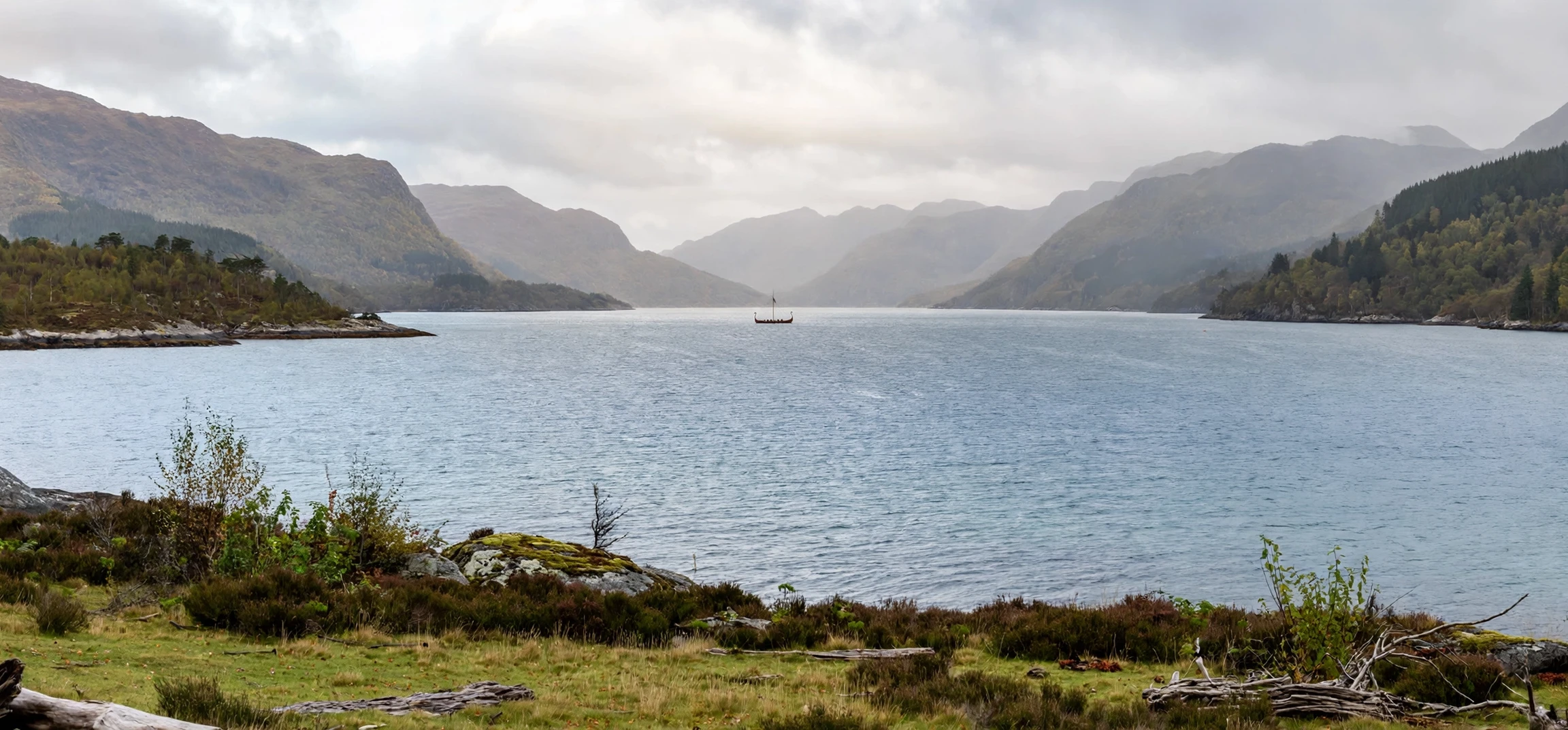
If you are researching norse family names, the first surprise is that the Vikings did not use family names the way we do today. There were no inherited surnames passed unchanged from parent to child for centuries. Instead, Norse naming followed a practical system built from a person’s given name, their father’s or mother’s name, and sometimes a farm, a place, or a nickname earned in life. This guide to norse family names explains how that system worked, what the most common name patterns mean, and how modern families with Scandinavian roots can trace their names back to the Viking Age.
The Viking Age, roughly from the late eighth century to the eleventh century, covered Scandinavia and Norse settlements across the North Atlantic, from Iceland and the Faroe Islands to parts of Britain, Ireland, and Normandy. Across that wide world, naming stayed personal rather than dynastic. A child was identified by who their parents were, not by a fixed family label. That is why a Norse family tree looks different from a modern one: the second name changes every generation, and brothers and sisters can carry different second names if the system uses both parents’ names.
How Norse Family Names Worked
The heart of norse family names is the patronymic, a name formed from the father’s given name. A son of a man named Erik would be called Eriksson in modern spelling, meaning Erik’s son, while a daughter would be called Eriksdottir, meaning Erik’s daughter. The same logic applied to every name: Olaf’s son became Olafsson, Astrid’s daughter became Astridsdottir, and so on. The system was descriptive, not permanent. When that child grew up and had children of their own, their children took a new patronymic based on their parent’s name, and the chain continued.
Matronymics worked the same way but used the mother’s name instead of the father’s. These were less common, but they were fully accepted, especially when a mother was prominent, widowed, or better known than the father in a community. A child might be known as Hallgerdsson or Gunnhildardottir, and nobody considered that unusual. The flexibility of the system is one of its most interesting features. Norse naming described real relationships, and it changed when relationships changed, rather than forcing people into a fixed label.
Nicknames, called bynames, added a second layer. A person might be known by a nickname describing their appearance, character, occupation, or a famous deed. Some of these nicknames stuck so firmly that they functioned almost like family names in later records. Examples from sagas and histories include names referring to hair colour, height, temperament, or skill with a weapon. A nickname could also become attached to a farm or a settlement, which is how some modern Scandinavian surnames began: a place name outlived the person who earned it.
Common Patterns in Norse Family Names
Most norse family names fall into a small number of patterns, and learning those patterns makes old records much easier to read. Patronymics ending in -son and -dottir are the most famous, but farm names, place names, and occupational bynames also appear regularly. In Iceland, the patronymic system survived into the modern era, which is why Icelandic phone books are famously organised by first name: the second name still changes each generation. In Norway, Denmark, and Sweden, patronymics gradually froze into fixed surnames during the nineteenth century, which is why names like Hansen, Johansson, and Eriksen are so common today.
Farm names deserve special attention because they explain many modern Norwegian surnames. A family living on a particular farm might be known by that farm’s name in addition to, or instead of, a patronymic. When people moved, they sometimes kept the farm name as an identifier, and later generations inherited it as a fixed surname. That is why Norwegian surnames include so many nature and landscape words: they began as descriptions of where a family lived, such as a hill, a meadow, a bay, or a clearing in the forest.
| Pattern | Example | Meaning |
|---|---|---|
| Patronymic, son | Haraldsson | Son of Harald |
| Patronymic, daughter | Haraldsdottir | Daughter of Harald |
| Matronymic, son | Sigridsson | Son of Sigrid |
| Farm or place name | Berg, Dahl, Lund | Mountain, valley, grove |
| Occupational byname | Smed, Fisker | Smith, fisherman |
| Descriptive byname | Skalle, Rauðr | Bald, red-haired |
The Son and Dottir Endings
The endings -son and -dottir are the clearest markers of norse family names, and they follow simple grammar. The father’s or mother’s name takes a possessive form, and then -son or -dottir is added. Spelling varied by region and period: Old Norse used -sonr and -dottir, while later Scandinavian languages simplified these to -sen, -son, and -datter. When you see a modern surname like Andersen, it usually began as Anders’ son, frozen at the point when a government or church began recording fixed surnames. That freezing process happened at different times in different countries, which is why the same Norse root can appear in several modern spellings.
Farm Names Explained
Farm names are the second great source of norse family names, especially in Norway. A farm name often combined a nature word with a settlement word, producing names that described the landscape in practical terms. A farm on a hillside, beside a stream, or near a grove would be named for that feature, because neighbours needed a reliable way to say which farm they meant. Over time, families who lived on those farms for generations adopted the farm name as their own, and when Norway standardised surnames, many families kept the farm name they already used every day.
What Norse Family Names Mean
The meanings behind norse family names reveal what Norse society valued. Many given names combined elements referring to gods, animals, weapons, or protection. Names containing Thor, for example, invoked the god of thunder, while names containing Bjorn meant bear, and names containing Ulf meant wolf. When those given names became patronymics, the meanings carried forward. A person called Thorsson was literally Thor’s son in naming terms, but the name also connected the family to a wider cultural world of gods, heroes, and nature.
Nature words dominate the farm-name group. Berg means mountain or hill, dal means valley, vik means bay or inlet, and lund means grove. These words are practical rather than poetic: they told a traveller what to expect from the landscape. When they became surnames, they carried that practicality with them. A modern person named Berg or Dahl carries a name that once told neighbours exactly where their ancestors lived, which is a very different origin from surnames that began as occupations or titles in other parts of Europe.
Occupational and descriptive bynames add colour to the picture. A smith, a fisherman, a sailor, or a trader might be known by their work, especially in towns where several people shared the same given name. Descriptive nicknames recorded hair colour, height, build, speech, or temperament. Some of these nicknames were flattering, some were teasing, and some were brutally honest, but they all served the same purpose: telling one Erik apart from another Erik in a small community. That practical need, not vanity, drove most of Norse naming.
Readers who enjoy name guides will find related reading in the seven dwarfs names guide and the common English last names overview, which show how different cultures solved the same problem of telling people apart. For another naming tradition built from descriptive words, see the Amish names guide.
Norse Family Names Today
Today, norse family names survive in three main ways. In Iceland, the patronymic system is still alive: most Icelanders carry a patronymic or matronymic rather than a fixed family surname, and children still receive a new second name each generation. In Norway, Denmark, and Sweden, the old patronymics froze into surnames like Hansen, Larsen, Johansson, and Eriksson, which are now among the most common names in those countries. In diaspora communities, especially in North America, Norse-derived surnames were sometimes respelled by immigration officials or simplified by families, producing variants that researchers need to untangle.
The modern popularity of Norse culture has also revived interest in these names. Parents choosing names for children, writers creating historical fiction, and families researching genealogy all turn to norse family names for inspiration. The appeal is understandable: the names sound strong, their meanings are clear, and their history is well documented in sagas, runestones, and church records. At the same time, researchers warn against treating every Norse-sounding name as ancient. Some names that look Viking in origin were actually created in the nineteenth century during waves of national romanticism, when Scandinavian families adopted old-sounding names deliberately.
Tracing Your Own Norse Name
If you are tracing a family name with Norse roots, start with the pattern, not the spelling. Ask whether your name ends in -son, -sen, -dottir, or -datter, which points to a patronymic, or whether it matches a landscape word, which points to a farm name. Then check the country of origin, because Norway, Denmark, Sweden, and Iceland standardised names at different times and in different ways. Church records, census lists, and emigration documents are the most reliable sources, and they often show the moment a patronymic froze into a fixed surname. That freezing moment is the key to understanding your name’s history.
Common Mistakes When Researching Norse Names
The most common mistake is assuming a Norse name worked like a modern surname. If a saga mentions a man called Olaf Haraldsson, his children would not automatically be Haraldssons; they would be Olafssons and Olafsdottirs. Another mistake is treating every -son name as Viking in origin. The -son pattern exists in English and other languages too, so a name needs Scandinavian evidence, not just a familiar ending, before it can be called Norse. A third mistake is trusting a single online list. Norse names varied by region, period, and spelling, so cross-checking against scholarly sources and primary records is always worth the effort.
One final point for researchers: norse family names reward patience. A single record rarely tells the whole story of norse family names in one family, because spellings shifted, patronymics changed each generation, and farm names came and went with moves. The families who get the most from studying norse family names are the ones who follow the pattern across several records, watching how norse family names evolve from a patronymic in one document to a fixed surname in a later one. That slow detective work is the most reliable way to connect a modern surname to its Norse roots.
Frequently Asked Questions About Norse Family Names
Did Vikings have surnames?
Not in the modern sense. Vikings used patronymics and matronymics that changed each generation, plus nicknames and farm names. Fixed inherited surnames developed much later, as Scandinavian countries standardised naming in the nineteenth century.
What does dottir mean in norse family names?
Dottir means daughter. A girl named Astrid whose father was called Erik would be known as Eriksdottir, meaning Erik’s daughter. The male equivalent is -son, meaning son.
Why does Iceland still use patronymics?
Iceland kept the traditional system while other Scandinavian countries moved to fixed surnames. Most Icelanders still receive a patronymic or matronymic, which is why Icelandic directories are organised by first name rather than last name.
Are all Scandinavian surnames Norse?
No. Many Scandinavian surnames come from the Norse system, but others were adopted later from farm names, occupations, or nineteenth-century name reforms. A name needs historical evidence before it can be described as Norse rather than simply Scandinavian.
Conclusion
The story of norse family names is the story of a practical people solving a practical problem: how to tell one person from another in a world without fixed surnames. Patronymics named parents, farm names named places, and nicknames named character, and together they created a system flexible enough to last for centuries. Whether you are tracing your own ancestry, choosing a name, or simply curious about Viking culture, understanding that system turns a list of unfamiliar names into a window on how Norse families actually lived, worked, and remembered each other.