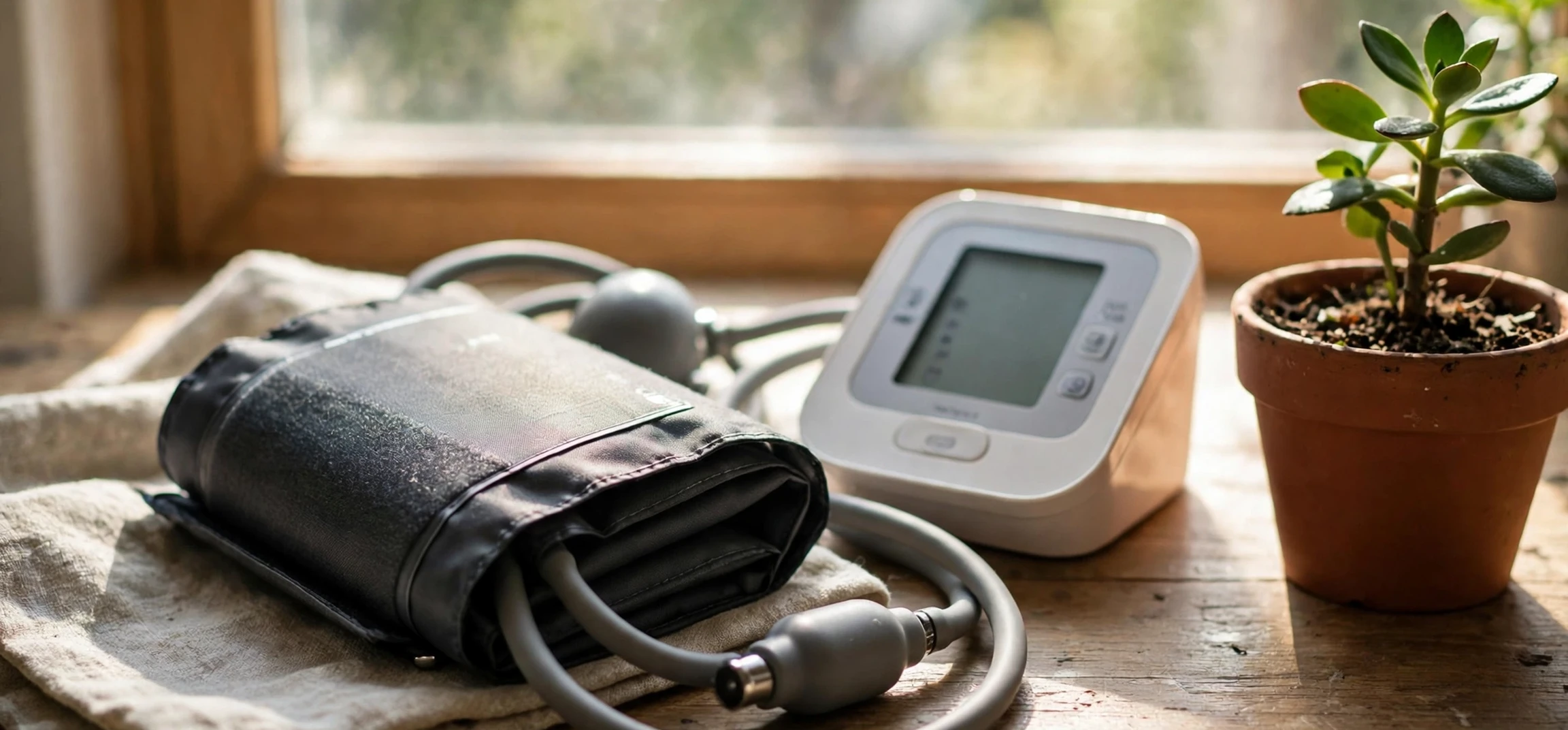
Home blood pressure monitors have become a common household item, and many people who use one still ask what do bp numbers mean when the screen shows a pair of numbers after a reading. This guide focuses on that everyday home situation: what the numbers represent, how to take a reading in consistent conditions, how to keep a simple record, and when to talk to a clinician. It is general health education only. It does not diagnose any condition, it does not recommend any treatment or device, and it does not interpret any personal reading. If you have a personal concern, a clinician who knows your history is the right person to advise you.
A home reading works the same way as a clinic reading in its basic structure. A cuff around the upper arm inflates, senses the pulses as it deflates, and displays two numbers. The first number is the systolic number, the pressure during the heartbeat. The second number is the diastolic number, the pressure between heartbeats. Both use the unit millimetres of mercury, shortened to mmHg. The monitor may also show your pulse, which is a separate measurement: the number of beats per minute. Knowing which display is which is the first step to making sense of a home check.
What do bp numbers mean for everyday home checks?
At home, the two numbers mean exactly what they mean in a clinic: a snapshot of pressure across one heartbeat cycle at one moment in time. What changes at home is the context. You are in control of the conditions, the timing, and the record, and those choices affect how useful the numbers are over time. A home check is most useful as a pattern-building habit, not as a single verdict on a single day. One reading tells you about one moment. A series of readings taken in similar conditions tells you about a pattern, and patterns are what clinicians find most informative in general terms.
That distinction matters because home readings can easily mislead if they are treated as pass-or-fail tests. A reading taken after rushing upstairs, after a large meal, or during a tense phone call reflects those moments as well as the body. A reading taken after sitting quietly reflects a resting moment. Both are genuine measurements, but they are not directly comparable. The value of home checks comes from consistency: similar conditions, similar timing, and a simple written record that a clinician can review alongside your history.
Setting up a home reading in consistent conditions
Consistent conditions start with posture. Sit in a chair with back support, place both feet flat on the floor, and rest the arm on a table so that the cuff sits at about the level of the heart. Avoid talking during the measurement, and sit quietly for a few minutes beforehand if you can. Keep the legs uncrossed and the body relaxed. These steps are not rituals for their own sake. Each one removes a source of variation, so that readings taken on different days are more comparable with each other.
Cuff fit deserves attention too. Home monitors usually come with a cuff sized for an average adult arm, but arms vary, and a cuff that is too small or too large can shift the numbers. Check the monitor manual for the arm size range, and measure around the upper arm if you are unsure. Place the cuff on bare skin rather than over thick clothing, and position it as the manual directs, usually with the lower edge just above the elbow. If you are unsure about fit or position, ask a clinician or pharmacist to check your technique once. A single check can remove a lasting source of doubt.
Timing your checks through the day
Timing is another source of variation worth standardising. Many people find it practical to take readings at the same times each day, for example once in the morning and once in the evening, and to note the time alongside each pair. Morning readings and evening readings are not expected to match, because pressure varies naturally across the day. What matters is that morning readings can be compared with other morning readings, and evening readings with other evening readings. A simple routine, repeated the same way, builds the clearest record.
What to avoid just before a reading
General guides commonly suggest avoiding vigorous activity, and giving yourself a short quiet rest, immediately before a reading. The point is not to engineer a particular result, but to measure a resting state that can be compared across days. If you have just exercised, climbed stairs, or had a stressful conversation, wait until you have settled before taking a reading, and note the circumstances if you take one anyway. An honest note about conditions is more useful than a number without context.
What do bp numbers mean when you track them in a logbook?
A logbook turns isolated numbers into a pattern, and the pattern is the point. A useful home log is simple: date, time, the pair of numbers exactly as displayed, pulse if shown, and a short note about conditions, such as after rest, after activity, or feeling unwell. There is no need for elaborate charts or colour coding. A plain notebook, a notes app, or a printed sheet all work, as long as the entries are consistent and honest. Bring the log to appointments, because a clinician can read a pattern far more usefully than a remembered summary of one or two readings.
When reviewing a log yourself, look for broad tendencies rather than single entries. Are most readings in a similar area, or do they swing widely? Do morning and evening entries differ in a consistent way? Are there notes that explain the outliers, such as illness, poor sleep, or a rushed measurement? These are general questions that help you describe the log clearly, not conclusions to draw on your own. The log is a communication tool: it gives a clinician better material to work with, and it gives you a clearer record of what was actually measured, rather than what you remember feeling.
It is also worth recording the device itself. Note the brand and model in general terms, or keep the manual with the log, so that a clinician can check whether the device type is appropriate and whether the cuff size fits. Home monitors vary in design, and some are validated for general use while others are not. A clinician or pharmacist can advise on whether a particular device is suitable, which is a better route than relying on advertising claims.
Reading the display without overreacting to one number
Home monitors sometimes add symbols, colour indicators, or messages alongside the numbers. These extras vary by device and are not standardised in the same way as the two numbers themselves. A coloured light or a warning symbol is a prompt to notice the reading, not a diagnosis. If a symbol confuses you, check the manual for what that device means by it, and ask a clinician if the meaning is still unclear. The two numbers remain the core measurement, and the extras are secondary.
One reading that surprises you is best handled calmly. Sit quietly for a few minutes, check that the cuff is positioned correctly and that you are sitting in the usual posture, and repeat the measurement. If the repeat reading is very different, note both readings and the conditions. If you feel unwell in any way, seek appropriate care promptly rather than relying on repeated home measurements. A monitor is a measuring tool, not an emergency service, and feeling unwell is a reason to contact a clinician or emergency services as appropriate, regardless of what any number shows.
| Home-check habit | Why it helps | Common pitfall |
|---|---|---|
| Same posture every time | Makes readings comparable across days | Measuring while standing or talking |
| Same times of day | Separates morning and evening patterns | Comparing a rushed reading with a rested one |
| Simple written log | Turns single numbers into a reviewable pattern | Remembering only the readings that worried you |
| Correct cuff fit | Removes a hidden source of variation | Measuring over thick clothing |
Home checks sit alongside other everyday health records. For a similar plain-language approach to lab results, see the guide to blood test labels and what they mean, and for another commonly misunderstood result, the guide to cholesterol terms in everyday language. Both share this guide’s rule: general education here, personal interpretation with a clinician.
When to talk to a clinician about home readings
Talk to a clinician if you are unsure how to use your monitor, if your technique has never been checked, or if your log shows a pattern that worries you. Also talk to a clinician if readings vary so widely that the log is hard to interpret, or if you feel unwell. These are ordinary reasons to seek advice, and clinicians expect questions about home monitors. Bring the device manual or the device itself if possible, along with the log, so the conversation can be practical rather than abstract.
There is no need to wait for a dramatic reading before asking a question. A question about technique, timing, or cuff fit is worth asking at any appointment, and it can improve every future reading. Equally, do not use home readings to adjust any medicine or routine on your own. Changes to medicines or treatment plans belong to a clinician who knows your history. Home checks inform conversations; they do not replace them.
Frequently asked questions
How often should I check at home?
There is no single frequency that suits everyone. Ask a clinician what schedule makes sense for your situation, and follow a consistent routine once you have one, rather than checking constantly or sporadically.
Should I always use the same arm?
Consistency helps comparison, so using the same arm each time is a sensible default. If a clinician advises otherwise, follow that advice and note the arm used in your log.
Why do two readings minutes apart differ?
Because pressure changes moment to moment, and small changes in posture, talking, or cuff position also shift the numbers. A short rest and a repeat measurement, with both results noted, is the practical response.
Are home monitors accurate?
A well-fitting, properly used home monitor can give useful readings for pattern tracking, but accuracy depends on device, cuff size, and technique. Having your technique checked is the simplest way to build confidence in your readings.
Conclusion
For everyday home checks, blood pressure numbers mean a snapshot of a heartbeat cycle: the systolic push and the diastolic pause, read as a pair in millimetres of mercury. Their real value at home comes from habit, not from any single display. Sit in the same posture, use a correctly fitting cuff, take readings at similar times, keep a simple honest log, and repeat a surprising reading after a quiet rest. Treat symbols and colours as prompts, not verdicts, and take any worry, any confusing pattern, or any feeling of being unwell to a clinician promptly. Used that way, a home monitor becomes a calm, practical tool: it builds a record, supports clearer conversations, and keeps general education and personal advice in their proper places.



