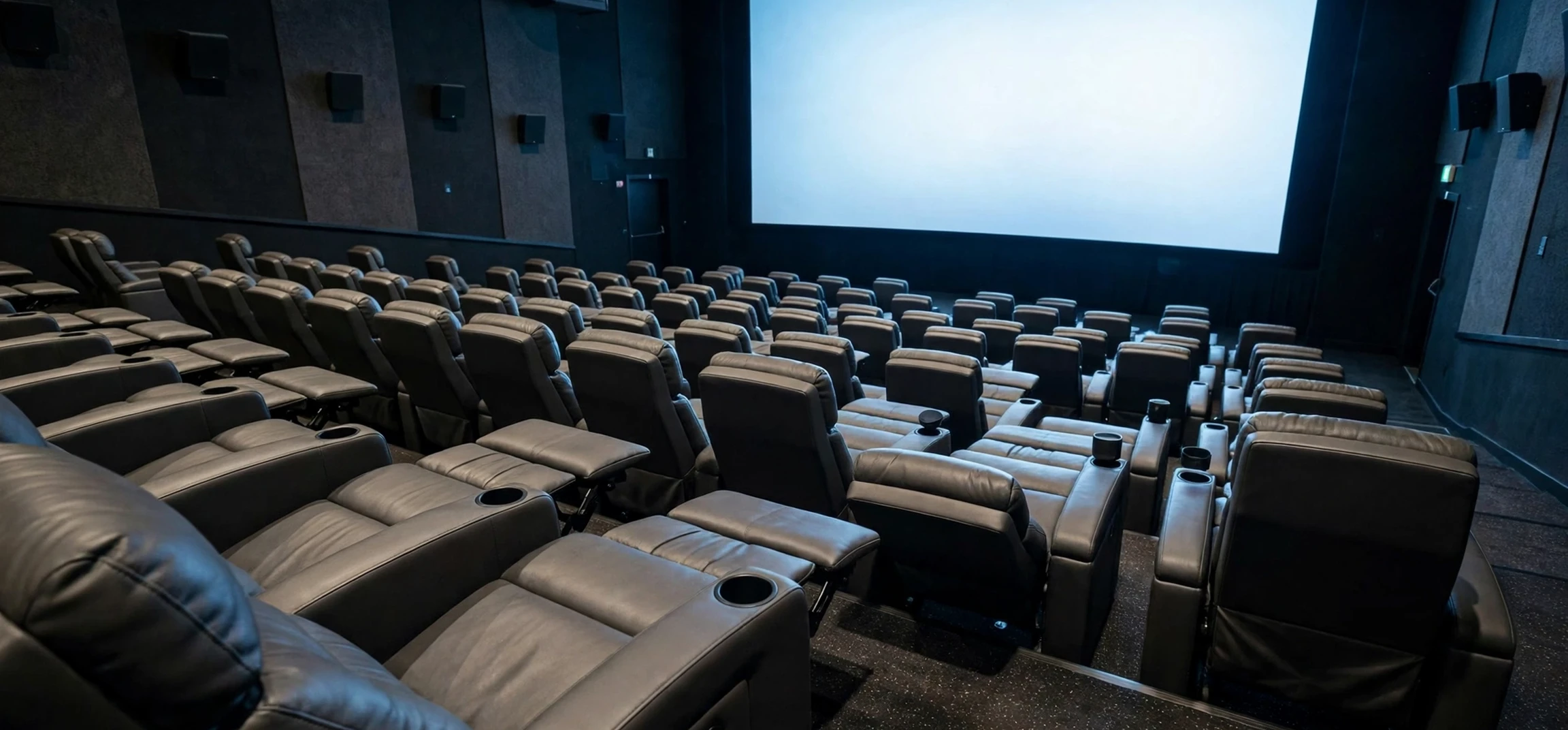
If you have seen D-BOX on a cinema booking page and searched for d’box hoyts meaning, you have found a search term that mixes a brand name, a cinema chain, and a question about movie formats. To be clear and honest about that search term itself: d’box hoyts meaning appears to be a search artifact, a phrase typed by moviegoers trying to work out what D-BOX means when it appears on a Hoyts cinema listing. This guide answers the real question behind it, in general terms that apply to cinemas everywhere: what D-BOX motion seating is, how it differs from a standard seat, and how it relates to other choices on a booking page such as subbed and dubbed versions.
D-BOX is not a language option, a subtitle setting, or a picture format like 2D or 3D. It is a motion seating system. In a D-BOX auditorium, certain seats are mounted on motion platforms that move, tilt, vibrate, and shift in sync with the film. When a car chases through a city on screen, the seat may lean and rumble. When an explosion shakes a scene, the seat may jolt. When a character flies, the seat may rise and fall gently. The aim is to add a physical layer to the film without changing the story, dialogue, or language.
D’Box Hoyts Meaning Explained: What D-BOX Actually Is
The phrase d’box hoyts meaning is best unpacked word by word. D-BOX, usually written D-BOX or DBOX, is a Canadian company that makes motion systems for cinemas, home theatre, and simulation. Hoyts is an Australian and New Zealand cinema chain that has offered D-BOX auditoriums in some locations. Put together, d’box hoyts meaning is therefore most naturally read as a search for what the D-BOX label means on a Hoyts booking page. It does not refer to a separate Hoyts-only format with a different definition. The D-BOX experience is the same core idea wherever it is installed: motion-enabled seats programmed to match the film.
That programming is important. D-BOX motion is not random shaking. Each supported film receives a motion track, created by motion designers who watch the film and code movements to match on-screen action, music, and pacing. A quiet dialogue scene should feel still. A storm scene may feel turbulent. A racing scene may lean into corners. The intensity is designed to enhance immersion, not to distract from the plot, although individual viewers differ in how much motion they enjoy. Many cinemas allow viewers to adjust motion intensity at their seat, or to turn motion off while keeping the seat itself, which is useful for viewers who prefer a calmer experience.
It is also worth noting that not every film, and not every screening, offers D-BOX. Motion tracks are made for selected titles, usually action, animation, adventure, and other visually dynamic films where movement adds something. A drama or a quiet comedy may not have a D-BOX version at all, even at a cinema that has D-BOX seats. The booking page is the reliable guide: if D-BOX is listed for a specific session, that session has motion seats. If it is not listed, that session is a standard screening, whatever the cinema’s general facilities may be.
How D-BOX Motion Seats Work
A D-BOX seat looks, at first glance, like a comfortable cinema recliner or premium seat. Underneath, however, it sits on actuators, small motorised platforms that can move the seat in several directions. Typical systems provide pitch, meaning forward and backward tilt, roll, meaning side-to-side tilt, and heave, meaning up-and-down movement, plus vibration for effects such as engine rumble or impacts. The combination creates a surprisingly wide range of sensations from a relatively small range of physical movement.
The motion track is synchronised to the film’s soundtrack and timing, so movements arrive at the same moment as the corresponding on-screen event. This synchronisation is what separates D-BOX from a theme-park ride that shakes on a fixed cycle. In a well-designed track, motion follows the camera, the action, and the emotional rhythm of a scene. A slow, sweeping landscape shot may produce a gentle sway. A sudden crash produces a sharp jolt. The system is designed to be felt, not to throw viewers around, and safety limits keep movements within a controlled range.
Seat controls vary by installation, but many D-BOX seats include a small controller that lets the viewer choose an intensity level. Common options include a standard setting, a stronger setting, and an off setting. Families often find this helpful, because adults and children in the same row can choose different intensities, or one person can switch motion off for a calmer scene and back on later. If you are unsure, start on the lowest setting for your first D-BOX film and adjust from there. Motion sickness is uncommon but possible, especially for viewers sensitive to movement, so a low setting is a sensible first test.
D-BOX Versus Standard, 3D, and 4DX Screenings
Cinema booking pages can be confusing because several format labels appear side by side. Understanding the differences helps you choose the session you actually want, rather than paying extra for a feature you did not intend to buy.
| Format | What changes | What stays the same |
|---|---|---|
| Standard 2D | Nothing extra: a normal seat and screen | Story, dialogue, language, and runtime |
| 3D | Depth effect through special glasses | Motion seating is not included unless also labelled D-BOX |
| D-BOX | Motion, tilt, and vibration in the seat | Picture format may still be 2D or 3D, as labelled |
| 4DX and similar | Motion seats plus environmental effects such as wind, water, scent, and strobe lighting | Film story itself, though effects are added around it |
| Premium large format | Larger screen, enhanced sound, sometimes recliners | Motion is not automatic unless D-BOX is also listed |
The key point is that D-BOX and 4DX are related but not identical. Both use motion seats, but 4DX typically adds environmental effects beyond the seat, while D-BOX focuses on motion itself. A D-BOX session may also be a 3D session, in which case you will need 3D glasses as well as a motion seat, and the booking page should list both labels. Always read the full session description, including screen type, language, and seating, before confirming, especially when booking for children or for viewers with motion sensitivity, back problems, or other health considerations.
Price is another practical difference. D-BOX sessions usually cost more than standard sessions at the same cinema, because motion seats are more expensive to install and maintain, and because the motion track is an extra production step. Whether that premium is worth it depends on the film and on personal taste. Fast, visual films tend to benefit most. Dialogue-heavy films gain less, and some viewers prefer to spend the difference on a premium large screen or a better seat location instead. There is no right answer, only a personal preference, and trying D-BOX once on a suitable film is the best way to judge.
D’Box Hoyts Meaning and Subbed Versus Dubbed
The slug for this guide mentions subbed and dubbed, because cinema listings often combine format, seating, and language choices on one page, and it is easy to mix them up. The phrase d’box hoyts meaning does not itself tell you anything about subtitles or dubbing. Subbed and dubbed are language options, completely separate from motion seating, and they can apply to a D-BOX session, a standard session, or any other format.
Subbed, short for subtitled, means the film is shown in its original spoken language, with subtitles in the local language displayed on screen. A Japanese film shown subbed in Australia, for example, would be heard in Japanese and read in English subtitles. Dubbed means the dialogue has been re-recorded in another language, so the audience hears the film in that language, usually without subtitles for the main dialogue. Some dubbed versions also include subtitles for songs or signs, but the core idea is that the voices you hear are not the original actors’ voices.
Why does this matter for D-BOX? Because a single film can have multiple sessions on the same day: a D-BOX subbed session, a D-BOX dubbed session, a standard subbed session, and a standard dubbed session, each with different audiences in mind. Families with young children often prefer dubbed versions, because children can follow the story without reading quickly. Adult fans of foreign-language cinema often prefer subbed versions, because they want the original performances. Neither choice is better in absolute terms. The booking page should state the language clearly, and if it does not, check with the cinema before buying, especially for animated films where both versions are common.
A practical booking checklist therefore has four questions, not one: What format is the picture, such as 2D or 3D? Is motion seating included, such as D-BOX? What language will I hear, original with subtitles or dubbed? And where is my seat, including accessibility and row position? Answering all four avoids the classic cinema disappointment of arriving for a dubbed family film and finding a subtitled adult session, or paying for motion seats when you wanted a quiet standard screening.
Who Enjoys D-BOX and Who Should Skip It
D-BOX tends to suit viewers who enjoy immersive, physical cinema experiences and who like action, animation, adventure, and science fiction. Fans of racing films, superhero films, and animated adventures often report that motion adds excitement to chase scenes, flights, and battles. Viewers who like to feel part of the action, rather than watching it from a distance, are the core audience.
Other viewers may prefer to skip it. People prone to motion sickness, people with certain back, neck, or joint conditions, pregnant viewers, and very young children should consider a standard seat, or at least try the lowest intensity setting and be ready to switch motion off. Most cinemas publish age, height, or health guidance for motion seats, and that guidance should be followed. Motion seats are designed for entertainment, not for medical benefit, and no film experience is worth discomfort or risk. If in doubt, ask cinema staff, who can explain local seat controls and any restrictions for that auditorium.
Accessibility is also worth mentioning. Motion seats may not be suitable for all wheelchair users or viewers with specific access needs, and cinemas usually offer accessible seating in the same auditorium or in a standard auditorium for the same film. Checking access information at booking time, rather than on arrival, saves stress and ensures everyone in a group can enjoy the same session, or can make an informed choice about different sessions.
D-BOX Beyond the Cinema
Although this guide focuses on cinema listings, D-BOX technology also exists beyond the multiplex. Home theatre versions allow compatible films and games to drive motion seats or platforms in a living room, and simulation versions are used for racing, flight, and training applications. The underlying idea is the same: synchronised motion makes a screen experience feel more physical. Cinema remains the most common way most people first encounter D-BOX, because the seats, tracks, and auditorium setup are provided for a single ticket price, without buying hardware.
For cinema operators, D-BOX is one of several premium formats competing for attention alongside large screens, enhanced sound, recliners, and food service. Each premium format tries to give audiences a reason to leave home, in an era when large televisions and streaming services make home viewing very comfortable. Motion is a distinctive selling point because it cannot be replicated by a standard television, even a very good one. Whether that distinction justifies a premium ticket is, again, a personal judgement, and it varies by film, by cinema, and by viewer.
Readers interested in how cinema formats are described on booking pages may also find this movies and shows guide on this site useful as background on how film listings are organised, even though format labels themselves change from cinema to cinema and from country to country.
D’Box Hoyts Meaning: Search Summary
If you arrived here by searching for d’box hoyts meaning, the clear answer is that D-BOX means motion seating, and Hoyts is the cinema chain on whose listing you saw it. The phrase d’box hoyts meaning is a search artifact, not a separate format, and the phrase d’box hoyts meaning is best answered by separating motion seating from language choices. A session labelled D-BOX may still be subbed or dubbed, and a subbed or dubbed session may or may not include D-BOX, so readers searching for d’box hoyts meaning should check the full booking description. Once you understand d’box hoyts meaning in that way, booking becomes simple: choose picture format, motion seating, language, and seat location, in that order. In short, d’box hoyts meaning is motion seating on a Hoyts listing, and d’box hoyts meaning should never be confused with subtitles or dubbing. If a friend asks about d’box hoyts meaning, tell them it is D-BOX seats that move with the film, and that d’box hoyts meaning is the same idea at any cinema that offers D-BOX.
Frequently Asked Questions
What is the d’box hoyts meaning?
The search term d’box hoyts meaning is best understood as a question about what the D-BOX label means on a Hoyts cinema listing. D-BOX is a motion seating system: seats that move, tilt, and vibrate in sync with the film. It is not a language or subtitle setting.
Is D-BOX the same as 3D?
No. D-BOX is motion seating, while 3D is a picture depth effect requiring glasses. A session can be D-BOX only, 3D only, or both, and the booking page should list each label separately.
What is the difference between subbed and dubbed?
Subbed means the original spoken language with subtitles. Dubbed means the dialogue has been re-recorded in another language. Both options are independent of D-BOX motion seating.
Can I turn D-BOX motion off?
In many installations, yes. Seats often include an intensity controller with a low setting and an off option, so you can enjoy the seat without motion if you prefer.
Conclusion
The honest answer to d’box hoyts meaning is simpler than the search phrase suggests. D-BOX means motion seating: a cinema seat that moves in time with the film, adding tilt, vibration, and physical sensation to action, flight, and impact scenes. Hoyts is simply one cinema chain where that label appears, and the same core definition applies wherever D-BOX is installed. It is separate from 3D picture format, separate from premium large screens, and separate from subbed and dubbed language choices, even though booking pages list all of these together. Next time you see D-BOX on a listing, check four things: picture format, motion seating, language, and seat location. That checklist turns a confusing booking page into a clear choice, and lets you decide whether motion will make your film better, or whether a standard seat is the right call for that night. For more on cinema viewing choices, see this home cinema seating guide on this site for the other end of the spectrum: enjoying films comfortably at home.