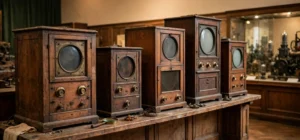
The question of when color tv started has fascinated television historians for decades, because colour television did not arrive in a single moment but emerged through a long chain of experiments, demonstrations, and rival systems. The story of when color tv started begins in the late nineteenth century with mechanical scanning ideas, passes through the first colour demonstrations of the 1920s, and reaches regular experimental broadcasts in the 1940s and 1950s. Understanding when color tv started means tracing that whole arc, from laboratory curiosity to a technology ready for the living room.
It also helps to separate two questions that people often blend together. One asks when colour television was invented, meaning the first working demonstrations of moving pictures in colour. The other asks when colour sets reached ordinary homes, which happened years later and belongs to the commercial story. This article answers the first question: the invention timeline. A companion story covers the first sets sold to the public, but here the focus stays firmly on inventors, experiments, and the technical breakthroughs that made colour possible at all.
Color TV Started With Mechanical Scanning Ideas
The earliest roots of when color tv started lie in the mechanical television systems of the late 1800s and early 1900s. Inventors already understood that a picture could be broken into tiny elements, transmitted one after another, and reassembled at the receiver. Colour added a second problem: each element also had to carry colour information, not just brightness. Early proposals solved this by scanning the scene three times through red, green, and blue filters, or by spinning a colour filter wheel in step with the scanning disc.
These mechanical ideas were ingenious but fragile. Spinning discs and filter wheels had to stay perfectly synchronised between transmitter and receiver, and the pictures were small, flickery, and dim. Yet they proved the core principle: colour could be separated, sent, and recombined. Without that proof, the later electronic systems would have had no roadmap, and the question of when color tv started would have no nineteenth-century chapter at all.
Color TV Started in Public Demonstrations of the 1920s
The first widely reported colour television demonstrations arrived in the late 1920s. Scottish inventor John Logie Baird, already famous for mechanical television, demonstrated colour pictures in 1928 using a spinning filter system. The images were crude by modern standards, but audiences could recognise coloured objects on screen, and that was the breakthrough that mattered. For the first time, colour television was not a theory on paper but something people could watch with their own eyes.
Around the same period, other inventors in the United States and Europe pursued their own colour systems, often building on the same filter-wheel principle. These demonstrations attracted newspaper coverage and investor interest, but none produced a practical home receiver. The equipment was bulky, the pictures were tiny, and the mechanical approach was already approaching its limits. Still, the 1928 demonstrations mark the moment when color tv started to feel real to the public, and historians often cite them as the first answer to when colour television began.
Why Mechanical Colour Television Stalled
Mechanical colour television stalled because electronics overtook it. The cathode-ray tube offered larger, brighter, flicker-free pictures, and engineers soon realised that a mechanical filter wheel could not compete. Colour research therefore paused, in a sense, while black-and-white electronic television matured through the 1930s. The colour problem was not abandoned; it was waiting for electronic tools good enough to solve it properly.
Color TV Started Again With Electronic Systems in the 1940s
The second great phase of when color tv started belongs to the 1940s, when American engineers developed fully electronic colour systems. The most famous early contender was the field-sequential system promoted by CBS, which still used a spinning colour wheel, now synchronised with an electronic tube. In 1940 and 1941, CBS demonstrated this system to the Federal Communications Commission, producing vivid colour pictures that impressed regulators and journalists alike.
A rival approach, the dot-sequential and later shadow-mask system developed at RCA, took a different path: it encoded colour into a single signal that a specially built tube could decode into red, green, and blue dots. This approach was far more complex to build, but it had a decisive advantage. It was compatible with existing black-and-white sets, which would show the colour broadcast in black and white rather than as meaningless noise. That compatibility argument would eventually decide the standards war, but in the 1940s both systems were still laboratory and demonstration technologies.
The Standards Battle That Decided How Color TV Started for Viewers
In 1950, the Federal Communications Commission approved the CBS field-sequential system as the American colour standard, a decision that briefly made it look as though color tv started officially in that year. The victory was short-lived. Few compatible sets existed, manufacturers hesitated, and the Korean War restricted production of consumer electronics. Within a few years the decision was reversed, and in 1953 the Commission approved the RCA-compatible NTSC colour system instead.
The NTSC decision of December 1953 is often given as the formal answer to when color tv started in the United States, because it set the standard under which regular colour broadcasting could finally grow. The first coast-to-coast colour broadcast followed quickly, and networks began producing selected programmes in colour. The technology had crossed from invention into infrastructure: standards, studios, cameras, and transmission chains all had to work together, and from 1954 onwards they increasingly did.
Color TV Started: The Invention Timeline at a Glance
| Period | Milestone | Why it mattered |
|---|---|---|
| Late 1800s | Mechanical scanning proposals with colour filters | Proved colour could be separated and recombined |
| 1928 | Baird’s public colour television demonstration | First widely seen moving colour pictures |
| 1930s | Electronic black-and-white television matures | Gave colour research a better platform |
| 1940–1941 | CBS field-sequential demonstrations | Showed vivid electronic-era colour |
| 1950 | CBS system approved, then stalled | Showed standards alone cannot create a market |
| 1953 | NTSC compatible colour standard approved | Enabled colour alongside black-and-white sets |
| 1954 onwards | Regular colour broadcasts begin | Colour television becomes a broadcast reality |
This timeline also explains why simple answers mislead. If you count the first demonstration, color tv started in 1928. If you count the first workable standard, it started in 1953. If you count regular broadcasts, it started in 1954. All three dates are defensible, and the honest answer names which milestone you mean. For the broader story of how television itself developed, see this guide to when television was invented, and for the earliest sets of any kind, the story of the first TV ever made.
Color TV Started at Different Times Around the World
Other countries followed their own timetables, which is another reason the question of when color tv started has no single global date. Britain began regular colour broadcasts in 1967 using the PAL system, and much of Western Europe adopted PAL or the French SECAM system around the same period. Japan launched colour broadcasting in 1960, while many countries in Africa, Asia, and Latin America introduced colour through the 1970s and 1980s as equipment became cheaper and standards settled.
These staggered launches also shaped what viewers watched. Early colour programming leaned heavily on spectacle: sport, nature documentaries, variety shows, and films, all genres where colour added obvious value. Drama and news followed as colour cameras became standard in studios. By the time colour overtook black and white in most living rooms, the invention story was already decades old, a reminder that invention and adoption are very different milestones.
Frequently Asked Questions About When Color TV Started
What was the first colour television demonstration?
The first widely reported public demonstration of moving colour television pictures was John Logie Baird’s mechanical colour demonstration in 1928, using rotating colour filters to produce recognisable coloured images.
Why is 1953 so important for when color tv started?
In December 1953, American regulators approved the NTSC compatible colour system, which let colour broadcasts work alongside existing black-and-white sets. That compatibility made regular colour broadcasting commercially viable for the first time.
Did colour television start before black-and-white television?
No. Black-and-white television reached regular public broadcasting first, in the 1930s, while colour remained experimental. Colour only became a broadcast service after black-and-white networks, studios, and receivers were already established.
Why did it take so long from invention to living rooms?
Colour needed compatible standards, affordable receivers, colour cameras, and studio equipment, all at once. Any one missing piece could stall adoption, and the standards reversal of the early 1950s shows how fragile that chain was.
Conclusion: When Color TV Started, in One Honest Answer
So, when color tv started? The invention story begins with mechanical colour ideas in the late nineteenth century, becomes visible in Baird’s 1928 demonstration, and becomes a practical broadcast technology with the NTSC standard of 1953 and the regular colour broadcasts of 1954. Each date marks a different kind of beginning: proof of concept, public demonstration, and working system. The invention timeline matters because it shows that colour television was not a sudden breakthrough but a patient accumulation of ideas, each generation solving the problems the last one could not. The next chapter, the arrival of colour sets in ordinary homes, is a story of prices, programming, and manufacturing, and it deserves its own telling.