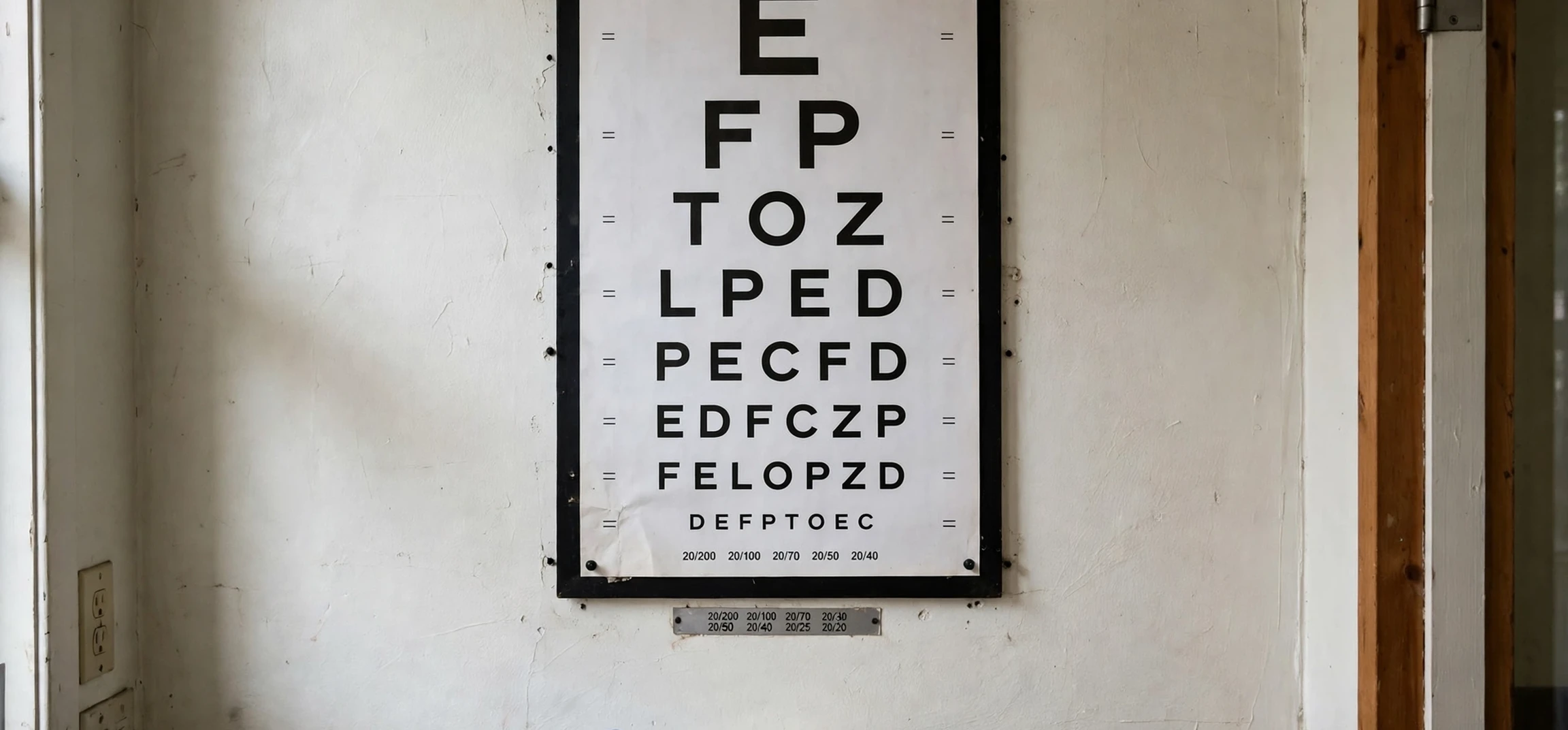
What does 20/40 eyesight mean, and why do so many people search for vision numbers in strings such as 50 20 40? The short answer is that 20/40 is a measure of visual acuity: it means that at 20 feet, you can read what a person with standard vision can read at 40 feet. In other words, you need to be closer than usual to see the same detail. Some readers arrive here after typing 50 20 40, and it is worth being honest about that phrase from the start: 50 20 40 is best understood as a search artifact, a string of vision-chart numbers typed together by people looking for explanations of 20/50, 20/40, and related measurements. This guide explains 20/40 eyesight clearly, separates the real measurement from the search string, and encourages anyone with vision concerns to see an eye care professional for a personal assessment. It is general education only, not a diagnosis.
Vision numbers can feel intimidating because they look like grades, but they are not grades and they are not prescriptions. A visual acuity result describes how sharply you can see detail at a distance under test conditions, using a standard eye chart. It does not, by itself, tell you whether you need glasses, what lens power you need, or whether your eyes are healthy. Those questions require a full eye examination, which checks far more than chart reading. This guide explains how the numbers work, what 20/40 does and does not mean, and what to do next if you have received such a result or are simply curious.
That separation of numbers is the key to understanding searches for 50 20 40.
What Does 20/40 Eyesight Mean?
Visual acuity is usually written as a fraction, with the testing distance on top and the standard distance below. In 20/40, the top number, 20, is the distance in feet at which the test was taken. The bottom number, 40, is the distance at which a person with standard vision could read the same line. So 20/40 eyesight means you must stand at 20 feet to read letters that standard vision can read at 40 feet. Your vision is less sharp at distance than the standard, but the fraction describes that difference precisely rather than vaguely. It is a measurement, not a judgement, and many people with 20/40 vision function well in daily life, especially with correction if an eye care professional recommends it.
It helps to compare 20/40 with neighbouring results. Standard vision is written as 20/20, meaning you read at 20 feet what standard vision reads at 20 feet. A result of 20/30 means you read at 20 feet what standard vision reads at 30 feet, a smaller difference than 20/40. A result of 20/50 means a larger difference again, and a result of 20/200 is the threshold often used in legal definitions of blindness in some jurisdictions, though exact legal standards vary by place and purpose. Seeing these numbers side by side shows that 20/40 sits in the mild-to-moderate range of reduced distance sharpness: noticeable on a chart, but far from the severe end of the scale. Only an eye care professional can interpret your result in the context of your full eye health.
Readers who type 50 20 40 are usually comparing several chart results at once.
50 20 40 as a Search Artifact
Now for the honest framing that this guide promised. The string 50 20 40 does not name a single eye condition, a single test, or a single prescription. It is most plausibly a search artifact: three familiar vision numbers, 50, 20, and 40, typed together by someone trying to find explanations for several chart results at once, or by a search system combining related queries. People often search this way when they have seen more than one number, perhaps 20/50 on one line and 20/40 on another, or when they are comparing results for two eyes. The numbers are real individually, but the combined string 50 20 40 is not a medical term.
Why does this distinction matter? Because treating 50 20 40 as if it were a diagnosis could mislead a reader into worrying about a condition that does not exist, or into ignoring a real result that needs attention. The safe approach is to separate the string into its parts: 20/50 is one acuity result, 20/40 is another, and each belongs to a specific eye, a specific test, and a specific date. If you received a result sheet with several numbers on it, bring that sheet to your eye care professional and ask them to walk through each line. That conversation will give you far more clarity than any search for 50 20 40 alone, and it is the step this guide recommends most strongly.
Treating 50 20 40 as a single diagnosis would mislead, which is why this guide unpacks it.
How Vision Search Strings Form
Search strings like 50 20 40 form for understandable reasons. Eye test results are full of numbers, fractions, plus and minus signs, and abbreviations, and it is easy to remember the numbers without remembering the slashes, decimal points, or labels that give them meaning. A person might remember seeing 50 and 40 near a 20, and type all three into a search box hoping the search engine will sort it out. Search engines then match that string to pages about 20/40 and 20/50 vision, which is helpful, but the match does not turn the string itself into a term. Good health guides should say so plainly, rather than inventing a definition for a phrase that has none.
The Snellen Chart and How Acuity Is Tested
Most distance acuity tests use a Snellen chart, named after the Dutch ophthalmologist who designed it. The chart shows rows of letters that get smaller towards the bottom, and each row corresponds to a standard viewing distance. During a test, you stand or sit at a set distance, usually 20 feet, cover one eye, and read the smallest line you can manage. The tester records the result for each eye separately, because the two eyes often differ. A result of 20/40 means the smallest line you read reliably at 20 feet is the line that standard vision reads at 40 feet. The test is simple, but it must be done under proper lighting, at the correct distance, and with the correct correction, if any, to be meaningful.
A result sheet, not a search for 50 20 40, is the document an eye care professional needs.
Several factors can affect a chart result on a given day. Tiredness, dry eyes, poor lighting, an incorrect testing distance, or a scratched lens can all shift the result by a line or two. That is why a single chart reading is rarely the whole story, and why eye care professionals repeat tests, check both eyes, and examine the eyes themselves. Children and adults may also be tested with different charts, using pictures or symbols where letters are not suitable, but the principle is the same: the smallest detail reliably seen at a standard distance. If your result surprises you, ask whether the test will be repeated or confirmed before drawing conclusions.
20/40 Vision, Driving, and Daily Life
Many readers ask whether 20/40 vision affects driving, work, or daily activities, and the honest answer is that it depends on jurisdiction, correction, and individual circumstances. In many places, a visual acuity standard for driving is set by law, and 20/40 with correction is often within the range that licensing authorities accept, while uncorrected vision below a threshold may require glasses or contact lenses. Exact rules vary by country and by state or region, and they may also consider visual field, both eyes together, and other factors. This guide cannot state your local rule, and you should check the current requirements of your licensing authority or ask your eye care professional, rather than relying on a general article.
Decimal notation and prescriptions are separate systems from the string 50 20 40.
In daily life, 20/40 vision without correction may make distant signs, whiteboards, cinema subtitles, or scoreboards harder to read, while near tasks such as reading a book or using a phone may feel unaffected. That pattern is common with distance sharpness problems, but it is not universal, and it does not diagnose a specific cause. Possible causes of reduced distance acuity include refractive errors such as myopia, astigmatism, or other focusing issues, as well as eye health conditions that only an examination can identify. Do not try to self-diagnose from a chart result alone. An eye care professional can determine the cause, discuss correction options, and check eye health in a way that no article can.
Correction Options an Eye Care Professional May Discuss
Correction options commonly discussed after an acuity test include glasses, contact lenses, and, for suitable adults, refractive procedures, each with benefits, risks, costs, and suitability criteria that depend on the individual. Glasses are the simplest and most widely used option, and they can often bring 20/40 vision to 20/20 or close to it if the cause is a refractive error. Contact lenses offer a wider field of view and freedom from frames, but require hygiene and fitting. Surgical options involve a fuller assessment of eye health, prescription stability, and personal circumstances, and they are not suitable for everyone. This guide lists these options only as general education: the right choice, if any, is a personal decision made with a qualified professional after a full examination.
When in doubt about 50 20 40, ask a professional to walk through each number with you.
50 20 40 and Other Vision Numbers Explained
To prevent further confusion, it helps to place 50 20 40 alongside the numbers it is often confused with. A result of 20/50 means you read at 20 feet what standard vision reads at 50 feet, which is less sharp than 20/40. A result of 20/25 means you read at 20 feet what standard vision reads at 25 feet, which is closer to standard than 20/40. Decimal acuity, used in some countries, writes the same idea differently: 20/20 becomes 1.0, 20/40 becomes 0.5, and 20/50 becomes 0.4, because the decimal is the top number divided by the bottom number. A prescription, meanwhile, uses entirely different numbers, such as sphere, cylinder, and axis values, which describe lens power rather than chart performance. Mixing up acuity fractions, decimal acuity, and prescription values is a common source of confusion, and keeping them in separate mental boxes will help.
The number 50 also appears in other eye contexts, which may contribute to the 50 20 40 search string. It can appear as part of a 20/50 result, as a frame measurement, as an age-related screening recommendation, or as a percentage in a different test altogether. Without the original result sheet, it is impossible to know which meaning a searcher had in mind, and this guide does not pretend otherwise. If you are holding a result sheet, look for the labels beside each number: acuity, prescription, pressure, or another measure. Those labels, not the bare numbers, tell you what you are looking at, and your eye care professional can explain each label in plain language.
The table above makes the status of 50 20 40 explicit: a search artifact, not a measurement.
When to See an Eye Care Professional
See an eye care professional promptly if you notice a sudden change in vision, loss of vision in one eye, flashes, new floaters, eye pain, redness that does not settle, double vision, or difficulty seeing that interferes with driving, work, or safety. Seek urgent care for sudden vision loss or eye injury, following local emergency guidance. For routine matters, such as a 20/40 result at a screening, book a full eye examination and bring your result sheet, your current glasses or contact lens details, and a list of medicines and health conditions. Regular eye examinations matter even when vision feels fine, because some eye conditions develop without early symptoms, and early detection makes treatment more effective.
Children, older adults, people with diabetes, people with a family history of eye disease, and people who notice gradual changes should be especially careful not to rely on online chart simulators or search results alone. Online vision tests can be useful as a rough screen, but they cannot replace a professional examination, they cannot check eye health, and they cannot prescribe correction. If cost or access is a barrier, look for community clinics, screening programmes, or professional guidance in your area, and ask what low-cost options exist. Your eyesight is worth a proper assessment, and a professional conversation will answer the questions that a search for 50 20 40 cannot.
Vision Numbers at a Glance
| Acuity Result | Meaning in Plain Language | Decimal Equivalent | General Note |
|---|---|---|---|
| 20/20 | Standard vision at 20 feet | 1.0 | Reference standard, not perfect vision |
| 20/25 | Read at 20 feet what standard reads at 25 feet | 0.8 | Slightly less sharp than standard |
| 20/30 | Read at 20 feet what standard reads at 30 feet | 0.67 | Mild reduction in distance sharpness |
| 20/40 | Read at 20 feet what standard reads at 40 feet | 0.5 | Noticeable on a chart; often correctable |
| 20/50 | Read at 20 feet what standard reads at 50 feet | 0.4 | Less sharp than 20/40 |
| 20/200 | Read at 20 feet what standard reads at 200 feet | 0.1 | Threshold used in some legal definitions |
| 50 20 40 | Not a single measurement | Not applicable | Search artifact combining separate numbers |
Use this table to orient yourself, not to diagnose yourself. The decimal equivalents show the same acuity idea in a different notation, and the final row makes the search-artifact point explicit: 50 20 40 is a string to be unpacked, not a result to be acted upon. For related vision reading, see the guide to what 20/30 vision means and the explainer on what a twitchy eye can mean, remembering that both are general education, not personal medical advice.
Frequently Asked Questions About 50 20 40
What does 20/40 eyesight mean?
It means that at 20 feet, you can read what a person with standard vision can read at 40 feet. It describes distance sharpness under test conditions, and it is not by itself a prescription or a diagnosis.
What does 50 20 40 mean?
On its own, 50 20 40 is best understood as a search artifact, a string of vision numbers typed together when looking for explanations of 20/50, 20/40, and related results. It is not a single medical term, and it should be separated into its individual results before interpretation.
Is 20/40 vision bad?
It is less sharp than standard 20/20 vision at distance, but it sits in the mild-to-moderate range and is often correctable with glasses or contact lenses if a professional recommends correction. Only a full examination can say what it means for you personally.
Can 20/40 vision improve?
Correction with glasses or contact lenses often improves chart performance when the cause is a refractive error, and other causes require professional assessment and treatment. Eye exercises, supplements, and online programmes should not be relied upon as substitutes for professional advice, and any product claiming to cure vision problems should be discussed with an eye care professional first.
Conclusion
Understanding 20/40 eyesight starts with a simple fraction: at 20 feet, you see what standard vision sees at 40 feet. That measurement tells you about distance sharpness, nothing more and nothing less, and it becomes useful only when an eye care professional places it alongside a full examination of your eyes and health. The search string 50 20 40, meanwhile, deserves an honest answer rather than an invented one: it is a collection of familiar vision numbers typed together, not a single condition or result, and unpacking it into 20/50, 20/40, and any other numbers on your sheet is the first step to clarity. Keep this guide as general education, bring your real results to a professional, and let a proper eye examination, not a search string, decide what your vision numbers mean for you.



