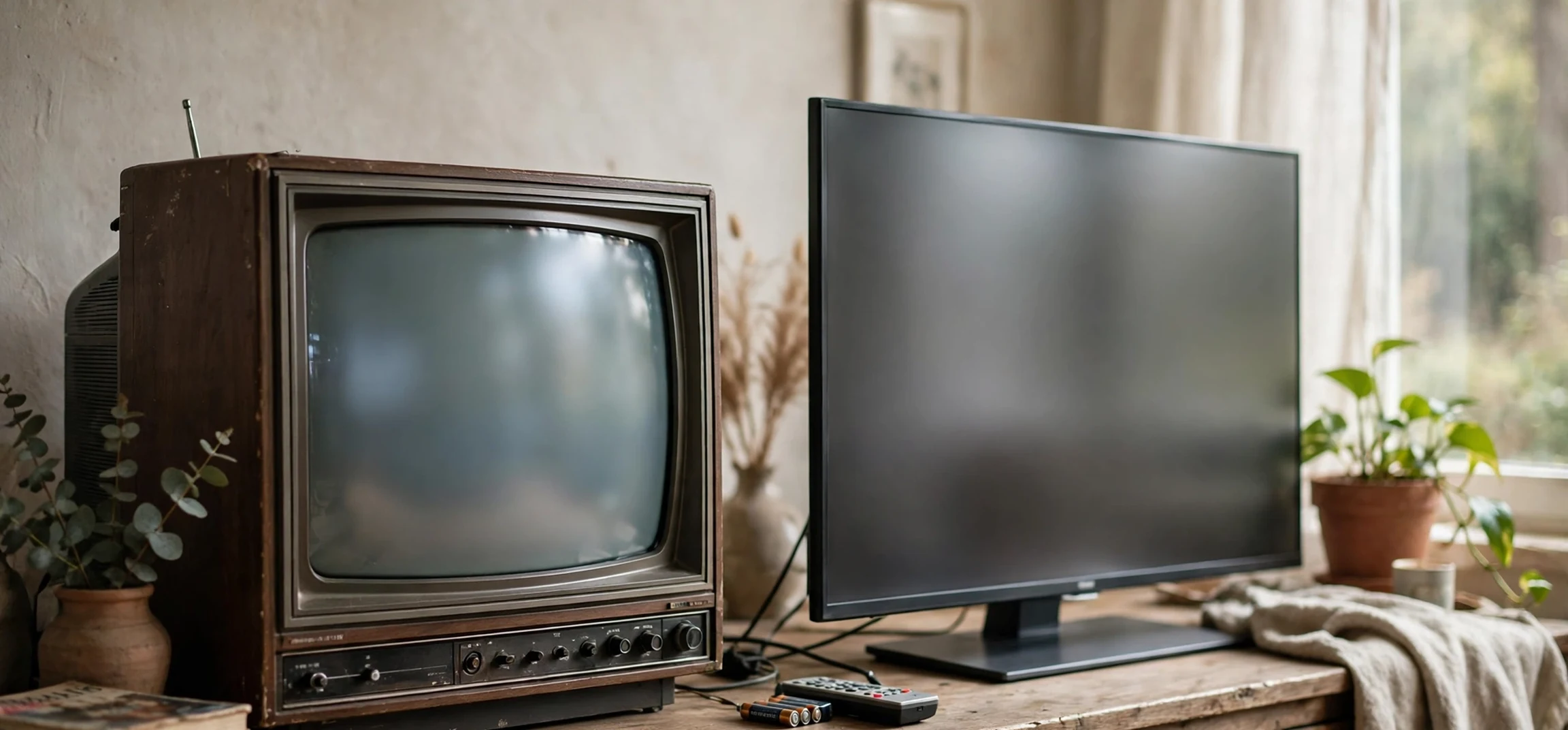
If you have ever wondered whats analog tv, here is the short answer: analog television is the original way TV pictures and sound were broadcast, using continuously varying radio waves to carry the signal from a transmitter to your home. For most of the twentieth century, every television in the world was an analog TV. This guide explains whats analog tv in plain language, how it worked, how it differs from digital TV, and why the world eventually switched over.
For anyone asking whats analog tv, it helps to know that analog TV feels like ancient history to younger viewers, but it shaped television for more than half a century. The fuzzy picture, the rabbit-ear antenna, the need to adjust the aerial on a windy day, and the famous static hiss between channels were all part of the analog experience. Understanding analog TV helps explain why modern television looks and sounds so different, and why the switchover to digital was such a major project in countries around the world.
- Whats Analog TV, Exactly?
- How Analog TV Worked
- Whats Analog TV Compared to Digital TV?
- Strengths and Weaknesses of Analog TV
- The Switchover to Digital
- Analog TV Today: Collectors and Retro Fans
- Frequently Asked Questions
- Conclusion
Whats Analog TV, Exactly?
To answer whats analog tv precisely: it is a television system in which the picture and sound are transmitted as analog signals, meaning signals that vary continuously in strength or frequency to mirror the original image and sound. When a camera captured a scene, the brightness and color of each part of the image were converted into a wave. That wave was broadcast over the air, and the television set reversed the process, turning the wave back into light and sound on the screen.
If you ask whats analog tv in technical terms, remember that analog TV is called analog because the signal is analogous to the original: the ups and downs of the radio wave correspond directly to the ups and downs of brightness and sound. This is the same principle behind vinyl records and old cassette tapes, where a physical groove or magnetic pattern mirrors the sound itself. Digital systems work differently: they convert everything into numbers, ones and zeros, before transmission.
Three main analog broadcast standards dominated the world. NTSC was used in North America, Japan, and parts of South America. PAL was used across much of Europe, Asia, Africa, and Australia. SECAM was used in France, Russia, and parts of Africa. The standards differed in frame rates, color encoding, and resolution, which is why an old TV bought in one country often could not display broadcasts properly in another.
How Analog TV Worked
Understanding whats analog tv means following the signal: an analog broadcast began at a television station, where cameras and microphones captured the program. The video signal was built line by line. The TV screen drew each picture as a series of horizontal lines, scanned from top to bottom, many times per second. Standard definition analog TV in the NTSC system used 525 lines, of which about 480 were visible, while PAL used 625 lines with about 576 visible. The rapid scanning created the illusion of a moving image.
The signal traveled from the station’s transmitter to a rooftop or indoor antenna, or through a cable network. Inside the television, a tuner selected one channel’s frequency, and circuits separated the picture signal from the sound signal. The picture signal drove an electron beam inside the cathode ray tube, the large glass screen of old TVs, painting the image line by line with phosphors that glowed in red, green, and blue. The sound signal drove the speaker.
Reception quality depended heavily on signal strength and interference. A strong, clear signal produced a sharp picture. A weak signal produced snow, the grainy speckled noise familiar to anyone who grew up with analog TV. Nearby electrical equipment, weather, tall buildings, and even passing airplanes could cause ghosting, where a faint double image appeared beside the main picture. Adjusting the antenna, sometimes by hand during a program, was a normal part of watching television.
Whats Analog TV Compared to Digital TV?
When people ask whats analog tv compared to digital TV, the core difference is how the signal is carried. Analog carries a continuous wave that mirrors the picture. Digital converts the picture and sound into compressed data, transmits that data, and reconstructs the picture in the receiver. That single change brings a cascade of advantages.
Digital TV delivers a much sharper picture, including high definition and ultra-high definition, with clearer sound, including surround sound. It uses the radio spectrum far more efficiently, so one old analog channel’s worth of spectrum can carry several digital channels, including extra services such as program guides and subtitles. Digital signals also resist interference differently: instead of degrading gradually into snow, a digital picture stays perfect until the signal becomes too weak, at which point it breaks up into blocks or freezes, an effect known as the digital cliff.
| Feature | Analog TV | Digital TV |
|---|---|---|
| Signal type | Continuous wave mirroring the picture | Compressed numerical data |
| Picture quality | Standard definition, softens with weak signal | High definition, perfect until the signal fails |
| Sound | Basic stereo at best | Surround sound and multiple audio tracks |
| Channels per frequency | One channel | Several channels plus data services |
| Weak signal effect | Snow, ghosting, gradual decline | Blocking, freezing, sudden loss |
| Extra features | Teletext in some regions | Program guides, subtitles, interactive services |
Analog TV did have one advantage that some viewers still miss: graceful degradation. A weak analog signal still gave you a watchable, if snowy, picture. A weak digital signal gives you nothing at all once it falls below a threshold. That difference explains why some rural viewers found the digital switchover frustrating, even though the picture quality for most people improved dramatically.
Strengths and Weaknesses of Analog TV
For those still asking whats analog tv in practical terms, analog TV’s strengths were simplicity and universality. The technology was mature, cheap to manufacture, and easy to understand. A basic analog set needed no software, no updates, and no subscription. It worked with a simple antenna and a power socket, and repair shops everywhere knew how to fix it. For decades, it was the most democratic mass medium ever created, bringing news, sport, drama, and education into homes at every income level.
Its weaknesses grew more obvious as expectations rose. Picture resolution was limited, and it could not deliver high definition. It wasted spectrum, because each channel needed a wide frequency band and guard bands to prevent interference with neighbors. It offered no easy way to carry extra data, so features like electronic program guides, multiple language tracks, and on-screen information were limited or clumsy. And its picture quality degraded with distance from the transmitter, which meant rural viewers often had a worse experience than city viewers.
Another part of whats analog tv is that analog TV also struggled with recording and copying. Home video recorders copied analog signals, and each copy lost quality, producing the familiar fuzzy second-generation tape. Digital recording, by contrast, copies data without loss. That difference mattered to broadcasters, studios, and viewers alike, and it was one more reason the industry moved toward digital.
The Switchover to Digital
Countries around the world switched off analog television broadcasts in stages during the 2000s and 2010s. The United States completed its full-power switchover in June 2009. The United Kingdom finished in 2012. Many other countries followed over the following decade, with some smaller or lower-income nations completing the transition later. Each switchover required public information campaigns, because millions of households needed a new television or a set-top converter box to keep watching.
The switchover freed up valuable radio spectrum, sometimes called the digital dividend. Governments auctioned or reallocated that spectrum for mobile broadband, emergency services, and other wireless uses. That reallocation is part of why mobile data became faster and more widely available in the 2010s: the airwaves once used by a single analog TV channel could now support many mobile connections.
For viewers, the switchover was a mixed experience. Most gained more channels and a better picture. Some needed new antennas or discovered that their reception was worse than before, because of the digital cliff effect. Governments in several countries offered subsidies or free converter boxes to ease the transition, especially for older viewers and low-income households. Looking back, the switchover is now seen as one of the largest coordinated technology migrations in broadcasting history.
Analog TV Today: Collectors and Retro Fans
Even today, the question of whats analog tv still matters, because analog TV is not entirely gone. Old cathode ray tube televisions have become collector items, prized by retro gaming fans because classic video game consoles were designed for their screens and look best on them. Vintage TV enthusiasts restore old sets, and some low-power or community stations in a few countries continued analog broadcasts for a time after the main switchovers. Museums also preserve analog equipment as part of broadcasting history.
Analog technology also lives on, which is one more reason people keep asking whats analog tv. in other forms. Analog radio broadcasting continues in many places, and analog audio, from vinyl records to cassette tapes, has enjoyed a revival among music fans who like its warm sound. The story of analog TV is therefore not a story of total disappearance, but of a technology that served its purpose, shaped a century of culture, and then handed over to a more efficient successor.
If you enjoy classic television, our guides to the retro classic Airwolf, ABC Family TV series, and the Boston Public TV show revisit shows from the broadcast era that analog TV made famous.
Frequently Asked Questions
Whats analog tv in simple terms?
Analog TV is the original television system, in which pictures and sound were sent as continuously varying radio waves that directly mirrored the image and sound, rather than as digital data.
Can you still watch analog TV today?
Most countries have switched off analog broadcasts, so an old analog set cannot receive over-the-air channels without a digital converter box. Old sets can still play retro game consoles, video recorders, and other devices through their analog inputs.
Why did countries switch from analog to digital TV?
Digital TV offers higher picture and sound quality, more channels in the same spectrum, and extra features like program guides. The switchover also freed spectrum for mobile broadband and emergency services.
What is the difference between analog snow and digital blocking?
Analog signals degrade gradually, so a weak signal produces snowy, fuzzy pictures. Digital signals stay perfect until they weaken past a threshold, then break into blocks or freeze, an effect called the digital cliff.
Are old analog TVs worth anything?
Some cathode ray tube sets are valued by retro gaming fans and collectors, especially well-known brands in good working condition. Most ordinary old sets have little monetary value but remain interesting pieces of technology history.
Conclusion
So, whats analog tv? It was the technology that brought television into homes around the world for more than half a century: a system of continuous radio waves carrying pictures line by line and sound through the air to a glowing glass screen. It was simple, universal, and wonderfully democratic, but limited in quality and wasteful of spectrum.
Digital television replaced it with sharper pictures, more channels, and better sound, and freed the airwaves for the mobile era. Yet analog TV’s legacy remains in the shows it carried, the culture it shaped, and the glowing screens that retro fans still treasure. Understanding how it worked is understanding how television itself grew up.



