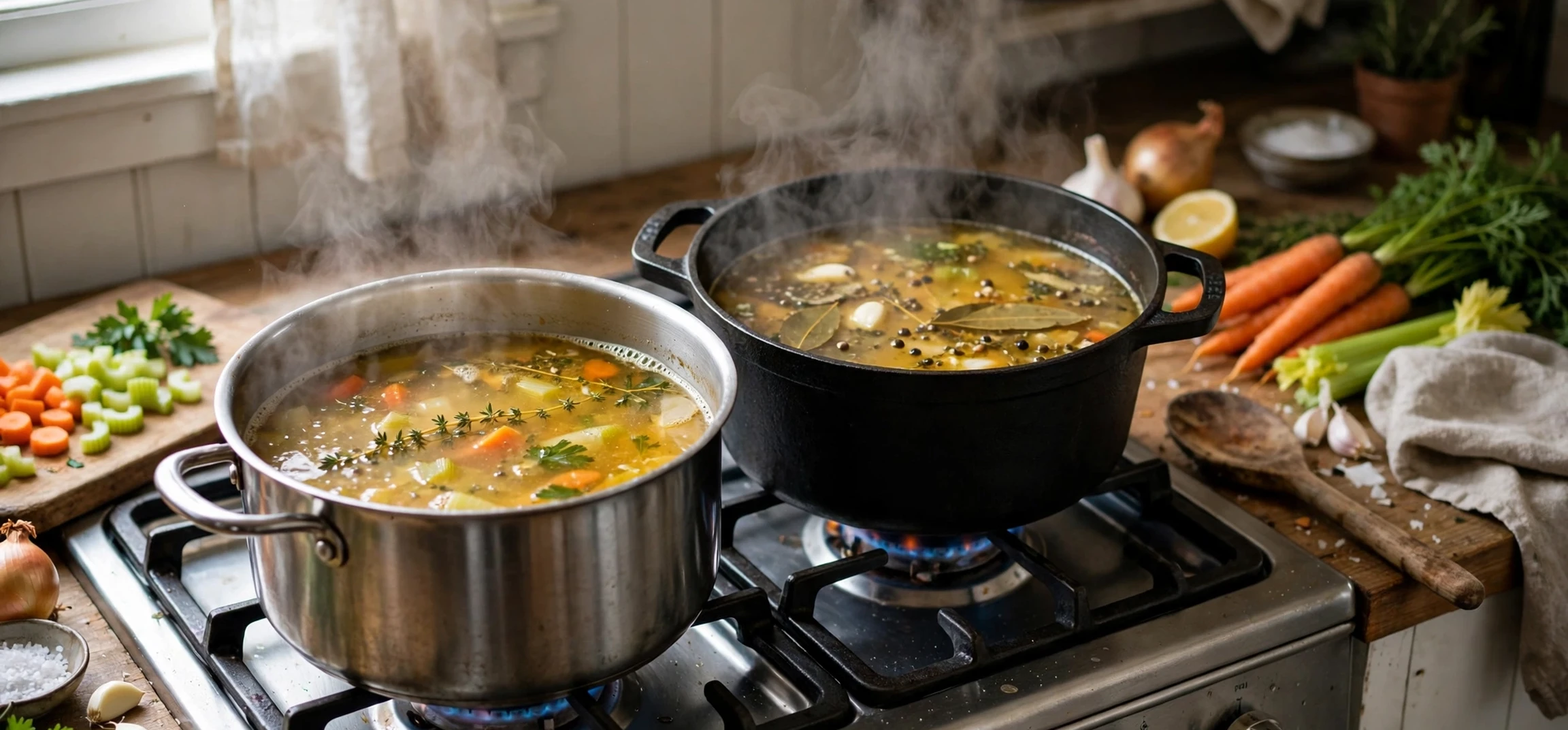
If you have ever stood in a supermarket aisle wondering about “chicken stock vs beef stock”, you are not alone. The two liquids look similar, they are often sold side by side, and many recipes use them interchangeably, yet they taste quite different and they suit different dishes. Chicken stock is lighter, cleaner, and more delicate, while beef stock is deeper, richer, and more robust. Understanding those differences helps you choose the right base for soups, stews, sauces, risottos, and gravies, and it also helps you understand why a recipe that works beautifully with one stock can taste flat, or overpowering, with the other. This guide compares flavour, body, ingredients, cooking time, and best uses, and it also clears up the common confusion between stock and broth.
At its simplest, stock is a flavoured liquid made by simmering bones, and often vegetables and aromatics, in water. The bones give stock its body, because collagen from bones and connective tissue turns into gelatine during a long, gentle simmer. That gelatine is what makes a good stock feel rich in the mouth and set to a jelly when chilled. Broth, by contrast, is traditionally made more from meat than from bones, is seasoned more fully, and is often intended to be eaten as it is, for example as a light soup. In shops, however, the labels are not always used strictly, so a product called broth may resemble a stock, and vice versa. Reading the ingredients and tasting the product matters more than trusting the label alone.
What “chicken stock vs beef stock” Means for Home Cooks
When cooks compare “chicken stock vs beef stock”, they are really comparing two flavour foundations. Chicken stock carries gentle savoury notes, a pale golden colour, and a clean finish that supports other ingredients without dominating them. It works well in dishes where vegetables, herbs, grains, or delicate proteins should stay in the foreground. Beef stock carries deeper roasted, almost earthy notes, a darker colour, and a fuller mouthfeel that can stand up to strong flavours such as red wine, mushrooms, onions, and hearty root vegetables. Neither is better in absolute terms; the right choice depends on the dish.
Body matters as much as flavour. A well-made chicken stock made from carcasses and wings will still gel when chilled, but it will feel lighter than a beef stock made from marrow bones and knuckles. Beef bones are larger and contain more connective tissue, so beef stock often has a more pronounced gelatine body. That body is valuable in sauces and gravies, where it gives gloss and cling, and in braises, where it enriches the cooking liquid as it reduces. Chicken stock gives a lighter gloss that suits velvety soups and delicate sauces without making them feel heavy.
Flavour, Colour, and Ingredients Compared
Chicken stock is usually made from a whole carcass or a mix of backs, necks, and wings, plus classic aromatics such as onion, carrot, celery, bay leaf, and peppercorns. Some cooks add parsley stalks or thyme. The result is golden, fragrant, and mildly savoury. Roasting the bones first gives a darker, more roasted chicken stock, sometimes called brown chicken stock, which sits between pale chicken stock and beef stock in depth. Unroasted bones give a paler, cleaner white stock that is ideal for light soups and sauces where colour matters.
Beef stock is usually made from marrow bones, knuckle bones, and sometimes shin or oxtail, plus the same family of vegetables, often in larger quantities and roasted alongside the bones. Roasting is almost essential for good beef stock, because it develops the deep colour and roasted flavour that distinguish it from a pale, boiled-beef liquid. Tomato paste is sometimes added during roasting for extra depth and colour, and herbs such as thyme and bay remain common. The finished stock is dark brown, intensely savoury, and noticeably richer than chicken stock.
Salt and Seasoning
Homemade stock is traditionally left unsalted, or only very lightly seasoned, so that the cook can control salt in the finished dish. This matters because stock reduces during cooking, and a liquid that tastes correctly salted at the start can become far too salty after an hour of simmering. Shop-bought stocks and broths, by contrast, are often seasoned, and salt levels vary widely between brands. When substituting one product for another, taste first and adjust salt at the end of cooking rather than at the start. Low-salt versions give more control, but they still vary, so tasting remains essential.
Fat and Clarity
Both stocks benefit from skimming. As bones simmer, fat and impurities rise to the surface, and skimming them off gives a cleaner flavour and a clearer liquid. Chilling stock and lifting off the solid fat layer is another reliable method. Beef stock tends to produce more fat than chicken stock, so skimming matters even more. Clarity is most important for clear soups and consommés, where a cloudy stock would spoil the appearance, but even for hearty stews, removing excess fat improves flavour and texture.
Cooking Time and Method
Chicken stock needs less time than beef stock. A gentle simmer of roughly three to four hours is usually enough to extract flavour and gelatine from chicken bones, although some cooks simmer longer for extra depth. Beef stock needs longer, often six to eight hours or more, because the bones are larger and denser. A slow cooker or a pressure cooker can shorten the process, but the principle remains the same: gentle heat, plenty of time, and regular skimming. Boiling hard rather than simmering gently can make stock cloudy and can emulsify fat into the liquid, giving a greasy rather than silky result.
Water quantity also matters. Bones should be just covered, with vegetables added on top, so that the finished stock is concentrated rather than watery. Starting with too much water gives a thin stock that needs long reduction, while starting with too little risks scorching or an overly intense result. As a rough guide, home cooks often aim for a stock that tastes clearly savoury even before seasoning, and that sets softly when chilled. If a chilled stock stays completely liquid, it may still taste pleasant, but it will lack the body that gelatine provides.
Best Uses: When to Choose Each Stock
Chicken stock shines in chicken soup, of course, but also in vegetable soups, risotto, light curries, noodle soups, and sauces for poultry, fish, and vegetables. It adds savouriness without changing the colour of a pale dish, which matters for dishes such as a creamy vegetable soup or a light lemon sauce. It is also a good choice for cooking grains, because it flavours rice, couscous, and quinoa gently without overwhelming them.
Beef stock shines in beef stew, French onion soup, mushroom sauces, rich gravies, braised dishes, and hearty bean or barley soups. It supports bold flavours and gives sauces a satisfying depth that chicken stock cannot match. It is also the natural partner for dishes built around roasted or braised beef, where matching the stock to the main protein reinforces the flavour rather than introducing a competing note. For a mixed dish, such as a stew containing both meats, either stock can work, and the choice often comes down to which flavour should lead.
| Feature | Chicken stock | Beef stock |
|---|---|---|
| Flavour | Light, clean, delicately savoury | Deep, roasted, robustly savoury |
| Colour | Pale gold, or darker if bones are roasted | Dark brown |
| Body | Light to moderate gelatine body | Full, glossy gelatine body |
| Typical simmer | A few hours | Considerably longer |
| Best for | Light soups, risotto, poultry and vegetable dishes | Stews, braises, rich sauces and gravies |
| Substitution risk | May taste thin in a bold beef dish | May overpower a delicate dish |
Can You Substitute in “chicken stock vs beef stock” Recipes?
In many everyday recipes, substitution is perfectly acceptable, especially when the stock is one ingredient among many. A vegetable soup made with beef stock instead of chicken stock will taste darker and richer, but it will still be pleasant. A beef stew made with chicken stock will taste lighter, but it will still be satisfying if the other flavours are well balanced. Problems arise mainly at the extremes: a delicate dish such as a light seafood risotto can be overwhelmed by beef stock, while a dish that depends on deep beef flavour, such as French onion soup with a rich cheese topping, can taste thin with chicken stock.
If you must substitute, adjust the rest of the dish. When using beef stock in place of chicken stock, consider holding back strongly flavoured additions until you have tasted the result. When using chicken stock in place of beef stock, consider adding depth with mushrooms, a little tomato paste, or a longer simmer, so that the dish does not feel flat. In both cases, taste and adjust salt at the end, because shop-bought products differ in seasoning. For general kitchen background, the guide on what chicken stock is is a useful companion, and the article on kitchen terminology helps with other terms that recipes often assume you already know.
Stock Versus Broth: Clearing Up the Labels
The stock-versus-broth distinction confuses even experienced cooks, largely because manufacturers use the words loosely. Traditionally, stock is unseasoned, bone-based, and used as an ingredient, while broth is meat-based, seasoned, and suitable for sipping. In practice, many supermarket products labelled broth are made in a stock-like way, and many labelled stock are seasoned like broth. The practical lesson is to ignore the label debate and focus on what is in the carton: check whether bones or meat are listed first, check the salt content, and taste a spoonful before cooking. A product that tastes balanced and savoury will behave well in cooking, whatever the label says.
Storage is similar for both. Homemade stock keeps for a few days in the fridge and for months in the freezer, especially when frozen in portions that match your usual recipes. Ice-cube trays work well for small amounts needed to deglaze a pan, while larger containers suit soups and stews. Cool stock quickly, label containers with the type and date, and discard anything that smells off or has been left at room temperature for an extended period. Shop-bought cartons should be used within the period stated on the packaging once opened, and unopened cartons should be stored as directed.
Frequently Asked Questions
Is chicken stock healthier than beef stock?
Both can be part of a balanced diet, and the difference depends more on salt, fat, and what else is in the dish than on the stock type alone. Skimming fat and choosing lower-salt products, or making stock at home without added salt, gives you the most control.
Can vegetarians use either stock?
No, both chicken stock and beef stock are made from animal bones, so neither suits a vegetarian diet. Vegetable stock is the usual alternative, and mushroom-based stocks can add depth for dishes that would otherwise use beef stock.
Is homemade stock always better than shop-bought?
Homemade stock usually has better body and a cleaner flavour, but good shop-bought stock is convenient and perfectly acceptable for everyday cooking. Choose a brand with a short ingredient list and a taste you like, and adjust seasoning carefully.
Can stock be frozen?
Yes, stock freezes very well. Freeze it in portions, leave room for expansion, label each container, and thaw in the fridge before use.
Conclusion
The “chicken stock vs beef stock” choice comes down to flavour, body, and the dish in front of you. Chicken stock is light, golden, and versatile, ideal for delicate soups, grains, and poultry dishes. Beef stock is dark, rich, and full-bodied, ideal for stews, braises, and robust sauces. Both reward gentle simmering, careful skimming, and restrained seasoning, and both can be substituted in a pinch if you adjust the rest of the dish and taste as you go. Keep a supply of each in the freezer, learn how each one behaves in your favourite recipes, and you will rarely reach for the wrong carton again.



