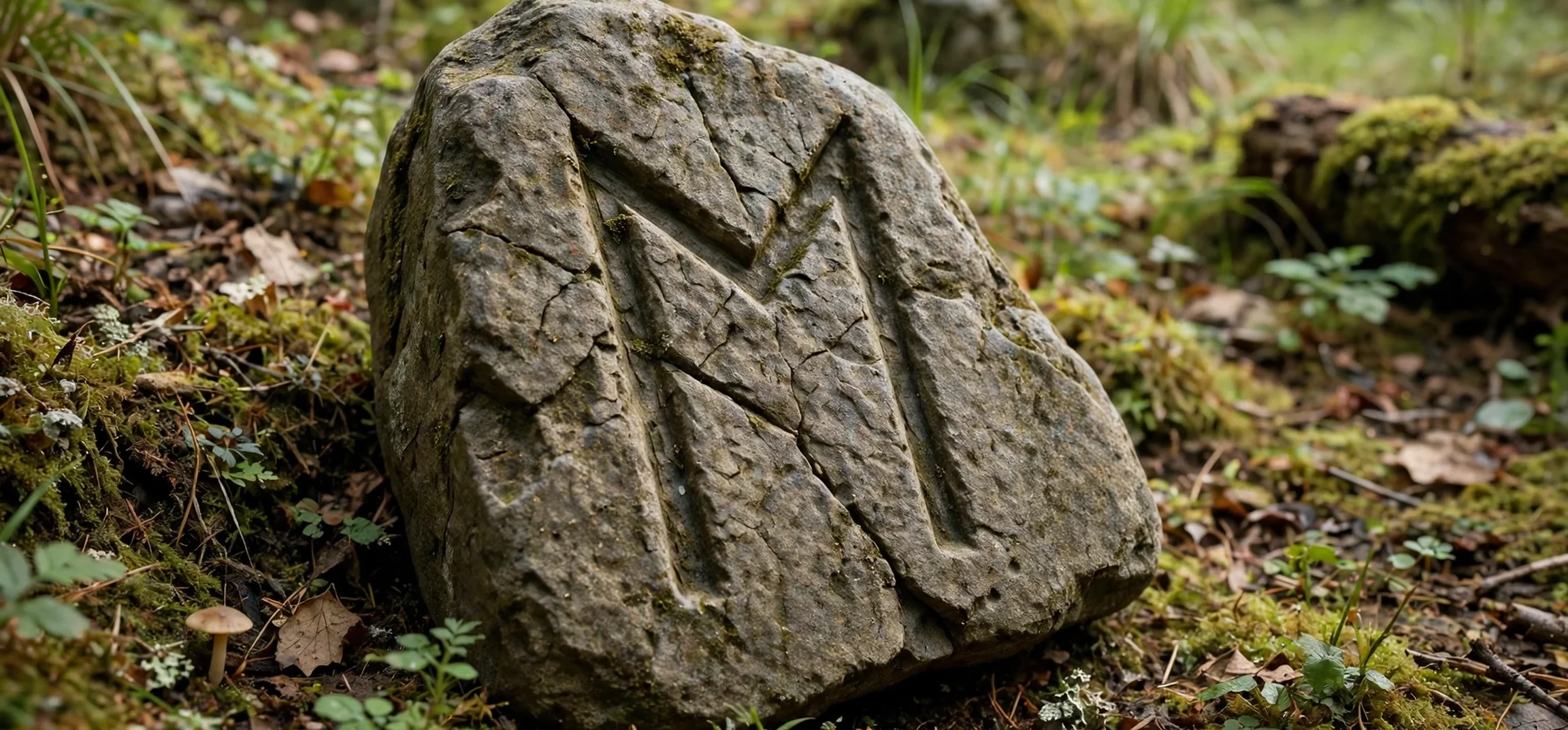
The ehwaz rune is one of the most quietly powerful symbols in the Elder Futhark, the oldest runic alphabet used by Germanic peoples. Its name is usually translated as horse, and that single image opens up a whole field of meaning: movement, partnership, trust, and steady progress. Unlike runes that point to sudden change or hard conflict, the ehwaz rune speaks about travelling well with another living being, whether that companion is a person, an animal, a team, or even a project that needs both direction and cooperation. Readers who meet this rune in a reading, a piece of jewellery, a tattoo design, or a history book often want the same thing: a clear, grounded explanation that separates what scholars can say with confidence from what modern spiritual practice has added later. This guide does that work step by step, so you can understand the shape, the sound, the history, and the modern uses of the symbol without getting lost in vague claims.
At its simplest, the ehwaz rune looks like a capital letter M with its outer strokes extended, or like two upright lines joined by a zigzag in the middle. It is the nineteenth rune of the Elder Futhark, sitting between the runes for protection and for joy in the usual ordering. Its reconstructed Proto-Germanic name is Ehwaz, meaning horse, and its sound value is a short e sound, similar to the e in bed. In the Anglo-Saxon rune poem, the related rune Eh describes the horse as a source of pride and comfort for riders, a creature that carries people across distances and helps them reach places they could not reach on foot. That old poem does not present the horse as a wild force to be feared. It presents the horse as a partner, valued for strength, speed, and willingness to work with a rider. That partnership idea is the thread that runs through almost every modern interpretation of the rune.
What the ehwaz rune Means in Plain Language
When people ask what the ehwaz rune means, the short answer is movement made through cooperation. A horse does not carry a rider by accident. The rider must learn balance, timing, and clear signals, while the horse must learn to trust the rider and respond to guidance. The rune therefore points to any situation where progress depends on a relationship working smoothly. It can describe a journey, a move to a new home, a change of job, a collaboration at work, or a friendship that helps both people go further than either could alone. It also carries a sense of gradual, controlled movement rather than a sudden leap. A horse can gallop, but a long journey is mostly walking, trotting, resting, and continuing. The rune honours that rhythm.
There is also a practical side to this meaning. Horses in the ancient world were valuable and demanding. They needed feeding, shelter, training, and care, and in return they gave transport, labour, and status. The ehwaz rune can therefore remind a reader to look after the means of progress, not only the destination. If a vehicle keeps breaking down, a team keeps misunderstanding each other, or a plan keeps stalling, the problem may not be a lack of ambition. It may be a lack of maintenance, communication, or mutual respect in the partnership that is supposed to carry the work forward. In that sense the rune is less about magic and more about good management of relationships and resources, expressed through an old and vivid image.
The History Behind the ehwaz rune
Runes were not invented as a secret code for fortune telling. They were a working alphabet, carved into wood, bone, metal, and stone, used for names, ownership marks, memorials, and short messages. The Elder Futhark, with twenty-four runes, developed in the early centuries of the Common Era and spread across northern Europe. The ehwaz rune belonged to that practical system first. Its shape is simple enough to carve with a knife, and its sound value made it useful in ordinary words. Only later, in medieval rune poems from England, Iceland, and Norway, do we find short verses that give each rune a memorable image or proverb. Those poems are valuable because they show how rune users themselves thought about the symbols, but they are poems, not encyclopaedias, and they do not all agree in detail.
The Anglo-Saxon poem treats the horse as noble and useful, while later Scandinavian material often links horses with travel, status, and ritual. Horses appear in burial finds, in stories of gods and heroes, and in accounts of long journeys across land and sea. None of that proves that every ancient carver of the ehwaz rune meant partnership in a spiritual sense. It does show that the horse was central to daily life, warfare, trade, and ceremony, so a rune named for the horse would naturally carry strong associations. Modern readers should enjoy those associations while keeping the history honest: the rune began as a letter, gained poetic meaning over time, and gained most of its modern divinatory meanings in the twentieth and twenty-first centuries, when rune reading became a popular spiritual practice.
Shape, Sound, and Position in the Alphabet
The shape of the ehwaz rune is sometimes confused with other runes because several runes use straight lines and angles. A helpful way to remember it is to picture two horses standing side by side, or two riders moving in step, joined by the line that connects them. That mental image matches the partnership meaning and makes the shape easier to recall. Its sound, a short e, connects it to the Old English word eh and the Old Norse word for horse, and it sits late in the Elder Futhark order, after runes linked with defence and before runes linked with joy, fertility, and the sun. Position in the alphabet does not by itself prove a spiritual sequence, but many modern rune readers like to read the late runes as dealing with the results of earlier work: after learning, struggle, and protection, there comes movement, partnership, and reward.
Ehwaz in Modern Rune Readings
In a modern rune reading, ehwaz often appears when a question concerns travel, relocation, teamwork, or a relationship that needs better coordination. A reader might interpret it upright as a sign that progress is possible, provided both sides move together and communicate clearly. It can suggest a good time to plan a trip, to start a joint project, to repair a working relationship, or to change direction gradually rather than forcing a sudden break. Some readers also link it to adaptability, because a good rider adjusts to the horse and the terrain instead of insisting on one rigid route. That flexibility is not weakness. It is the skill that keeps a long journey safe.
When the rune appears reversed, or upside down, many readers interpret it as a warning that movement has stalled, a partnership is out of balance, or trust has weakened. That reading should not be treated as a prediction of failure. It is more useful as a prompt for questions: who is pulling in a different direction, what has not been said clearly, what support is missing, and what small adjustment would restore balance? A reversed ehwaz can also point to restlessness, to wanting to move before the groundwork is ready, or to relying too heavily on one person or tool. In every case, the practical advice is the same: slow down, check the partnership, and fix the coordination before pushing for speed.
It is worth stating plainly that rune readings are a form of reflection and storytelling, not a tested method for predicting the future. People find them helpful because the symbols give them a fresh way to think about a problem, much as a good question from a friend can clarify a decision. If you use runes in that spirit, ehwaz is a generous symbol to work with, because it points toward cooperation, patience, and care. If you are making a major life decision, combine reflection with practical information, trusted advice, and, where relevant, professional guidance. The rune can help you think, but it should not replace evidence or conversation.
Symbolism Beyond Travel: Trust, Loyalty, and Change
The horse in the ehwaz rune is not only a means of transport. It is also a symbol of loyalty earned over time. A horse that trusts its rider will cross water, climb hills, and face noise that would frighten an untrained animal. That trust is built through consistent, calm handling, not through force. Modern writers therefore link ehwaz with loyalty, mutual respect, and the slow building of confidence between people. In a friendship, a marriage, a business partnership, or a team, the rune asks whether trust is being built daily through small reliable actions, or whether it is being assumed without being maintained.
Ehwaz also speaks about change that is carried rather than imposed. Some changes arrive like storms, sudden and disruptive. Others arrive like a journey, with preparation, packing, a route, companions, and rest stops. The rune belongs to the second kind. It suits people who are moving house, changing careers, starting a course of study, or guiding a family through a transition. The message is not to hurry the journey or to travel alone if help is available. Pack well, choose companions wisely, agree on the direction, and keep checking that everyone is still comfortable with the pace. That advice sounds simple, but it is often the difference between a change that holds and a change that falls apart halfway.
Ehwaz and Personal Growth
For personal growth, ehwaz can be read as a reminder that we do not develop in isolation. We grow through teachers, friends, colleagues, mentors, and even rivals who challenge us to improve. The rune invites a reader to notice who is helping them move forward and to return that help. It also invites honesty about dependence: there is no shame in needing a guide, a vehicle, a team, or a tool. The skill lies in choosing good support and using it well, rather than pretending to need nothing. That reading makes ehwaz a practical symbol for students, apprentices, new parents, new managers, and anyone learning a demanding skill.
Ehwaz in Art, Jewellery, and Tattoos
Ehwaz appears frequently in jewellery, carvings, and tattoo designs, often chosen by people who love horses, who travel often, or who value partnership. In jewellery, the rune is usually engraved on a pendant, ring, or bracelet, sometimes alone and sometimes combined with other runes that the wearer finds meaningful. When choosing a rune for permanent art, it helps to learn the history first and to choose a design for its personal meaning rather than for a supposed power. A symbol gains meaning from the story its wearer tells about it, and from the care taken in choosing it, not from the metal or ink alone. Readers exploring other symbolic designs may also enjoy guides to meaningful symbols, such as the discussion of the ankh and its long history as a sign of life, which shows how an ancient symbol can carry many layers of meaning across cultures. See the ankh meaning guide for a comparison of how symbols evolve.
Tattoo choices deserve extra thought, because a tattoo is permanent and because runes carry cultural history. Some people choose ehwaz to honour a horse they loved, a journey that changed them, or a partnership that sustained them through difficulty. Others choose it as part of a larger Norse-inspired design. Either way, it is wise to work with an artist who understands the rune shape, to check the design carefully before inking, and to avoid combining runes into a string that spells something unintended. For context on how tattoo meanings are discussed and interpreted, readers can look at the guide to 888 tattoo meaning and Samoan tattoos with meaning, both of which show why research matters before committing to a design.
Ehwaz Rune at a Glance
| Feature | Detail |
|---|---|
| Elder Futhark position | Nineteenth rune in the usual order |
| Reconstructed name | Ehwaz, meaning horse |
| Sound value | Short e, as in bed |
| Core themes | Movement, partnership, trust, steady progress |
| Common modern readings | Travel, teamwork, relocation, balanced change |
| Reversed reading | Stalled movement, imbalance, need for clearer communication |
| Historical role | A working letter first, with poetic meaning added later |
Common Mistakes About Ehwaz
One common mistake is to treat ehwaz as a guarantee of success. No rune, card, or symbol can guarantee an outcome, and treating one as a promise can lead to poor decisions. A second mistake is to read ehwaz only as physical travel. Travel is one meaning, but the rune also covers mental journeys, career moves, learning, and changes in relationships. A third mistake is to confuse ehwaz with runes that look similar, especially when reading carved or handwritten runes. Always check the shape against a reliable rune chart, and remember that hand-carved runes can vary slightly. A fourth mistake is to assume that ancient people used runes exactly as modern spiritual books describe. They used them as letters and memorials, and their poetic associations were part of a living culture, not a fixed dictionary of fortune-telling meanings. Keeping those distinctions clear makes the modern use of ehwaz more honest and more useful.
How to Work With Ehwaz Thoughtfully
If you want to work with ehwaz as a reflection tool, start with a simple practice. Write down a journey or partnership you are involved in, then ask three questions: what is the destination, who is travelling with you, and what needs attention before you move faster? Use the rune as a prompt, not as an answer. You can also keep a short journal note when ehwaz appears in a reading, recording what was happening at the time and what changed afterwards. Over time, that record will show whether the symbol is helping you notice patterns in your own decisions. That personal, evidence-based approach is far more valuable than memorising a list of supposed powers.
Frequently Asked Questions About the Ehwaz Rune
Is ehwaz only about horses?
No. The horse is the starting image, but the meaning extends to partnership, movement, trust, and steady change. Think of the horse as a vivid example of cooperation, not as a limit on what the rune can describe.
What does ehwaz mean in love or friendship?
In relationships, ehwaz often points to balance and mutual support. It asks whether both people are moving in the same direction, communicating clearly, and sharing the work of the relationship, rather than one person carrying all the weight.
Is ehwaz a good rune for travel?
Many readers associate ehwaz with travel, relocation, and journeys of all kinds. It is often read as encouraging careful planning, good companions, and a steady pace, rather than rushed or solitary travel.
Can ehwaz appear in a reading about work?
Yes. At work, ehwaz can describe teamwork, a joint project, a change of role, or a partnership with a client or colleague. It suggests checking communication and shared goals before pushing for faster results.
Conclusion
The ehwaz rune endures because its image is simple and its lesson is practical: progress works best when it is shared, trusted, and paced well. From its origins as a letter meaning horse, through the Anglo-Saxon poem that praised the horse as a companion, to its modern use as a symbol of partnership and journey, ehwaz has kept that core idea intact. Whether you meet it in history, in art, or in a reading, use it as an invitation to look at your own journeys and partnerships with fresh attention. Check the direction, care for the companion, keep the pace sustainable, and the road ahead becomes much easier to travel.



