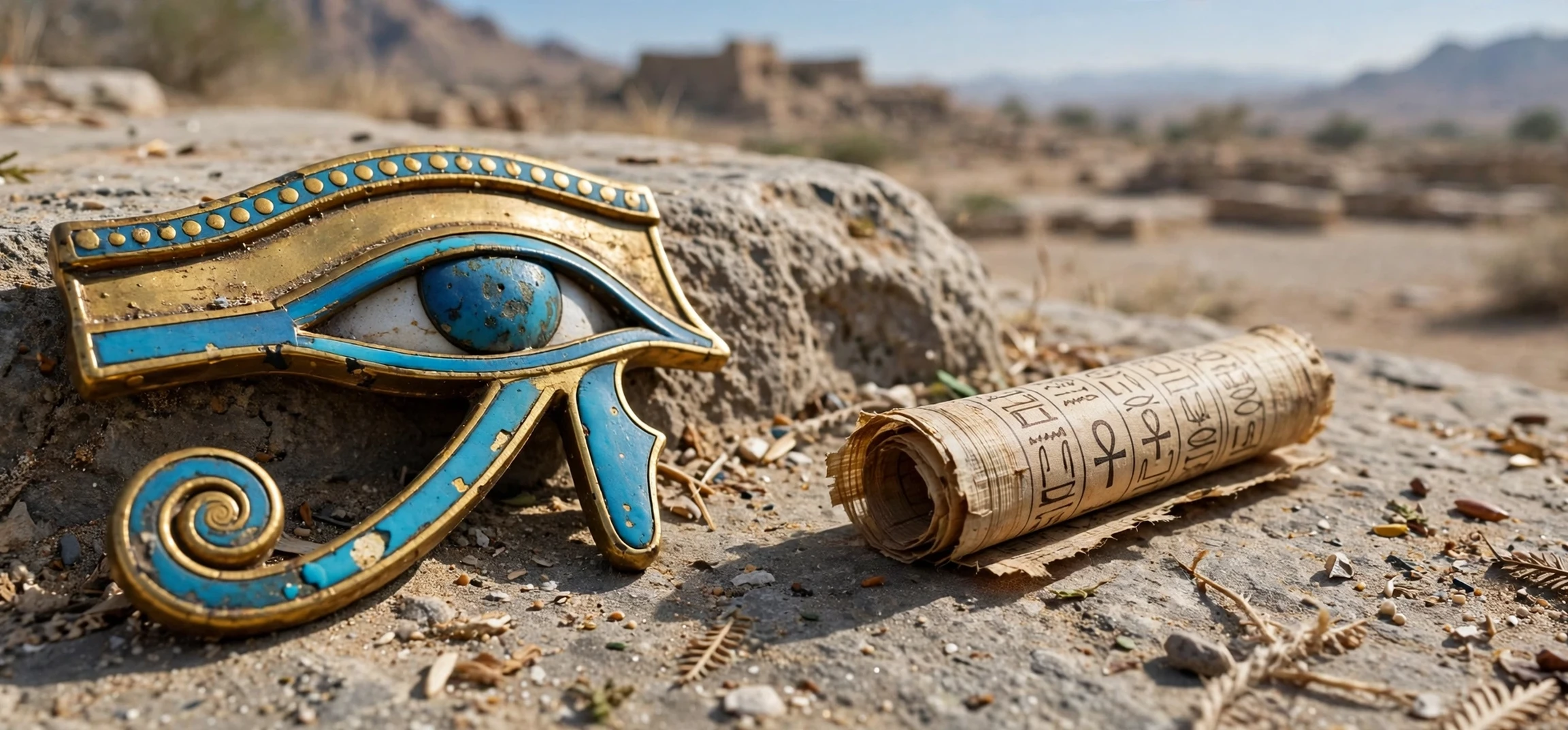
The meaning of the eye of ra begins in ancient Egypt, where the symbol stood for the power, protection, and watchful presence of the sun god Ra. Often drawn as a stylised human eye with a curved brow, a spiral curl, and a teardrop line, the Eye of Ra is one of the most recognisable images from the ancient world. It appears on temple walls, amulets, jewellery, and coffins, and it has survived for thousands of years as a sign of safety, health, and royal authority. To understand the symbol fully, it helps to separate the myth behind it from the many modern meanings people attach to it today.
Ra was the Egyptian god of the sun, creation, and kingship. Each day he was believed to travel across the sky, bringing light and order to the world, and each night he passed through the underworld, facing darkness and chaos before rising again at dawn. The Eye of Ra was often described as a powerful extension of the god himself, sometimes pictured as a goddess who acted on his behalf. That idea matters, because the eye was not just a picture of a god. It was an active force, watching, protecting, and striking against enemies. When Egyptians wore the symbol, they were asking for that watchful power to stay close to them.
The Meaning of the Eye of Ra in Ancient Egypt
In Egyptian myth, the Eye of Ra was linked to the sun and to the fierce, protective side of divine power. Stories describe Ra sending out his eye to punish those who rebelled against order, and the eye returned with great force. In some versions the eye took the form of a lioness goddess, full of heat and strength, and had to be calmed before it could return to Ra. This story gave the symbol a double meaning. It was protective for those under Ra’s care, and dangerous for those who threatened order. That combination of protection and power is why the eye appears so often in royal and religious art.
The eye was also connected to healing and wholeness through its close relative, the Eye of Horus. The two eyes are often confused, and the confusion is understandable, because both are eye symbols from Egyptian religion and both were used as amulets. The Eye of Horus is tied to the story of Horus, whose eye was injured in a struggle and then restored, making it a symbol of healing, restoration, and completeness. The Eye of Ra, by contrast, is tied more directly to the sun, to royal power, and to the force that defends order. Many modern writers blend the two, but in ancient Egyptian thought they had different stories, even if their protective uses overlapped in daily life.
For ordinary Egyptians, the practical meaning was simpler and more personal. An amulet in the shape of an eye could be worn around the neck, placed in a home, or included in a burial. It was meant to ward off evil, guard against illness, and keep the wearer safe on a journey, including the final journey into the afterlife. Craftsmen made these amulets from stone, faience, gold, and other materials, and the quality varied with the wealth of the owner. Rich or poor, the hope was the same: that a watchful, divine eye would see danger before the wearer did, and turn it aside.
The Meaning of the Eye of Ra: Symbolism and Design
Every part of the Eye of Ra design carries meaning, even if modern copies simplify the drawing. The eye itself suggests watchfulness and knowledge, because sight is the sense most linked to awareness. The heavy brow above the eye suggests strength and authority, like the brow of a falcon or a lion. The spiral curl below the eye is often compared to the marking on a falcon cheek, which connects the symbol to the sky and to swift, sharp vision. The teardrop line running down from the eye is sometimes linked to mourning, to the tears of a god, or to the idea that protection comes at a cost. Read together, the design is not just decorative. It is a compact picture of a god who sees everything, judges fairly, and protects fiercely.
Colour also mattered in Egyptian art. Gold suggested the sun and the eternal nature of the gods. Blue and green suggested life, rebirth, and the fertile land along the Nile. Red suggested power, heat, and the fierce side of the sun. When the Eye of Ra appears in a temple painting, the colours around it are part of the message, not just decoration. A golden eye on a dark background would read as the sun breaking through night. A blue or green eye might stress health and renewal. Modern reproductions often use a single colour, which is fine for jewellery or tattoos, but the ancient original was part of a much richer visual language.
The eye also appears alongside other Egyptian symbols, and those pairings change the emphasis. Paired with the ankh, the symbol of life, the eye stresses protection that leads to life and health. A guide to the ankh meaning shows how often Egyptian symbols were combined to build a fuller message. Paired with a sun disk or a cobra, the eye stresses royal power and the defence of the king. Paired with a scarab, it stresses rebirth and the daily rising of the sun. Learning to read these combinations is like learning to read a sentence made of pictures, which is exactly how Egyptian art often worked.
The Eye of Ra, Pharaohs, and Temples
Pharaohs used the Eye of Ra as a sign of their link to the gods. As rulers, they were seen as the sons of Ra and as guardians of order on earth, so a symbol of Ra’s watchful power was a natural emblem for kingship. It appears in royal crowns, thrones, and ceremonial objects, where it told viewers that the king ruled with divine backing. Temple priests also used the eye in rituals, paintings, and offerings, especially in ceremonies linked to the sun, to healing, and to protection against chaos. In a temple, the eye was not a private charm. It was a public statement about who held power and whose order the temple defended.
The names and stories of Egyptian rulers are part of the same world of symbols and titles. A list of Egyptian pharaoh names gives a sense of how many kings claimed a connection to Ra, to the sun, and to divine protection. Some took throne names that included Ra, placing the god’s name at the heart of their royal identity. Others built temples aligned to the rising sun, so that light would fall on a statue or a sacred chamber at dawn. In that setting, the Eye of Ra was more than an amulet. It was part of a whole system of kingship, astronomy, and religion that tied the ruler, the sun, and the land together.
Burial practice shows the personal side of the symbol again. Coffins, tomb walls, and funerary amulets often carried eyes, because the dead were believed to need sight and protection in the next world. A painted eye on the side of a coffin allowed the deceased to see out, in Egyptian belief, and to watch for dangers on the journey ahead. The Eye of Ra in a burial therefore combined two hopes: that the dead person would be watched over by a god, and that the dead person would remain watchful and aware. For modern readers, that detail is a reminder that Egyptian symbols were practical tools for living and dying, not just art for display.
Eye of Ra Versus Eye of Horus: Clearing Up the Confusion
The most common question about this symbol is how it differs from the Eye of Horus, and the table below gives a clear comparison. Keep in mind that ancient sources themselves vary, and some writers use the two names loosely, so the table reflects the most widely taught distinction rather than a single fixed rule.
| Feature | Eye of Ra | Eye of Horus |
|---|---|---|
| Main god | Ra, god of the sun | Horus, god of kingship and the sky |
| Core meaning | Power, protection, and royal authority | Healing, wholeness, and restoration |
| Key story | Ra sends his eye out to defend order | Horus loses an eye in battle and it is restored |
| Common use | Royal emblems, temple art, protective amulets | Healing amulets, measures, and protective charms |
If you are choosing a design for jewellery, art, or study, the distinction can help you pick the meaning you actually want. A person drawn to sun symbolism, strength, and protection may prefer the Eye of Ra. A person drawn to recovery, balance, and wholeness after a hard time may prefer the Eye of Horus. Many modern designs blend features of both, and sellers do not always label them carefully, so it is worth comparing a design against museum images or reliable reference books before deciding what it represents. The goal is not to police other people’s jewellery, but to make an informed choice for yourself.
The Meaning of the Eye of Ra Today
Today the Eye of Ra appears in jewellery, tattoos, clothing, films, games, and home decoration. For many wearers, the meaning is personal rather than religious. It may stand for protection, for inner strength, for watchfulness, or for an interest in ancient history. Some wear it as a reminder to stay alert and make clear decisions. Others wear it as a cultural or spiritual symbol, connecting them to Egyptian heritage or to a broader interest in ancient wisdom. Because the symbol has travelled so far from its original temple setting, its modern meaning depends heavily on the wearer and the context.
That freedom brings a responsibility to use the symbol with respect. Ancient Egyptian religion was a living faith for thousands of years, and its symbols still matter to people who study, preserve, and honour that heritage. Wearing the eye as a fashion item is not the same as mocking it, and most people will not object to thoughtful use. Still, it is worth learning the basic story before adopting a sacred image, and worth avoiding designs that mix it carelessly with unrelated symbols in ways that distort its meaning. A little research turns a decorative choice into an informed one, and it helps keep an ancient symbol from becoming an empty trend.
Popular culture has also added layers that have little to do with ancient Egypt. Films and games sometimes use the eye as a shorthand for mystery, secret knowledge, or hidden power. That shorthand can be fun, but it can also create confusion, especially when the Eye of Ra is mixed up with the all-seeing eye found in other traditions. If you see the symbol in a film or a game, enjoy the story, but check a reliable history source before assuming the film version matches the ancient one. The real Egyptian story, with its sun god, its protective goddess, and its link to kingship, is rich enough without added mystery.
Using the Symbol Thoughtfully
If you plan to wear, draw, or display the Eye of Ra, start with the ancient meaning, then decide what it means to you. Learn the difference between the Eye of Ra and the Eye of Horus. Choose a design that matches the story you want to tell. If you are buying jewellery, ask the maker what the design is based on, and compare it with museum examples. If you are teaching children about Egypt, explain that the eye was a protective sign, not a magic spell, and that Egyptians used many symbols together to express ideas about life, death, and order. Thoughtful use keeps the symbol alive in a way that honours its origins.
Frequently Asked Questions About the Eye of Ra
What does the Eye of Ra protect against?
In ancient Egyptian belief, it protected the wearer against evil, illness, and chaos, and it guarded kings, temples, and the dead. In modern use, people often wear it as a general symbol of protection, strength, and watchfulness.
Is the Eye of Ra the same as the Eye of Horus?
No, although they look similar and both were used as protective amulets. The Eye of Ra is linked to the sun god Ra and to power and royal authority, while the Eye of Horus is linked to Horus and to healing and restoration after injury.
Is the Eye of Ra a good luck symbol?
Many people treat it that way today, and in ancient Egypt its protective role was close to what modern readers call good luck. The ancient meaning was stronger, though: it was not just luck, but the active protection of a god who defended order.
Can anyone wear the Eye of Ra?
Yes, it is widely worn as jewellery and art. Learning its history first, and using it with respect for Egyptian heritage, is the best way to wear it thoughtfully rather than as an empty fashion item.
Conclusion
The meaning of the eye of ra is rooted in the sun, in protection, and in royal power. In ancient Egypt it was the watchful eye of Ra, sent out to defend order, guard the king, and protect ordinary people in life and in death. Its design, with a strong brow, a falcon-like curl, and a teardrop line, packed those ideas into a single image that could be worn, painted, or carved. Today the symbol lives on in jewellery, art, and popular culture, where its meaning is often personal, but its ancient story still gives it depth. Understand that story, respect the difference between the Eye of Ra and the Eye of Horus, and the symbol becomes more than a striking design. It becomes a link to one of the oldest and most enduring visual languages in human history.