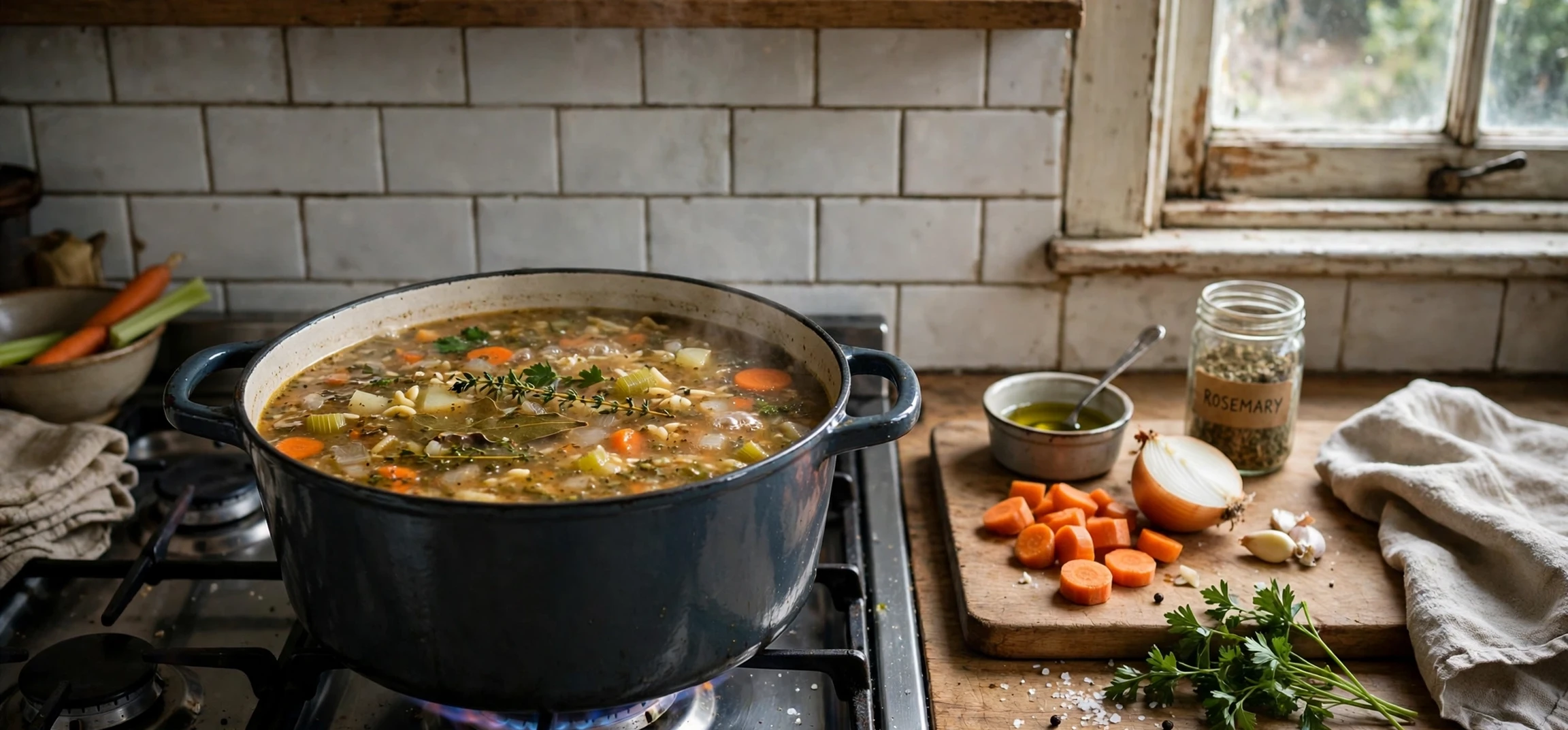
Storing homemade chicken stock properly keeps it safe, flavourful, and ready whenever a recipe needs it. Homemade stock beats shop-bought versions for depth of flavour, but because it has no preservatives, it must be cooled, stored, and reheated with care. This guide covers storing homemade chicken stock in the fridge and freezer, how long it lasts, and how to tell when it has gone off.
Storing Homemade Chicken Stock: Cool It Quickly
The first step in storing homemade chicken stock is cooling it quickly. Hot stock left sitting at room temperature for hours passes through the temperature range where bacteria multiply fastest, so speed matters. Transfer the strained stock to shallow containers, which cool faster than one deep pot, and place them in the fridge once the stock has stopped steaming. An ice bath, made by setting the container in a sink of cold water and ice, cools a large batch faster still.
Strain the stock before storing it. Remove bones, vegetables, and herbs, and skim fat from the surface if you prefer a lighter stock, though a layer of fat can actually help seal the surface during short fridge storage. Some cooks leave the fat on for fridge storage and remove it when reheating. Either approach works, provided the stock itself is cooled promptly and refrigerated.
Storing Homemade Chicken Stock in the Fridge
In the fridge, homemade chicken stock keeps for about 3 to 4 days at or below 4 degrees Celsius. Store it in clean, airtight containers, and label them with the date so you never have to guess. Glass jars and rigid plastic containers both work well, but leave headspace if you plan to freeze later, since liquid expands as it freezes.
If you need to keep stock for longer than a few days but are not ready to freeze it, bring it back to a full rolling boil, cool it quickly again, and return it to the fridge. This re-boiling can extend fridge life by a couple of days, but it is not a substitute for freezing, and stock that has been re-boiled more than once should be used promptly or discarded.
Storing Homemade Chicken Stock in the Freezer
Freezing is the best method for long-term storage. Homemade chicken stock keeps well in the freezer for 4 to 6 months, though it remains safe beyond that if kept constantly frozen; quality, rather than safety, is what declines. Freeze stock in portion-sized containers so you can defrost exactly what a recipe needs, and consider freezing some in ice cube trays for small amounts to enrich sauces and gravies.
Freezer bags laid flat save space and thaw quickly, but make sure they are sealed tightly and labelled. Rigid containers are easier to stack and less prone to leaks. Whichever you choose, cool the stock completely before freezing, leave expansion room, and write the date on every container. Frozen stock should be thawed in the fridge overnight, or reheated directly from frozen in a saucepan over gentle heat, stirring until it reaches a full boil.
How to Tell If Chicken Stock Has Gone Off
Trust your senses. Stock that smells sour, sharp, or unusually unpleasant should be thrown away, even if it is within the usual storage window. Slimy texture, mould on the surface, or a swollen container are also signs to discard it. When in doubt, throw it out: the cost of a batch of stock is far less than the cost of food poisoning.
Note that chilled stock often sets into a jelly, which is a good sign, not a fault. Gelatin from the bones gives well-made stock a wobbly, jelly-like texture when cold, and it melts back into liquid when heated. A fat cap on the surface is also normal and can be lifted off before reheating if you prefer a leaner result.
| Method | Storage time | Best for |
|---|---|---|
| Fridge (at or below 4 C) | 3 to 4 days | Stock you will use this week |
| Freezer | 4 to 6 months at best quality | Long-term storage, batch cooking |
| Ice cube trays, then bags | 4 to 6 months | Small amounts for sauces |
Storing Homemade Chicken Stock: Reducing and Concentrating
One useful trick for storing homemade chicken stock is to reduce it before freezing. Simmering the strained stock until it has lost half or more of its volume concentrates its flavour and gelatin, and the resulting concentrate takes up far less freezer space. A litre of full-strength stock can become a small tub of intense jelly that, when diluted with water, makes a litre again. This is especially handy for cooks with small freezers or for those who make stock in large batches.
Reduction also improves versatility. A concentrated stock can be used undiluted as a glaze or sauce base, or diluted to different strengths for different dishes: light for rice, full for soups, and extra-rich for risottos. Label reduced stock clearly with its concentration, such as “half-strength, dilute 1:1”, so that future you, or another cook, knows how to use it. Without a label, concentrated stock can easily overpower a delicate dish.
Be careful not to reduce stock that has already been salted, since salt concentrates along with flavour and can quickly become excessive. It is better to leave homemade stock unsalted and to season dishes at the cooking stage, which gives you full control and makes reduction safe. Unsalted stock also keeps more options open, since it can be used in any recipe without worrying about salt levels.
Storing Homemade Chicken Stock: Getting the Most from Every Batch
A well-stocked freezer changes how you cook. With portions of homemade chicken stock always available, weeknight meals improve dramatically: rice cooked in stock instead of water gains depth, pan sauces come together in minutes, and soups start from a base of real flavour rather than a cube. Freezing stock in varied portion sizes, from ice cubes for deglazing a pan to litre containers for soup, means you always have the right amount without waste.
Stock-making itself is economical. Bones and vegetable trimmings that might otherwise be thrown away become the raw material, and a single batch can supply weeks of cooking. Keeping a bag of trimmings in the freezer, adding onion ends, carrot peels, and herb stems as you cook, means you are always a few steps from a fresh batch. That cycle, from trimmings to stock to meals, is one of the most satisfying habits in home cooking.
Finally, share the habit. Homemade stock makes a thoughtful gift for a new cook, and teaching someone to make and store it passes on a skill that improves every meal they cook. In a kitchen culture dominated by convenience products, a freezer full of homemade stock is a quiet statement about cooking with care.
Storing Homemade Chicken Stock: Food Safety Essentials
Food safety is the foundation of storing homemade chicken stock, and the key rule is the two-hour guideline: perishable food should not sit at room temperature for more than two hours, and less in warm conditions. Stock that has simmered for hours should be cooled promptly, not left on the stove overnight to cool slowly. Shallow containers, ice baths, and fridge space cleared in advance all help meet that standard.
Reheating also matters. Stock should be brought to a full rolling boil before serving, and it should only be reheated once after storage. Repeated heating and cooling cycles degrade quality and increase risk, so portioning before freezing, so that each portion is heated only once, is the safest approach. If stock smells off, looks slimy, or shows mould, discard it without tasting, since tasting spoiled stock is itself a risk.
Clean equipment completes the picture. Containers should be washed in hot, soapy water and dried before use, and hands should be clean when handling stock. Those basic hygiene steps, combined with prompt cooling and proper storage times, make homemade stock as safe as it is delicious.
Storing Homemade Chicken Stock: Labelling and Organisation
Good labelling is the unglamorous secret of storing homemade chicken stock well. Every container should carry the contents, the date it was made, and, if reduced, its strength. Without labels, freezers fill with anonymous tubs that nobody dares to use, and stock is wasted. A simple system, masking tape and a marker, or printed labels for regular batches, prevents that waste and makes cooking faster, because you can find the right portion at a glance.
Organisation matters too. Store the oldest stock at the front, use a first-in, first-out rotation, and keep a rough inventory if you freeze large quantities. Those habits, borrowed from professional kitchens, take minutes and save both food and frustration.
Finally, review your freezer periodically. Stock kept for more than six months is still safe if constantly frozen, but its flavour fades, so plan to use older batches first and to make fresh stock regularly. A well-organised freezer is a well-used freezer.
Storing Homemade Chicken Stock FAQs
How long does homemade chicken stock last in the fridge?
About 3 to 4 days at or below 4 degrees Celsius, in a clean airtight container.
Can you freeze chicken stock in glass jars?
Yes, provided the jars are freezer-safe and you leave headspace for expansion, since liquid expands as it freezes.
Is jelly-like stock safe?
Yes. A jelly texture when cold is caused by natural gelatin from the bones and is a sign of good stock.
Conclusion
Storing homemade chicken stock well comes down to three habits: cool it quickly, label and date every container, and freeze what you will not use within a few days. With those habits, a weekend pot of stock becomes a freezer full of flavour for months of cooking. For more kitchen guides, see our articles on what chicken stock is, kitchen terminology, and healthy snack guides.



