If you have ever stood in a gallery, browsed an auction listing, or picked up a print and wondered what exactly you were looking at, the phrase lithograph meaning is the key to a satisfying answer, because a lithograph is not just any printed picture: it is a print made by a particular chemical process that shaped art, advertising, and publishing for two centuries. This is a general art and print explainer, written for curious readers and new collectors, not an announcement about any new release. A lithograph begins life on a flat stone or a prepared plate, not on a carved block or an engraved metal sheet, and that flatness is the whole point: the image is drawn, treated with chemicals, and then printed from a surface where the printing and non-printing areas sit at the same level.
The word itself gives the game away. It comes from Greek roots meaning stone and writing, and the technique was invented in the late eighteenth century by Alois Senefelder, a German playwright who was looking for a cheap way to print his own work. He discovered that greasy marks on limestone, treated with acid and gum, would attract ink while the damp, unmarked stone would repel it. That simple chemical trick turned out to be revolutionary. Suddenly, an artist could draw directly onto the printing surface with a crayon or a brush, and the print would carry the freedom and texture of the drawing itself, rather than the stiff lines forced by carving tools. That freedom is central to lithograph meaning, because the artist’s hand reaches the print almost untouched. Within a few decades, lithography was everywhere: in posters, sheet music, maps, newspapers, and fine art.
Lithograph Meaning in Plain Language
At its simplest, lithograph meaning is this: a print produced by lithography, a planographic printing process based on the fact that oil and water do not mix. The artist draws on a slab of limestone or a grained metal plate with a greasy material. The surface is then treated so that the drawn areas accept ink and the blank areas, kept damp, reject it. When paper is pressed against the surface, only the drawn image transfers. Because the artist draws directly, lithographs can capture soft shading, crayon texture, and painterly washes in ways that engraving and woodcut, which rely on cutting away material, cannot easily match.
It is worth distinguishing the original process from later industrial cousins. Commercial offset lithography, the process behind most modern books, magazines, and packaging, uses the same oil-and-water principle but transfers the image from a plate to a rubber blanket and then to paper, at enormous speed. A fine-art lithograph, by contrast, is usually printed by hand, in a limited edition, with the artist involved in proofing and approving the result. When a gallery or auction house describes a work as an original lithograph, it generally means the artist created the image on the stone or plate for the purpose of printing, rather than a photographic copy of an existing painting being reproduced by a machine. Keeping that distinction in mind is the most useful part of lithograph meaning for a buyer.
Stone, Plate, and Paper
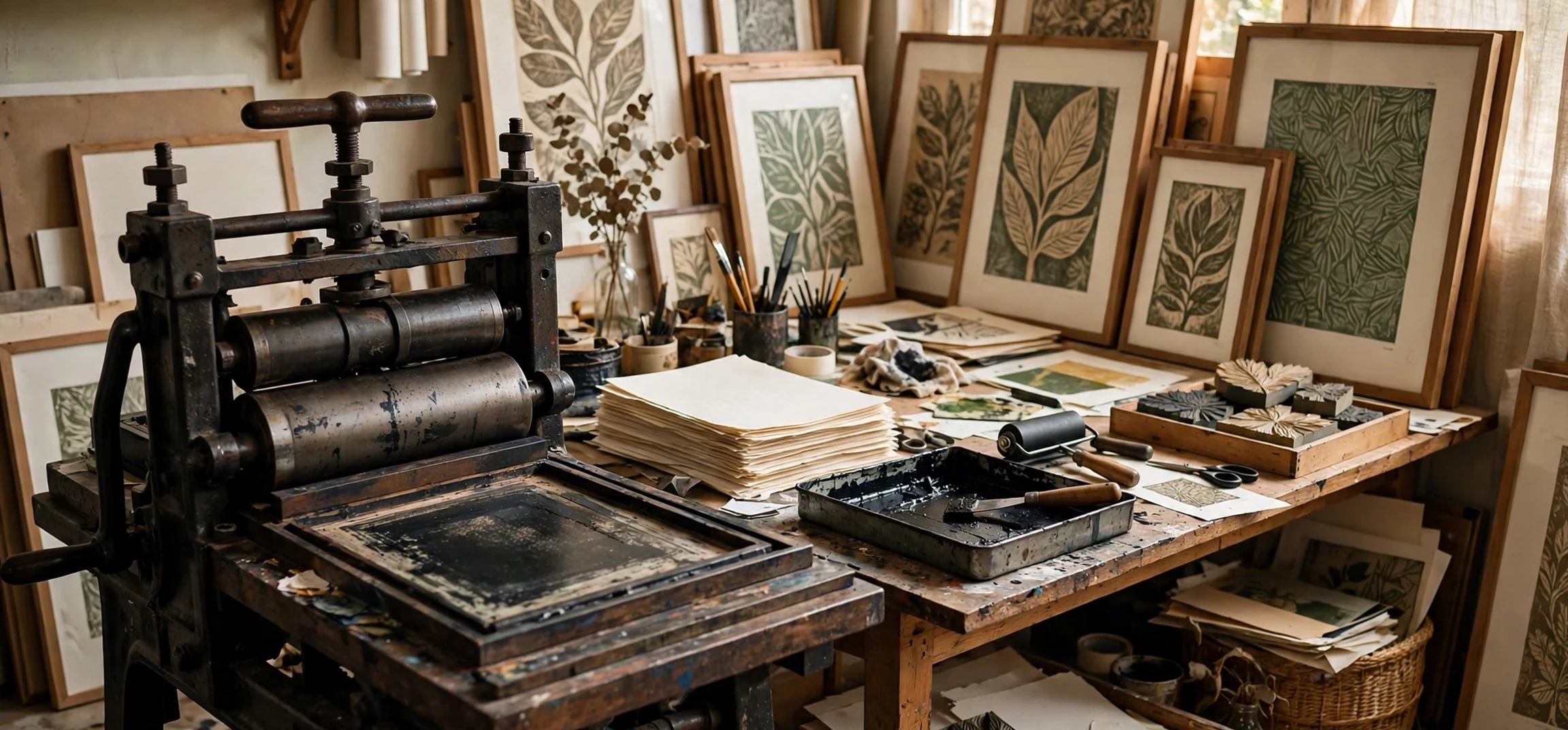
Traditional lithographic stones are slabs of fine-grained Bavarian limestone, heavy, flat, and polished to a smooth, even grain. The artist draws with lithographic crayons, tusche (a greasy liquid ink), or other greasy media. After the drawing is complete, the printer applies a solution of acid and gum arabic that fixes the image chemically: the drawn areas become receptive to ink, and the rest of the stone becomes receptive to water. During printing, the stone is kept damp and rolled with ink, which sticks only to the drawing, and a sheet of paper is pressed onto it under pressure. Each colour in a colour lithograph requires its own stone or plate, carefully aligned, or registered, so the colours meet precisely on the sheet. Registration is one of the quiet crafts behind lithograph meaning, and it is why multi-colour prints take such skill.
Lithograph Meaning in Art History
Lithography changed who could make art and who could afford it. Before its arrival, reproducing an image meant slow, skilled engraving. Lithography was faster, cheaper, and closer to drawing, so it became the medium of the illustrated press, the theatrical poster, and the political cartoon. In nineteenth-century Paris, artists such as Honoré Daumier used it for biting satire, while Henri de Toulouse-Lautrec turned the advertising poster into an art form in its own right, using bold flat colour and expressive line to sell cabarets and dance halls. The poster, as we know it, is largely a lithographic invention. In that sense, lithograph meaning belongs as much to advertising history as to fine art.
The medium also gave printmaking a new artistic status. Artists including Goya, Delacroix, and later Picasso, Miró, and Chagall all made important lithographs, drawn to the medium’s directness and its capacity for rich, tonal effects. In the twentieth century, workshops in Paris, London, and New York became centres where artists collaborated with master printers, and the limited-edition lithograph became a standard way for collectors to own work by major artists at a fraction of the price of a unique painting. That accessibility is a large part of why lithograph meaning still matters to collectors today. That tradition continues today, alongside digital printing, and it is why lithographs remain a staple of galleries, auctions, and museum print rooms.
How to Tell a Lithograph From Other Prints
For a new collector, the practical question is identification: how do you know a print is a lithograph rather than an etching, a woodcut, or a modern reproduction? A few clues help. Lithographs tend to show a flat, even ink surface with no plate mark, the shallow rectangular indentation left when an etched or engraved metal plate is pressed into paper. The lines often look like crayon or wash, with soft, grainy edges, rather than the crisp, incised lines of engraving or the bold, cut shapes of a woodcut. Colour lithographs may show slight misregistration at the edges, where one colour stone did not align perfectly, which is a charming sign of hand printing rather than a flaw to fear. Learning to read such signs is the practical side of lithograph meaning for anyone buying prints.
Edition marks matter too. A fine-art lithograph often carries a pencil signature by the artist and a fraction such as 12/100, meaning the twelfth impression of an edition of one hundred. The paper may be a heavy, high-quality sheet, sometimes with a watermark or a deckle edge. None of these signs is proof on its own, and a reputable dealer or auction house will provide documentation, but together they build a picture. If you are spending serious money, an independent appraisal or a print specialist’s opinion is money well spent, because the market contains both honest reproductions and works whose descriptions are, shall we say, optimistic.
Lithograph Meaning for Collectors
What should a collector actually look for? First, the artist’s involvement: an original lithograph, where the artist drew on the stone, is a different and generally more valuable object than a reproduction lithograph, where an existing painting was copied onto a plate by a technician. Both can be attractive, and a good reproduction of a beloved image is nothing to be embarrassed about, but the price should reflect the difference, and the description should be honest about it. A dealer who explains lithograph meaning clearly, including whether the artist drew the stone, is a dealer worth trusting. Second, condition: look for fading, foxing (brown spots), creases, and trimming, all of which affect value. Third, provenance: a clear chain of ownership and, where relevant, a certificate from the publisher or the artist’s estate adds confidence.
Framing deserves a thought as well. Lithographs are works on paper, and paper dislikes sunlight, damp, and acidic mounts. A good framer will use acid-free materials, keep the print away from direct sun, and allow the paper to breathe. Done well, a framed lithograph can be enjoyed daily for generations; done badly, a print can fade or stain within a few years. Protecting paper is part of respecting what lithograph meaning represents: a hand-pulled object, not a disposable copy. These are small, practical decisions, but they are the difference between a purchase that holds its pleasure and one that quietly deteriorates on the wall.
Lithography Today
Is lithography still alive? Absolutely, in two very different worlds. In fine art, print workshops continue to produce hand-pulled lithographs, and contemporary artists still choose the medium for its unique textures and its collaborative craft. In industry, offset lithography remains the backbone of high-volume commercial printing, even as digital methods grow. The two worlds share a principle and a name, but they are different practices, and knowing which one a seller means is half of understanding any listing you read. When a listing says “lithograph” without further detail, the context, the price, the edition size, and the seller’s description should tell you which world you are in. Asking that question is, in short, asking what lithograph meaning amounts to in this particular listing.
Lithography also survives in education and in community print studios, where the stone, the crayon, and the press give students a hands-on sense of how images are made. There is something satisfying about a process that depends on grease, water, stone, and pressure, and that has barely changed in its essentials since Senefelder’s discovery. It is a reminder that not every technology needs to be digital to remain relevant, and that a good idea, clearly understood, can serve art and communication for centuries.
Lithograph Terms Quick Reference
| Term | What it means | Why it matters |
|---|---|---|
| Planographic | Printing from a flat surface | The defining feature of lithography |
| Stone | Limestone slab drawn on by the artist | The original printing surface |
| Tusche | Greasy liquid drawing ink | Creates wash-like tones on the stone |
| Registration | Aligning each colour stone precisely | Keeps multi-colour images sharp |
| Edition | The total number of impressions printed | Shown as a fraction, such as 12/100 |
| Offset lithography | Industrial version using a rubber blanket | Behind most modern mass printing |
Frequently Asked Questions
Is every lithograph a valuable artwork?
No. Some lithographs are mass-produced decorative prints, while others are limited-edition artist originals. Value depends on the artist, the edition, the condition, and whether the artist created the image directly on the stone or plate.
What is the difference between a lithograph and a giclée print?
A lithograph is printed from a stone or plate using the oil-and-water principle, often by hand. A giclée is a high-quality inkjet reproduction of an existing image. Both can look beautiful, but they are different processes with different markets.
How should I care for a lithograph at home?
Frame it with acid-free materials, hang it away from direct sunlight and damp walls, and avoid touching the printed surface. Good framing and placement protect paper prints for decades.
Conclusion
So, lithograph meaning is richer than “a kind of print”: it names a chemical discovery that let artists draw directly onto stone, made images cheap enough for posters and newspapers, and gave collectors a way to own original work by great artists. Whether you are browsing a gallery, reading an auction listing, or simply curious about a print on your own wall, knowing the stone, the grease, the water, and the press behind it turns a flat picture into a small piece of history. For more word and art explainers, see our guide to unity in art, our look at a night at the museum, and our explainer on meaning and its aliases.