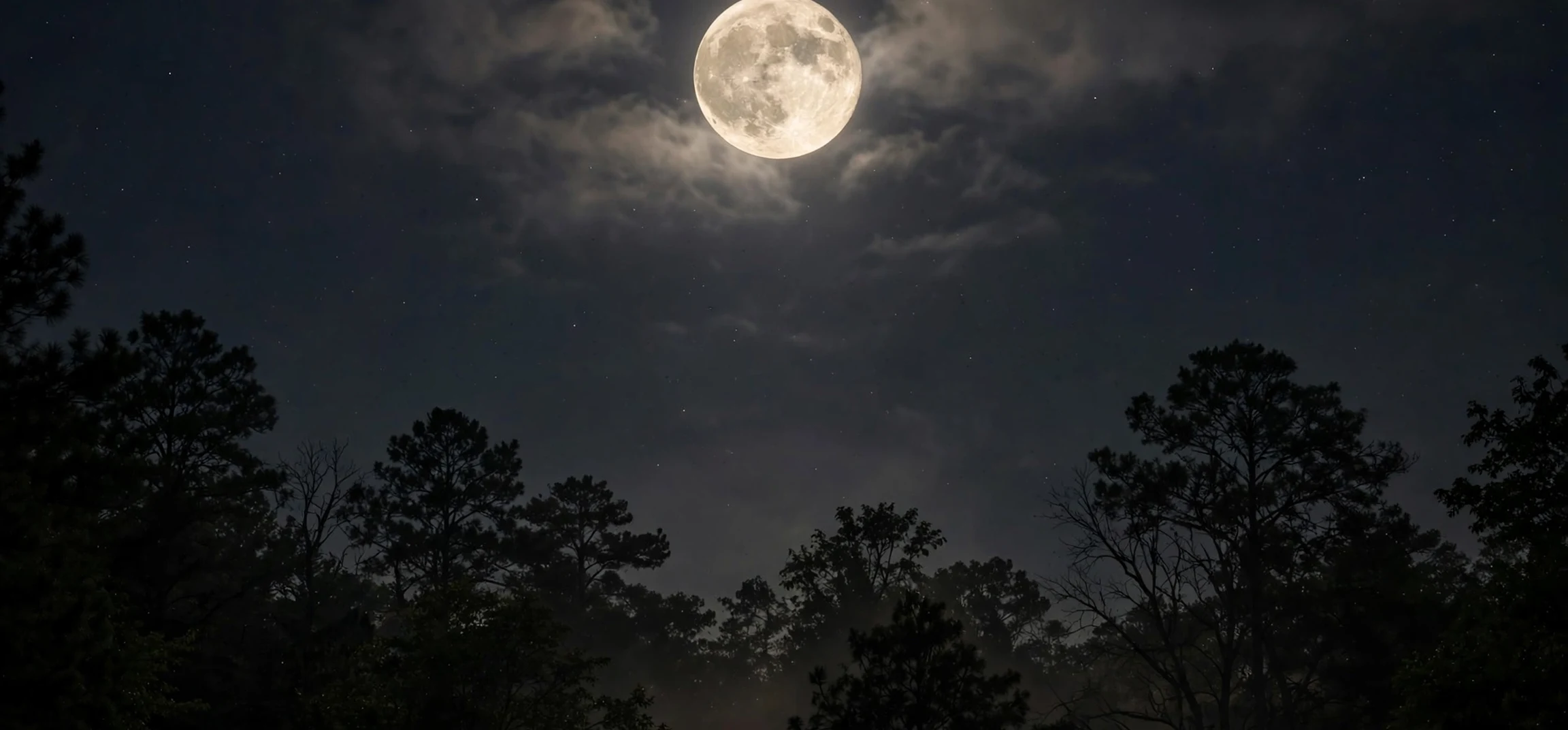
So, what is the moon’s real name? The honest answer is simpler than many people expect: Earth’s Moon is officially called the Moon. It does not have a secret scientific name that replaces the everyday word, although it does have poetic and classical names that appear in science and literature. This guide explains the moon’s real name in full, why the question comes up so often, how moons are named in general, and the key facts about our own Moon that make it special.
The question usually comes from a reasonable place. Planets have proper names such as Mars and Venus, and many moons have striking names such as Titan, Europa, and Io. It feels natural to ask what Earth’s Moon is called in the same way, and to wonder whether scientists use a different, more formal name behind the scenes. They do, in a sense, but the formal names are additions to the word Moon, not replacements for it. Understanding that distinction clears up most of the confusion at once.
What Is the Moon’s Real Name?
The moon’s real name is the Moon, written with a capital M when it refers to Earth’s natural satellite. That capital letter matters: a lowercase moon can mean any natural satellite of any planet, while the Moon with a capital M means our Moon specifically. In scientific writing, the Moon is often referred to simply as the Moon, and its properties are described with the adjective lunar, which comes from the Latin word Luna.
Luna is the Latin name for the Moon, and it is the source of words such as lunar, lunatic in older usage, and lunation for the cycle of phases. Selene is the Greek equivalent, named after the Greek goddess of the Moon, and it gives us words such as selenology, the study of the Moon, and selenium, an element whose name was inspired by the Moon. These classical names are real and widely used in scientific terms, but neither Luna nor Selene is the official proper name that replaces the Moon in everyday or official use. Think of Luna and Selene as the Moon’s classical titles, while the Moon remains its name.
Why There Is No Other Official Name
Part of the reason is history. People named the Moon long before they knew it was one moon among many. For most of human history, the Moon was simply the Moon, the bright object in the night sky, just as the Sun was simply the Sun. When astronomers later discovered moons around other planets, they needed names for those new objects, but there was no need to rename the original. The original kept its ancient name, and the newcomers received new ones.
Official naming in astronomy is overseen by the International Astronomical Union, which approves names for planets, moons, asteroids, and surface features. That body recognises the Moon as the name of Earth’s satellite, and it approves names for features on the Moon’s surface, such as craters and mountains, many of which honour scientists and explorers. The system works precisely because the Moon itself needs no new label: everyone already knows which object the word refers to.
Why People Search for the Moon’s Real Name
Several common confusions drive searches for the moon’s real name. One is the comparison with other moons. Jupiter’s moon Europa and Saturn’s moon Titan sound like proper names, so people assume Earth’s Moon must have an equivalent that they have simply never learned. Another is school and quiz culture, where a question such as “What is the real name of the Moon?” implies a hidden answer, when the expected answer is often Luna, given as the Latin name. A third is fiction and popular science, where writers use Luna for a lunar colony or a futuristic setting, which makes Luna feel like the scientific name.
Search engines also amplify the question. When many people type the same phrase, related questions appear, and each one makes the mystery feel bigger. In reality, the answer is a matter of naming convention, not a concealed fact. Once you know that the Moon is the official name and that Luna and Selene are classical and scientific roots, the whole topic falls into place, and you can enjoy the classical names without being misled by them.
Luna, Selene, and Other Names Explained
Luna comes from Roman mythology, where Luna was the goddess of the Moon. The word survives in lunar calendars, lunar eclipses, and lunar modules, all of which describe things relating to the Moon. Selene comes from Greek mythology, where Selene was the goddess of the Moon, often pictured driving a chariot across the sky. The word survives in selenology and in the names of some lunar missions and projects. Both words are useful, beautiful, and scientifically legitimate as roots, but neither one is used as the official name of the Moon in place of the Moon itself.
You may also hear the Moon called Earth’s natural satellite, which is a description rather than a name. That phrase distinguishes the Moon from artificial satellites, the machines humans have placed in orbit. It is accurate and common in textbooks, but it is not a proper name either. The pattern is consistent: the Moon has one name, several classical roots, and several descriptions, and keeping those categories separate prevents confusion.
How Moons Are Named in General
Moons of other planets are named through a formal process. When astronomers confirm a new moon, they give it a temporary designation, and the International Astronomical Union later approves a permanent name, usually drawn from mythology related to the parent planet’s mythology. Moons of Jupiter, for example, are often named after figures connected with Zeus, the Greek equivalent of Jupiter, while moons of Saturn often carry names from related myths. This system keeps names organised and avoids duplicates across the solar system.
Earth’s Moon predates that system, which is why it does not follow the pattern. It was named by ordinary language thousands of years before formal astronomical naming began. Other ancient objects share the same pattern: the Sun is called the Sun, not by a mythological replacement, and Earth is called Earth. These ancient names are proper names in their own right, even though they sound like ordinary words. That is a feature of language, not a gap in science.
| Moon or body | Parent planet | Name origin | Note |
|---|---|---|---|
| The Moon | Earth | Ancient English word for the night luminary | Official name is the Moon; Luna and Selene are classical roots |
| Titan | Saturn | Greek mythology, the Titans | Largest moon of Saturn |
| Europa | Jupiter | Greek mythology, a figure linked with Zeus | Icy moon with a subsurface ocean |
| Io | Jupiter | Greek mythology, a figure linked with Zeus | Most volcanically active body known |
| Phobos | Mars | Greek word for fear | Larger of the two moons of Mars |
| Deimos | Mars | Greek word for panic | Smaller of the two moons of Mars |
| Charon | Pluto | Greek mythology, ferryman of the dead | Largest moon of Pluto, nearly half its size |
This comparison makes the point clearly. Every other moon on the list needed a new name when it was discovered, because it had no name in ordinary language. Earth’s Moon already had one, and science kept it.
Key Facts About the Moon
The Moon is about 384,400 kilometres from Earth on average, and it takes about 27.3 days to orbit Earth, which is also about how long it takes to rotate once. That match is why we always see the same face of the Moon from Earth, a situation called synchronous rotation. The far side is sometimes called the dark side, but that nickname is misleading: the far side receives just as much sunlight as the near side over a full cycle, and we simply cannot see it from Earth.
The Moon is about one quarter the diameter of Earth, making it unusually large relative to its planet. That size is one reason its gravitational pull has such a strong effect on Earth, driving the tides in the oceans. The Moon’s phases, from new moon to full moon and back, are caused by the changing angle of sunlight as the Moon orbits Earth, not by Earth’s shadow, except during a lunar eclipse, when Earth does pass between the Sun and the Moon.
Humans have visited the Moon directly. The Apollo programme landed astronauts on the Moon between 1969 and 1972, and robotic missions from many countries have studied its surface, its water ice at the poles, and its history. The Moon is thought to have formed about 4.5 billion years ago, most likely when a Mars-sized body collided with the early Earth and the debris gathered into orbit. That violent origin story makes the Moon’s calm, familiar presence in our sky all the more remarkable.
Naming stories like this one are part of a wider pattern in how we label the sky. For a related example, see how the planet Earth got its name, and for another naming tradition, explore the constellation of stars names used by astronomers. Objects named after people follow a similar formal process, as shown by an asteroid named after a scientist.
Moon’s Real Name: Frequently Asked Questions
Is the Moon’s real name Luna?
Luna is the Latin name for the Moon and the root of the word lunar, but the official name remains the Moon. Luna is best described as a classical and scientific name for the same object, not a replacement for the everyday name.
Is the Moon’s real name Selene?
Selene is the Greek name for the Moon and the root of selenology, the study of the Moon. Like Luna, it is a classical name that describes the same object, while the official name remains the Moon.
Does the Moon have a scientific name?
In scientific writing, the Moon is called the Moon, and related things are described as lunar. There is no separate scientific proper name that scientists use instead of the Moon in formal contexts.
Why do other moons have names but ours seems not to?
Ours does have a name: the Moon. Other moons needed new names when they were discovered, because they had no name in ordinary language. Earth’s Moon was named thousands of years before modern astronomy, so its ancient name became its official name.
Moon’s Real Name Quick Recap
To recap the moon’s real name, the official name is the Moon, Luna is its Latin root, and Selene is its Greek root. Anyone asking about the moon’s real name can now answer in one sentence, and anyone who hears the moon’s real name debated online can spot the confusion at once. The moon’s real name is not hidden, the moon’s real name is not a code word, and the moon’s real name has been in plain sight for thousands of years.
Conclusion
The moon’s real name is the Moon, and that simple answer is the correct one. Luna gives us the word lunar, Selene gives us selenology, and both classical names enrich how we talk about our nearest neighbour in space. But neither one replaces the name that people have used for thousands of years, and neither one is a secret that science keeps from the public. The next time someone asks for the moon’s real name, you can answer with confidence: it is the Moon, known in Latin as Luna and in Greek as Selene, and it remains one of the most familiar and most studied objects in the sky.