If you have ever read an eye test result and wondered what it means, you are not alone. The phrase 20/40 visual acuity sounds technical, but it describes a simple comparison: what you can see clearly at 20 feet, compared with what a person with standard vision can see clearly at 40 feet. In other words, 20/40 visual acuity means you need to be closer to an object to see it as clearly as someone with standard vision sees it from farther away. This guide explains 20/40 visual acuity in plain language, how eye charts measure it, how it compares with 20/20 vision, what it does and does not mean for driving, reading, and daily life, and when you should see an eye-care professional for a full examination.
It is important to say at the start that this article is general educational information only. It is not a diagnosis, and it cannot replace an eye examination. Vision is affected by many factors, including refractive error, eye health, lighting, age, and medical conditions, and only a qualified eye-care professional who examines your eyes can interpret your individual result. If you notice a sudden change in vision, eye pain, flashes, a shadow, or loss of vision, seek prompt professional care rather than relying on an online guide. With that boundary clear, the rest of this article will help you understand what 20/40 visual acuity usually means and what questions to ask at your next eye appointment.
Table of Contents
- What 20/40 Means in Plain Language
- How Eye Charts Measure Acuity
- Comparing 20/20, 20/40, and Other Levels
- Common Causes and Correction Options
- Daily Life, Driving, and Reading
- When to See an Eye Professional
- Frequently Asked Questions
- Conclusion
What 20/40 Visual Acuity Means in Plain Language
The numbers in 20/40 visual acuity are a fraction, and reading them as a fraction makes the meaning clearer. The top number, 20, is the distance in feet at which you are tested. The bottom number, 40, is the distance in feet at which a person with standard vision can read the same line on the chart. So if your result is 20/40 visual acuity, you can read at 20 feet what a person with standard vision can read at 40 feet. You need to be twice as close to see the same detail. That is the whole idea, and it is less alarming than it first sounds, because many people function very well with this level of vision, especially with glasses or contact lenses.
It helps to avoid two common misunderstandings. First, 20/40 visual acuity does not mean you see only 40 percent, or that your vision is 40 percent as good in every way. Vision involves sharpness, contrast, colour, depth, peripheral awareness, and how your eyes work together, and a single acuity number captures only sharpness at a distance under test conditions. Second, the number does not by itself tell you why your vision measures that way. It could reflect a need for a different glasses prescription, tired eyes on the day of testing, a dry eye surface, or an eye health issue, and only a full examination can distinguish those possibilities. Treat 20/40 visual acuity as a measurement to discuss with a professional, not as a diagnosis in itself.
Acuity is also measured separately for each eye and for both eyes together, and with and without correction. Your chart may therefore show several related results, such as uncorrected acuity without glasses, best-corrected acuity with glasses, and binocular acuity with both eyes open. Those distinctions matter. A person whose uncorrected result is 20/40 visual acuity but whose corrected result is 20/20 has a very different situation from a person whose best-corrected result remains 20/40. Always check which version your result refers to, and ask your eye-care professional to explain it in those terms.
How Eye Charts Measure 20/40 Visual Acuity
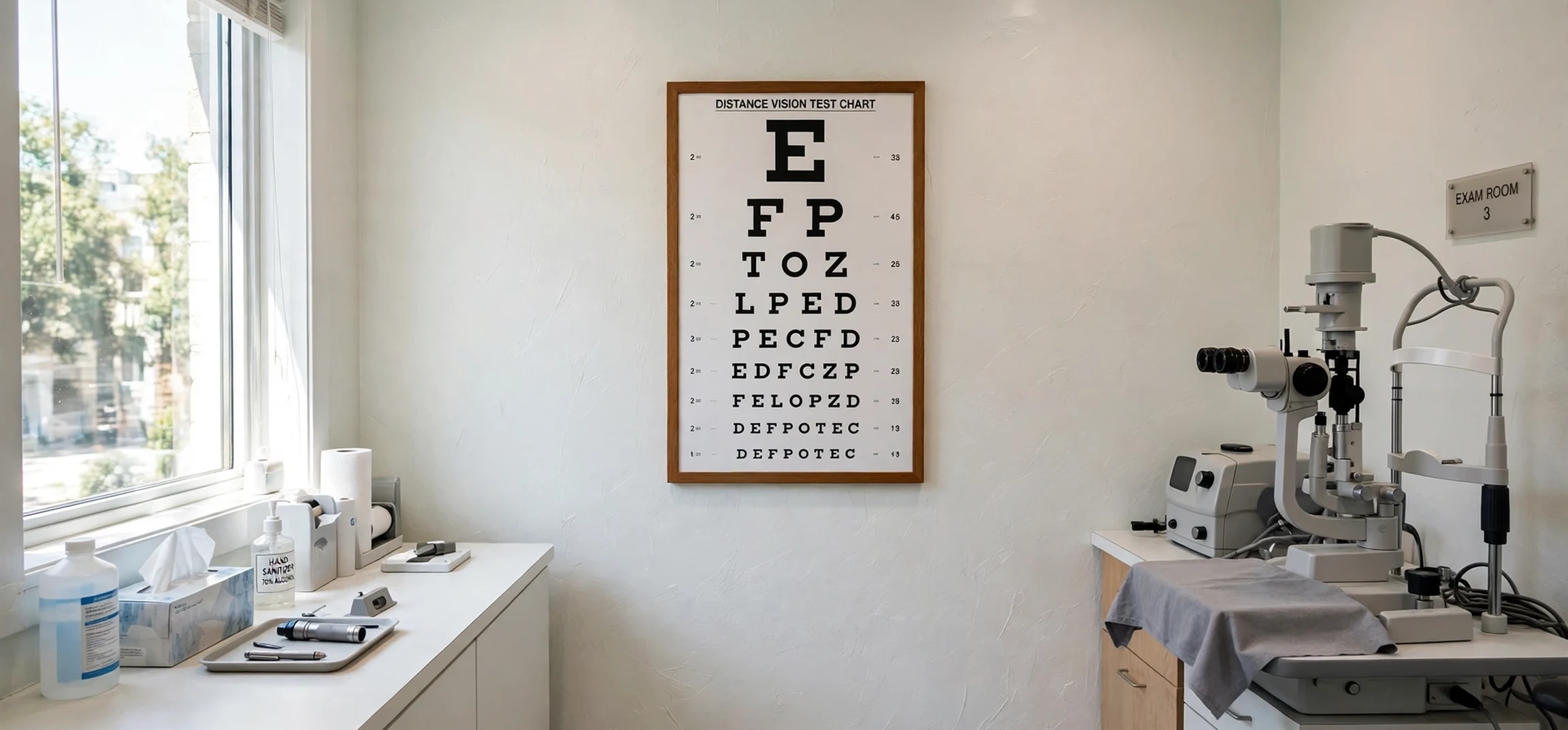
The most familiar eye chart is the Snellen chart, named after the Dutch ophthalmologist who designed it in the 1860s. It shows rows of letters that get smaller towards the bottom, and each row corresponds to a level of acuity. The large letter at the top is designed to be read at 200 feet by a person with standard vision, so it is labelled 20/200. As you read down, the letters get smaller, and the row you can read reliably at 20 feet determines your result. If the smallest line you can read reliably is the line labelled 40, your result is 20/40 visual acuity. Modern charts may use different letters, symbols for children, or a logarithmic design, but the underlying comparison is the same.
Testing conditions affect the result more than people expect. Lighting, chart distance, whether you squint, whether you guess, and how tired your eyes are can all shift a line or two. A good examiner will test each eye separately, often by covering one eye, will ask you to read without squinting or leaning forward, and will repeat a line if your answers are uncertain. If you wear glasses or contact lenses, the examiner will usually test both with and without them, so the change from correction can be seen clearly. That is why a single home test on a phone screen, while interesting, is not a substitute for a clinical measurement: screen size, distance, brightness, and room lighting are rarely standardised at home.
Children are often tested with picture charts or matching games rather than letters, and the expected acuity for a young child is different from that for an adult, because visual development continues through early childhood. Older adults may also have different expectations, because age-related changes in the lens and retina can affect sharpness even with an up-to-date prescription. In both cases, the number is interpreted against age and eye health, not in isolation. If a child’s result is described as 20/40 visual acuity, a paediatric eye professional can explain whether that is within the expected range for that age or whether follow-up is needed.
The Difference Between Acuity, Prescription, and Eye Health
Acuity, prescription, and eye health are three different things, and confusing them causes unnecessary worry. Your prescription, written in dioptres, describes the lens power needed to focus light correctly on your retina. Acuity describes how small a detail you can resolve once focus is corrected as well as possible. Eye health describes the condition of the eye itself, including the cornea, lens, retina, and optic nerve. A person can have 20/40 visual acuity with a mild prescription that is easily corrected, or with a healthy eye that simply needs a new prescription, or with an eye condition that limits acuity even with the best glasses. Only a comprehensive examination, which usually includes refraction, eye health checks, and sometimes additional tests, can separate those stories.
Comparing 20/40 Visual Acuity With 20/20 and Other Levels
The reference level 20/20 is often called standard or normal vision, but that label can be misleading. It means you can read at 20 feet what a person with standard vision reads at 20 feet, which is a useful benchmark, not a perfect score. Many people see better than 20/20, with results such as 20/15, meaning they can read at 20 feet what a standard eye reads at 15 feet. Others see at 20/25 or 20/30, which is slightly below the benchmark but still very functional. In that context, 20/40 visual acuity is one step further down the chart, noticeable in tasks that require fine distance detail, such as reading small road signs early, but often manageable in everyday life.
The table below puts common levels in context. Remember that these descriptions are general, that individual experience varies, and that corrected vision is usually what matters most for daily tasks. A person who measures 20/40 without glasses but 20/20 with glasses has a different daily experience from a person who measures 20/40 even with glasses, and both should discuss their specific results with their eye-care professional rather than relying on a general table.
| Acuity level | What it means | Everyday sense |
|---|---|---|
| 20/15 | Reads at 20 feet what standard vision reads at 15 feet | Sharper than the standard benchmark |
| 20/20 | Reads at 20 feet what standard vision reads at 20 feet | Standard benchmark for distance sharpness |
| 20/25 | Reads at 20 feet what standard vision reads at 25 feet | Slightly below benchmark, usually very functional |
| 20/30 | Reads at 20 feet what standard vision reads at 30 feet | Mild reduction in distance detail |
| 20/40 | Reads at 20 feet what standard vision reads at 40 feet | Noticeable for small distant detail; often correctable |
| 20/60 | Reads at 20 feet what standard vision reads at 60 feet | More noticeable; professional advice important |
| 20/200 | Reads at 20 feet what standard vision reads at 200 feet | Significant reduction; legal blindness threshold in many places |
In many regions, 20/40 visual acuity is also relevant to driving standards, because licensing authorities often set a minimum acuity for driving, sometimes with correction. The exact standard, whether it applies to one eye or both eyes together, and whether glasses or contact lenses count, varies by country and by licence type, so you should check your local driving authority’s current rules rather than assuming a general rule applies to you. If you are unsure whether your vision meets your local driving standard, ask your eye-care professional and your licensing authority, and do not drive if you feel your vision is unsafe, even if a number alone does not tell the full story.
Common Causes of 20/40 Visual Acuity and Correction Options
The most common cause of reduced distance acuity is refractive error: nearsightedness, farsightedness, or astigmatism, where light is not focused sharply on the retina. Those conditions are usually corrected with glasses or contact lenses, and a change in prescription can often bring 20/40 visual acuity back to 20/20 or close to it. That is why an up-to-date prescription matters so much: a prescription from several years ago may no longer match your eyes, and the gap can show up as a line or two on the chart. Regular eye examinations, typically every one to two years for adults, or as advised by your professional, help catch those changes early.
Other causes are less simple. Dry eyes, especially after long screen use or in dry environments, can blur vision intermittently and make a chart result vary during the day. Cataract, which is clouding of the eye’s natural lens, commonly develops with age and can reduce acuity even with glasses, often with glare or faded colours as additional clues. Retinal conditions, corneal irregularities, and other eye diseases can also limit acuity, and some of them need treatment that glasses alone cannot provide. That range of possibilities is exactly why a persistent result of 20/40 visual acuity, especially if it is new, worsening, or different between your two eyes, deserves a professional examination rather than a new pair of ready-made glasses alone.
Correction options go beyond a single pair of glasses. Your professional may discuss updated glasses, contact lenses, or, where appropriate, refractive procedures, but those options depend on your eye health, prescription, age, and lifestyle, and they carry their own benefits and risks that must be discussed individually. For near tasks such as reading, a separate near prescription or a multifocal lens may be relevant, because distance acuity and near acuity are different measurements. Do not choose a procedure or a lens type based on an online article; use this guide to prepare questions, then decide together with your eye-care professional after a full examination.
Daily Life With 20/40 Visual Acuity: Reading, Screens, and Driving
Daily life with 20/40 visual acuity is usually very manageable, particularly when correction brings vision to a sharper level. Without correction, you may notice that distant signs, bus numbers, classroom boards, or television subtitles are harder to read early, that you need to move closer to see fine detail, or that your eyes feel tired after distance tasks. With correction, many of those difficulties disappear. If difficulties persist even with glasses, tell your examiner, because that information helps distinguish a prescription issue from an eye health issue, and it may lead to additional tests or a referral.
Screen habits can help comfort even when they do not change acuity itself. Follow the common 20-20-20 habit for screen breaks: every 20 minutes, look at something about 20 feet away for about 20 seconds, to give focusing muscles a rest. Keep screens at a comfortable distance, use adequate lighting that does not create glare, and blink regularly, especially if your eyes feel dry. Those habits do not cure refractive error or eye disease, but they reduce strain and make it easier to notice genuine changes in vision, because you are less likely to confuse tired eyes with a lasting change.
For reading, remember that distance acuity and near vision are separate. A person can have 20/40 visual acuity at distance and still read comfortably up close, or can need reading glasses for near work while distance vision remains sharp. If reading has become harder, if you hold books farther away, or if print seems to blur after a short time, mention that specifically at your appointment, because near vision is tested separately and may need its own correction. Related eye topics on this site include our guide to what 20/30 vision means and our guide to what a twitchy left eye can mean, both of which explain why a single symptom or number rarely tells the whole story.
When to See an Eye-Care Professional About 20/40 Visual Acuity
You should book a routine eye examination if you have a new result of 20/40 visual acuity, if your glasses no longer seem to help as well as they did, if one eye is noticeably worse than the other, or if you have not had an eye examination in the recommended interval for your age and health. A routine examination is also the right step if you need vision documentation for driving, work, school, or sports, because the professional can measure acuity under standard conditions and explain the result in context. Bring your current glasses or contact lenses, a list of medicines, and a note of any symptoms, so the examination is as useful as possible.
Seek prompt care, the same day if possible, if you experience a sudden drop in vision, sudden loss of vision in one eye, eye pain, a shower of new floaters or flashes, a dark shadow or curtain across your vision, double vision, or vision changes after an injury or a chemical splash. Those symptoms can signal conditions that need urgent assessment, and waiting to see whether they improve on their own can risk lasting harm. If you cannot reach your usual eye professional quickly, use local urgent eye care, emergency services, or a hospital eye department as advised in your region. This guide cannot assess urgency for you; when in doubt, seek professional advice promptly.
Children, people with diabetes, people with a family history of eye disease, and people who take medicines known to affect the eyes should follow the examination schedule their professional recommends, which may be more frequent than the general interval. If a child is struggling to see the board, sitting very close to screens, squinting frequently, or complaining of headaches after schoolwork, an eye examination is a sensible first step, even if a school screening did not flag a problem. Early detection of vision problems in children supports learning and development, and it is one of the clearest reasons to treat a chart number as a prompt for care rather than a label to worry about alone.
Frequently Asked Questions About 20/40 Visual Acuity
Is 20/40 visual acuity bad?
It is below the 20/20 benchmark, but it is not automatically serious. Many people have 20/40 visual acuity without correction and see 20/20 with glasses. What matters is whether it is corrected, whether it is new or worsening, and what a full examination shows.
Can glasses fix 20/40 visual acuity?
Often, yes, if the cause is refractive error. An updated prescription frequently restores sharper acuity. If glasses do not fully correct it, your eye-care professional will investigate other causes.
Can I drive with 20/40 visual acuity?
Driving standards vary by region and licence type, and they often consider corrected vision in both eyes together. Check your local authority’s current rules and ask your eye professional if you are unsure.
Is 20/40 visual acuity the same as needing reading glasses?
No. Distance acuity and near vision are different. You can need help at distance, at near, or both, and each is tested and corrected separately.
Should children with 20/40 visual acuity worry?
Not necessarily, because expected acuity varies with age and development. A paediatric eye professional can explain whether follow-up, glasses, or monitoring is needed for that child.
Conclusion
In plain language, 20/40 visual acuity means you see at 20 feet what standard vision sees at 40 feet: a modest reduction in distance sharpness that is often correctable and often very manageable. It is a measurement, not a diagnosis, and its meaning depends on whether it is corrected, whether it is new, and what a full eye examination reveals about your eyes. Use this guide to understand the number, to ask better questions, and to recognise when routine care is enough and when prompt care is needed. Above all, if you have a result of 20/40 visual acuity that is new, worsening, unequal between eyes, or accompanied by worrying symptoms, see an eye-care professional. That examination, not an online chart, is what turns a number into a plan for your vision.



