When people search for pictures of witches marks, they are usually looking at photographs of strange carvings, scratched symbols, and painted signs found in old houses, churches, and barns. Historians call most of these apotropaic marks, a term that comes from a Greek word meaning to turn away evil. For centuries, ordinary people in Britain, Europe, and colonial America believed that certain marks could protect a home, a barn, or a church from witches, evil spirits, and bad luck. This guide explains what pictures of witches marks actually show, what historians believe the symbols meant to the people who made them, and how trial-era beliefs shaped the way communities interpreted unusual marks on buildings and bodies alike. It is a historical and folklore explainer, not a guide to any practice, and it draws on museum research and surviving buildings rather than legend alone.
Pictures of Witches Marks: What the Photographs Show
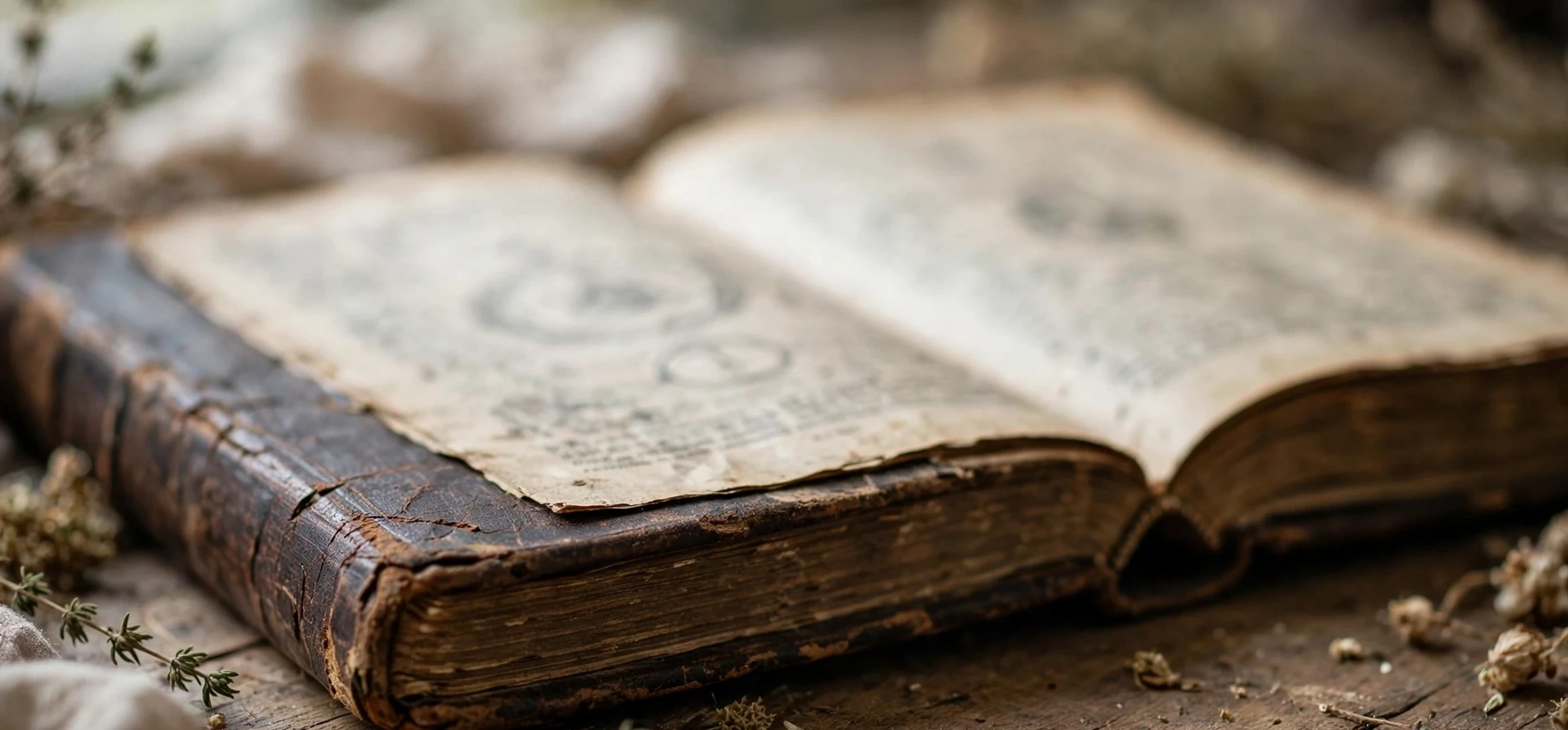
Most pictures of witches marks show one of a handful of recurring designs. The most common is a series of overlapping circles, often called a hexafoil or daisy wheel, carved with a compass into a wooden beam, a door frame, or a plaster wall. Another frequent design is a mesh of interlocking lines that looks like a tangled net, sometimes called a scratch dial or a mesh mark. Letters also appear, especially the intertwined letters V and M, which historians interpret as a reference to the Virgin Mary, and the letters IHS, a traditional monogram for the name of Jesus. Burn marks, made by holding a candle flame against timber until it scorched, form a fourth group, and shoes or other objects concealed inside walls form a related tradition of household protection. None of these marks was made to be decorative in the modern sense. They were placed deliberately, often near openings such as doors, windows, and fireplaces, where people believed harmful forces might enter.
Understanding the placement is the key to reading pictures of witches marks correctly. A daisy wheel carved beside a bedroom fireplace was not random doodling. In the beliefs of the time, the hearth was a vulnerable threshold, a hole in the house through which spirits could slip, and a mark beside it was meant to guard that opening. Marks cluster around the same spots again and again: the lintel above a door, the frame of a window, the beam over a bed, and the walls of barns where animals were kept. When historians find a cluster of marks in a building, they can often reconstruct which rooms people worried about most, and that pattern tells us more about everyday fears than any single symbol does. The marks are, in effect, a map of anxiety drawn onto the architecture of daily life.
How Historians Date and Identify Marks
Dating a carved mark is detective work. Historians look at the tool marks, the depth of the carving, the timber or plaster it sits on, and the building’s construction history. A mark cut into a beam that was installed in 1650 cannot be older than that beam, and a mark covered by later plaster must predate the plastering. Written records help too: churchwardens’ accounts, building surveys, and local histories sometimes mention the carving of protective symbols, though ordinary householders rarely wrote about their own marks. Modern surveys use photography, 3D scanning, and careful cataloguing to record marks before renovation or decay erases them, which is why so many pictures of witches marks now come from heritage projects and museum archives rather than from chance discovery.
Apotropaic Marks and the Beliefs Behind Them
The idea behind apotropaic marks was simple and deeply human: if evil could be confused, trapped, or turned away at the threshold, the household inside would be safe. The tangled mesh designs were understood, in folklore accounts, as endless lines that a spirit would have to follow forever, never finding its way through. The daisy wheel, with its overlapping petals, was read as a symbol of completeness and protection, a design with no beginning and no end. Letters and monograms invoked holy names, placing the household under spiritual protection. Burn marks may have been made during a ceremony of blessing a new house, or may simply have been a way of marking timber with fire, which itself was associated with purification. Historians disagree about individual meanings, and that disagreement is honest: the people who made these marks left few explanations, so modern interpretations rest on patterns, parallels, and the occasional written reference.
It is important to separate these protective marks from the very different marks associated with witch trials. Protective marks were made by householders to keep harm out. Trial-era marks, by contrast, were marks that accusers claimed to find on the bodies of suspected witches, and they belonged to a legal and theological framework about pacts with the devil. Confusing the two traditions leads to the common misunderstanding that every carved symbol in an old house is evidence of witchcraft. In fact, the opposite is closer to the truth: most surviving marks were made by people who feared witches, not by people accused of being witches. Keeping that distinction clear is essential for reading pictures of witches marks with historical accuracy rather than sensationalism.
Related symbolism appears across many cultures and periods, and comparing traditions helps historians avoid over-claiming a single meaning for any one mark. Our article on the meaning of the ankh symbol shows how one ancient sign accumulated layers of interpretation over centuries, a useful parallel for understanding how protective marks were read differently by different generations. Similarly, modern readers sometimes project tattoo symbolism onto old carvings, but the contexts differ sharply, as our piece on the meaning of 888 tattoos illustrates for a contemporary symbol with its own history.
Trial-Era Beliefs and the Search for Marks
The witch trials of the sixteenth and seventeenth centuries created a second, darker chapter in the history of marks. In England, Scotland, and colonial America, as well as across continental Europe, trial literature described the idea that a witch bore a mark where a familiar spirit suckled, an extra teat, a wart, a mole, or an insensitive spot on the skin. Witchfinders and searchers, often local people paid to examine suspects, looked for such marks on the body, and their findings could be presented as evidence in court. Modern historians regard this practice as unreliable and deeply unjust. Moles, scars, and birthmarks are common, pain responses vary, and the searchers themselves were often under pressure to find what the prosecution expected. The trial records therefore tell us more about the fears and legal customs of the period than about the accused, most of whom were ordinary people caught in community panics.
The social context matters as much as the theology. Trials often followed misfortunes that a community could not otherwise explain: a child fell ill, cattle died, a harvest failed, or a neighbour quarrelled with a poor, elderly, or outspoken woman. Accusations gave a frightening event a human cause and a legal remedy, and the search for bodily marks supplied the physical evidence that courts of the time expected. Historians also note the gendered pattern: most of the accused in England and America were women, many of them poor, widowed, or living on the margins of village life. Reading trial records today means recognising that the “marks” described were usually ordinary features of the human body, interpreted through a framework of belief that modern medicine and law have long abandoned.
What Trial Records Actually Say
Surviving pamphlets and court records describe searches in formulaic language, repeating phrases about teats and insensible spots across different cases. That repetition is itself evidence: searchers and pamphleteers borrowed language from one another, and a description that appears word for word in several trials probably reflects a shared template rather than independent observation. Some trials, such as the famous Pendle trials of 1612 in Lancashire, are documented in unusual detail, and they show how accusations built on gossip, family feuds, and the testimony of children. Later sceptics, including physicians and clergy, began to question the reliability of bodily searches, and by the eighteenth century the legal basis for witchcraft prosecutions in England had collapsed, though folk beliefs about protective marks in houses continued for much longer.
Where Pictures of Witches Marks Come From Today
Most pictures of witches marks published today come from four sources: heritage building surveys, museum collections, local history societies, and archaeologists recording marks before renovation. Churches are a rich source, because their medieval and early modern fabric survives and because church walls were seen as needing protection just as houses were. Farm buildings are another, since livestock represented wealth and their loss could ruin a family, so barns and stables received protective marks near doors and stalls. Domestic houses contribute the most intimate examples: marks beside beds, hearths, and children’s rooms, placed where the people who slept there felt most vulnerable. Each setting adds a layer to the story, showing that protection was not an abstract idea but a practical concern tied to specific rooms, animals, and family members.
If you visit a historic house and notice a carved daisy wheel or a scorched mark on a beam, the best response is curiosity, not alarm. Ask the guide or check the property’s guidebook, since many heritage organisations now label and explain their marks. Photographing them for personal interest is usually welcome, though flash photography and touching fragile timber should be avoided. Online, museum archives and university projects publish catalogues of marks with measured drawings and explanations, and these are far more reliable than sensational social media posts, which sometimes mislabel ordinary carpenter’s marks, mason’s marks, or later graffiti as witch marks. A carpenter’s assembly mark, for example, is a practical label used during construction, and it can look superficially similar to a protective symbol while having a completely different purpose. Context, placement, and the building’s history are what separate a genuine apotropaic mark from a lookalike.
| Mark type | Typical appearance | Where usually found | Historical interpretation |
|---|---|---|---|
| Daisy wheel / hexafoil | Overlapping circles forming petals | Beams, door frames, fireplace surrounds | Protective symbol of completeness |
| Mesh / endless line | Interlocking scratched lines | Walls near doors and windows | Design meant to confuse or trap harmful forces |
| Marian mark | Intertwined V and M letters | Bedroom walls, church fabric | Invocation of the Virgin Mary for protection |
| Christogram | IHS monogram | Churches, house lintels | Invocation of the holy name |
| Burn mark | Scorched patch on timber | Beams, especially near hearths | Possibly linked to fire blessing or purification beliefs |
| Concealed object | Shoe or item hidden in a wall | Chimneys, wall cavities, under floors | Household protection deposit, related tradition |
The Folklore Legacy and Why It Still Fascinates
The fascination with pictures of witches marks endures because the marks sit at the meeting point of history, folklore, and architecture. They are tangible evidence of beliefs that rarely appear in formal documents, since ordinary householders did not write treatises about scratching symbols on beams. They also challenge a common assumption that the past was uniformly rational or uniformly superstitious. The same families who carved protective marks also farmed, traded, went to church, and managed complex households. Their beliefs were part of everyday practical life, not a separate world of magic, and the marks remind us that fear of misfortune was once handled with the tools at hand: timber, a compass, a candle, and a hopeful symbol.
Popular culture has kept the subject alive, sometimes at the cost of accuracy. Television programmes and novels often present every old carving as sinister, while the historical picture is more domestic and more poignant: people protecting their children, their animals, and their homes as best they knew how. The word “bewitched” itself has softened over time from a serious accusation into a lighthearted description, a shift traced in our article on the meaning of bewitched, which shows how language around witchcraft changed as beliefs faded. Understanding that shift helps modern readers approach old marks with empathy rather than fear, seeing them as evidence of how our ancestors coped with a world where illness, fire, and bad harvests could strike without warning or explanation.
How to Read Pictures of Witches Marks Like a Historian
Approach pictures of witches marks the way a historian would, by asking where, when, and why before deciding what a mark meant. First, pictures of witches marks should always be read with their location in mind, since a mark beside a hearth and a mark on a church wall may have guarded different things. Second, pictures of witches marks gain meaning from dating evidence, so check whether the beam or wall is original to the building or a later addition. Third, pictures of witches marks are most reliable when they come from heritage surveys with measurements and context, rather than from isolated photographs with dramatic captions. Fourth, pictures of witches marks should be compared across buildings, because a single symbol proves little while a repeated pattern across a region proves a shared belief. Fifth, pictures of witches marks remind us that ordinary people left few written records, so the marks themselves are precious primary evidence of everyday fear, hope, and household care. Reading pictures of witches marks in this careful way turns curiosity into genuine historical understanding.
Frequently Asked Questions
Are witches marks proof that witches lived in a house?
No. Most surviving marks were protective symbols made by householders who feared witchcraft, not by accused witches. They are evidence of folk belief about protection, not evidence of witchcraft itself.
What is the most common witches mark?
The daisy wheel, or hexafoil, a pattern of overlapping circles carved with a compass, is the most frequently recorded mark in British houses, churches, and barns.
Why are marks usually near doors and fireplaces?
Doors, windows, and hearths were seen as openings where harmful forces could enter, so protective marks were placed at those thresholds to guard them.
What did witchfinders look for during trials?
They looked for bodily features such as moles, warts, or insensitive spots, which trial literature claimed were marks of a pact with a familiar spirit. Historians now regard this evidence as unreliable.
Finally, pictures of witches marks deserve patience: pictures of witches marks found in one building tell a local story, while pictures of witches marks compared across a region reveal shared beliefs. Treat pictures of witches marks as historical evidence, not as sensational curiosities, and pictures of witches marks will reward careful study. Museums and heritage surveys publish pictures of witches marks with the context that makes them meaningful, and that context is what turns pictures of witches marks into history.
Conclusion
Pictures of witches marks open a window onto a world where protection was carved into the very fabric of a home. The daisy wheels, mesh patterns, letters, and burn marks that survive in old buildings were made by people trying to keep their families safe from dangers they could not control, while the separate trial-era search for bodily marks shows how the same fears could turn, tragically, against neighbours. Reading both traditions together, with care for evidence and empathy for the people involved, turns a curious photograph into genuine history. The marks remain, quietly, on beams and lintels, reminding us that folklore was once not a story told for entertainment but a practical part of everyday life.