If you searched for ‘turkeys group name‘, you are looking for the collective noun for turkeys, and the short answer is that there is more than one. The best-known turkeys group name is a rafter, although a gang and a flock are also widely used. Which word sounds right depends on whether you are talking about wild turkeys, domestic turkeys, a group on the move, or a group at rest. This guide explains each term, where it came from, and how to choose between them without getting tangled up in old hunting language. That seasonal pattern is part of why the turkeys group name question has more than one good answer.
Collective nouns are often more colourful than they are scientific. Many of them come from medieval hunting terms, poetry, and folk tradition rather than from biology textbooks. That is why a single animal can have several group names, and why different dictionaries and field guides do not always agree. Turkeys are a good example. Biologists usually just say a group of turkeys, while writers, hunters, and birdwatchers reach for rafter, gang, or flock. None of these words is wrong in everyday English, but they carry slightly different shades of meaning.
The most useful way to think about the question is to separate the animal from the occasion. A rafter is the traditional, distinctive term for turkeys, especially wild turkeys. A gang is an informal term that suits a noisy, moving group. A flock is the general, all-purpose word for birds kept or seen together, and it works perfectly well for domestic turkeys on a farm. If you remember those three distinctions, you will rarely go wrong, whether you are writing a quiz answer, a school project, or a caption for a photograph.
Turkeys Group Name: Why a Rafter Leads the List
When people ask for the turkeys group name, a rafter is usually the answer they are hoping to find, because it is specific to turkeys and it sounds like a proper piece of trivia. A rafter of turkeys is the classic collective noun, and it appears in lists of animal group names alongside a pride of lions, a murder of crows, and a parliament of owls. It is not a word you would use in a scientific paper, but it is the word that quiz setters, crossword compilers, and trivia books tend to expect. For a quiz, the turkeys group name to write down first is still a rafter.
The origin of rafter is less certain than many lists suggest. Some explanations connect it to the way turkeys roost, perched in a row like the rafters of a roof. Others suggest it comes from an old word for a company or a gathering. What matters for everyday use is that rafter is understood, it is distinctive, and it immediately signals that you are talking about turkeys rather than about birds in general. If you use it in a sentence such as “a rafter of turkeys crossed the field at dawn”, most readers will follow you without needing a footnote.
When to use rafter
Use rafter when you want the traditional collective noun, when you are writing about wild turkeys, or when a question clearly asks for a special group name rather than a general one. It works well in trivia, in nature writing, and in children’s books about animal groups. It is less common in farm reports or veterinary writing, where flock is the ordinary working word, but it would still be understood there.
Turkeys Group Name: Gang, Flock, and Other Common Terms
A gang of turkeys is the second term most people meet, and it fits the birds’ behaviour surprisingly well. Wild turkeys can be loud, confident, and fond of moving together through woodland edges, fields, and gardens. A gang suggests a slightly unruly crowd rather than a neatly organised parade, which is why it feels natural for a group of young male turkeys strutting, calling, and jostling for position. It is informal, but it is widely recognised. In everyday speech, the turkeys group name you hear most often on a farm is a flock.
A flock of turkeys is the safest general choice. Flock is used for many birds, including sheep in a different sense, and it simply means a group kept, fed, or moving together. For domestic turkeys, flock is the normal word. A farmer talks about a flock of turkeys in the same way a shepherd talks about a flock of sheep, and nobody expects a more exotic term. In writing, flock is also useful when you do not want to draw attention to the collective noun itself and would rather keep the focus on what the birds are doing.
Other terms appear in older or more playful lists. A dole of turkeys is sometimes mentioned, although it is much rarer and is more often associated with doves. A run of turkeys can describe birds moving together, but it is descriptive rather than a formal collective noun. If you come across a long list of turkey group names, treat the first three, rafter, gang, and flock, as the reliable core, and treat the rest as curiosities unless a reputable dictionary supports them.
Wild Turkeys in Groups Through the Seasons
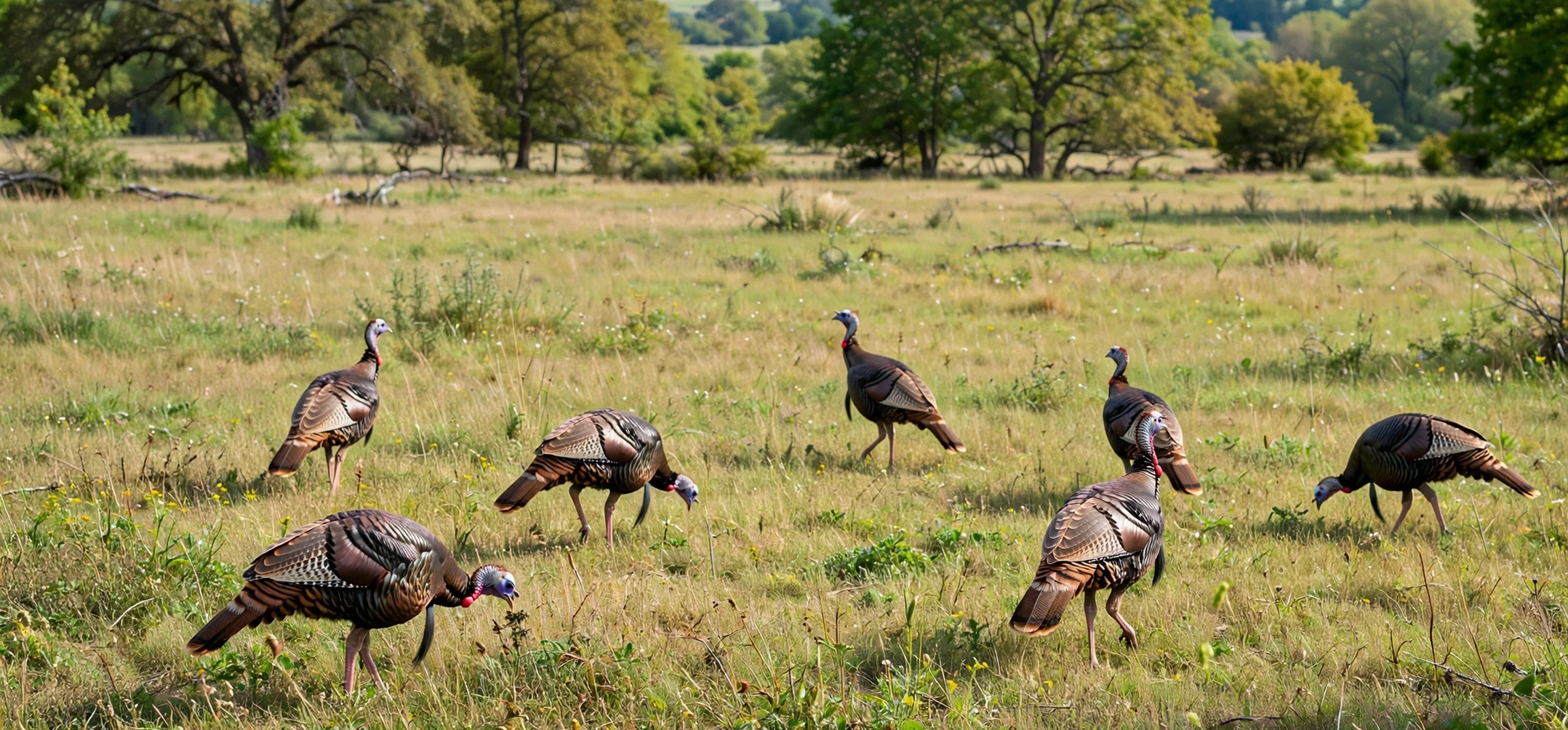
Wild turkeys live social lives that change with the seasons, which helps explain why more than one turkeys group name has survived. In winter, wild turkeys often gather in larger groups for safety and for finding food. There is safety in numbers: more eyes watch for predators, and a group can cover more ground while scratching for seeds, nuts, insects, and buds. These winter gatherings can include birds of different ages, and they often use the same roosting trees night after night. A noisy party crossing a road is often described with the turkeys group name gang, because it fits the scene.
In spring, the pattern shifts. Male turkeys display, call, and compete for the attention of females, and groups break into smaller, more competitive parties. Hens may move away to nest alone, while young birds stay together in broods with their mother for protection. By summer, a hen with her poults is a familiar sight at woodland edges, and those family groups are smaller and quieter than the big winter gatherings. In autumn, young birds join larger groups again, and the cycle repeats.
This seasonal rhythm is one reason a single group name never quite captures the whole story. A winter gathering, a spring display party, and a summer family group are all groups of turkeys, but they behave differently and they look different to an observer. Writers who know this tend to choose their word to match the scene: a rafter for a roosting or resting group, a gang for a noisy moving party, and a flock for a general description that covers all of them.
Domestic Turkeys and Why Flock Is the Farm Word
Domestic turkeys are descended from wild turkeys, but their daily lives are shaped by farming rather than by woodland seasons. On a farm, turkeys are kept together in a barn, a pen, or a pasture, fed at regular times, and managed as a single unit for health, shelter, and feeding. In that setting, flock is the practical word, because it describes a managed group rather than a wild gathering that formed by itself.
Farm writing also uses flock because it avoids confusion. A farm may keep several species, and each one has its own everyday group word: a flock of sheep, a flock of chickens, a herd of cattle. Using flock for turkeys keeps the language consistent and clear for workers, vets, and buyers. A rafter would sound out of place on a feed delivery note, even though it would be understood in a storybook. Context, in other words, matters as much as correctness. Whatever term you choose, the turkeys group name should match the setting you are describing.
Domestic turkeys are also much heavier and less flight-capable than their wild relatives, having been bred for size over many generations. They still show social behaviour, following each other, calling, and gathering around food and water, but they do not roam woodland in the same way. When people picture a group of domestic turkeys, they usually picture a farmyard scene, and flock matches that picture best.
What a Group of Turkeys Actually Does Together
Watching a group of turkeys is more interesting than memorising its name. Turkeys communicate with a wide range of calls, from soft clucks and purrs to loud gobbles, and different calls mean different things: keeping in contact, warning of danger, or showing excitement during display. In a group, birds watch each other as well as their surroundings. If one bird freezes or gives an alarm call, others often respond at once, which is a clear advantage when predators are near.
Turkeys also roost together, often in trees, where they are safer from ground predators overnight. At dawn they fly or flutter down and begin feeding, scratching the ground with strong feet to uncover food. Young turkeys learn by following older birds, copying where to feed, where to hide, and how to respond to calls. That learning is another reason group life matters: a lone young turkey would have to learn everything the hard way, while a bird in a group can follow experienced companions. Children learning animal groups usually meet the turkeys group name rafter before they meet the others.
Display behaviour is the most famous part of turkey group life. Male turkeys fan their tails, puff out their feathers, drag their wings, and gobble to attract attention. This display is not just showing off for its own sake; it is part of competition and courtship, and it happens in full view of other birds. A group setting makes the display meaningful, because there are rivals to impress and potential mates watching. Even people who have never studied birds recognise a displaying turkey at once, which is why the bird has become such a strong cultural symbol.
Turkeys Group Name at a Glance
The table below summarises the main terms, so you can pick the right one quickly. Keep in mind that all three core words are correct in everyday English; the choice is about tone and context, not about one word being true and the others false.
| Group name | Best used for | Tone |
|---|---|---|
| Rafter | Wild turkeys, trivia, nature writing | Traditional and distinctive |
| Gang | A noisy, moving group, especially young males | Informal and lively |
| Flock | Domestic turkeys, general descriptions, farm writing | General and practical |
| Group | Scientific or neutral writing | Plain and precise |
If you are answering a quiz, choose rafter first. If you are describing a farm, choose flock. If you are describing a boisterous party of birds crossing a road, gang may capture the scene best. And if you are writing for a scientific or formal audience, a group of turkeys is perfectly acceptable and avoids any doubt about which traditional term your readers expect. Field guides tend to avoid the turkeys group name debate altogether and simply say a group of turkeys.
How the Turkeys Group Name Compares With Other Birds
Turkeys are not the only birds with a special group name, and comparing them helps show why collective nouns exist at all. Geese on the ground are a gaggle and in flight a skein. Crows are a murder. Owls are a parliament. Starlings in a swirling evening flock are a murmuration. Each term tries to capture something about the bird: its sound, its movement, or its reputation in folklore. Rafter fits that pattern, even if its exact origin is debated, because it gives turkeys a name of their own rather than leaving them with the generic flock.
Some collective nouns were invented as jokes or wordplay in medieval hunting books, and later lists copied them without checking. That is why modern animal-name lists sometimes disagree, and why a careful writer checks more than one source. The turkeys group name debate is a mild version of that problem: rafter is well supported, gang is widely used, and flock is always safe, while rarer terms should be treated with caution. For more animal-name curiosities, see our guide to names of water dinosaurs and our list of dog names in Spanish for females, which show how naming traditions vary from subject to subject.
Frequently Asked Questions About the Turkeys Group Name
What is the most common turkeys group name?
A rafter is the most distinctive and most commonly expected answer in trivia and collective-noun lists. A flock is the most common word in everyday and farm use, and a gang is a popular informal alternative. If you remember rafter, gang, and flock, you have the turkeys group name question covered.
Is a flock of turkeys correct?
Yes. Flock is a general word for a group of birds, and it is the standard term for domestic turkeys. It is correct even though it is not unique to turkeys.
What do you call a group of baby turkeys?
Baby turkeys are called poults, and a mother with her poults is usually described as a brood or simply a family group. There is no separate, widely accepted collective noun only for poults.
Do wild and domestic turkeys have different group names?
Not officially. The same words can be used for both, but writers tend to use rafter more for wild turkeys and flock more for domestic turkeys, because those words match the setting.
Conclusion
The answer to the turkeys group name question is a rafter first, with gang and flock as strong alternatives. Rafter is the traditional, turkey-specific term and the best quiz answer. Gang suits a lively, moving party of birds. Flock is the general, practical word, and the right choice for domestic turkeys and farm writing. Knowing all three, and knowing when each one fits, is more useful than memorising a single word, because it lets you match your language to the scene you are describing. Whether you picture a rafter roosting at dusk, a gang strutting across a field, or a flock feeding in a farmyard, you are describing the same social, watchful, and noisy bird, in a group, doing what turkeys have always done together.