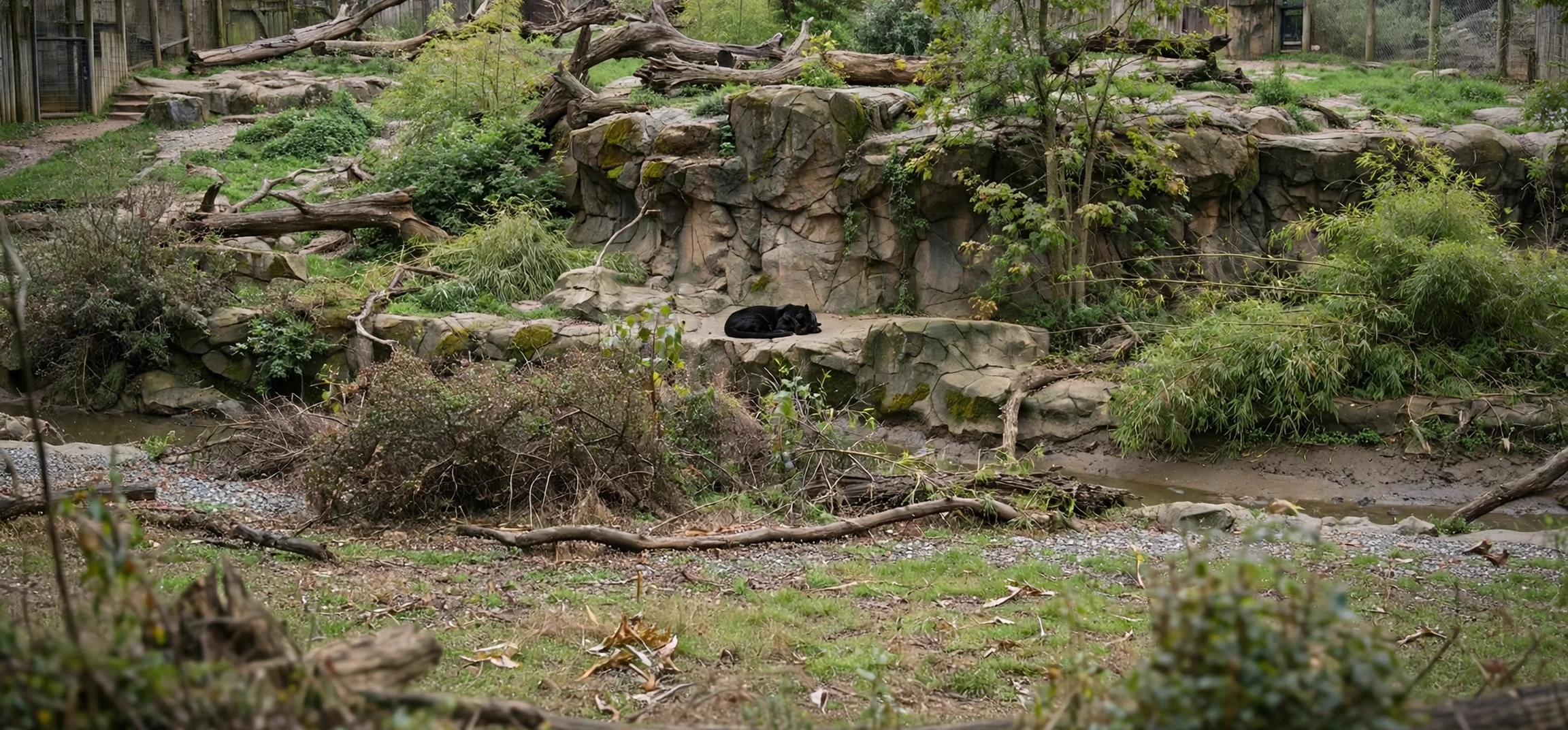
So, what is a black panther animal? What is a black panther animal in scientific terms is simpler than many people expect: it is not a separate species at all. A black panther animal is a leopard or a jaguar with a dark coat, caused by a genetic condition called melanism. The animal underneath the dark fur is still a leopard, Panthera pardus, in Africa and Asia, or a jaguar, Panthera onca, in the Americas. Its spots are usually still present, hidden beneath the dark pigment, and they often become visible in bright sunlight. Understanding that single fact clears up most of the mystery around the black panther animal.
The term black panther animal is a common name, not a scientific classification. People have used panther loosely for centuries to describe large dark cats, which is why the name can feel confusing. In North America, panther sometimes refers to the cougar, also called the mountain lion or puma, although a cougar is not normally black. In the context most people mean today, however, a black panther animal is a melanistic leopard or jaguar. This guide explains the science, appearance, habitat, behaviour, diet, and conservation of these remarkable cats, and separates fact from film and folklore.
What Is a Black Panther Animal? The Science Explained
What is a black panther animal from a genetics point of view? Melanism is an increase in dark pigment, melanin, in the fur. In leopards, melanism is linked with a recessive gene, which means a cub usually needs the gene from both parents to show a fully dark coat, although carriers can pass it on without showing it themselves. In jaguars, melanism is linked with a dominant gene, so the pattern of inheritance differs. In both species, melanistic and normally spotted cubs can appear in the same litter, which surprises many people who assume a black panther animal must come from two black panther animal parents.
Look closely at a black panther animal in sunlight, and you will often see ghost rosettes, the faint outlines of the usual spots showing through the dark coat. That is a beautiful clue to its true identity. Leopards have rosettes, which are rose-shaped clusters of spots, while jaguars have larger rosettes that often contain a central spot. Even on a very dark animal, the pattern, body shape, and size can help experts tell a melanistic leopard from a melanistic jaguar. Leopards are generally more slender and lighter, while jaguars are stockier, with a broader head and stronger jaws.
Scientific names to remember
The scientific name for a melanistic leopard remains Panthera pardus, because melanism does not create a new species. The scientific name for a melanistic jaguar remains Panthera onca. Some older sources used the name Panthera pardus for a black panther animal as if it were a species, but modern taxonomy is clear: black panther animal is a description of colour, not a species name. If you see a source listing black panther animal as its own species, treat that as outdated or simplified. The correct approach is to name the underlying species first, then note that the individual is melanistic.
What Is a Black Panther Animal Like in Appearance?
A black panther animal is a large, muscular cat with a sleek dark coat that ranges from deep black to very dark brown. In shade, the coat can look almost pure black. In strong light, it may show a brownish sheen and faint rosettes. The eyes are usually pale green, yellow, or amber, which creates a striking contrast with the dark fur. The ears are rounded, the tail is long and thick, and the paws are large, with retractable claws for climbing and hunting. Like other big cats, a black panther animal moves with a fluid, silent grace that makes it seem to appear and disappear in dense forest.
Size varies by species and sex. Leopards typically weigh between 30 and 70 kilograms, with males larger than females, and measure around 90 to 160 centimetres in body length, plus a long tail. Jaguars are heavier, often weighing 55 to 100 kilograms, with some very large males exceeding that range. A melanistic jaguar therefore tends to be bulkier than a melanistic leopard, with a more powerful build suited to its prey and habitat. Cubs are born with spotted coats in the normal pattern, and melanistic cubs darken as they grow, although the degree of darkness can vary between individuals.
Why would a dark coat evolve? In dense, shadowy forests, dark fur can provide excellent camouflage, helping a cat stalk prey and avoid detection. That advantage may explain why melanism is more common in leopards living in dense tropical forests than in open savannas, where a spotted coat blends better with dappled grassland. Camouflage is never perfect, and a dark coat may be less helpful in open country, which is one reason melanistic cats remain a minority in most populations. Nature balances these trade-offs over generations, and melanism persists where it helps, at least some of the time.
Where Black Panthers Live and How They Behave
Melanistic leopards live across parts of Africa and Asia, in forests, woodlands, and mountainous regions where leopards occur. They are particularly associated with dense forests in places such as Malaysia and parts of India, although they are not common anywhere. Melanistic jaguars live in Central and South America, in rainforests, swamps, and wooded areas where jaguars roam. Both cats are solitary and territorial, except for mothers with cubs and brief mating encounters. They mark territory with scent and scratches, and they avoid other adults where possible.
Behaviourally, a black panther animal behaves like any leopard or jaguar. Leopards are superb climbers, often hauling prey into trees to keep it safe from scavengers. They are also strong swimmers when needed, although they generally prefer to stay dry. Jaguars are powerful swimmers and are closely linked with water, often hunting near rivers and wetlands. Both species are mostly nocturnal or active at dawn and dusk, which suits their hunting style. They stalk prey quietly, using cover and patience, then launch a short, explosive attack. Their dark coats, especially in forest shade, enhance that stealth.
Socially, black panthers are not a separate pack or group. A melanistic leopard may live near spotted leopards, mate with them, and raise mixed litters. The same applies to jaguars. That is an important point for anyone who imagines black panthers as a hidden tribe. They are individual cats with a colour variation, living the same solitary lives as their spotted relatives, in the same territories, hunting the same prey, and facing the same threats.
Diet, Hunting, and Life Cycle
The diet of a black panther animal depends on its species and habitat. Leopards eat a wide range of prey, from small antelope and deer to monkeys, birds, rodents, and, when opportunity arises, livestock. Their adaptability is one reason leopards survive in many habitats, from forests to farmland edges. Jaguars eat larger prey on average, including capybaras, deer, peccaries, caimans, and turtles, and they are famous for a bite powerful enough to crush bone and pierce shells. Both cats are opportunistic, taking what is available rather than specialising in a single prey type.
Hunting success relies on stealth, strength, and patience. A leopard or jaguar will watch, wait, and move slowly through cover, freezing when prey looks up. The final rush is short, because a prolonged chase would waste energy and alert other animals. After a kill, a leopard often drags its prey into a tree, while a jaguar may drag it into dense cover near water. Cubs stay with their mother for up to two years, learning to hunt through play and observation before becoming independent. In the wild, leopards and jaguars can live for around 12 to 17 years, although many face threats that shorten their lives.
| Feature | Melanistic leopard | Melanistic jaguar |
|---|---|---|
| Scientific name | Panthera pardus | Panthera onca |
| Region | Africa and Asia | Central and South America |
| Build | Slender and agile | Stocky and powerful |
| Spot pattern | Rosettes without central spot | Rosettes often with central spot |
| Typical habitat | Forest, woodland, mountains | Rainforest, swamp, woodland |
| Melanism gene | Usually recessive | Usually dominant |
| Key skill | Climbing and tree caching | Swimming and powerful bite |
This table makes the distinction clear. If you are looking at a photograph and trying to decide whether it shows a melanistic leopard or jaguar, consider location first, then build and spot pattern. A dark cat photographed in Africa or Asia is almost certainly a leopard, while one photographed in the Amazon is almost certainly a jaguar. Captive animals are the exception, because zoos house both species worldwide, so location alone does not settle identification in captivity.
Myths, Culture, and Conservation
Black panthers loom large in culture, from ancient folklore to modern films and books. In some traditions, a black panther animal in the forest symbolises mystery, power, or protection. In popular film, a fictional kingdom and hero have made the name black panther famous worldwide, although that character is not an animal at all. These cultural images are entertaining, but they can also create confusion, leading people to believe that black panthers are a rare, separate, almost magical species. In reality, they are real, but they are leopards and jaguars with a colour variation, and their conservation story is the same as that of their spotted relatives.
Both leopards and jaguars face serious threats. Habitat loss from deforestation, farming, and development fragments their territories and reduces prey. Conflict with farmers over livestock can lead to retaliatory killing. Poaching for skins and body parts, although illegal, continues in some regions. Jaguars are listed as Near Threatened, while leopards are listed as Vulnerable overall, with some populations faring worse. Protecting forests, creating wildlife corridors, supporting anti-poaching work, and helping farmers coexist with big cats are all vital. If you want to help, support reputable conservation organisations, avoid products linked with deforestation, and never buy big cat parts or skins.
Seeing a black panther animal in the wild is extremely rare, and most people will only encounter one in a zoo, a wildlife documentary, or a photograph. Responsible zoos play a role in education and, in some cases, breeding programmes, but they cannot replace wild habitat. If you visit a zoo, look for signs explaining melanism and the underlying species. A good zoo will make that distinction clear, rather than presenting a black panther as a separate species. That educational detail matters, because it helps visitors understand and support conservation for leopards and jaguars as a whole.
Related animal guides on this site include the cat name from Alice in Wonderland and Gargamel’s cat name on the Smurfs. Those lighter guides are a reminder that cats, large and small, have fascinated humans for centuries, whether in stories or in the wild.
Frequently Asked Questions About Black Panthers
What is a black panther animal, in one sentence?
A black panther animal is a melanistic leopard, Panthera pardus, or a melanistic jaguar, Panthera onca, meaning a leopard or jaguar with a dark coat caused by extra melanin pigment.
Are black panthers a separate species?
No. Black panther is a common name for a colour form, not a species. Melanistic leopards and jaguars belong to their usual species, and they can have spotted siblings and spotted offspring.
Can you see spots on a black panther?
Often, yes. In bright sunlight, faint ghost rosettes usually show through the dark fur. The pattern is clearest on the flanks and legs, and it helps identify whether the animal is a leopard or a jaguar.
Are black panthers dangerous to humans?
Like all large wild cats, leopards and jaguars should be treated with respect and distance. Attacks on humans are rare, and these cats normally avoid people. Never approach a wild big cat, and follow local guidance in areas where they live.
What Is a Black Panther Animal? A Short Summary
If someone asks you what is a black panther animal, give the short scientific answer first: it is a melanistic leopard or jaguar. When people ask what is a black panther animal in more detail, explain that melanism darkens the coat but does not change the species, so the animal keeps the behaviour, diet, and habitat of a leopard or a jaguar. Anyone wondering what is a black panther animal should also know that ghost rosettes often show through the dark fur in sunlight, which is the clearest visible clue to its true identity.
Teaching others what is a black panther animal helps conservation too, because it directs attention to leopards and jaguars as whole species, not to a mythical separate cat. So, whenever the question what is a black panther animal comes up, answer with the species name first, Panthera pardus or Panthera onca, and then describe the dark coat. That habit keeps the science accurate and helps listeners understand why protecting forests and prey matters for every leopard and jaguar, spotted or dark.
Many searchers type the exact question, what is a black panther animal, because they have seen a photograph and want a straight answer. The straight answer to what is a black panther animal is that it is a leopard or jaguar with melanism, not a new species. If a friend asks what is a black panther animal at a zoo, point to the sign, note whether it says leopard or jaguar, and explain that the dark coat is a colour form. Teachers, guides, and documentaries that answer what is a black panther animal clearly help the public understand big cat conservation, because they link the dark cat to its real species. So keep asking what is a black panther animal, and keep answering with the species name first: that simple habit, repeated whenever someone asks what is a black panther animal, protects both the science and the cats themselves.
To recap, what is a black panther animal? It is a melanistic leopard or jaguar. What is a black panther animal not? It is not a separate species, and it is not a cougar in the usual sense. What is a black panther animal in the forest? A stealthy, solitary hunter, camouflaged by dark fur. What is a black panther animal to conservationists? A leopard or jaguar that needs the same forest protection as its spotted relatives. Remembering what is a black panther animal in those four ways makes the answer easy to share.
Conclusion
What is a black panther animal? It is a leopard or a jaguar wearing a dark coat, shaped by melanism and perfected for life in shadowy forests. Its scientific name is Panthera pardus or Panthera onca, depending on the species beneath the colour. Far from being a separate, mysterious species, the black panther is a reminder of how much variation nature can hold within a single species. Protecting leopards and jaguars, and the forests they need, is the surest way to ensure that future generations can still glimpse these magnificent dark cats in the wild.